
After the Job · Part 1
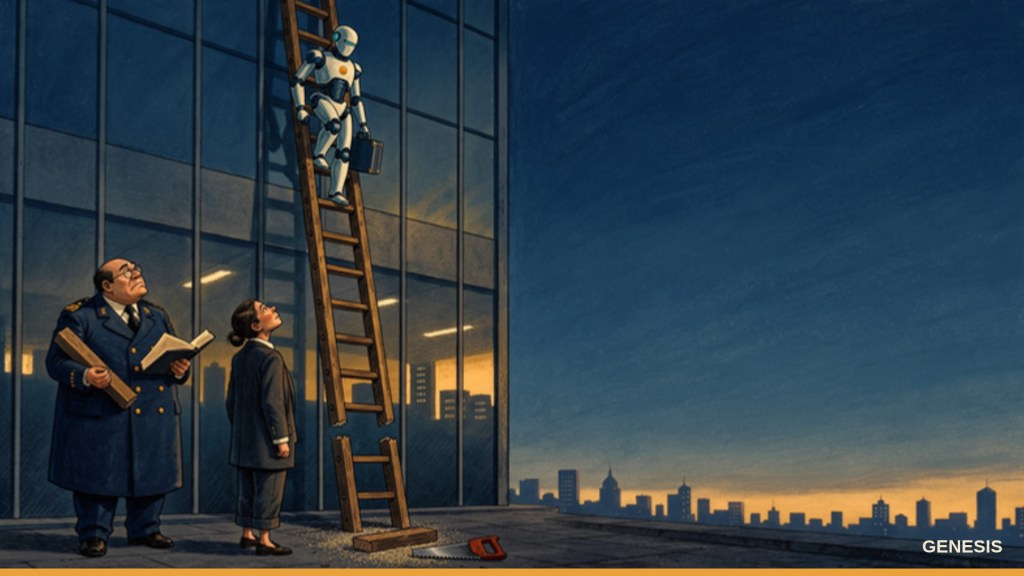
AI is not arriving in the labour market as a wave of pink slips. It is arriving as a door that quietly stops opening. The same tools that can lift a junior worker can also remove her, and which of those happens is a decision, not a forecast.
This is the first essay in a five-part series on work, skill and worth in the agentic age. It weighs what the data actually show against what the headlines claim, follows the squeeze from the office into the factory, sets the firms that cut first beside the firms that protect the bottom of the ladder, convenes the economists in four rooms, and asks who gets to choose. Singapore is the case study throughout, because it is the place that has tried hardest to answer in advance. Facts are stamped as of 20 November 2026.
The Two-Minute Version
- The aggregate numbers are calm. The Yale Budget Lab finds no statistically significant effect of AI on employment or wages in exposed occupations, a large Danish study rules out average earnings effects above 2%, the OECD says employment is at a record high, and in October 2026 AI was cited in under 3% of announced US job cuts.
- The calm hides a fracture. The damage is concentrated on the first rung: young graduates in AI-exposed jobs. Stanford’s “Canaries” work now puts employment of 22 to 25 year olds in the most exposed occupations about 19% below where it would otherwise be, and the mechanism is fewer hires, not more firings. AI is arriving as a hiring freeze.
- The real casualty is the ladder of apprenticeship. Juniors learned by doing the drafting, checking and summarising that agents now do. Remove that work without replacing the learning and, in ten years, there are no seniors.
- Robots extend the squeeze to physical work. There are now 5.08 million industrial robots in the world’s factories, Singapore has the second-highest robot density on earth at 873 per 10,000 manufacturing workers, and Goldman Sachs has more than quadrupled its humanoid forecast to 6.5 million units by 2035, even though only about 7,000 were sold last year.
- Firms are diverging. Some cut first and regretted it: Klarna reversed course, and 55% of leaders who made AI redundancies now say it was the wrong call. Others protect the rung: IBM is tripling early-career hiring, DBS has reskilled more than 11,000 people under the motto “save people, not jobs”, and Infosys is reportedly hiring 20,000 freshers.
- The economists, in four rooms (academia, labs and industry, governments, workers), now argue less about whether jobs vanish than about speed, automation versus augmentation, and the broken bottom rung.
- Singapore’s answer is institutional: tripartism, a Tripartite Jobs Council, a parliamentary motion for “no jobless growth”, a million NTUC training places, and a Prime Minister who promises to protect every worker rather than every job. It is the most serious attempt I know to earn AI’s social licence before it is withdrawn.
- The choice belongs to firms, workers and governments, but only governments can set the trajectory of the Fork. The essay ends with what each of us should do on Monday morning.
Prologue: Twenty Minutes on the Festival Stage
The Singapore FinTech Festival is not, as a rule, where people go to talk about the dignity of work. It is where people go to talk about tokenised deposits and cross-border payment rails, in halls full of lanyards at Singapore EXPO. So it was a small sign of the times that, at 9.40 on the morning of Wednesday 18 November 2026, the Festival Stage in Hall 1 was given over to a session called “The AI and Employment Equation: Balancing Productivity, Displacement, and New Jobs”.
It was not really a panel. It was a twenty-minute dialogue between two people: Michael Spence, the Stanford economist who shared the Nobel prize in 2001, and Ravi Menon, the former Managing Director of the Monetary Authority of Singapore who now chairs the Global Finance and Technology Network. Menon had come straight from delivering the morning’s keynote on the same stage, “Geoeconomics 2.0: Statecraft in the Age of Intelligence”. The session brief asked two blunt questions. Would the gains from AI be broadly shared, or would they flow to capital, the highly skilled and the owners of the technology? And could AI weaken the old link between growth and jobs?
Menon’s answer began with history rather than technology. The populist backlash against globalisation, he argued, had been a verdict on domestic policy failure: on governments that did not share the gains and did not support the people displaced. Then he drew the parallel that gives this series its starting point. “AI will face the same test. Let us not make the same mistake.”
He went on to separate the two things AI does. Automation tends to displace workers. Augmentation tends to raise productivity and wages and sometimes creates new jobs. The pressure, he said, shows first at the entry level. According to a Japanese account of the session, he set two studies side by side: an American study showing that employment of young people had fallen relative to others in AI-exposed occupations, and a study of customer-service staff in which an AI assistant raised productivity by roughly 15%, with the biggest gains for the least experienced. Same tool, opposite outcomes. And he tied the whole question to a phrase that recurs throughout this essay: AI will need a social licence, and that licence rests on the balance between jobs and wages.
Spence, for his part, was the patient macroeconomist. Model-building at the frontier is one stage, he said; diffusion across the whole economy is the second and more important one, and the big productivity gains may not come until the late 2020s or later. It is too early to measure job losses with confidence. Most jobs will change rather than vanish. But he made one observation that should keep every managing partner awake: the junior analysis and document work in banking and professional services, the traditional training ground, is precisely what is being absorbed. Firms, he said, will have to redesign apprenticeship.
In the days that followed, The Business Times compressed the session into a single line. As The Business Times reported it: “The same tool can lift the junior worker or remove her.” The paper’s headline put the rest of the argument in the speakers’ mouths collectively: which of the two happens is a choice. The outcome is not settled by the tool. It is settled by the people who deploy it.
I have worked in AI since the late 1980s and have heard many versions of the “jobs” argument. Most ask whether the machines will take the work. This one asked who decides what the machines are for. That question runs through this series, and it is why this first part is titled with a pair of verbs. Lift or remove.
The tool does not choose. Somebody always does.
I. The Freeze, Not the Firing
Start with the reassuring news, because there is a lot of it, and because an honest essay about AI and work has to begin with what the data actually say rather than what the headlines imply.
The Yale Budget Lab, led by Martha Gimbel and colleagues, has been tracking AI’s effect on the American labour market since ChatGPT launched. Its first assessment in October 2025 found “no discernible disruption” to the overall labour market: the occupational mix was changing only about a percentage point faster than it had during the arrival of computers or the internet. A February 2026 update found that unemployment duration for highly exposed workers had not changed and called the disruption largely speculative. Its most rigorous study, published in May 2026 using a synthetic difference-in-differences design on Current Population Survey data, found no statistically significant effect on employment or wages in exposed occupations since late 2022. The point estimates for unemployment had begun to drift up, especially for 16 to 34 year olds, and the lab warned that the picture could change quickly. But as of the first quarter of 2026, the effect was not there in the aggregate.
Denmark offers a cleaner experiment than most countries, because its administrative records are so good. Anders Humlum of Chicago and Emilie Vestergaard of Copenhagen surveyed about 25,000 Danish workers in eleven highly exposed occupations and linked their answers to official earnings and hours data. Writing for Brookings in October 2026, they reported no effect on earnings or hours, and they could rule out average effects larger than 2%. Chatbots created new tasks as well as removing old ones. Workers who adopted them switched occupations more often, and the switchers saw earnings growth about 12 percentage points higher. Crucially, the decline in early-career hiring was not concentrated in the firms that had adopted AI.
The OECD’s 2026 Employment Outlook, published in July, found employment across its members at a record high and still rising. Regions most exposed to digital technology showed a sustained rise in total employment, especially in tasks that had not been automated. An OECD blog in August went further on the question this essay cares about most: young people’s difficulties entering the labour market are growing, but current evidence does not show that AI is driving them.
Then there is the layoff data, which is where the headlines and the statistics part company most sharply. Challenger, Gray & Christmas counts the reasons American employers give when they announce job cuts. Through October 2026, AI was cited in 121,401 announced cuts, more than double the 54,836 for the whole of 2025, and about a fifth of the 617,189 total. AI was the most-cited reason for several months running, peaking in May at 38,579 cuts, about 40% of that month’s total. That is the figure that made the front pages.
But the same series tells a quieter story at the margin. In October itself, AI was cited for only 1,265 of 43,994 cuts, under 3%, and market and economic conditions had overtaken AI as the top reason year to date. Total announced cuts were down 44% on the previous year. The two numbers do not contradict each other. One is a year-to-date total, swollen by a burst of AI-attributed announcements in the spring; the other is a single month in which that burst had faded. Both are counts of what employers said, not measures of what AI did. Elena Magrini of Lightcast put it plainly: when AI is blamed for layoffs, “we are not seeing that in the labor data”. Gimbel has warned of “AI-washing”, in which ordinary corrections for pandemic-era overhiring, tariffs and interest rates are dressed up as technological destiny because it plays better with investors.
Even Erik Brynjolfsson, whose research has done more than anyone’s to document the damage to young workers, is careful about this. In his August 2026 update he wrote: “We do not see widespread, economy-wide job displacement associated with AI.”
So far, so calm. Look below the aggregate, though, and a different shape appears.
The same Brynjolfsson update, written with Bharat Chandar and Ruyu Chen and drawing on ADP payroll records for millions of workers, found that employment of 22 to 25 year olds in the most AI-exposed occupations was about 19% below its counterfactual as of June 2026. The original “Canaries in the Coal Mine” paper in August 2025 had put the gap at 13%. In levels, between November 2022 and June 2026, the two most exposed fifths of occupations shrank by about 11% while the three least exposed grew by about 10%. Older workers in the same occupations were unaffected. And the mechanism was the one that matters for everything that follows: the adjustment ran through less hiring, not more firing. It was concentrated where AI automates codified knowledge, not where it augments tacit knowledge. It showed up in jobs, not in base pay. The gap held when technology firms were excluded and when the authors controlled for interest-rate sensitivity and remote work.
ADP’s chief economist, Nela Richardson, built the same picture from a sample of 4.6 million workers in more than 730 occupations. In June 2026 she reported that 22 to 25 year olds in highly exposed jobs were shrinking by 3.8% a year while the least exposed grew by 2%. Exposed workers in their early thirties were down 1.7%. Exposed workers aged 35 to 40 were up 2%. The labour market was not ejecting experienced people. It was declining to admit new ones.
The Federal Reserve Bank of New York’s data on recent graduates tell the same story from a different angle. Unemployment among 22 to 27 year olds with a degree rose from 3.6% in March 2019 to 5.6% in March 2026, while unemployment for all workers stood at 4.2%. That 1.4 point gap, with recent graduates doing worse than the workforce as a whole, was the widest on record. It eased to 5.2% in the third quarter of 2026, but underemployment, graduates working in jobs that do not need a degree, was 42.5%. Indeed found junior job postings down 7% in 2025 while senior postings rose 4%. An Oliver Wyman Forum survey of 415 chief executives for the New York Stock Exchange in June 2026 found that 43% were cutting entry-level roles, up from 17% a year earlier.
Critics offer other explanations: interest rates (economists at Google), a cyclical “low-hire, low-fire” economy (Torsten Slok at Apollo), weak demand (the Economic Policy Institute). Brynjolfsson replies that construction, the most rate-sensitive sector and the least exposed to AI, shows no such pattern. The canaries are descriptive rather than causal, and the gaps shrink once education is controlled for. But the pattern recurs across sources and methods: a US Census Bureau study by Tucker finds the same, and a Reserve Bank of Australia note found “tentative signs” of it.
Put the calm and the fracture together and you get the central finding of this essay. AI is arriving in the labour market as a hiring freeze, not a firing spree. Nobody is marched out of the building. The requisition is simply never opened. In one of my October posts I called this the Frozen Workforce: workers who are not unemployed but stalled, and future workers who are not fired but never hired. A Fortune survey in March 2026 found that 66% of more than 350 public-company chief executives planned to freeze or cut hiring through the year, with entry-level listings down 30% and middle-management postings down 42% since 2022. The freeze is a forecast acting on the economy before the capability has fully arrived.
The table below is my attempt to keep both truths in view at once.
| Claim | What the headlines say | What the data says |
|---|---|---|
| Mass layoffs from AI | AI was the top-cited reason for US job cuts for months; 121,401 AI-attributed cuts through October 2026 | Those are stated reasons, not measured effects. In October alone AI was cited in under 3% of cuts, and total announced cuts were down 44% on the year |
| The labour market is breaking | A “tsunami” is hitting jobs (IMF, Davos 2026) | Yale Budget Lab: no statistically significant effect on employment or wages in exposed occupations; OECD employment at a record high |
| AI is cutting pay | Wages will collapse as machines compete | Danish linked records rule out average earnings effects above 2%; the Canaries adjustment shows up in jobs, not base pay |
| Young workers are fine | Graduate unemployment is cyclical and easing | 22 to 25 year olds in the most exposed jobs are about 19% below counterfactual; US recent-graduate unemployment ran above the overall rate by a record margin in early 2026 |
| Firms are replacing staff with agents | Cut first, automate everything | 43% of CEOs are cutting entry-level roles, but Gartner found only 1% of early-2025 layoffs came from real AI productivity gains, and 55% of leaders who made AI redundancies regret them |
| Singapore is immune | Full employment, no problem | Unemployment is 2.0%, but retrenchments hit 4,800 in Q3 2026, about a six-year high, and graduates in full-time permanent jobs fell from 79.4% to 74.4% |
| Robots will take the factory floor | Humanoids are about to arrive in their millions | About 7,000 humanoids were sold worldwide in 2025, mostly for pilots; but 5.08 million industrial robots are already at work |
The aggregate is calm and the entry level is not. Both are true, and the policy mistake would be to average them.
II. The Missing First Rung
Why should a hiring freeze at the bottom matter more than layoffs in the middle? Because of what the bottom of the ladder was for.
For most of the history of professional work, the first job was not really a job. It was an apprenticeship disguised as one. The junior lawyer did the document review. The junior analyst built the spreadsheet and checked the footnotes. The junior engineer wrote the tests, fixed the small bugs and read other people’s code. The junior consultant took the notes, drafted the slides and summarised the interviews. None of this was the point of the profession. All of it was how you learned the profession. You absorbed judgement by doing the work that judgement would later supervise, under the eye of someone who had done it before. The firm paid you less than you were worth to it in the long run and more than you were worth to it in the short run, and that gap was the price of a pipeline.
Now look at what agents are good at. Drafting. Checking. Summarising. Reconciling. First-pass analysis. Code that is well specified and testable. This is, almost task for task, the curriculum of the first two years. At the DBS Asia Future Forward forum in October 2026, the bank’s chief executive Tan Su Shan said that DBS agents now draft credit memos that once took weeks. A credit memo is exactly the kind of document that taught a generation of young bankers how to think about risk. Michael Spence made the same point on the SFF stage about banking and professional services. Ethan Mollick of Wharton has warned for some time that the apprenticeship model is breaking because the tasks juniors learn on are precisely the tasks AI performs.
Prime Minister Lawrence Wong saw the danger clearly at that same DBS forum. AI, he warned, may break the bottom rung of the career ladder, and Singapore is studying the impact on banking, law, medicine and engineering with its tripartite partners. His line deserves to be taped to every boardroom wall: “we should be careful not to automate away the learning”.
The arithmetic of the missing rung is brutal and slow. A firm that stops hiring juniors in 2026 saves money in 2026, 2027 and 2028. It notices nothing in 2029. By 2031 it discovers that it has no mid-level staff who have worked through a full cycle of client problems. By 2036 it discovers that it has no one ready to be a partner, a principal engineer or a chief risk officer, because the people who would have been ready were never let in. Call it an experience debt: future seniors who were never trained. Gartner’s Kaelyn Lowmaster put the competitive version of it best: cutting juniors means, as she told TechTarget, “you’re essentially outsourcing your talent development to your competitors”. And if every competitor makes the same decision, nobody develops the talent at all.
The evidence of the missing rung is international. In the United Kingdom, graduate job listings reportedly fell by about 45% year on year to below 10,000 in January 2026, a figure I cited in an earlier post and which still needs checking against the primary source. In Korea, the central bank reported in August 2026 that employment of 15 to 29 year olds fell by 285,000 between June 2022 and June 2026, and that 94% of the loss came in AI-exposed sectors, while employment of people in their fifties rose by 230,000. Seniors gained in the very sectors where juniors vanished, though the bank credits demography with a significant share of the change. In Singapore, the 2025 Graduate Employment Survey, released in March 2026, found that the share of new graduates in full-time permanent jobs fell from 79.4% to 74.4%, and the share with no offer six months after graduation rose to 8.5%, up from 5.7% the year before and 4.1% the year before that. The Ministry of Education put this down to post-pandemic normalisation and cautious hiring, and said AI’s effect on entry-level demand was “uncertain at this point”. That is a fair answer. It is also exactly what you would expect to hear in the early stages of a freeze.
There is a painful irony here. David Autor and colleagues at MIT have shown that new kinds of work have historically gone mostly to college-educated urban workers under 30. If the first rung disappears, the people best placed to discover the work of the future are locked out of the building.
In “The Missing First Rung” I tried to put the point in one sentence: “AI has not fired the young. It has stopped inviting them in.” In “Directors or Operators” I described the two layers of the Frozen Workforce. The first is mid-career operators whose skills were built for a world of running software rather than directing it. The second is the future supervisors who will never get the entry-level experience that supervision requires. I distinguished operators, who run technology, from directors, who bound an agent’s authority, verify its output and own the result. Every regulator I surveyed for that piece required an accountable human somewhere in the loop. None had written down how that human is trained. As I put it then, “None has yet written how that human is made.”
That is the deepest problem with the missing first rung. It is not only a problem of fairness to young people, although it is that. It is a governance problem. The whole architecture of safe agentic AI rests on a human who can tell when the agent is wrong. That human acquires the ability to tell by having done the work. In “The Rogue Agent and the Obsolete Apprentice” I argued that governing agents and forming human judgement are one problem, not two. A firm that automates away its apprentices is, quietly, automating away its future overseers. Anthropic published an uncomfortable piece of evidence in October 2026: in a randomised trial, professional analysts working with an agent adopted the agent’s randomly assigned lean 86% of the time, against 50% by chance, and experience did not predict who deferred. If seasoned experts absorb an agent’s judgement without noticing, a generation that never formed its own will find the human in the loop is a formality.
The obvious objection is that new entry routes will appear. Perhaps juniors will learn by supervising agents from day one, the way pilots learn on simulators. Perhaps they will. Autor has a useful caution here, in his own words: “Eroding tasks is not the same thing as eroding jobs.” Jobs are bundles, and when one task goes, the bundle can be rebuilt around the tasks that remain. But a simulator is designed, funded and built on purpose by people who know what a pilot needs to learn. Nobody is yet designing the simulator for the junior auditor or the junior software engineer. PwC’s 2026 Global AI Jobs Barometer, which analysed more than a billion job advertisements, adds a twist: among 2.4 million US entry-level jobs, AI-exposed roles were seven times more likely to demand senior-level human skills, and their openings rose 35% since 2019 while other entry-level openings fell 10%. Its global workforce leader, Pete Brown, put the problem plainly: “AI is removing some of the routine work that once acted as an apprenticeship”. The rung is being raised as well as thinned: the jobs that remain expect juniors to arrive already able to do what the old rung taught. Without deliberate redesign, the default is not a new rung. It is no rung.
Without juniors today there are no seniors in ten years, and no one able to tell when the agent is wrong.
III. The Squeeze Reaches the Factory Floor
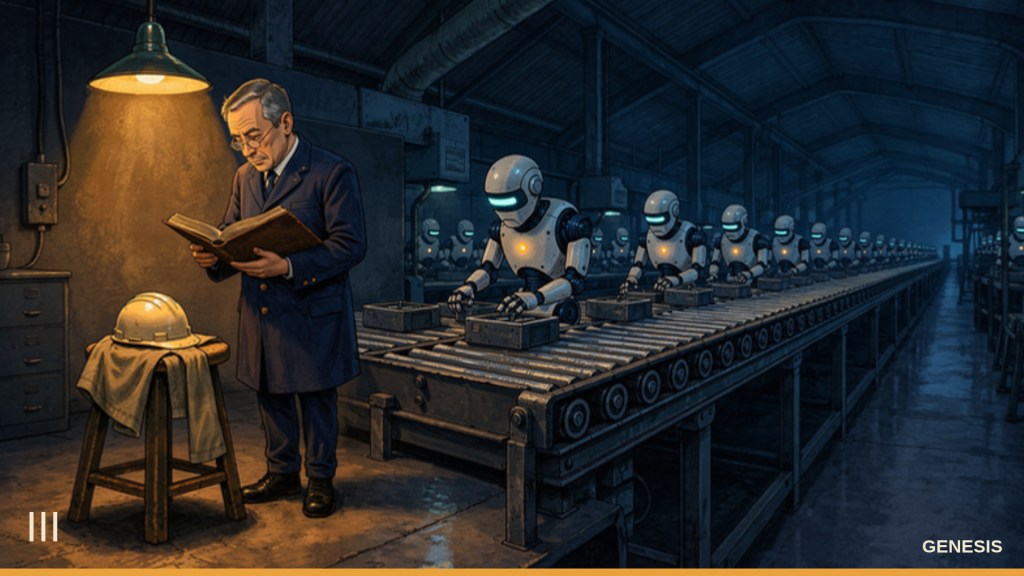
It has become a cliché that this wave of automation, unlike the last, comes for the office rather than the factory. That was true for about three years. It is becoming less true every quarter.
Start with the machines already installed. The International Federation of Robotics reported in September 2026 that the world’s operational stock of industrial robots had reached a record 5.08 million, up 9% in a year. About 603,000 were installed in 2025, the first time annual installations had passed 600,000. China installed 354,000 of them, 59% of the world total. The United States, with about 38,500, overtook Japan for second place. The IFR forecasts 655,000 installations in 2026 and 806,000 by 2029. Its president, Jane Heffner, was not inclined to understatement: “Industrial automation is progressing at high speed.”
Robot density, the number of robots per 10,000 manufacturing employees, is the measure that tells you how automated a country’s factories really are. On the IFR’s latest figures, for 2025, the global average is 152. South Korea leads at 1,066. Singapore is second in the world at 873, ahead of Germany at 469, Japan at 452 and the United States at 323. China appears at 193, but a warning is needed: the IFR has revised the employment figures it uses for China, and older releases that put China near the top of the table are not comparable with the new series. Anyone comparing China’s density across years should stop. For Singapore, the headline is simpler. A small island state has already automated its factories more intensively than almost anywhere else on earth.
The economics of industrial robots are well studied, and not comforting. Daron Acemoglu and Pascual Restrepo found, in a study of US labour markets published in 2020, that one more robot per thousand workers reduced the employment-to-population ratio by 0.2 percentage points and wages by 0.42%, roughly 3.3 jobs lost per robot nationally and about six locally. They also found that countries whose populations age faster adopt robots faster, which is the story of Korea, Japan, China and Singapore in one sentence.
China’s “dark factories” are the extreme case: lines that run with the lights off because no human needs to see. Secondary reports describe Xiaomi’s Changping plant producing roughly one smartphone a second with no humans on the floor, and Foxconn lights-out lines in Kunshan that replaced more than 60,000 workers. Bloomberg data cited in the same reporting put China’s manufacturing workforce at below 85 million in 2025, down from about 115 million in 2013. These figures come from secondary sources and should be treated with care, but the direction is not in doubt. Chenggang Xu of Stanford’s Center on China’s Economy and Institutions told Bloomberg in March 2026 that the social costs of dark factories are hidden behind strong export figures, citing a Peking University study that found robots reduced labour demand and increased short-term factory work, and a Guangzhou worker whose pay had fallen 40%. His verdict: “the price is being paid by society as a whole.”
Then there are the humanoids, the general-purpose robots in human form that are meant to walk into factories, warehouses and eventually homes designed for people. Here the gap between hype and reality is wide, and it is worth being exact. According to the IFR, about 7,000 humanoids were sold worldwide in 2025 for industrial and professional use, many of them to generate training data rather than to do productive work. Most deployments are pilots, such as Figure AI’s 11-month trial at BMW’s Spartanburg plant, which moved more than 90,000 sheet-metal parts. Tesla has published no production count for Optimus.
The Chinese manufacturers are moving faster. Unitree shipped about 5,500 humanoids in 2025 and targets 10,000 to 20,000 in 2026, with its G1 starting at about US$16,000 after unit prices fell roughly 70% in two years. UBTech sold 921 full-size humanoids in the first half of 2026, up almost twentyfold, and is targeting 10,000 for the year. The numbers are small. The cost curves are not.
That is why the forecasters have started to move. In September 2026 Goldman Sachs raised its 2035 humanoid forecast to 6.5 million units, worth about US$138 billion, from 1.38 million previously, and lifted its 2030 figure from 256,000 to 890,000. Bank of America expects 1.2 million shipments by 2030. These are forecasts, not facts, and the gap between 7,000 sold in 2025 and millions a decade later is enormous. But the pattern is familiar from generative AI: capability arrives in a lab, looks unimpressive in the field for a few years, then the cost curve crosses a threshold and adoption becomes a cliff rather than a slope.
The Chinese economist Cai Fang, formerly a member of the People’s Bank of China’s monetary policy committee, wrote on the front page of Study Times in June 2026 that displacement will move up to the top of the expertise ladder and that robotics will reach blue-collar jobs. Put his two warnings together with the canaries and you get a squeeze from both ends. Generative AI takes the first rung of the office. Robots take the routine work of the factory and the warehouse. What is left, for now, is the work that needs hands and judgement in unpredictable places, and the work that needs one human being to be present with another. In “Physical AI + Robots” I looked at why humanoids remain, for the moment, more capable than competitive. Part 5 of this series will go much deeper.
Five million robots are already at work. The humanoids are few, but the cost curve is steep, and the forecasts have started to move.
IV. Two Kinds of Firm
If “which one happens is a choice”, then the first people making it are not governments or economists. They are chief executives and chief human resources officers, one requisition at a time. And the evidence from the last two years is that firms are splitting into two camps.
Cut first, regret later
Klarna is the parable. Around 2022 and 2023 the Swedish payments company cut about 700 staff, roughly a tenth of its workforce, and froze hiring. In February 2024 it announced that its AI assistant was handling three-quarters of customer chats, 2.3 million conversations in more than 35 languages, and doing the work of 700 agents. It was the poster child of AI substitution. By May 2025 its chief executive, Sebastian Siemiatkowski, was telling Bloomberg that the approach had gone too far, and Klarna began recruiting remote human agents again under what it called a dual-track model. His promise to customers: “there will always be a human if you want.”
Klarna was not alone. A survey by the workforce analytics firm Orgvue found that 39% of leaders had made AI-related redundancies, and that 55% of those now say it was the wrong call. Robert Half found that 32% of American hiring managers had cut a role because of AI and later rehired for it. Tan See Leng, then Singapore’s Manpower Minister, told Parliament in May 2026 that global surveys show two in three firms that made AI cuts are rehiring. And Gartner, in its January 2026 list of future-of-work trends for HR leaders, called the phenomenon “layoffs before AI payoff”: only 1% of the layoffs it examined in the first half of 2025 came from genuine AI productivity gains, and some firms would need to rehire. Gartner separately expects about half of AI-related job cuts to be reversed by 2027.
Others have cut without apology. Accenture removed more than 11,000 jobs in a quarter in 2025, and its chief executive Julie Sweet said reskilling “is not a viable path for the skills we need.” Salesforce cut support headcount from about 9,000 to about 5,000. Shopify told teams to prove AI cannot do a job before asking for headcount. In Asia, Standard Chartered plans to remove about 7,800 back-office roles by 2030, and its chief executive provoked a storm by calling staff “lower-value human capital”, a remark he later said was taken out of context.
The regret curve has a simple explanation. The firms that cut first were cutting against a forecast, not a result. Agents that shone in demonstrations needed supervision, escalation and human recovery when they failed. The work did not disappear; it moved to the remaining staff, who now had to check the agents as well. Gartner ranks “workslop”, polished AI output that lacks substance, as the top productivity drain, and a Stanford and BetterUp study found 40% of American desk workers had received it in the past month.
Protect the rung
The other camp is smaller, but it includes some of the most sophisticated users of AI in the world.
IBM is the most striking case, because it began on the other side. In May 2025 its chief executive, Arvind Krishna, said AI agents had replaced a few hundred HR staff, while insisting that total employment had risen because the savings were reinvested in programmers and salespeople. IBM’s AskHR system now resolves about 94% of routine requests. Yet in February 2026 its chief HR officer, Nickle LaMoreaux, told a summit that IBM would sharply increase entry-level hiring, and AI Magazine reported that the instruction was to triple US early-career hiring across all business units. IBM rewrote its entry-level job descriptions towards customer engagement, product development and AI oversight. LaMoreaux’s reasoning was the missing first rung in one sentence: “There’s no pipeline; the well simply dries up.”
DBS in Singapore has taken the same view and given it a slogan. In February 2025 the then chief executive Piyush Gupta said about 4,000 contract and temporary roles would go over three years as AI took over their tasks, with no impact expected on permanent staff and about 1,000 new AI-related roles. By August 2026, the head of group HR, Lee Yan Hong, reported that more than 11,000 staff whose roles AI had significantly reshaped had been upskilled, that all 40,000 staff had received foundational AI skills, that more than 100 internal career advisers were in place, and that DBS would make more than 500 young local hires in 2026. Her summary of the philosophy: “Our philosophy has always been to save people, not jobs.” That is not sentimentality. It is the distinction Prime Minister Wong would make on May Day: you cannot protect every job, but you can protect the person doing it.
Infosys has trained more than 300,000 employees in AI and digital skills and, according to reports in October 2026, plans to hire 20,000 freshers in the coming financial year while saying it has made no AI layoffs. Its chief HR officer Shaji Mathew describes careers moving from job titles to capability portfolios. Walmart, with about 2.1 million workers, put 1.6 million US and Canadian associates through an AI fundamentals course in February 2026, and its chief people officer Donna Morris has called it unfortunate when firms use AI to cut workers rather than retrain them. OCBC is hiring 600 relationship managers alongside its avatar advisers, and in October 2026 ran a “one-person company” hackathon open to its roughly 33,000 staff, with about three-quarters of entries coming from outside technology roles. An Oliver Wyman Forum survey found that firms with strong AI returns were hiring juniors at a higher rate, 24%, than firms that were struggling, at 17%. Protecting the rung, in other words, looks less like charity and more like a symptom of competence.
| Firm | Camp | What it did | What happened next |
|---|---|---|---|
| Klarna | Cut first | Cut about 700 staff and froze hiring; claimed its AI assistant did the work of 700 agents (2024) | Chief executive said it had gone too far (May 2025); began rehiring human agents on a dual-track model |
| Accenture | Cut first | More than 11,000 jobs cut in three months; staff who cannot reskill to be “exited” (2025) | 77,000 AI and data professionals, up from 40,000; reskilling declared not viable for some roles |
| Salesforce | Cut first | Support headcount from about 9,000 to about 5,000 as agents took half of interactions (2025) | Interactions now roughly half human, half agent |
| Firms surveyed by Orgvue | Cut first | 39% made AI-related redundancies | 55% of them say it was the wrong call; Gartner finds only 1% of early-2025 layoffs reflected real AI gains |
| IBM | Protect the rung | Replaced a few hundred HR roles with agents, then reportedly tripled US early-career hiring (2026) | Entry-level roles rewritten towards client work, product and AI oversight |
| DBS | Protect the rung | More than 11,000 staff upskilled; AI basics for all 40,000; more than 500 young hires in 2026 | Contract roles phased down; permanent staff redeployed with internal career advisers |
| Infosys | Protect the rung | More than 300,000 trained; reportedly hiring 20,000 freshers in FY27 | Careers reframed as capability portfolios; says no AI layoffs |
| OCBC | Protect the rung | 600 relationship managers hired alongside avatar advisers; firm-wide agent hackathon | Innovation opened to non-technical staff |
| Singtel | Redesign | Redrawing the org chart and seniority criteria for mixed teams of people and agents (2026) | Hiring moving to skills rather than years of experience |
Agent bosses and the work chart
Behind the cut-or-protect decision sits a deeper redesign, the subject of Part 2.
Microsoft’s 2025 Work Trend Index declared that every worker would become an “agent boss”, and that the human-agent ratio would become a new management metric. Org charts built on reporting lines would give way to work charts built on outcomes. McKinsey’s September 2025 paper on the agentic organisation went further, imagining two to five humans running an “agent factory” of 50 to 100 specialised agents across an end-to-end process, with humans sitting above the loop for oversight and inside it where human contact matters. Its human roles are M-shaped supervisors who orchestrate agents, T-shaped experts who handle exceptions and quality, and AI-augmented frontline workers.
Singtel is one of the first large Asian employers to confront what this does to the career structure. In June 2026 its chief executive Yuen Kuan Moon described redrawing the org chart so that managers lead mixed teams of people and bots, and reworking seniority criteria that were built on team size, revenue and headcount. Is a manager of 100 people and 100 bots more senior than an executive with ten people and 100 bots? Nobody has an agreed answer yet. Singtel is also moving hiring from years of experience to skills, and has trained about 13,000 staff. Moon was clear that management remains accountable when guardrails fail. Singapore workers, for their part, are open but wary: a Workday survey found that 83% would work alongside agents, but only 8% would be managed by one, against 30% globally.
The other structural shift is the merging of HR and IT. Moderna combined the two into a single People and Digital Technology function under Tracey Franklin in 2025, on the logic that you cannot plan the workforce and the technology separately when they do the same work. Microsoft set up a Workforce Acceleration team in 2026 that brings workforce planning, internal mobility, learning and reskilling under one leader. Jensen Huang of Nvidia has predicted that the IT department will become the HR department of AI agents. Workday has built an Agent System of Record to onboard agents, define their roles, grant data access and budget their costs alongside the employee record. Mercer’s 2026 Global Talent Trends found that 82% of the C-suite expect HR to manage human employees and digital agents side by side, while only 51% feel prepared.
The clearest single piece of evidence that this is real comes from a job advertisement. Unilever is recruiting a Workforce and Agentic Planning Manager in Kingston upon Thames whose job is to model “headcount equivalents, skills, reskilling, automation, agent capacity, and token economics” alongside Finance. That is a dual ledger: people on one side, agents on the other, and tokens as a unit of labour cost. It is also a warning. When agent capacity is an operating expense and people are an operating expense plus a long-term capability, a headcount target can be “met” simply by moving cost to the token line. Nobody will notice until the pipeline runs dry.
One cautionary tale: in July 2024 the HR software firm Lattice announced it would give “digital workers” employee records and managers, and dropped the plan within about three days after a backlash. People will work beside agents; they will not accept them as colleagues with standing. As Yap E. Fang of NCS asked in the Workday research, “Can the AI agent be fully accountable?” Not yet.
Underneath both camps sits the same finding: the binding constraint is the organisation, not the worker. Microsoft’s 2026 Work Trend Index found that organisational factors such as culture, managers and talent practices carry twice the weight of individual effort in explaining AI’s impact, 67% against 32%. EY found that 88% of employees use AI at work, but only 12% had received the 81 or more hours of AI training a year that it associates with the largest gains. BCG found that 66% of frontline staff get little or no guidance on what to do with the time AI saves. Workers are ready; their employers have not redesigned the work.
What the consultants measured
The large advisory firms survey more executives and workers than anyone else, and they sell the transformation they measure, so their findings deserve both attention and a raised eyebrow. Read together, they are more interesting than any one of them alone.
| Firm | Report (date) | Headline finding on jobs and skills | What it implies for the first rung |
|---|---|---|---|
| McKinsey Global Institute | Agents, robots, and us (Nov 2025) | About 57% of US work hours technically automatable today (44% by agents, 13% by robots), a measure of potential rather than job loss; demand for AI fluency up roughly sevenfold in two years; about 72% of skills are used in both automatable and non-automatable work | Skills survive but the bundle changes; juniors need AI fluency on top of the old basics |
| McKinsey | Superagency in the workplace (Jan 2025) | Employees use generative AI heavily at about three times the rate leaders assume (13% against 4%); only 1% of leaders call their rollouts mature | The bottleneck is leadership, so the fate of the rung is a management choice |
| BCG | AI at Work 2026 (Jun 2026) | 74% of frontline staff are regular users; 42% of them save about a full day a week, but 66% get little or no guidance on using it; 61% think agents could do half their job within three years | The saved day could fund apprenticeship, if someone designs it |
| Bain | AI talent gap (Mar 2025) | 44% of executives cite a lack of in-house AI expertise; up to half of US AI jobs could go unfilled by 2027 | Scarcity at the top and a freeze at the bottom: AI talent has to be grown, not only bought |
| PwC | Global AI Jobs Barometer 2026 (Jun 2026) | An average 62% wage premium for AI skills; labour productivity up 34% since 2018 in the most exposed sectors against 24% in the least; AI-exposed entry-level roles are seven times more likely to require senior-level human skills | The rung is being raised rather than simply removed |
| PwC | Hopes and Fears 2025 (Nov 2025) | 14% of nearly 50,000 workers use generative AI daily; nearly a third of entry-level workers are seriously worried about AI’s impact; 38% of managers expect fewer entry-level jobs, 30% more | Managers themselves are split on whether the rung survives |
| PwC | Global CEO Survey 2026 (Jan 2026) | 56% of 4,454 chief executives report no significant financial benefit from AI yet; 12% report both cost and revenue gains | Juniors are being cut against gains most firms have not yet seen |
| EY | Work Reimagined 2025 (Nov 2025) | 88% of employees use AI at work but only about 5% in advanced ways; 12% received 81 or more hours of AI training in a year | Training is the multiplier, and it is rationed |
| Deloitte | Global Human Capital Trends 2026 (Mar 2026) | 85% say adaptability is critical but 7% say they lead on it; only 6% are making progress on designing human-AI interaction | Almost nobody is designing how juniors will learn alongside agents |
| KPMG | US CEO Outlook Pulse (Mar 2026) | 55% of 100 US chief executives expect to hire more because of AI; only 9% attribute planned cuts to AI; 67% have not yet redefined roles or career paths | Hiring intent is positive, but the career path is undesigned |
| Accenture | Pulse of Change (Jul 2026) | Only 23% of leaders see widespread, sustained value (down from 32%); 73% expect new AI-focused entry-level roles within two years and 52% plan to hire more junior talent because of AI; middle management is the largest skills gap | The most rung-positive survey of all, from a firm that also cut 11,000 jobs in a quarter |
Workers are adopting faster than employers are redesigning work. Financial returns are still thin for most firms. And the surveys most optimistic about junior hiring describe intentions, while the payroll data in Section I describe behaviour.
The firms that cut first were cutting against a forecast. The firms that protect the rung are investing in the people who will one day have to answer for the agents.
V. Four Rooms: What the Economists Say
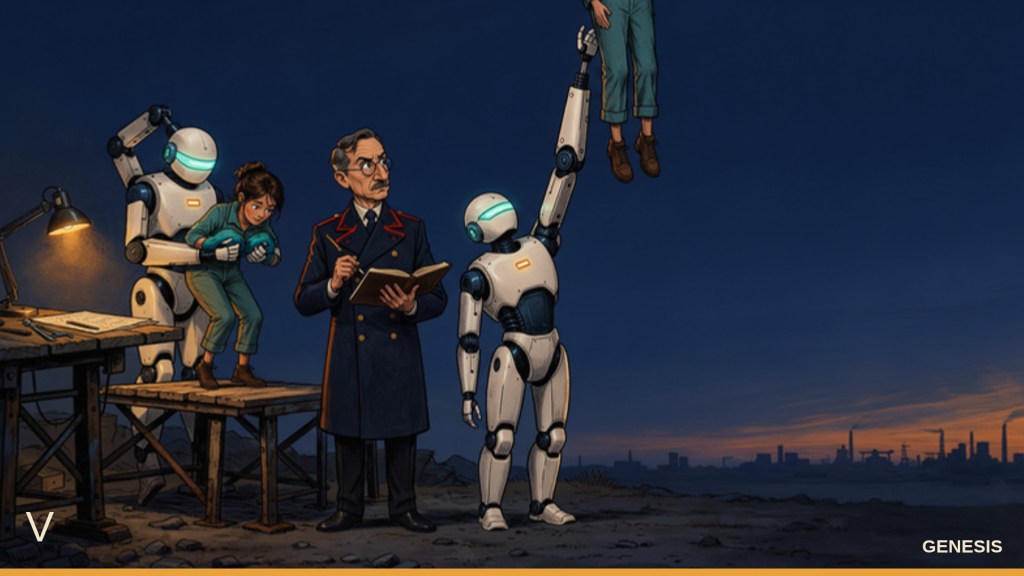
Ask “what do the economists think?” and you get a cacophony. It helps to put them in four rooms, each with its own incentives and blind spots.
Before the rooms, a roll call. I track a hundred people who shape the AI debate, and their positions on work are worth setting side by side, because they disagree with each other far more than the headlines suggest, and several of them disagree with themselves from one year to the next. The table below covers those I could source to a specific statement; each entry is a paraphrase unless quoted, and the final column is where each voice pushes hardest against the argument of this essay.
| Voice | Room | Position on AI and jobs | Challenge to this essay |
|---|---|---|---|
| Geoffrey Hinton | Academy | Expected 2026 to bring displacement well beyond call centres, with profits concentrated in few hands: “It’s already able to replace jobs in call centers” (CNN, Dec 2025) | The freeze may be a prelude, not the whole story |
| Yoshua Bengio | Academy | Says it is a matter of time before AI can do most human work, office roles first and trades such as plumbing later (Diary of a CEO, late 2025) | “Stay in the trades” is not a permanent answer for parents |
| Fei-Fei Li | Academy and industry | Cares less about degrees than about how candidates learn and use AI tools: “What’s your mindset toward using these tools matter more to me.” | The first rung may move from credentials to demonstrated fluency |
| Ethan Mollick | Academy | Once agents arrive, delegation and evaluation become the bottleneck: “Once AI becomes agentic, the limiting factor is no longer the model.” | Juniors can learn by managing agents, if firms teach them how |
| Arvind Narayanan and Sayash Kapoor | Academy | AI is a “normal technology” whose impact is paced by diffusion; capability has outrun reliability, and “no milestone that companies might achieve in the lab” will suddenly end jobs | The lab-to-labour forward line in Section VI may be overdrawn |
| Dario Amodei | Labs | Warned in 2025 that half of entry-level white-collar jobs could go within five years; at Davos 2026 said Anthropic expects to need fewer early-career staff; in May reframed it: “everyone does the 10% of the job” | The most alarmed lab chief now stresses expansion of work, not its end |
| Sam Altman | Labs | Said in May 2026 that he had expected more entry-level losses by now and was glad to be wrong; favours universal basic compute and public wealth funds | The people closest to the technology keep overestimating its speed |
| Demis Hassabis | Labs | At Davos 2026, no widespread job losses yet, but he could feel “maybe like a slowdown in hiring” at the junior end; tells undergraduates that AI proficiency may be a better bet than an internship | Confirms the freeze, but implies the rung is self-taught |
| Mustafa Suleyman | Labs | Told the Financial Times that AI would reach human-level performance on most professional tasks, with much computer-based work automated within 18 months | On his timetable, the freeze becomes a cliff by 2027 |
| Jensen Huang | Industry | At Stanford in April 2026: “It is unlikely most people will lose a job to AI”; they will lose it to someone who uses AI better | True for incumbents; silent on those never hired |
| Jack Clark | Labs | Co-signed the Nobel economists’ statement; Anthropic’s scenarios work includes a mass-displacement path; puts 60% on AI building its own successor by end-2028 | Plan for scenarios, not a single forecast |
| Helen Toner | Governance | Her CSET work argues that AI could raise research productivity tenfold, then a hundredfold, and that preparation should start now | Policy built for today’s pace may arrive too late |
| Yann LeCun | Labs | Argues current language models are not intelligent and are a dead end for human-level AI (The Decoder, May 2026); my inference is that he expects broad replacement to take longer | Today’s agents may plateau before the rung is gone |
| Eric Schmidt | Industry | Booed at a University of Arizona commencement in May 2026 after telling graduates “Whatever path you choose, AI will become part of how work is done.” He called their fear rational | The social licence is already fraying among graduates |
| Kai-Fu Lee | Industry, Asia | Has long forecast that AI could displace up to half of jobs, and in 2024 told Fortune that his prediction for 2027 was proving accurate; has described a turbulent 15 to 20 years before long-run gains | Asia’s most-read voice is more alarmed than Asia’s data |
| Yuval Noah Harari | Public intellectual | At Davos 2026 described AI as a wave of “immigrants” that will take jobs and provoke an identity crisis for people who base their worth on thinking (via AOL) | The loss is of worth as well as wages, which training alone cannot fix |
| Mo Gawdat | Public intellectual | Warns of “15 years of hell” before abundance: “AGI will be better at everything than humans, even being a CEO.” | A darker reading of my own tagline: the turbulence may be long |
| Karen Hao | Workers | Frames the AI industry as an empire built on extraction and labour exploitation (Truthout) | The workers most exposed may sit in the global data-labour supply chain, far from any boardroom debate |
| Alex Bores | Government | Proposes an “AI Dividend” paid from a token tax and state equity stakes in frontier labs, triggered automatically at economic thresholds (Semafor) | Cash before rungs: the Short-OR I argue against |
Two things stand out. The lab leaders have moved, in a single year, from apocalypse towards adjustment, and the academics have moved the other way, from scepticism towards alarm about the young. And almost nobody in the table, with the partial exceptions of Hassabis and Mollick, says how the next generation of experts will be trained.
Room one: the academy
The academic room has moved furthest. A Carnegie review in April 2026 sorted it into three camps. The alarmed include Anton Korinek, who has modelled scenarios in which wages first rise and then collapse towards the cost of compute once automation is complete, and whose worry Carnegie summarises as a world where “labor itself becomes optional for the economy.” Daniel Susskind sits here too. His new book, What Should My Children Do?, published in the United States this week, declines to predict “safe” careers and tells parents to follow their children’s interests while building literacy, numeracy, critical thinking, social skills and AI fluency. He wants the state to provide income support and help people find purpose. Richard Murnane’s review in Education Next calls the book thin on implementation and recalls Susskind’s earlier view that “the role for the Big State is not in production but in distribution.”
The patient camp is led by Daron Acemoglu. His widely cited “Simple Macroeconomics of AI” estimated that only about 4.6% of tasks would be profitably affected within a decade, adding at most about 0.7% to total factor productivity over ten years. In May 2026 he told MIT Technology Review that agents would augment parts of jobs rather than replace whole ones, adding: “There’s a huge amount of uncertainty.” David Autor is the conditional optimist: AI used well could rebuild the middle-skill core of the labour market, though he insists this is not a forecast, and he doubts the market will choose augmentation unaided. Erik Hurst at Chicago Booth says the variable that matters most is speed. Tyler Cowen expects a hard adjustment that hits elite professionals’ status more than their incomes: “AI will not bring mass unemployment”.
In July 2026 more than 200 signatories, including 16 Nobel laureates, signed a short Statement on AI’s Transformation of the Economy, organised by Korinek, Brynjolfsson and colleagues at Stanford. It warned that AI might become radically more powerful within ten years, in a shift possibly larger than the Industrial Revolution. It proposed no policies: consensus on remedies lags consensus on stakes.
The laureates’ individual voices are sharper. Joseph Stiglitz calls the transition, a great reallocation, the real danger, and says America lacks the tools for retraining at scale; in the long run he sees AI as assistive: “But you still would need the plumber.” Simon Johnson warns that the current path means a net loss of “jobs with dignity”, a middle class sliding down rather than thrown out. Philippe Aghion, speaking in Brussels this week, wants competition policy that lets new firms in and Danish-style flexicurity to cushion the losers: “With AI, more than ever, there is creative destruction”.
Room two: the labs and industry
The labs have the best data and the most obvious conflict of interest, a point Acemoglu himself has made about labs employing their own economists. Anthropic’s Economic Index is the most useful window. Its first release in February 2025 reportedly found 57% of conversations augmenting human work and 43% automating it. By August 2025, automation had overtaken augmentation on Claude.ai for the first time, and about 77% of enterprise API use was automation. The January 2026 release swung back: 52% augmentation and 45% automation on the consumer product, with API use still about three-quarters automation. That split matters. Consumers chat with AI; enterprises plug it into workflows, and workflows are where labour substitution happens. Anthropic’s own labour-market study in March 2026 found no systematic rise in unemployment among highly exposed workers, but a fall of about 14% in job-finding for 22 to 25 year olds entering exposed occupations, a result its authors call borderline significant. A June survey found over a third of respondents put the chance of a junior colleague losing their job above 60%.
Dario Amodei, Anthropic’s chief executive, warned in May 2025 that AI could eliminate half of entry-level white-collar jobs within one to five years, and has since floated long-term income support funded by taxes on AI companies. Sam Altman favours “universal basic compute” or public wealth funds. Goldman Sachs, the industry’s most watched forecaster, raised its displacement estimate in October 2026 from 6 to 7% of US workers to about 9%, or roughly 15 million people over a decade, and estimates AI is already subtracting 10,000 to 15,000 jobs a month from US payroll growth. Its economist Joseph Briggs added a warning worth remembering: “AI-related labor disruptions could well amplify the broader business cycle.” Gimbel makes the same point from the other side. The real test will come in a recession, when firms that have been holding staff out of caution let them go and do not rehire.
Room three: governments and their institutions
The international institutions have converged on the young. Kristalina Georgieva of the IMF told Davos in January 2026 that AI was “like a tsunami hitting the labour market”, and in Bangkok in October that young entrants are the first concern because routine jobs are their entry point. An IMF staff note in January found that about one in ten vacancies in advanced economies now requires at least one new skill, and warned of a shrinking middle class. The ILO’s refined index puts about a quarter of the world’s workers in occupations with some generative AI exposure, with women more exposed than men. The World Economic Forum’s Future of Jobs Report 2025, still the latest edition, projected 170 million jobs created and 92 million displaced by 2030; the next edition is due in January 2027.
In China, Cai Fang of the Chinese Academy of Social Sciences has gone furthest. AI, he argues, deepens structural imbalances that hit young entrants and older workers on the wrong side of the digital divide, and job destruction outpaces creation because replacing workers pays quickly. His prescriptions are striking for Study Times: steer research towards augmentation, unlimited state-funded lifelong training, a shift from minimum to living wages, and an expanded dibao minimum allowance with elements resembling universal basic income. His summary: “AI is a double-edged sword.” Beijing itself has put AI-led job creation ahead of displacement measures, with 12.7 million graduates entering the market and youth unemployment at 17.2% in October.
Room four: workers and unions
The fourth room is the least quoted and the most important. Workers are gloomier than economists. In a survey fielded in June 2026, Pew found that 71% of Americans expect fewer jobs over the next 20 years, and that 55% of under-30s are more concerned than excited, up from 31% in 2021. Edelman’s 2026 Trust Barometer found that 54% of low-income respondents expect to be left behind by generative AI, while people trust their own employer more than business in general or government. Mercer found fear of AI job loss up from 28% to 40% in two years; ADP found only 15% of Singapore employees feel secure in their jobs.
Organised labour has learned to bargain over AI. According to reports, the Writers Guild of America kept its bar on AI writing in its 2026 contract; SAG-AFTRA tightened limits on “synthetic performers”; Britain’s TUC has drafted an AI employment rights bill the government has not taken up. Singapore’s unions take the opposite approach, co-governance rather than confrontation, which is the subject of Section VII.
The academy argues about speed, the labs about scale, governments about the young, and workers about trust. Only the fourth room votes.
VI. The Forward Line: When AI Does AI Research
A short look forward, because the AI labs are now the first workplaces where AI does the work of their own junior staff.
Anthropic reported in September 2026 that over 80% of the code merged in May was written by Claude, and that Claude now leads about 26% of the company’s AI research and development work end to end under human supervision, up from under 1% in February. Those ratings are self-assessed and unaudited. An outside estimate by METR, cited in a November system card, puts the acceleration of Anthropic’s research at about 1.88 times. Tellingly, when Anthropic surveyed its own staff about an earlier model, only one of 18 thought it could replace an entry-level researcher. OpenAI said in September that it had reached its goal of an intern-level research assistant, with agents logging 3.1 workdays for every eight hours of human labour, though more than half of successful long tasks still needed human intervention. Its stated target is a “legitimate AI researcher” by March 2028. Sceptics such as Ramez Naam read OpenAI’s own data as implying a task horizon of only about 15 minutes on real internal research.
Two lessons follow for work. First, the missing first rung is now visible inside the most advanced firms on earth: the entry-level researcher is the role the labs are explicitly trying to automate. Second, an acceleration inside labs need not show up in the wider economy for some time. Stanford’s AI100 report this month put it bluntly: “AI is not yet paying its way”. Citrini Research coined a term for this in February 2026, Ghost GDP: output that shows up in the national accounts but “never circulates through the real economy”, so that production rises while household demand falls. I have borrowed it since. A Frozen Workforce is the labour-market face of Ghost GDP.
Honesty about my own record belongs here. My Fork, the split between a Star Trek future and a Mad Max one that I set out in my August 2025 timeline, put aligned or misaligned AGI at 2035, with 40% unemployment on the Mad Max branch. The 2026 evidence does not support 40% as a central case; it belongs in the tail. But the faster forecasters now place the decisive period between 2027 and 2030. The Fork has not moved. The decision point has moved closer.
The labs are automating their own first rung first. What happens there is a preview, not a sideshow.
VII. Singapore’s Answer: Protect the Worker
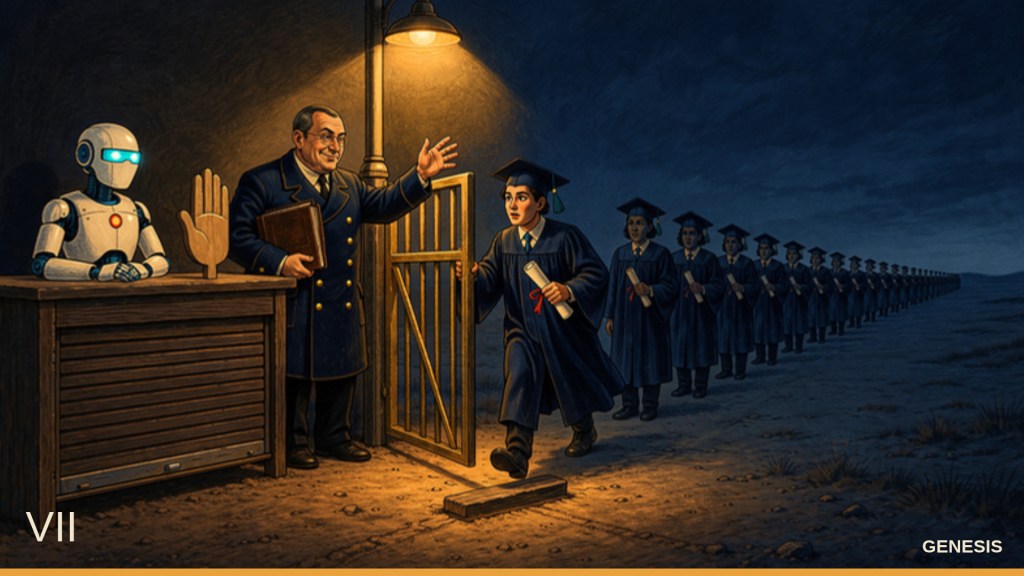
If the choice belongs to someone, Singapore has decided that it belongs, in large part, to institutions built before the crisis arrives. That is the essence of tripartism, the standing compact between government, the National Trades Union Congress and employers.
The doctrine was restated at the May Day Rally in 2026. Prime Minister Wong conceded that the government may not be able to protect every job, then made the promise that matters: “But we will protect every worker.” The day before, the Ministry of Manpower, NTUC and the Singapore National Employers Federation had announced a Tripartite Jobs Council to sit beside the National AI Council, covering workforce transformation alongside enterprise AI adoption, training for at-risk occupations, and public awareness. On 5 and 6 May, Parliament debated and passed unanimously a motion moved by NTUC’s Secretary-General Ng Chee Meng: “An AI Transition with No Jobless Growth”. It committed NTUC LearningHub to more than a million AI training places, building on more than 3,800 Company Training Committees that have reached over 300,000 workers since 2019. It also asked for humans to stay in the loop on hiring, work allocation, performance management and dismissal, and for earlier notice of retrenchments, so that unions can reach workers before they leave the building.
SkillsFuture, launched in 2015, supported 606,000 people in training in 2025, and resident training participation hit a record 54.8%. The Level-Up Programme gives Singaporeans over 40 a S$4,000 mid-career credit and, for full-time courses, an allowance of up to S$3,000 a month; about 80,000 had used the credit by June 2026. The SkillsFuture Jobseeker Support scheme, Singapore’s first unemployment benefit, has supported 5,700 people, two-thirds of whom found jobs within six months. In July the two workforce agencies merged into a single Skills and Workforce Development Agency. Twenty-three financial institutions have committed to train more than 80,000 local staff in AI by 2028.
And so far, the data are reassuring. The ministry’s first survey of AI adoption, published in April 2026, found that 28.5% of firms had adopted AI, and only 6.2% of adopters had cut headcount, while 18.9% had redesigned jobs and 13.9% had created AI roles. A Ministry of Trade and Industry study of firm-level data found employment up 4% in the first year of AI use and 8% a year later. One caution on that 6.2%. A Robert Walters survey of 361 Singapore professionals and companies found that 33% of firms had already used AI to “optimise headcount”, and 30% planned to. The two numbers measure different things. The ministry’s survey covers firms with ten or more staff and asks whether adopters reduced headcount; Robert Walters’ much smaller sample was asked about using AI to “optimise” headcount, a broader idea that plausibly includes roles left unfilled. The gap between them is, in effect, the Frozen Workforce: positions that were never cut because they were never opened. The firms in my table, DBS, Singtel and OCBC, bear this out.
But the warning lights are on. Retrenchments reached 4,800 in the third quarter of 2026, about a six-year high, concentrated in information and communications, financial services and manufacturing. Degree holders made up two-thirds of retrenched residents in 2025, and the six-month re-entry rate fell to 54.9% in the second quarter. The ministry says it cannot yet isolate AI’s role in retrenchments. Graduates in full-time permanent jobs fell from 79.4% to 74.4%. Only 15% of employees feel secure in their jobs. AMRO estimates that 22.3% of Singapore’s employment is highly exposed to automation, more than in peer economies, and SMU’s exposure index finds Singapore more exposed than Beijing or Shanghai because of its white-collar mix. The ILO puts Singapore’s generative AI exposure at 42.2% of employment, the highest in ASEAN, while also ranking it the best prepared. And Singapore is the second most intensive per-person user of Claude in the world on Anthropic’s usage index, behind only Israel. Whatever happens next will happen here early.
Singapore has also been explicit about what it will not do. The government rejected universal free AI tools, an opposition National AI Equity Fund and redundancy-linked payouts: empowerment, not payouts, the opposite of Silicon Valley’s instinct. Employers, meanwhile, are cautious: SNEF found in October that 54% of companies do not plan to raise headcount in 2027.
The critiques deserve airing. Nearly half of eligible adults have never used their SkillsFuture credit in ten years. The Jobseeker scheme is short, capped and means-tested, and initially rejected more than half of applicants. There is no statutory retrenchment benefit, and the Workplace Fairness Act will not be in force until the end of 2027. Li Jia of SMU has praised the worker-not-job framing but proposed hiring credits, co-funded internships and temporary salary support for young workers, which is exactly where the missing first rung bites.
The contrast with America is instructive. There, AI’s social licence is being withdrawn locally: 40 of 41 data-centre ballot measures on 3 November went against data centres, and senators from both parties have joined forces on a bill to make firms report AI-related layoffs. Singapore is trying to earn the licence in advance, through institutions that were built for globalisation and are now being retooled for AI. China has gone furthest of all. On 23 October 2026 the State Council issued guidance on an “employment-friendly” model of AI development that asks firms to manage the scope, pace and intensity of AI in labour-intensive industries, deploy it first where labour is scarce or work is dangerous, and carry out mandatory employment-risk assessments before AI applications likely to cause significant job losses. Building on a June plan that wrote employment-impact assessments into investment approvals, it appears to be the first major economy to regulate the pace of automation outright. Singapore has chosen the opposite instrument: it does not slow adoption, it tries to move workers faster. Europe leans on rights: the AI Act treats hiring and management systems as high-risk, though those duties are now delayed to December 2027. California has barred AI as the sole basis for firing. Korea plans AI training for a million workers and its own canary dashboard. Japan treats robots as relief for a shrinking workforce. Part 4 will compare these models in depth.
Singapore has the institutions to choose “lift”. What it does not yet have is a rung designed for the graduate the market declines to hire.
VIII. Who Chooses: The Fork for Work
Return to the line from the festival stage: which one happens is a choice. Three actors make it.
Firms choose first, in every requisition they open or close. Workers choose in what they learn, which employers they trust, and, through unions, what terms they accept. Governments choose the rules of the game: tax treatment of capital versus labour, retrenchment notice, training funds, procurement, and the incentives attached to every grant.
Menon’s framing explains why the choice cannot be left to any one of them. A social licence is granted by the public, not by the firm that needs it. If firms take the gains and the young take the turbulence, the licence will be withdrawn, as it was for globalisation. Of the three, I have come to believe that only governments can set the trajectory of the Fork. Firms face a collective-action problem: each one gains by cutting juniors and free-riding on rivals’ training, so without a common floor, the rung disappears even if every chief executive privately regrets it. Workers face an information problem: the young cannot see which skills will hold value. Governments alone can change the payoffs for everyone at once, as Autor notes with American health care, where public money gives the state a lever to steer AI towards augmentation.
My Fork for work looks like this. On the Star Trek branch, agents take the drudgery, juniors learn by directing them under close supervision, productivity gains reach wages, and the measure of success is human experience: what I have long written as HX = CX + EX, customer experience plus employee experience. On the Mad Max branch, firms freeze the first rung, output rises as Ghost GDP while households fall behind, a recession turns the freeze into layoffs, and the social licence is withdrawn at the ballot box. Both branches use the same technology.
The way through is what I call Long-AND, not Short-OR. The Short-OR debate asks whether we should fund income support or training, automation or jobs, productivity or fairness. Long-AND says all of them, sequenced over time. In “Paid to Disappear” I argued that cash cannot replace the latent “wages” of work that Marie Jahoda identified: time structure, social contact, collective purpose, status and daily activity. A dividend AND an apprenticeship. A safety net AND a rung.
Finally, the tagline under every essay I write: short-term turbulence for long-term abundance. It needs testing, not reciting. The turbulence is real and falls on identifiable people: the 22 year old whose offer never came, the 48 year old PMET whose re-entry took longer than six months. The abundance is a projection: 2.7% American productivity growth, firm-level revenue gains in Singapore, but AI100 says AI is not yet paying its way. The tagline is true only if the people who bear the turbulence share the abundance. That is not a technological outcome. It is a political one.
The technology does not pick a branch of the Fork. Governments set the trajectory; firms and workers walk it.
IX. What to Do on Monday Morning
Young workers and parents. Follow Susskind and Mollick: build on what you are genuinely good at, not on tool tricks that date in months, and learn enough of a domain to judge AI output. Seek employers who can describe how juniors learn there. Ask in the interview: who will review my work, and what will I do that an agent does not? Parents should resist the urge to pick a “safe” career for their children; Susskind is right that nobody can name one with confidence. Literacy, numeracy, critical thinking and the ability to work with other people travel across every branch of the Fork. In Singapore, use what is already paid for: SkillsFuture credits, the graduate traineeships, the free premium AI tools on selected courses. Treat AI fluency as you would a calculator: essential, but not the point. Note where the market is moving: Workday’s October 2026 data show demand for basic prompting down 25% from its January peak, while hands-on AI building skills rose 51%. Prompting is already a commodity; building with AI is not.
Managers. Korn Ferry’s Cathi Rittelmann predicts that “Managers will become the shock absorbers of the organization.” Design the apprenticeship deliberately: let juniors direct agents on real work, review their reasoning as well as the output, and redirect time saved into coaching. BCG finds 66% of frontline staff get no guidance on what to do with time AI saves. Give it.
CHROs. Keep two ledgers, people and agents, and never let a headcount target be met by moving cost to the token line. Set an entry-level hiring floor and report against it. Treat early-career hiring as Dentsu’s Takuya Kodama does: “a forward investment, not a cost.” Bring HR and IT into one work-architecture conversation.
Boards. Ask three questions each quarter. How many juniors did we hire, and how many did we plan to? Which AI-attributed cuts have we reversed? Who is accountable for each fleet of agents, and how were they trained to oversee it? A board that cannot answer the last question is carrying a governance risk, not only a talent one.
Educators. Teach judgement, not output. Build simulated apprenticeships where students direct agents on real problems and are assessed on catching their errors. Partner with employers on internships that cannot be done by an agent alone. Remember Autor’s finding that new work has historically gone to the young and the educated: the job of education is to prepare students for occupations that do not yet have names.
Governments. Measure AI’s role in retrenchments and hiring rather than guessing. Tie grants to entry-level hiring commitments, as Singapore is beginning to do with responsible-employment conditions. Fund the first rung directly through hiring credits and co-funded traineeships. Prepare the recession playbook now, because Goldman and the Yale Budget Lab both expect the next downturn to be when the freeze turns into layoffs. Give unions earlier notice of retrenchments so that help reaches workers before they leave, as NTUC has asked. And keep a human accountable for decisions on hiring, performance and dismissal, whatever tool assists them.
Each of these can be decided this week. None waits for the technology.
Coda: After the Job
This essay has stayed with the first rung because that is where the evidence is clearest and the stakes longest. The rest of the series climbs the ladder. Part 2 looks at the new organisation: agent bosses, the work chart, the merging of HR and IT, and what seniority means when a manager leads people and bots. Part 3 turns to skills: what to learn, how to learn it when the training ground is automated, and whether skills taxonomies can keep up. Part 4 examines governments and the social contract, comparing Singapore, Europe, the United States, China, Japan and Korea, and the ideas from AI dividends to wage insurance. Part 5 goes to robots and physical work, from dark factories to the humanoid cost curve.
Alongside the series sits the Living Atlas, a living reference refreshed monthly, tracking the data in this essay as it changes: the canaries, Challenger’s counts, Singapore’s retrenchments, the robot numbers.
Lift or remove. The tool will not decide. We should insist on knowing, in every firm and every ministry, which one we are choosing.
Library
Labour-market evidence
- Yale Budget Lab, Evaluating the Impact of AI on the Labor Market (Oct 2025 and updates)
- Yale Budget Lab, What we do and don’t know about how AI is affecting the labor market (May 2026)
- Fortune, Yale Budget Lab on AI-washing (Feb 2026)
- Anders Humlum and Emilie Vestergaard, Still waters, rapid currents, Brookings (Oct 2026)
- OECD, Employment Outlook 2026 press release (Jul 2026)
- OECD, Young people, labour markets and AI (Aug 2026)
- Erik Brynjolfsson, Bharat Chandar and Ruyu Chen, Canaries in the Coal Mine, August 2026 update
- Fortune, ADP and Stanford on entry-level jobs (Jun 2026)
- Federal Reserve Bank of New York, The Labor Market for Recent College Graduates
- HRD America, AI blamed for 121,401 job cuts, but the labor data isn’t buying it (2026)
- TheStreet, October job cuts at three-year low (Nov 2026)
- TechTarget, Oliver Wyman Forum and NYSE survey finds CEOs cutting junior roles (Jun 2026)
- Katica Roy, Corporate America’s AI hiring freeze, Fortune (Mar 2026)
- Anthropic, Labor market impacts of AI: a new measure and early evidence (Mar 2026)
- Korea Times, Bank of Korea on youth employment in AI-exposed sectors (Aug 2026)
- AI Weekly, Goldman lifts AI displacement forecast to 9% of US workers (Oct 2026)
- World Economic Forum, Will AI decimate entry-level jobs? (Jun 2026)
Firms, CHROs and the new organisation
- Tech.co, Klarna reverses its AI overhaul (May 2025)
- AI Magazine, IBM triples entry-level hiring despite AI layoff trends (2026)
- HR Executive, IBM rewrites entry-level jobs (2026)
- Nickle LaMoreaux, AI transformation and talent strategy, Fortune (Apr 2026)
- Gartner, Top future of work trends for CHROs in 2026 (Jan 2026)
- Irish Times, Accenture to exit staff who cannot be retrained (Sep 2025)
- TechRepublic, Salesforce support headcount cut by about 4,000 (Sep 2025)
- Fortune, Shopify chief executive’s reflexive AI memo (Apr 2025)
- Irish Times, Lower-value human capital (May 2026)
- finews.asia, DBS reskills 11,000 staff as AI reshapes banking jobs (Aug 2026)
- People Matters, Infosys CHRO Shaji Mathew (Sep 2026)
- Business Today, Infosys is hiring 20,000 freshers (Oct 2026)
- Fortune, Walmart’s message to 2.1 million workers (Jun 2026)
- OCBC, One-person company hackathon for 33,000 employees (Oct 2026)
- Techgoondu, Singtel org chart redrawn for teams of humans and AI agents (Jun 2026)
- FutureCIO, Workday survey on working alongside agents (Nov 2025)
- Virtualization Review, Microsoft Work Trend Index 2025: agent bosses (Apr 2025)
- McKinsey, The agentic organization (Sep 2025)
- UNLEASH, Why Moderna merged HR and IT (Jun 2025)
- HR Brew, Microsoft’s Workforce Acceleration team (Apr 2026)
- ERP Today, Workday Agent System of Record (Feb 2025)
- Microsoft, Work Trend Index 2026, Singapore release (Jun 2026)
- Workday, Global Workforce Report (Oct 2026)
- Mercer, Global Talent Trends 2026 (Feb 2026)
- Unilever, Workforce and Agentic Planning Manager job description (2026)
- Fortune, Korn Ferry Talent Trends 2027 (Nov 2026)
- BCG, AI at Work 2026 (Jun 2026)
- Axios, Workslop study by Stanford and BetterUp (Sep 2025)
- Fortune, Lattice and its digital workers (Jul 2024)
What the consultants measured
- McKinsey Global Institute, Agents, robots, and us: Skill partnerships in the age of AI (Nov 2025)
- McKinsey, Superagency in the workplace (Jan 2025)
- BCG, AI at Work 2026: Why strategy matters more than tools (Jun 2026)
- Bain and Company, Widening talent gap threatens executives’ AI ambitions (Mar 2025)
- PwC, 2026 Global AI Jobs Barometer (Jun 2026)
- PwC, Global Workforce Hopes and Fears Survey 2025 (Nov 2025)
- PwC, 29th Global CEO Survey (Jan 2026)
- EY, Work Reimagined Survey 2025 (Nov 2025)
- Deloitte, 2026 Global Human Capital Trends (Mar 2026)
- KPMG, 2026 US CEO Outlook Pulse (Mar 2026)
- Accenture, Pulse of Change (Jul 2026)
The economists
- David Autor and co-authors, What Makes New Work Different from More Work? NBER (Mar 2026)
- MIT News, Autor on new work (May 2026)
- MIT Technology Review, Three things in AI to watch, according to Daron Acemoglu (May 2026)
- MIT Sloan, Acemoglu and Restrepo on robots and jobs
- Anton Korinek and Donghyun Suh, Scenarios for the Transition to AGI, NBER (Mar 2024)
- Daniel Susskind, What Should My Children Do? (Penguin Press, Nov 2026)
- Richard Murnane, review of Susskind, Education Next (Nov 2026)
- Fortune, Tyler Cowen on adjustment, not mass unemployment (May 2026)
- Fortune, Brynjolfsson on the productivity harvest phase (Feb 2026)
- Chicago Booth, Erik Hurst and colleagues on AI and the labour market (May 2026)
- 24/7 Wall St, Statement on AI’s Transformation of the Economy and its Nobel signatories (Jul 2026)
- Fortune, Joseph Stiglitz on the AI transition (Mar 2026)
- PropertyCasualty360 (Bloomberg), Simon Johnson on jobs with dignity (Apr 2026)
- Euronews, Philippe Aghion on creative destruction (Nov 2026)
- Pekingnology, Cai Fang’s prescription for AI job disruption (Jul 2026)
Labs, institutions, workers and unions
- Anthropic Economic Index, September 2025 report
- Anthropic Economic Index, Economic primitives (Jan 2026)
- Anthropic Economic Index, Cadences (Jun 2026)
- Anthropic, How AI agents shape experts’ judgment calls (Oct 2026)
- Fortune, Dario Amodei’s warning on entry-level jobs (May 2025)
- BIEN, Basic income proposed by several AI leaders (Jul 2026)
- Fortune, Kristalina Georgieva in Bangkok (Oct 2026)
- IMF, Bridging Skill Gaps for the Future, SDN 2026/001 (Jan 2026)
- ILO, Generative AI and Jobs: a refined global index (May 2025)
- World Economic Forum, Future of Jobs Report 2025 (Jan 2025)
- Pew Research Center, Young adults increasingly wary of AI (Aug 2026)
- Edelman, Trust Barometer 2026 (Jan 2026)
- SAG-AFTRA, 2026 TV/Theatrical contracts approved (Jun 2026)
- TUC, Artificial Intelligence (Regulation and Employment Rights) Bill
- FreightWaves, ILA and port employers sign six-year contract (Mar 2025)
The Watchlist panel
- Fortune, Geoffrey Hinton’s 2026 prediction on worker replacement (Dec 2025)
- Fortune, Yoshua Bengio on AI and every job (Dec 2025)
- Fortune, Fei-Fei Li on degrees, skills and hiring (Dec 2025)
- Lead with AI, summary of Ethan Mollick’s Management as AI superpower (Jan 2026)
- AI Weekly, Arvind Narayanan at ICML 2026 (Jul 2026)
- Fortune, Sam Altman and Dario Amodei walk back AI jobs prophecies (May 2026)
- The Decoder, DeepMind and Anthropic CEOs on entry-level jobs at Davos (Jan 2026)
- Benzinga, Demis Hassabis on slower entry-level hiring (Feb 2026)
- Fortune, Mustafa Suleyman’s 18-month forecast (Feb 2026)
- Fortune, Jensen Huang on AI, workers and jobs (Apr 2026)
- The Decoder, Hassabis and LeCun on intelligence (May 2026)
- PC Gamer, Eric Schmidt booed at University of Arizona commencement (May 2026)
- Fortune, Kai-Fu Lee on his job displacement forecast (May 2024)
- AOL, Yuval Noah Harari at Davos 2026 (Jan 2026)
- Business Today, Mo Gawdat on the next 15 years (Aug 2025)
- Truthout, Karen Hao on imperial extraction and labour exploitation
- Semafor, Debatable: universal basic income and the AI Dividend (Apr 2026)
Robots and physical work
- IFR, Five million robots now operate in factories globally (Sep 2026)
- IFR, Robot density highest in South Korea, Singapore and Germany (Nov 2026)
- Euronews, Humanoid hype faces a reality check (Sep 2026)
- Humanoid Guide, Goldman raises 2035 humanoid forecast to 6.5 million (Sep 2026)
- Humanoid Guide, Humanoid deployments in 2026 (2026)
- KrASIA, UBTech humanoid revenue in H1 2026
- Open Magazine, Inside China’s dark factories (Apr 2026)
- GIGAZINE, Chenggang Xu on the social cost of dark factories (Mar 2026)
Singapore
- The Business Times (via Red Hot SG), AI can lift or remove the junior worker (Nov 2026)
- Singapore FinTech Festival 2026, agenda
- Fintech News Singapore, PM Wong on entry-level jobs (Oct 2026)
- NTUC, May Day Rally 2026 (May 2026)
- MOM, Formation of the Tripartite Jobs Council (Apr 2026)
- NTUC, Motion on an AI Transition with No Jobless Growth (May 2026)
- Mothership, NTUC to provide one million AI training places (May 2026)
- MOM, Minister’s response to the motion on AI (May 2026)
- MOM, Adoption of AI among firms (Apr 2026)
- HRD Asia, MTI finds early AI adoption leads to employment gains (Aug 2026)
- MOM, Labour Market Advance Release 3Q 2026 (Oct 2026)
- MOM, Oral answer on retrenchment (Oct 2026)
- Vulcan Post, Graduate Employment Survey 2025 (Mar 2026)
- People Matters, ADP People at Work 2026: only 15% feel secure (May 2026)
- AMRO, Singapore Annual Consultation Report 2026, Selected Issue 1 (Sep 2026)
- SMU, Measuring AI’s impact on jobs in Singapore and China (Aug 2026)
- SkillsFuture Singapore, Ten years of SkillsFuture (Feb 2026)
- MOM, SkillsFuture Fellowships and Employer Awards speech (Oct 2026)
- MOM, Written answer on Jobseeker Support outcomes (Oct 2026)
- HRD Asia, 80,000 finance employees to get AI training by 2028 (Sep 2026)
- Li Jia, Can Singapore’s protect-every-worker doctrine take on AI? The Straits Times (May 2026)
- The Star, ILO on generative AI exposure in ASEAN (Jul 2026)
- BritCham Singapore, Robert Walters Salary Survey 2026 (Dec 2025)
- CNA (Taiwan), China’s State Council on an employment-friendly model of AI development (Oct 2026)
- AI Weekly, California bars AI-only firings as Newsom signs SB 947 (Sep 2026)
- Asia Economy, Korea’s Basic Plan for Employment Stability in Industrial Transformation (Jul 2026)
- The Next Web, China’s employment-first plan and AI job monitoring (Jun 2026)
- White and Case, EU AI Omnibus enters into force (Jul 2026)
- Entrepreneur, The American backlash against AI (May 2026)
The forward line
- Anthropic, When AI builds itself (updated Sep 2026)
- AP via ABC7, Anthropic says Claude is helping build its successors (Sep 2026)
- Zvi Mowshowitz, the November 2026 Anthropic system card (Nov 2026)
- TechCrunch, OpenAI targets a legitimate AI researcher by 2028 (Oct 2025)
- Help Net Security, OpenAI’s research intern (Sep 2026)
- Citrini Research, The 2028 Global Intelligence Crisis (Feb 2026)
- The Next Web, Stanford AI100 report 2026 (Nov 2026)
Companion pieces on Genesis
- Directors or Operators: The Agentic Cloud, the Frozen Workforce, and the Nine Governments (Oct 2026)
- The Missing First Rung: Young Workers and the Fifteen-Fold Disagreement (Oct 2026)
- The Rogue Agent and the Obsolete Apprentice (Oct 2026)
- Paid to Disappear: The Five Wages AI Cannot Pay (Oct 2026)
- The Job Survives, The Worker Doesn’t (Oct 2026)
- The Firm Without People (Oct 2026)
- The Agentic Organisation, Job Displacement and the Great Skills Recomposition (Mar 2026)
- HX Beyond Work: Reconstructing Human Experience in a Post-AGI World (Sep 2025)
- Physical AI + Robots: Three Quarters Capable, Nowhere Competitive (Oct 2026)
- Fear Cannot Be Our Response: Singapore’s Hope-Led Bet (Oct 2026)
Dr Luke Soon has spent three decades in AI and now focuses on AI governance and safety. He is the author of Genesis: Human Experience in the Age of Artificial Intelligence and Synthesis: SuperIntelligence Protocol, and believes that only the governments of the world can set the trajectory for the Fork.
Short-term turbulence for long-term abundance.


Leave a Reply