
By Dr Luke Soon
Genesis: Human Experience in the Age of Artificial Intelligence | Synthesis: The Superintelligence Protocol
March 2026 (Enhanced Edition v4)
We are no longer asking whether AI will change work.
We are now confronting how deeply it will reshape it — and whether organisations and societies are prepared for the velocity of that change in 2026.
Across boardrooms, research labs and ministries of manpower, the consensus is clear: AI will not simply augment work. In many domains it will compress, substitute and recompose it.
The question is no longer technological. It is structural. And increasingly, it is societal — especially as AI “breaks the model” of traditional work, value creation, and competitive advantage, as highlighted in PwC’s Unmodeled Briefing series with Wharton professor Ethan Mollick, and as a new era of “agentic” work begins, per PwC’s latest insights on the future of work in the age of AI.
The Labour Data: Early Signals of Recomposition — Now Accelerating
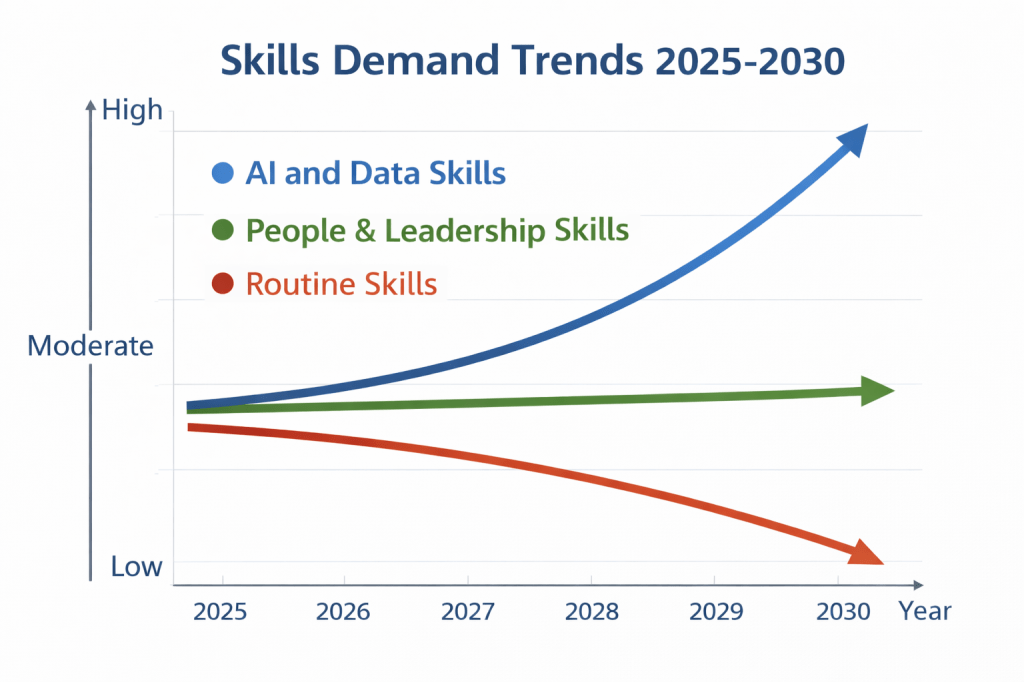
PwC’s AI Jobs Barometer has already shown AI-exposed roles growing faster, delivering measurable productivity uplifts, commanding wage premiums, and spreading across every sector. The World Economic Forum echoes this: analytical thinking, systems thinking and AI literacy are surging, while nearly half the global workforce will need reskilling this decade.
But 2026 marks a decisive inflection.
According to PwC’s latest 2026 AI Business Predictions, we are moving from experimentation to a disciplined march to value. Leading organisations are abandoning bottom-up crowdsourcing in favour of top-down enterprise strategies executed through centralised “AI studios” — reusable tech components, use-case frameworks, sandboxes and cross-functional talent. The payoff: focused investments in high-ROI workflows where agentic AI can automate complex, multi-step processes in demand sensing, hyper-personalisation, finance, HR, IT, tax and internal audit.
Productivity is no longer incremental. It is structural — and as PwC’s recent analysis on agentic AI workforce redesign highlights, it demands a rethink of organisational pyramids. No more default structures: AI agents enable specialists to expand into generalists, early-career talent to ramp faster, and deliberate org designs like diamonds or hourglasses to emerge. This aligns with Mollick’s view in PwC’s briefing: AI has crossed from “toy” use cases into real work, forcing leaders to redefine good work beyond tools to encompass leadership, management, and incentives. PwC’s 28th Annual Global CEO Survey reinforces this: 56% of CEOs report GenAI-driven efficiencies in employee time, with 32% seeing increased revenue and 34% profitability, while AI raises wages and accelerates demand for new skills.
When AI Pioneers Warn — And PwC Confirms the Shift
Dario Amodei, Geoffrey Hinton, Mo Gawdat and Demis Hassabis have all sounded the alarm on speed and scale. Their warnings are no longer speculative.
PwC’s 2026 outlook confirms that agentic AI is ready to shine — but only for organisations that insist on real-world benchmarks, centralised platforms, rigorous testing, human oversight protocols, and mutual agent-checking mechanisms. Agents that can document their own decisions make continuous monitoring not just possible, but highly effective.
The message is unambiguous: 2026 is the year exploratory pilots give way to measurable P&L impact — and to workforce models where AI expands human reach, shifting roles from narrow execution to broad, outcome-focused ownership. As Mollick discusses, this shift exposes “AI work slop” — low-quality outputs from superficial adoption — and underscores organizational fear as a barrier to true transformation. PwC emphasizes that AI provides a “limitless, made-to-order supply of digital labor,” enabling hyper-efficient workflows and real-time insights, but only through human-led, agent-powered processes.
From Augmentation to Agency — The 2026 Reality
Much of the workforce conversation still treats AI as a productivity tool.
In 2026 we enter the era of agentic AI in earnest: systems that plan multi-step workflows, interact with other agents, allocate tasks autonomously, escalate exceptions and self-monitor.
PwC notes that agents can already handle roughly half of the tasks people currently perform in many functions. When coordination friction collapses, entire layers of middle management and routine coordination roles become economically redundant. This is not mass unemployment — it is structural compression. As PwC emphasises, AI enables specialists to “do so much they become generalists,” orchestrating agents across full workflows in areas like software development, finance modelling, or marketing campaigns. Mollick adds that this “breaks the model,” compelling a rethink of decision-making and value in an AI-native world. PwC’s AI agent operating system exemplifies this, connecting and scaling agents into business-ready workflows, fostering hybrid collaboration for faster innovation.
The Vulnerable Zone: The Shrinking Middle Tier — And the Pyramid’s End
The roles most exposed are exactly those whose value once lay in synthesis, reporting, coordination and intermediary analysis.
PwC’s 2026 predictions describe a profound reshaping of workforce architecture:
• In knowledge work, the structure becomes an hourglass — AI-savvy entry-level generalists and senior strategists, with a dramatically smaller mid-tier.
• In front-line task work, it becomes a diamond — fewer entry-level roles replaced by agents, but more mid-level orchestrators needed to manage them.
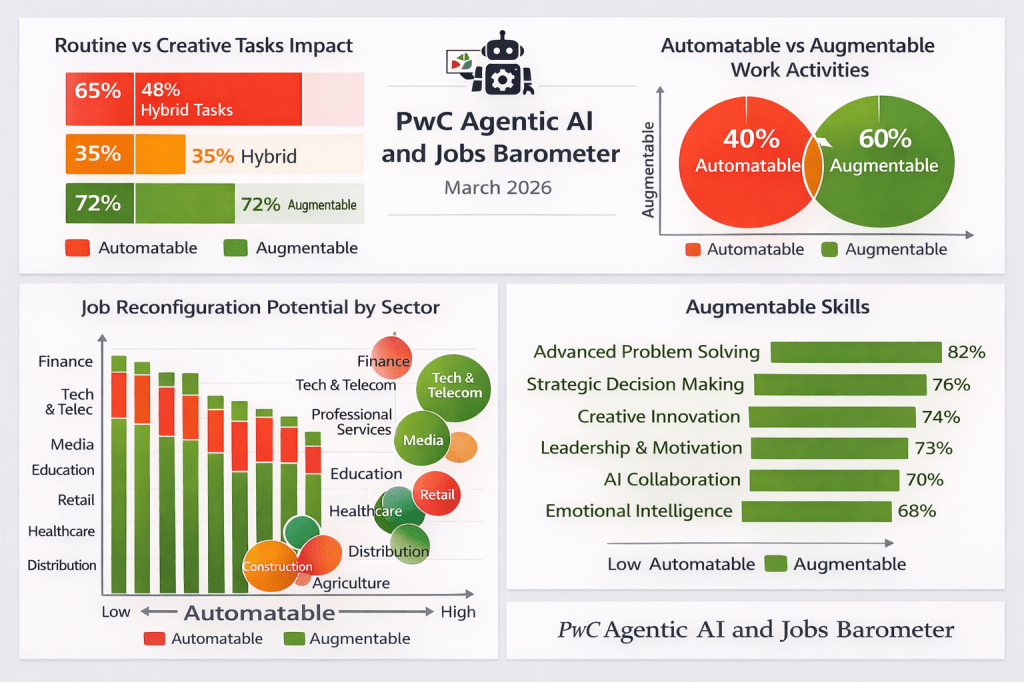
Traditional pyramids are obsolete. PwC warns against default cuts that erode capability: instead, redesign deliberately. For knowledge-intensive firms, an hourglass preserves the apprenticeship pipeline, allowing early-career talent — equipped with AI agents — to contribute faster, ramp up expertise, and feed future leadership. Reducing this base risks starving organisations of the high-performing generalists needed for innovation and error correction.
The result? The Great Skills Recomposition is no longer a future concept. It is the defining labour-market dynamic of 2026, where surface-level AI use leads to “work slop” and missed advantages, as per Mollick’s insights. Organisations must reinvent themselves with AI or risk obsolescence, as layering AI onto old processes won’t suffice.
The Rise of the AI Generalist and Five Emerging Archetypes
PwC explicitly forecasts the Rise of the AI Generalist — professionals who no longer need deep specialisation in narrow tasks because agents handle those. Instead, value shifts to those who can oversee agents, align them with business goals, and focus on revenue growth, innovation and strategic judgment. This isn’t uniform: it evolves differently across functions, with AI reducing human effort by 40-50% in areas like HR, while elevating roles in finance to growth engines, IT to strategic architects, marketing to customer anticipators, and HR to talent strategists.
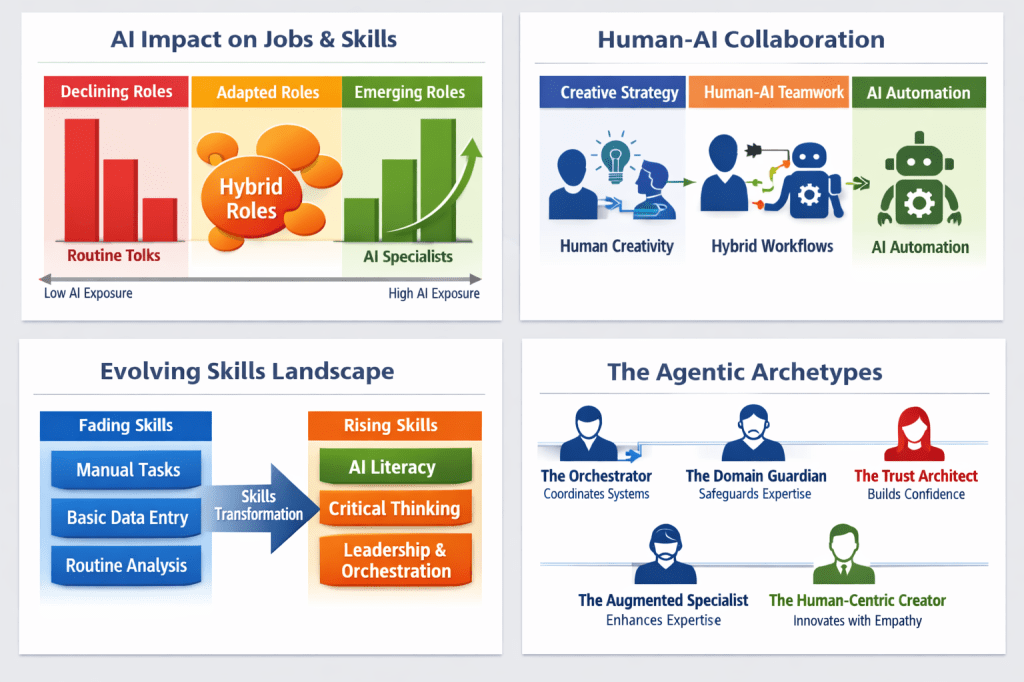
This maps perfectly onto the five archetypes I see forming inside the Agentic Organisation:
1. The Orchestrator
Designs and deploys human-AI workflows (PwC’s orchestration layer — the “command centre” with drag-and-drop agent assembly, real-time data and cross-vendor integration). In IT, this means shifting from support to proactive intelligent enterprise building.
2. The Domain Guardian
Supervises outputs, manages exceptions and provides human review and oversight. In finance, this evolves into applying judgment to agent analyses for strategic implications.
3. The Trust Architect
Embeds governance, explainability and ethical guardrails (aligning directly with Responsible AI practices). This counters organizational fear by building trust in AI systems.
4. The Augmented Specialist / AI Generalist
Leverages agents to deliver exponentially higher output while focusing on higher-order work, avoiding “work slop” through meaningful integration.
5. The Human-Centric Creator
Supplies empathy, ethics, creativity, relational depth and strategic imagination — the irreplaceable core of value in an AI-native world, where humans guide AI for innovation.
Responsible AI: From Talk to Traction in 2026
PwC’s 2025 Responsible AI survey already showed 60% of executives believe Responsible AI boosts ROI and efficiency, and 55% see gains in customer experience and innovation. Yet nearly half struggled to operationalise it.
2026 is the year that changes.
Agentic workflows spread faster than traditional governance can keep up, forcing organisations to adopt automated red-teaming, continuous monitoring, risk-tiered protocols and clear human-intervention triggers. The organisations that move Responsible AI from principle to repeatable process will gain measurable competitive advantage — and the trust required for adoption at scale, addressing the fears Mollick highlights. PwC stresses ethical, effective frameworks to accelerate innovation while mitigating risks, ensuring psychological safety in human-AI interactions.
Singapore’s Proactive Edge — Now Even More Critical
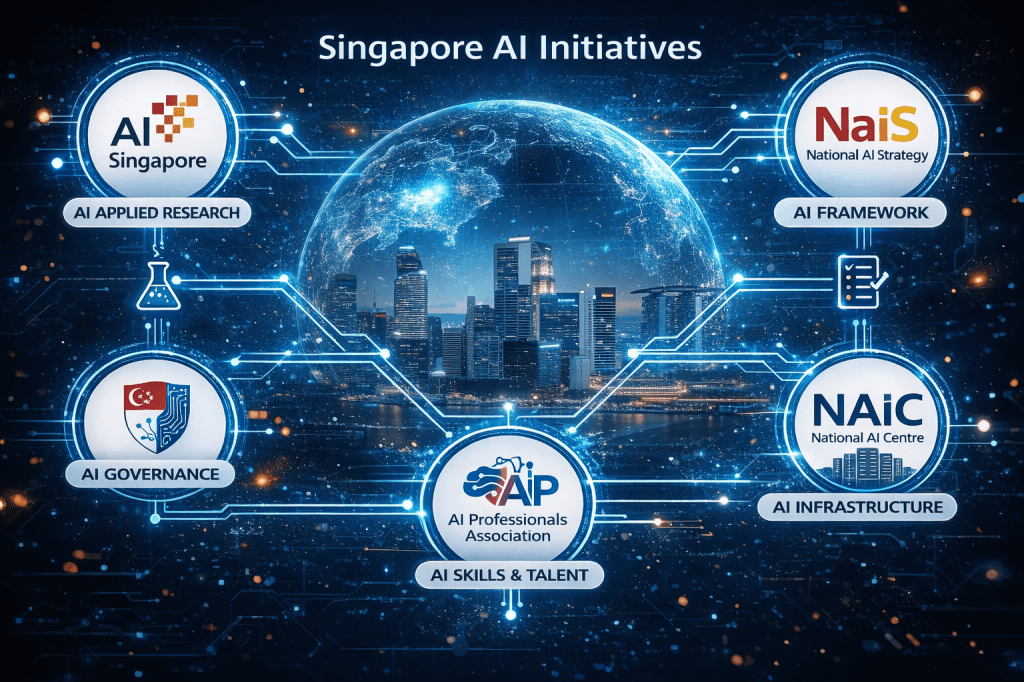
Singapore’s NAIS 2.0, National AI Council (NAIC), SkillsFuture evolution and Workforce Singapore’s job-redesign programmes position the nation exceptionally well for this transition.
The top-down discipline PwC says separates front-runners from the pack is already visible in Singapore’s centralised governance and enterprise enablement approach. SkillsFuture’s shift toward AI capability building, mid-career conversion and industry-aligned certifications is precisely the mechanism needed to grow the AI generalists and orchestrators the economy will demand.
Yet the velocity remains the challenge. Technology cycles continue to outpace training cycles. Singapore’s window to lead is real — but narrow, especially as AI demands a cultural shift beyond tools to incentives and leadership.
The Human Experience Imperative (HX = CX + EX)
As agentic systems take over routine cognitive work, the differentiator becomes trust.
Psychological safety, transparent governance, fair transition pathways and dignified reskilling are no longer nice-to-haves. They are the economic multipliers that determine whether AI adoption accelerates or stalls. Mollick’s discussion on organizational fear reinforces this: without addressing human concerns, AI risks becoming a source of resistance rather than advantage.
In my HX framework, success in the Agentic Organisation will be measured not just by productivity or ROI, but by whether people feel the change is happening with them, not to them — fostering a human-led, agent-powered future.
The Strategic Question for 2026 and Beyond
Leaders must stop asking “How many jobs will AI replace?”
The real question is:
“How do we redesign our organisations when intelligence itself becomes abundant, scalable and agentic — and when AI breaks the traditional models of work, value, and advantage?”
That requires:
• Top-down enterprise AI strategy and AI studios
• Centralised orchestration layers
• Rigorous Responsible AI operating models
• Deliberate creation of the five new archetypes
• Exponential mindset + continuous recomposition of skills
• Leadership focused on incentives, management evolution, and overcoming fear to unlock true competitive edge, as Mollick advocates
• Bold reinvention of value chains and workflows, experimenting with AI for revolutionary gains, as PwC advises.
The Decade Ahead
We stand at the threshold of the most cognitively disruptive technological wave in modern history.
If managed well:
Productivity rises
New domains of growth emerge
Work becomes more creative and meaningful
If mismanaged:
Trust erodes
Skill polarisation deepens
Social stability strains — amplified by “work slop” and unaddressed fears
Singapore’s early moves — NAIC leadership, SkillsFuture expansion, WSG job redesign support — signal that governments can act ahead of the curve.
But the window is narrow.
The agentic organisation is not a future abstraction.
It is forming now.
And the real work of leadership is not predicting disruption.
It is designing resilience before disruption becomes destabilisation — leveraging AI not just for efficiency, but for redefining human advantage.
The future of work is not about replacing humans.
It is about redefining human value in a world where intelligence itself is abundant.-level roles
—-
In this environment, the future workforce clusters around five archetypes:
1. The Orchestrator
Designs human-AI systems across domains.
2. The Domain Guardian
Supervises AI outputs and manages exceptions.
3. The Trust Architect
Ensures governance, explainability and ethical compliance.
4. The Augmented Specialist
Delivers higher output through AI leverage.
5. The Human-Centric Creator
Provides empathy, ethics, meaning and relational value.
Notice what diminishes: roles dependent solely on coordination and reporting.
Productivity Gains and Social Stability
PwC’s broader economic modelling suggests AI could materially lift GDP if responsibly deployed.
But productivity growth without workforce transition planning can lead to:
Wage polarisation Skill stratification Middle-layer compression Psychological insecurity
Geoffrey Hinton has raised concerns that retraining may not fully absorb displaced workers.
Mo Gawdat has warned that universal income discussions may accelerate.
Amodei has emphasised the importance of alignment and controlled deployment.
Hassabis highlights the need for international cooperation and governance.
Singapore’s approach — combining AI growth with SkillsFuture, WSG and national governance frameworks — may represent one of the more coherent national responses.
But it must scale with AI velocity.
The Human Experience Imperative
As AI becomes embedded in workflows, employee experience becomes critical.
In my own framework — HX (Human Experience) = CX + EX — the success of AI transformation depends on:
Psychological safety Transparent governance Fair capability pathways Dignified transitions
AI adoption without trust will stall.
AI adoption with equitable design can uplift.
Trust is no longer a moral variable.
It is an economic multiplier.
The Strategic Question
The question leaders must ask is not:
“How many jobs will AI replace?”
It is:


Leave a Reply