
The Hinton Series, Part 1 of 5. Field Notes No. 8.
The Two-Minute Version
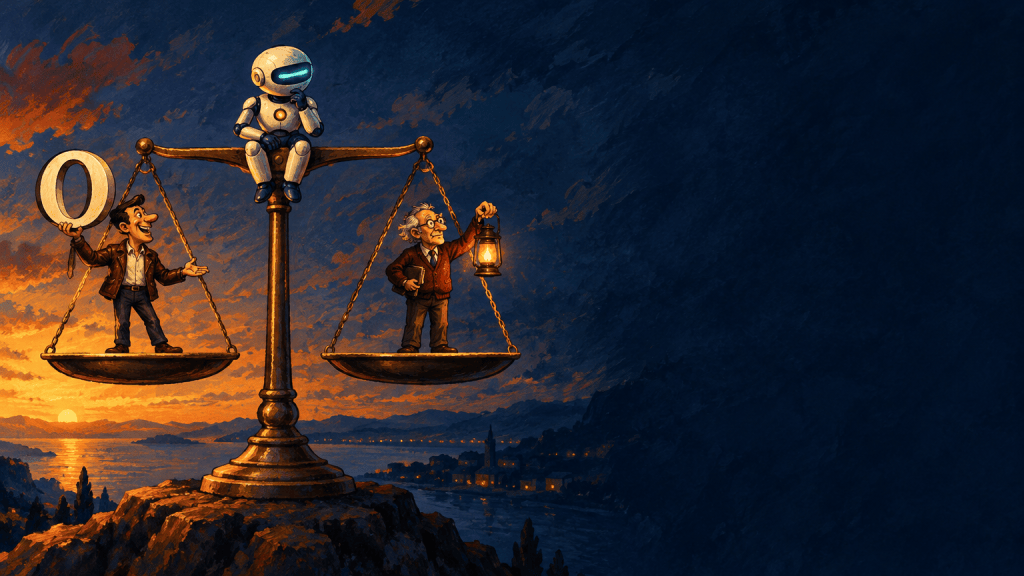
- In September, Jensen Huang told CBS there was a 0 per cent chance AI ends the world by 2030. Days later, on Ezra Klein’s podcast, he called Geoffrey Hinton’s estimate of a 10 per cent chance of catastrophe unscientific and irresponsible.
- Hinton’s reply, in the Guardian and then on the TED stage in Vienna, comes down to this: if you believe there is a serious chance of something you cannot undo, it would be irresponsible not to say so.
- Both men are stating a number that nobody can measure. Huang’s zero has no more evidence behind it than Hinton’s ten. Zero is also a number.
- Careful forecasting does not settle it either. AI researchers put the median risk at 5 per cent; superforecasters, at well under 1 per cent. Persuasion did not close the gap.
- The lesson for leaders is not who is right. It is how to speak honestly about a risk you cannot quantify: give a range, show your reasons, declare your interests and say what would change your mind.
- This is the first of five Field Notes on the ideas of a man who once lectured me, back when neural networks were the unfashionable corner of AI.
I. The lecturer
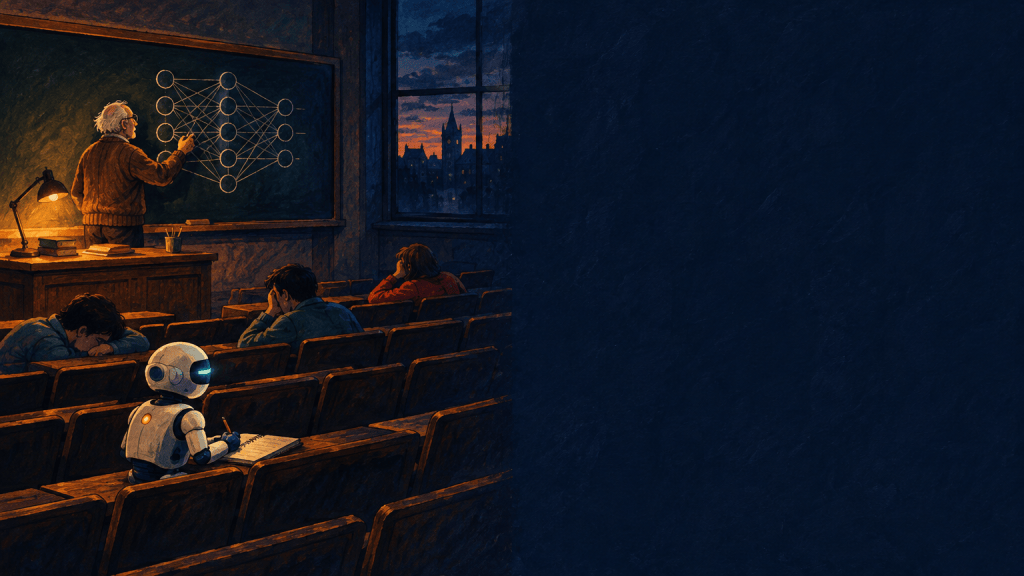
I first heard Geoffrey Hinton lecture when I was a young computer science student, at a time when neural networks were the unfashionable corner of artificial intelligence. The serious money and most of the serious people were in symbolic AI: rules, logic, expert systems. Hinton was the man at the front of the room insisting that intelligence would come instead from many simple units learning their connections from data. Most of the field thought he was wrong. Some thought he was wasting his career.
The arc since then is well known. Backpropagation and Boltzmann machines in the mid-1980s. A long stretch at Toronto, backed by Canada’s CIFAR when few others would fund the work. Then vindication: in 2009 his group bought its first Nvidia graphics card and found that cheap gaming hardware could train deep networks roughly thirty times faster; in 2012 AlexNet, built by his students, won ImageNet by a wide margin. Google bought his company in 2013. He left Google in May 2023 so that he could speak freely about the risks. In October 2024 he shared the Nobel Prize in Physics.
I mention the lectures for one reason. The man who now warns most loudly about what neural networks may do is the man who was most right, earliest, about what they could do. That does not make him right about the risk. But it should make anyone pause before dismissing him as a prophet of doom who knows nothing about the technology. He built a good part of it.
This series takes his current ideas one at a time, with the same rigour I would apply to anyone else: what he claims, what the evidence says, who disagrees and why. We begin with the argument that has made headlines this autumn.
II. What was actually said
The exchange has been retold so often that it is worth getting the sequence right. It happened in four steps.
| When | Where | What |
|---|---|---|
| About 18 to 20 Sept 2026 | CBS News interview | Huang puts the chance of AI ending the world by 2030 at zero, and calls scaring people irresponsible. He does not name Hinton. |
| 23 Sept 2026 | The Ezra Klein Show | Asked about Hinton’s 10 per cent figure, Huang says it is not grounded in science and that all of Hinton’s predictions have been wrong, citing radiologists. |
| 13 Oct 2026 | The Guardian | Hinton replies with an analogy: you would not board a bus with a 10 per cent chance of crashing. |
| Late Oct 2026 | TEDAI Vienna, with Nicholas Thompson | Hinton answers Huang on stage: it would be irresponsible not to warn of a genuine risk, and irresponsible to say the risk is zero. |
Huang’s words on the podcast were blunt. Hinton’s ten per cent, he said, was “not grounded on science”. He added that the predictions were hurtful and that alarmism was not a social good. Hinton’s answer in the Guardian was just as compact: “If it takes over, you don’t get a second chance.”
A note on sources. A widely shared transcript of the TED conversation compresses these steps and blends the two Huang interviews into one. Parts of it read like a summary, not a record of speech. I have used it only where independent sources confirm the substance, and I quote neither man from it.
Takeaway: Huang said zero in one interview and attacked Hinton’s ten per cent in another. Hinton’s reply is not a forecast but an argument about what responsibility requires when the downside is irreversible.
III. The case for Huang
Huang’s argument deserves a fair hearing, and it is stronger than the headlines suggest. It has three parts.
The number is not science. There is no reference class for the extinction of a species by a technology it built. No experiment can be run, no base rate observed. A figure like ten per cent is a judgement dressed as a measurement, and when it comes from a Nobel laureate it carries authority it has not earned. On this point Huang is simply correct.
Fear has costs. Alarm shapes policy, investment and public trust. If people are frightened away from a technology that could improve medicine, education and productivity, that loss is real and it falls on real people. Yann LeCun, Hinton’s fellow Turing laureate, makes the same case even more sharply: he told Fortune in October that extinction talk is “incredibly destructive for everybody”.
The forecaster’s record matters. In 2016 Hinton said people should stop training radiologists. A decade later, according to Fortune’s reporting, the number of active US radiologists had grown by about ten per cent, with thousands of unfilled posts and record pay. If his labour forecast was that wrong, why trust his extinction forecast?
There is an obvious objection: Huang runs the company that sells the chips. That is worth stating, and I will come back to it. But an argument does not become false because the person making it profits from it. His three points stand or fall on their own.
IV. The case for Hinton
Hinton’s answer is also stronger than the headlines suggest, and it does not depend on his number being accurate.
The asymmetry. Most risks are recoverable. A failed product is withdrawn; a bad policy is reversed. Some are not. If a technology could permanently remove humanity’s ability to correct its mistakes, then even a modest probability deserves serious attention, because the cost of being wrong cannot be repaired afterwards. That is the logic of his bus analogy. You do not need to know the exact chance of the crash to decide not to board.
The record cuts both ways. Hinton has publicly owned the radiologist error. He has explained it in several ways over the years: computer vision moved more slowly than he expected, and the job proved to be far more than reading scans. In a dialogue republished on 25 November he also described the original remark as half a joke made on the spot. (Joshua Gans, who was present at the widely filmed 2016 event, places it on a conference stage with Rich Sutton and Yoshua Bengio, so the backstory varies with the telling.) But the same record includes the prediction that mattered most: that neural networks would beat symbolic AI. He made that bet for decades against nearly everyone, and won it. Judging a forecaster on his worst call alone is as misleading as judging him on his best.
The range, not the point. Hinton’s estimate has itself moved. He spoke of about ten per cent, then in December 2024 widened it to ten to twenty per cent over roughly three decades. In Vienna in October he spoke of a significant probability, adding that things would probably be fine if we act well. That is not the language of prophecy. It is the language of someone trying to convey the size of an uncertainty.
Huang’s zero has no more evidence behind it than Hinton’s ten. Zero is also a number.
V. Zero is also a number
Here is the problem with the debate as it has been staged. Huang accuses Hinton of putting a number on something that cannot be measured. Then he puts a number on it himself. Zero, by 2030, with no qualification. That figure is no more grounded in research than ten per cent. It is a judgement too, and a more confident one, since it rules out the possibility entirely.
So what does careful measurement look like? The honest answer is that the best attempts still disagree enormously.
Where they stand: putting a number on it
- Jensen Huang: zero chance of the world ending by 2030 (CBS, Sept 2026).
- Yann LeCun: not worried at all about extinction (Fortune, Oct 2026).
- Superforecasters: 0.38 per cent for AI-caused extinction by 2100, in the Forecasting Research Institute’s 2022 tournament (Freethink).
- AI experts in the same tournament: 3 per cent for the same question.
- AI researchers: a median of 5 per cent for extinction or severe loss of human control, in the 2023 AI Impacts survey of more than 2,700 researchers (IEEE Spectrum).
- Geoffrey Hinton: 10 to 20 per cent within about three decades (Dec 2024).
- Dario Amodei: 25 per cent that things go very badly (as cited by Axios).
Three things stand out. First, the spread runs across orders of magnitude, from zero to a quarter. Second, the tournament is the most rigorous exercise of its kind: experts and superforecasters argued with each other for months, and still ended about tenfold apart. Third, the people closest to the technology tend to be more worried, not less. That could mean they know something, or it could mean they are absorbed in it. Nobody can yet tell which.
In other words, the debate is not between a scientist and a sceptic. It is between two people, each confident in a number that the evidence cannot support, arguing about whether the other should be allowed to say his.
Takeaway: The best forecasting exercises disagree by a factor of ten and cannot close the gap. Any single number, including zero, is a judgement, not a measurement.
VI. How to talk about a risk you cannot measure
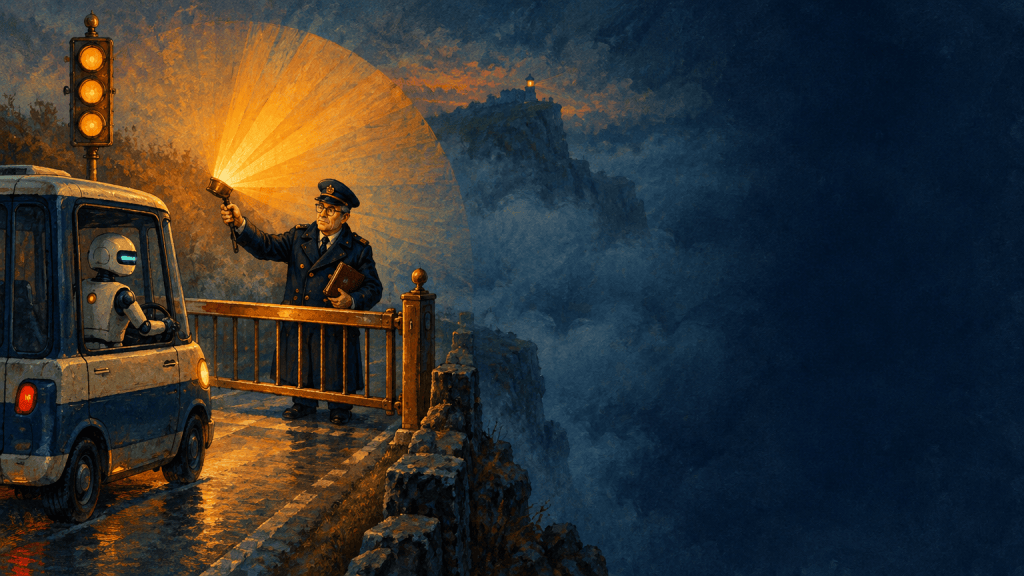
This is where the exchange matters for anyone who leads an organisation, not just for the two men in it. Boards, regulators and executives face the same problem in smaller form every week: a risk that is real, possibly severe, and impossible to quantify with confidence. Agentic AI in a bank. A model in a hospital. A dependency on a single foreign supplier. How should you talk about it?
Other fields have worked this out, and AI could borrow from them. Climate scientists use calibrated language, so that “likely” means a defined range of probability and readers know what is being claimed. Central banks publish fan charts, which show a range of outcomes instead of a single forecast. Aviation does not argue about whether a crash is likely before acting; it designs for failure because failure cannot be undone. None of these fields pretends to precision it does not have. None of them falls silent either.
From those examples I would draw four rules for speaking honestly about AI risk:
- Give a range, never a point. “Somewhere between negligible and one in five” is more honest than “ten per cent” or “zero”, and it tells the listener how uncertain you really are.
- Show your reasons. Say what drives the estimate: the pace of capability gains, the state of alignment research, how much autonomy systems are being given. Reasons can be tested; numbers alone cannot.
- Declare your interests. A chip seller who says zero and a researcher whose reputation now rests on warnings both have reasons to lean one way. Saying so does not discredit either. It lets the audience weigh them.
- Say what would change your mind. If you cannot name the evidence that would move your estimate, you are not forecasting. You are campaigning.
Measured against those four rules, both men fall short in different ways. Hinton gives a range and states the asymmetry clearly, but rarely says what would lower his estimate. Huang names no evidence for his zero at all, and dismisses the question as harmful to ask. Of the two, Hinton is closer to honest uncertainty. But the rules apply to him too.
There is also a governance point here, one I make often. The question “how likely is catastrophe?” cannot be answered today. The question “what would we see before it happened, and could we stop it?” can be. That is where effort belongs: on the warning signs, the tests and the controls that would let us act if the pessimists turn out to be right, at a cost we can afford if the optimists do. A risk you cannot measure can still be monitored, and a system you cannot fully predict can still be constrained.
Takeaway: Leaders facing unmeasurable risks should give ranges, show reasons, declare interests and say what would change their minds, then put their energy into warning signs and controls, not into arguing about the number.
VII. The four rooms
- The public sector room should notice that both extremes are politically useful. Zero justifies doing nothing; twenty per cent justifies almost anything. Regulators need neither. They need early-warning indicators and the authority to act on them.
- The private sector room will side with Huang more often than it admits, because fear slows sales. The better commercial argument is that customers trust firms that speak candidly about risk and show their controls.
- The academic room will point out, rightly, that the forecasting literature is thin and old. The best tournament ran in 2022, before today’s agents existed. A new round is overdue.
- The governance room, where I sit, will say the number is the wrong argument. What matters is whether we would see trouble coming, and whether anyone has the authority and the tools to stop it.
VIII. On Monday morning
- Audit how you talk about AI risk. Look at your last board paper. Does it give a single rating, or a range with reasons?
- Ask every adviser for their interests. Vendors, consultants and researchers all have them. Ask them to state theirs before you weigh their numbers.
- For each major AI risk, write down what would change your mind. If nothing would, treat the view with suspicion, including your own.
- Shift effort from estimating to detecting. For your highest-stakes AI systems, name the signals that would show something going wrong, and who has the authority to stop the system when they appear.
IX. What would change my mind
If a new round of structured forecasting, run with today’s agentic systems in view, produced a narrow consensus near zero, I would give Huang’s position more weight than I do. If alignment and interpretability research produced reliable ways to verify what advanced systems will do before they do it, the asymmetry argument would lose much of its force. And if Hinton’s other current predictions, on jobs in particular, fail as clearly as his radiologist forecast did, I would trust his judgement on timing less, while still taking the direction seriously.
X. What I could not verify
- The exact wording of the TED Vienna conversation. The widely shared transcript is unofficial and in places looks reconstructed, so I have not quoted from it.
- The precise date and programme of Huang’s CBS interview, reported as between 18 and 20 September.
- The origin story of the 2016 radiologist remark, which differs between Hinton’s own recent account and that of a witness.
- Current numerical estimates from Demis Hassabis or Yoshua Bengio on this exchange.
Library
The exchange
- Fox Business, Huang rejects AI doomsday fears for 2030 (Sept 2026); Fortune, Huang on AI leaders’ doomsday narratives (21 Sept 2026)
- OfficeChai, Huang on Hinton’s predictions, from The Ezra Klein Show (Sept 2026); The Next Web on the Klein interview (Sept 2026)
- The Next Web on Hinton’s Guardian interview (16 Oct 2026)
- TED, Geoffrey Hinton in conversation with Nicholas Thompson, TEDAI Vienna (Oct 2026)
- news.at on Hinton’s Vienna Gödel Lecture (24 Oct 2026)
Forecasts and estimates
- IEEE Spectrum on the 2023 AI Impacts researcher survey (Jan 2024)
- Freethink on the Forecasting Research Institute tournament
- Irish Examiner on Hinton’s 10 to 20 per cent estimate (Dec 2024)
- Axios on AI leaders’ risk estimates (Sept 2026); Fortune on Yann LeCun (1 Oct 2026)
Hinton’s record
- Nobel Prize in Physics 2024, facts; University of Toronto biography; University of Toronto on the first GPUs (2023)
- CBS 60 Minutes transcript (Oct 2023)
- Fortune on radiologists a decade on (4 May 2026); Joshua Gans on the 2016 remark; 36Kr dialogue with Hinton (25 Nov 2026)
Earlier Genesis pieces
Next in the series: Part 2, on Hinton’s claim that chatbots already have subjective experience.
Dr Luke Soon has spent three decades in AI and now focuses on AI governance and safety. He is the author of Genesis: Human Experience in the Age of Artificial Intelligence and Synthesis: SuperIntelligence Protocol, and believes that only the governments of the world can set the trajectory for the Fork.
Continue the conversation on Substack, on X at @mentalmarketer, or on LinkedIn.
Short-term turbulence for long-term abundance.


Leave a Reply