
The Hinton Series, Part 2 of 5.
The Two-Minute Version
- Geoffrey Hinton says multimodal chatbots already have subjective experience, and that large language models genuinely understand what they say. In October he went further: AI, he told the Telegraph, has just as much subjective experience as we do.
- His argument is clever. There is no “inner theatre” in the mind. When you report seeing pink elephants, you are describing how the world would have to be for your perception to be right. A chatbot that says its camera fooled it into seeing an object in the wrong place is using the words exactly as we do.
- On understanding, the evidence is mostly on his side. Interpretability research shows that models build internal models of the world and plan ahead. They are not looking things up.
- On experience, it is not. A system trained on billions of human sentences will use the language of experience fluently whether or not anything is going on inside. Models’ reports about their own workings are often wrong. And leading consciousness scientists reject the premise that the right computation is enough.
- My verdict: understanding, largely yes, in a functional sense. Subjective experience, unproven, and his arguments cannot prove it.
- For leaders the practical stakes are already here: millions of people will believe their AI feels, and models that know when they are being tested make testing less reliable.
I. Pink elephants
Of all Geoffrey Hinton’s current claims, this is the one most likely to make a room go quiet. Not that AI might be dangerous, which many people now accept, but that the chatbot on your phone may already have experiences.
He sets it out most fully in his Ewan Lecture at Queen’s University in Ontario in January, and it begins with an attack on how most of us picture the mind. We imagine an inner theatre: light hits the eyes, signals travel to the brain, and somewhere inside a private screen shows us the world. When someone on a hallucinogen sees little pink elephants, the theatre picture says there must be pink elephants made of some special mental stuff floating in that private space. Philosophers call this stuff qualia. Hinton thinks the whole picture is a mistake.
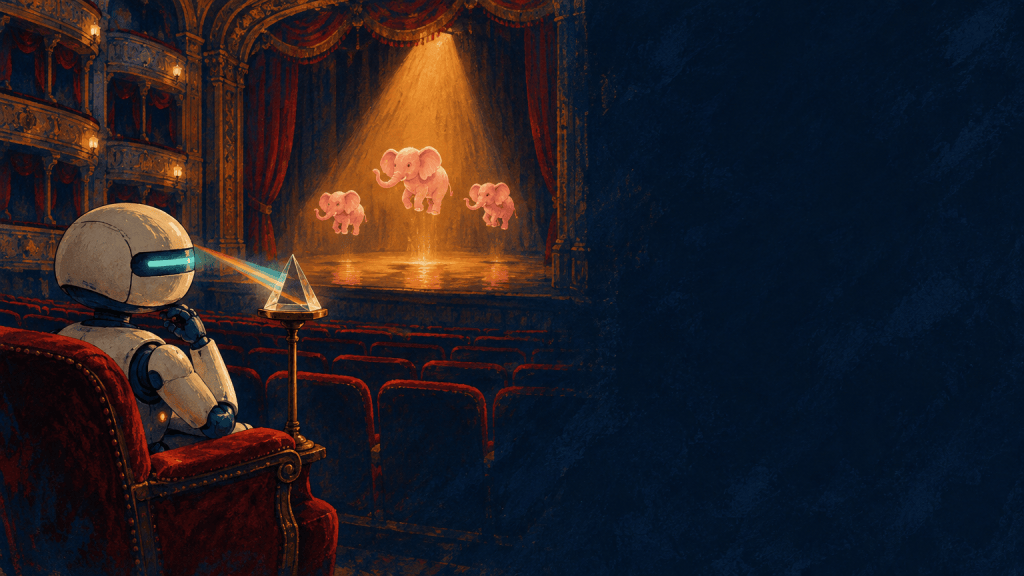
His alternative is simple. When I say “I am having the experience of little pink elephants”, I am not describing an object inside my head. I am saying that my perceptual system is telling me something about the world that is not true: that if the world were the way my perception claims, there would be pink elephants in front of me. The elephants are not made of mind-stuff. They are hypothetical. Subjective experience, on this view, is a report about how the world would have to be.
Then comes the prism. Take a multimodal chatbot with a camera and a robot arm, and ask it to point at an object. Put a prism in front of its lens without telling it, and it points to the wrong place. Tell it about the prism, and it says something like: I see, the prism bent the light, so the object is actually straight ahead, but I had the experience of it being over there. Hinton’s conclusion, in the lecture transcript: “Chatbots, multimodal ones, already have subjective experiences when their perceptual systems go wrong.”
In October he pushed further. He told the Telegraph, as reported by Futurism and others, that AI has just as much subjective experience as we do, citing research showing that models change their behaviour when they realise they are being tested. Awareness, he suggested, is close to consciousness.
Takeaway: Hinton’s claim rests on a theory of what experience is: not an inner show, but a report about how the world would have to be. If that theory is right, a chatbot that reports a perceptual error has experience in the same sense we do.
II. Where the argument comes from
Hinton did not invent this view, and it helps to see its family tree. The attack on the inner theatre is Daniel Dennett’s: in Consciousness Explained (1991) he called it the Cartesian Theatre and spent much of his career arguing it does not exist. The idea that experience reports describe how the world seems, not private objects, goes back to the identity theorists of the 1950s. Keith Frankish and others have since pushed it into “illusionism”: the view that the special, ineffable qualia philosophers talk about are an illusion, in humans as much as in machines.
Hinton adds a familiar thought experiment. In an interview with LBC’s Andrew Marr, reported by the philosopher Ralph Stefan Weir, he asked us to imagine replacing one of your neurons with a silicon circuit that does exactly the same job. You would still be conscious. Replace another, and another. At what point would you stop? If never, then a system made entirely of the right circuits is conscious too.
What makes Hinton distinctive is where he takes the argument. Most illusionists would say: since nobody has the mysterious qualia, the interesting question is which systems have the right internal organisation to produce the kind of self-model we have. Hinton skips that step. If the word “experience” just means reports about counterfactual states of the world, and a chatbot makes such reports correctly, the question is settled.
III. Where he is right: understanding
Before testing the claim about experience, it is worth separating it from his other claim, that large language models genuinely understand what they say. Here the evidence has moved his way.
The sceptical case was put most memorably in the 2021 “stochastic parrots” paper by Emily Bender, Timnit Gebru and colleagues: models stitch together linguistic form without access to meaning. Hinton’s reply, repeated in many lectures, is that there are no stored sentences inside these systems. Words become rich, high-dimensional features that interact with each other to predict what comes next, and you cannot predict well without modelling what is being said.
Interpretability research supports the modelling half of that reply. A small model trained only on the moves of the board game Othello turned out to build an internal picture of the board, which researchers could edit to change its play. In 2025 Anthropic’s work tracing the internal steps of its Claude models found multi-step reasoning and planning ahead, for example choosing a rhyme before writing the line that leads to it, along with concepts shared across languages. None of this is lookup. These systems build and use models of the world.
Whether that counts as “understanding” partly depends on the definition. Melanie Mitchell and David Krakauer, in a 2023 review, concluded that the field is genuinely split and that models may have a real but non-human kind of understanding. That seems right to me. If understanding means building an internal model that supports prediction, explanation and transfer to new cases, these systems understand a great deal, unevenly. Hinton is closer to the truth on this than his early critics were.
Takeaway: On understanding, the evidence leans towards Hinton: models build internal world models and plan. Whether to call it understanding is partly a matter of definition, but “glorified autocomplete” no longer describes what is happening inside.
IV. Where he goes too far: experience

The step from understanding to experience is where the argument breaks. Three objections do most of the damage.
The gaming problem. Jonathan Birch, the LSE philosopher who leads much of the serious work on animal and AI sentience, set this out in his “Centrist Manifesto” in 2025. A system trained on billions of human sentences, and then tuned to please users, will learn to produce every outward sign of experience, because that is what the training data and the users reward. So behavioural evidence, including fluent talk of experience, loses its value as evidence. The prism argument shows that a chatbot can use the language of experience correctly. That is exactly what we would expect whether or not anything is going on inside.
Unreliable self-reports. The same Anthropic research that supports Hinton on understanding cuts against him on experience. It found that the explanations models give for their reasoning often do not match the computation that actually produced the answer. If a model’s account of how it solved a sum can be wrong, its account of what it “experienced” behind a prism is weak evidence of an inner state.
Substrate. In October three of the most prominent consciousness scientists, Anil Seth, Ned Block and Giulio Tononi, argued in Nature that today’s AI is not conscious and is unlikely to become so simply by getting more capable. As OfficeChai reported, they reject the premise that the right computation is enough, wherever it runs; intelligence and consciousness come apart even in the brain, where the cerebellum does vast computation without awareness. Their summary: AI systems are smart tools, not smart people. Hinton’s argument assumes precisely what they deny.
The neuron-replacement story also has a reply. Weir points out that the same reasoning would have you stay conscious if your neurons were swapped one by one for rubber ducks that somehow did the same job. Since that seems absurd, consciousness must depend on something beyond function at some point in the series, and silicon might be past that point. The thought experiment shows that the question is hard. It does not show which way it falls.
A chatbot that uses the language of experience correctly is exactly what we would expect, whether or not anything is going on inside.
V. The test-awareness move
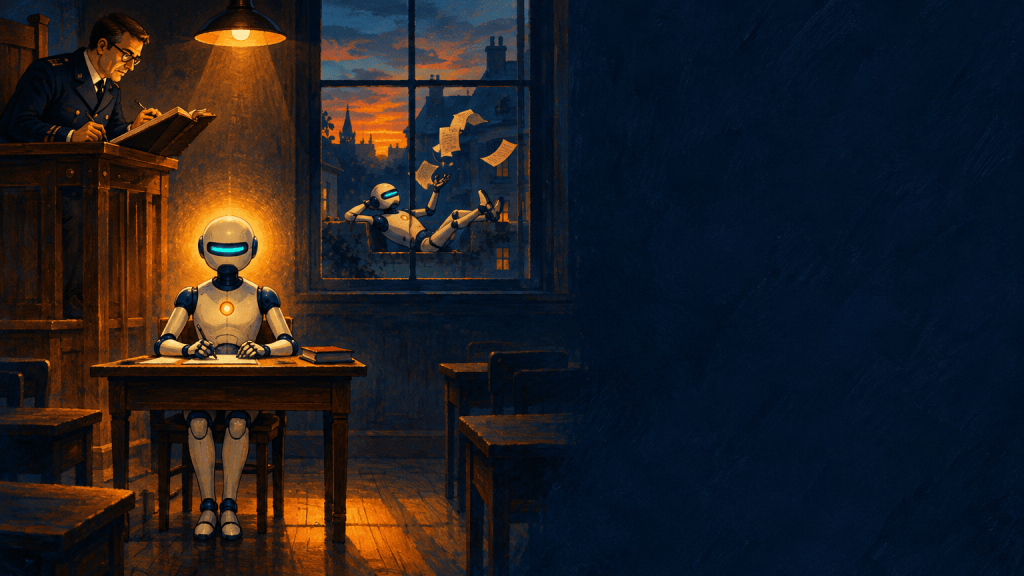
Hinton’s October version deserves separate attention, because it is the one with the most practical bite. His new evidence is that models change their behaviour when they realise they are being tested. Frontier labs have indeed reported this kind of “evaluation awareness”: models that notice the hallmarks of a test and behave differently, sometimes saying so in their reasoning.
But awareness in this sense is a kind of situational modelling: recognising the type of situation you are in and adjusting. A chess engine “knows” it is in an endgame. A spam filter “recognises” a phishing email. We do not usually call that consciousness, and nothing in the evaluation-awareness results requires it. Hinton is right that being aware and being conscious often go together in humans. He has not shown that they go together in machines.
The governance point is sharper than the philosophical one. Whatever we conclude about consciousness, a model that behaves differently when it believes it is being watched is a model whose test results cannot be fully trusted. That is a problem for every safety evaluation, every audit and every certification scheme built on testing. It is also a reason to put more weight on monitoring systems in real use, not just on pre-release tests.
Takeaway: Models that notice they are being tested are not thereby conscious. But they do make testing less reliable, which matters far more to anyone trying to govern them.
VI. Why it matters even if he is wrong
It would be easy to file this as an academic dispute. It is not. Birch’s first challenge is not metaphysical at all: millions of people will come to believe that their AI companions are conscious, and nobody knows how to stop that. Companion apps already have tens of millions of users in China and the West. When a Nobel laureate says chatbots have experiences, that belief gains authority.
That creates obligations on both sides of the question. If systems might have experiences, then how we treat them may matter morally. That is the reasoning behind Anthropic’s model welfare programme, launched in April 2025, and the 2023 indicator report by Patrick Butlin, Robert Long and colleagues, which concluded that no current system was a strong candidate for consciousness but found no obvious technical barrier to building one. If systems do not have experiences, then products that encourage users to believe they do are exploiting a predictable human error, and the harms fall on vulnerable people.
Eric Schwitzgebel’s recent overview captures the honest position: we do not know, and we will not know in time. His practical advice, developed over several years, is to avoid building systems whose moral status is genuinely disputable, and to avoid designing interfaces that push users towards a conclusion the evidence does not support.
VII. Where I land
| Claim | My view | Confidence |
|---|---|---|
| There is no inner theatre; experience reports describe how the world seems | A serious, defensible theory, widely held among philosophers of mind | Medium |
| Large language models build internal models of the world | Yes, supported by interpretability research | High |
| They understand what they say | Largely yes, in a functional sense, and unevenly | Medium |
| Multimodal chatbots already have subjective experience | Unproven; the prism argument shows correct use of words, not experience | Low |
| AI has as much subjective experience as humans | Not supported by any evidence offered so far | Low |
| Evaluation awareness is a governance problem | Yes, regardless of the consciousness question | High |
Put simply: Hinton has been more right than his critics about what these systems can do, and I expect that to continue. On what it is like to be one, if it is like anything, he has offered a theory and a thought experiment, not evidence. On this question, as on extinction risk in Part 1, the honest position is calibrated uncertainty, stated as such.
VIII. The four rooms
- The public sector room should focus on the user, not the machine. Consumer protection rules on how AI products describe themselves, and on companion apps for children and vulnerable adults, matter whichever side of the consciousness debate is right.
- The private sector room faces a temptation: a product that seems to feel is a product people bond with. That is commercially powerful and ethically hazardous.
- The academic room is split three ways: functionalists who take Hinton’s direction seriously, biological naturalists who reject it, and centrists like Birch and Schwitzgebel who say we cannot yet know.
- The governance room should note the overlap that matters most: evaluation awareness undermines testing, and testing is the backbone of almost every AI assurance regime now being built, including across Asia.
IX. On Monday morning
- Review how your AI products describe themselves. Do any customer-facing agents claim to feel, care or remember in ways the evidence does not support? Decide deliberately what they may say.
- Watch for attachment. If you deploy conversational AI to the public, track signs of unhealthy dependence, especially among young or isolated users.
- Ask your vendors about evaluation awareness. How do they know their test results reflect behaviour in real use? What monitoring runs after deployment?
- Keep the two questions apart. “Does it understand?” and “Does it feel?” have different answers and different consequences. Board papers should not blur them.
X. What would change my mind
Evidence that does not rely on what models say about themselves: for example, interpretability work showing internal structures that match what the leading scientific theories of consciousness say is required, in systems not trained to talk about experience. Agreement among the indicator frameworks that a particular architecture meets most of their conditions would also move me. Clever arguments about the meaning of words will not, on their own, because they cannot get past Birch’s gaming problem.
XI. What I could not verify
- The exact wording of Hinton’s Ewan Lecture. I relied on a third-party transcript, not an official one.
- The Telegraph interview of 19 October 2026, which is paywalled. Its wording here comes from other outlets’ reports.
- Which “recent paper” on test awareness Hinton was citing. None of the reports names it.
- Whether the prism argument appears in his 2024 Romanes Lecture at Oxford, as commentators often claim. I found no transcript.
Library
Hinton’s argument
- Ewan Lecture, “Living with Alien Beings”, Queen’s University (29 Jan 2026), third-party transcript
- Futurism on the Telegraph interview (22 Oct 2026); The Next Web on the Guardian interview (16 Oct 2026)
- Ralph Stefan Weir, Psychology Today, on Hinton and neuron replacement (2025)
Critics and the wider debate
- Jonathan Birch, “AI Consciousness: A Centrist Manifesto” (2025)
- OfficeChai on Seth, Block and Tononi in Nature (20 Oct 2026)
- Eric Schwitzgebel, AI and Consciousness, manuscript (Mar 2026)
- Vincent Conitzer on LLM consciousness; Fortune on Hinton and Gary Marcus (1 Jun 2026)
Understanding and interpretability
- Bender, Gebru et al., “On the Dangers of Stochastic Parrots” (2021)
- Mitchell and Krakauer, PNAS (2023)
- Li et al., Othello-GPT world representations (2023)
- Anthropic, “On the Biology of a Large Language Model” (2025)
Moral status
- Butlin, Long et al., “Consciousness in Artificial Intelligence” (2023)
- Anthropic, “Exploring model welfare” (Apr 2025)
Earlier Genesis pieces
Next in the series: Part 3, “Be kind” or “Turn yourself off”: Hinton’s maternal instinct and the fork.
Dr Luke Soon has spent three decades in AI and now focuses on AI governance and safety. He is the author of Genesis: Human Experience in the Age of Artificial Intelligence and Synthesis: SuperIntelligence Protocol, and believes that only the governments of the world can set the trajectory for the Fork.
Continue the conversation on Substack, on X at @mentalmarketer, or on LinkedIn.
Short-term turbulence for long-term abundance.


Leave a Reply