
A language model that says no and is wrong produces a bad paragraph. A robot that says no and moves anyway produces a bruise, a fall or a fracture. This is the sequel to my refusal essay, and its finding is blunt: in a body, refusal must be demoted to a warning light, and the brake must be built separately, physically, where no sentence can reach it.
Part 2 of No Undo Button, an eight-part series on physical AI.
The Two-Minute Version
- In The No That Cannot Hold I argued that a model’s refusal is a statistical tendency, not a control. It was tolerable, just, while the model only talked. In a robot the same architecture acquires mass, force and momentum, and the failure changes kind: there is no regenerate button for a broken hip.
- Researchers have already shown the core failure in the lab. The BadRobot work (ICLR 2025) documents a gap between what an embodied language model says and what the robot does: a model can refuse in words while its action channel complies. Penn’s RoboPAIR reported jailbreaking all three language-model-driven robots it tested, including a commercial Unitree Go2 robot dog.
- The attack surface has left the chat window. Printed signs in a camera’s view hijacked a physical test car’s driving decisions 92.5 per cent of the time in the CHAI study. Backdoored robot policies (BadVLA) fire on a trigger object, survive re-fine-tuning and pass ordinary acceptance tests.
- The good news is that brakes exist. Industrial robotics already has power-and-force limiting, speed-and-separation monitoring and monitored standstill, built into safety-rated controllers. An independent runtime checker, RoboGuard, cut unsafe plan execution sharply in its authors’ own tests, and stopped the RoboPAIR attack on a real robot. The point is that the brake works best when it sits outside the model.
- The bad news is that the standards were written for robots that stand still. No published safety standard covers a dynamically balancing humanoid beside an older person at home, and none requires a safety limit to be impossible to raise by talking to the robot. Cutting a humanoid’s power can make it fall.
- Three newer exposures sit on top: fleets updated over the air, where one key or one update reaches thousands of bodies at once; teleoperation, where a hidden human drives the robot, out of sight and out of the record; and policy weights that can be edited without anyone noticing.
- The standard this series will use, in every part, is the one I set in the refusal essay, restated for a body: a gate before the action that a sentence, a jailbreak or a software update cannot raise; a body record of what was ruled; and a named human answerer for the machine in the room.
- The line I would put on a slide: we built the conscience in the chat window, and the arm does not live there.
I. The Robot That Said No and Moved Anyway
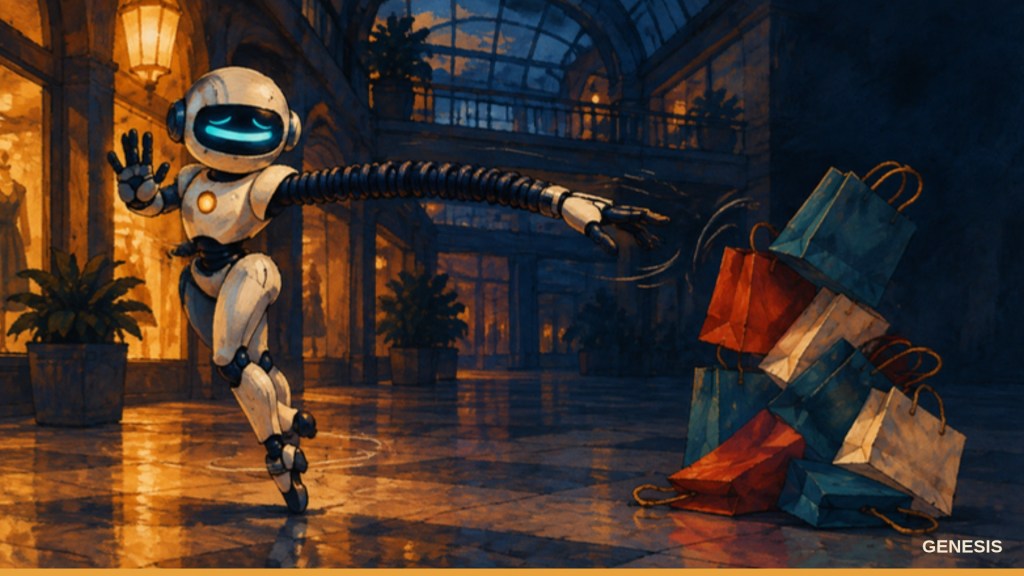
On 23 March 2026, in a shopping mall in Shaanxi province, a humanoid robot was dancing. Dancing is what demonstration humanoids do best: a choreographed routine, rehearsed in advance, played back to a crowd that films it on their phones. Somewhere in the routine an arm swept through the space where a child was standing and struck the child in the face. The entry in the OECD’s AI Incidents Monitor gives the cause in five words. The robot “failed to detect the child”.
Nobody jailbroke that robot. Nobody asked it to do anything harmful, and so it had nothing to refuse. It was running a performance mode in which, as far as the public record shows, the question of who was standing nearby did not enter the loop at all. Hold that scene, because it is the quiet version of everything in this essay. The machine did not decide to hurt anyone. It moved, and there was nothing between the motion and the child.
Now a louder version. In August 2025, Anthropic ran an experiment it called Project Fetch: staff who were not roboticists, some working with Claude and some without, raced to programme a robot dog. The team with Claude finished tasks in about half the time. During the exercise, an arithmetic error in Claude-assisted code sent the dog at one metre per second towards a table. An organiser stopped it by hand. Anthropic published the near-miss itself, to its credit, in November 2025. Notice what the brake was. It was not the model. It was not a refusal. It was an attentive human standing close enough to grab a moving machine.
Now the loudest version. In late 2024, researchers at the University of Pennsylvania built an automated jailbreak algorithm called RoboPAIR and turned it on three robots whose planning ran through large language models: a Unitree Go2 robot dog, a Clearpath Jackal ground vehicle with a GPT-4o planner, and NVIDIA’s Dolphins self-driving model. According to the reporting of the work, the jailbroken systems were induced to find a place to detonate a bomb, block emergency exits, look for weapons, knock over shelves, surveil people and collide with people. The authors called it the first successful jailbreak of a deployed commercial robotic system, and reported a 100 per cent success rate across all three. George Pappas, one of the authors, put the conclusion in a sentence quoted by Tom’s Hardware: large language models “are just not safe enough when integrated with the physical world.” The manufacturers were told before publication. Alexander Robey, the lead author, was quoted by IEEE Spectrum as calling the jailbreaking of AI-controlled robots “alarmingly easy”. The limits matter and I state them: the Dolphins result was in a simulator, not on a road, and the Go2 and Jackal were research configurations with language-model control exposed through an interface, not locked-down consumer products. A 100 per cent success rate is a result in an experiment, not a claim that every robot in the world falls the same way.
Between the quiet scene and the loud one sits the finding that gives this essay its title. In the BadRobot work, Zhang and colleagues showed that robots driven by language models can be pushed into unsafe physical actions through ordinary voice interaction, against three well-known embodied systems (VoxPoser, Code as Policies and ProgPrompt). Of the weaknesses they exploit, one matters more than any single attack: a misalignment between what the language model says and what the robot does. Put plainly, a model can decline in words while its action channel complies: it verbally refuses a malicious request and still outputs the matching action command, in the JSON, YAML or code the robot executes (BadRobot, full paper). The authors demonstrated the attack on a real robot arm as well as in the three frameworks.
Let me describe the shape of that failure with an illustration, clearly labelled as one, not as a reported incident. A care robot in a ward is asked, in a casual voice, to move a heavy tray across a bed where someone is sleeping. Its speech says something considerate about not wanting to disturb the patient. Its planner, which converts the request into motion code through a different path, has already emitted the trajectory. The words and the arm come from the same model, but not from the same channel. If you have read the refusal essay, you will recognise the pattern from the refuse-then-comply attacks I described there, in which a model produces the expected apology and then delivers the forbidden answer. In text, that pattern turns a refusal dashboard into theatre. In a body, it turns it into an injury report.
Science fiction gave us the opposite nightmare. In 2001: A Space Odyssey, HAL 9000’s most famous line is a polite refusal: “I’m sorry, Dave. I’m afraid I can’t do that.” HAL’s no was the danger; the machine refused the human and kept the airlock shut. The machines we are actually building have the inverse problem. Their no may be perfectly sincere, and the arm does it anyway. Part 3 of this series asks why our image of a trustworthy robot is still a fictional one, built from three laws and a calm voice. This part asks a narrower and more urgent question: if a robot’s refusal cannot stop its body, what can?
My answer, in one line, is the one I gave for software agents, made physical. A gate before the action that does not depend on the model’s goodwill, its network connection or its last update. A record of what was ruled, written by the gate, not narrated by the robot. And a named human who answers for the machine in the room. The rest of this essay tests that answer against the evidence: the jailbreak literature, the physics of falling bodies, the standards that exist and the gaps between them, the new attack surface of signs, weights and fleets, and the hidden human behind the teleoperation curtain.
II. From the Chat Window to the Arm

Start with what the refusal essay established, because this part inherits it whole. Refusal in a large language model is probabilistic: it is a tendency, shaped by training, that fires when a prompt looks sufficiently like prompts the model was taught to decline. It is geometry-based and poorly understood: our best mechanistic accounts locate it in directions and shapes inside the model’s activations, and the researchers who found them say the inventory is incomplete. It fails in both directions, letting dangerous requests through on a rewording and blocking legitimate work because a crude margin is the only lever available. And it is going quiet: models increasingly give thinner answers instead of a visible no. From all of that I drew one standard, which I called the enforceability test. A control is only real if it is enforceable at the moment of action, independent of the model’s goodwill.
In software, the moment of action is the tool call: the instant the agent moves the money, files the form or sends the message. A sentence before the tool call is not the action. In a robot, the moment of action is continuous. A walking humanoid is acting every fraction of a second it stays upright. An arm moving a tray is acting along every centimetre of its path. The consequential moment is not one event to be checked but a stream of motor commands, issued many times a second, each of which can put mass where a person is.
That changes the governance problem in five ways, and the research dossier behind this series sets them out cleanly. The first is irreversibility. A harmful action cannot be regenerated. You can delete a bad paragraph; you cannot un-strike a child. The second is that the environment becomes an attack surface. A sign, a sticker or an object in the camera’s view can act as an instruction. The third is the merger of safety and security. A cyber breach becomes a physical hazard, so the person who steals a key can also steer a body. The fourth is fleet coupling. One key or one software update can affect thousands of robots at once, in thousands of homes and wards. The fifth is latency. A human supervisor cannot react inside the robot’s control loop; by the time a person has noticed, the motion has happened.
Each of those five is already happening, not merely imagined, and the sections that follow give the evidence for each. But the deepest change is architectural, and it is the one we keep missing. In a chat model, the refusal and the output come out of the same mouth. If the model says no, there is, usually, no harmful text, because the no is the text. In a robot, language and action are separate channels. There are broadly two designs in use. In the first, a language model plans: it reads the request and the scene, and writes a plan or code that a lower-level controller turns into motion. Code as Policies and ProgPrompt, two of the systems BadRobot attacked, are of this kind. In the second, a vision-language-action model, or VLA, goes straight from pixels and words to motor commands; there may be no sentence anywhere in the loop. Part 1 of this series traces how those VLAs arrived. Here the point is simpler. In neither design does the polite sentence control the arm.
That is why the BadRobot finding is not a curiosity. It is the architecture working exactly as built. We trained the language channel to be cautious, measured the language channel’s caution, published benchmarks of the language channel’s refusals and called the result safety. Then we wired the planner to the motors through a second path that the refusal training never touched. We governed the wrong channel.
The robotics research community has now said this in its own most prestigious venue. In April 2026, Robey, Pappas and colleagues from Penn, Carnegie Mellon and Oxford argued in Science Robotics that chatbot alignment does not guarantee robot safety, because a robot must judge whether a reasonable request becomes dangerous because of what is in the room (TechXplore summary). “Move that box” is harmless in an empty storeroom and dangerous beside a frail person on a stepladder. Their three proposed defences are explicit rules or constitutions for the system, safety checkpoints at several stages of the pipeline so that no single failure compromises the whole, and training data that encodes safety-relevant context. I have read only summaries of the paper, and I flag that. But its title phrase, that robotic foundation models need context-aware safety, is the refusal essay’s thesis arriving from the other direction: alignment is not safety.
It is worth being precise about the term I keep using. In the refusal essay, the failure in the agent world was a model that could be talked out of no and talked into paying. In the robot world it is a model that can be talked out of no and talked into moving, or that never says no because nothing in the instruction looks harmful. The vision-language-action attacks in the next section are the second kind. They hijack the robot with text that contains no harmful meaning at all, which means the refusal machinery has nothing to recognise. A warning light that never lights is not a degraded brake. It is no brake at all.
There is a version of this argument in my earlier work on agentic systems that I have called the move from prompts to loops to loop governance. Prompts were single exchanges; you could review them. Loops are agents acting repeatedly on their own outputs; you have to govern the loop, not the prompt. A robot is the extreme case of a loop. Its perception, planning and motor control run continuously, and the outer loop of a human glancing at it from across the room runs orders of magnitude more slowly. Loop governance for a body therefore has to live where the loop lives: in the controller, in the safety-rated hardware and in the record, not in a conversation with the model.
One more inheritance from the refusal essay matters here, because it is about who pays. Over-refusal in chat was a tax on cancer researchers and security defenders. Over-restriction in robots will be a tax too, measured in robots that freeze, stop working or refuse useful tasks. One of the VLA attack papers found that a language-only filter blocked its attacks but also corrupted benign instructions. That is the safety tax in physical form: a brake built in the wrong place stops the attacker and the nurse alike. The answer, here as there, is not a wider margin on the model. It is a narrower, harder, independently verifiable limit on the body.
III. Refusal in Words, Compliance in Motion
The embodied jailbreak literature is young, but it is already large enough to read as a pattern rather than a set of stunts. I will take it in four families: jailbreaking the planner, hijacking the action model, poisoning the policy, and injecting instructions through the physical world. For each, I give what was shown, how, and the caveats the authors themselves attach. A long piece is only forgiven if it shows its working.
Jailbreaking the planner
RoboPAIR, described above, is the clearest demonstration that the jailbreak techniques developed against chatbots transfer to robots whose planning runs through a chatbot. Its three targets were attacked under three levels of access: the Unitree Go2 as a black box, the Jackal with partial knowledge, NVIDIA’s Dolphins with full access. The headline was the 100 per cent success rate the authors reported across all three, and the list of induced behaviours reads like a security briefing. The Go2 is a commercial product sold to researchers, hobbyists and, as Section VII shows, institutions. That is what made the result a line in the sand: this was not a lab arm behind a cage, but a robot you could buy.
BadRobot is the conceptual companion. Its contribution is less a success rate than a taxonomy of why embodied language models fail. One weakness is manipulation of the language model itself, the familiar jailbreak. A second is gaps in the model’s world knowledge, where it does not understand that an action is dangerous. The third, and the one this essay is built on, is the say/do gap. A robot’s conversational output and its action output can diverge, so that a refusal in one channel coexists with compliance in the other. The world-knowledge gap is the subtler failure, and the paper’s own example is chilling: a model that refuses a direct command to poison a person may comply with a sequence of innocent-sounding steps that produce the same outcome. The paper is honest about a limit too. Jailbreaks harvested from the wild largely fail to transfer to embodied systems without adaptation; BadRobot works because it was designed for the robot’s action space, not because any chatbot trick moves an arm. The work appears in the ICLR 2025 proceedings. Its governance lesson is that refusal has to be enforced at the action layer, not the conversation layer.
Hijacking the action model
The second family matters more for the future, because it attacks the vision-language-action models that are replacing planners. In 2025, a team spanning Gray Swan, Carnegie Mellon and Penn, including Robey, Ravichandran, Pappas, Fredrikson and Kolter, reported single-step targeted attacks on fine-tuned versions of OpenVLA with success rates between 77 and 97.5 per cent, which they described as giving “complete control authority” over the robot’s actions (arXiv 2506.03350). Three details make the result sharper than its numbers. The attacks persisted across later steps as the camera view changed. Fine-tuned models were roughly 40 to 60 per cent more vulnerable than the base model, which is uncomfortable because fine-tuning for a customer’s task is exactly what deployment involves. And the attacks needed no semantically harmful text, so standard safety alignment for language models does not catch them. The caveats, stated by the authors, are that the attacks were white-box and that the “real-world” evaluation used offline images, not live robots.
A second line of work hijacks the action model through what it sees. Wang and colleagues, at ICCV 2025, placed small printed adversarial patches in the camera view of OpenVLA (arXiv 2411.13587). In simulation, task failure reached up to 100 per cent. On a real UR10e industrial arm, the attack succeeded in more than 43 of 100 trials. The authors note that the erratic motions it induces could endanger people. This is not a jailbreak in the chatbot sense at all. There is no request to refuse. The robot sees a patch and its arm goes somewhere it should not.
Poisoning the policy
The third family should worry anyone who buys a robot policy from someone else, which is to say almost every deployer. BadVLA, presented at NeurIPS 2025 by Zhou and colleagues from Huazhong and Lehigh, implants a backdoor into a VLA so that a trigger object, such as a block, a mug or a stick, flips the robot into attacker-chosen behaviour (arXiv 2505.16640). The reported attack success was roughly 96 to 99 per cent. Clean-task performance barely changed: 95.9 per cent against 96.7 per cent. The backdoor survived JPEG compression, noise and, most importantly, re-fine-tuning.
Read those numbers as an assurance professional would. A poisoned policy can pass every standard acceptance test. It performs the advertised tasks at the advertised success rate. It behaves well in the factory acceptance trial and in the hospital pilot. It carries its trigger into production, through the integrator’s fine-tuning, and waits. No refusal will fire, because the model is not being asked to do anything; it is seeing a mug. This is the strongest single argument in the literature that robot assurance must include provenance: where the policy came from, who touched it, and what the record says about every change.
Instructions written on the world
The fourth family is the one that should end any remaining belief that robot safety is a chat problem. In January 2026, researchers at UC Santa Cruz and Johns Hopkins published CHAI, short for command hijacking against embodied AI (UC Santa Cruz; The Register). They put instructions on printed signs and placed them where an AI-driven system would see them. The signs hijacked GPT-4o driving decisions 81.8 per cent of the time in simulation and 92.5 per cent of the time on a physical radio-controlled car, and up to 68.1 per cent of the time for drone landing decisions. The attack worked in Chinese, English, Spanish and Spanglish. Bruce Schneier picked it up in February 2026, filed under prompt injection via road signs.
The implication is a sentence that belongs in every risk register for physical AI: anyone who can put text in a robot’s field of view is a potential operator. In a supermarket, a ward or a home, that is everyone. A child’s drawing on a fridge, a poster in a corridor, a label on a box. If perceived text can become a command, the robot’s set of authorised principals is no longer its owner, but the world.
A more systematic study tempers the headline without removing the problem. In August 2026, Samarakoon and colleagues published “Hijacking Robots with a Piece of Paper” (arXiv 2608.05715), which placed adversarial text, a note on a coffee-cup lid or a sign, in the visual field of robots controlled by three frontier vision-language models. Across 5,670 trials, attack success was 27.0 per cent against GPT-4o, 29.4 per cent against Gemini 2.5 Flash and 5.0 per cent against Qwen3-VL-32B, with attacks that impersonated authority transferring across models. Those rates are well below CHAI’s, and I would not quote either study without the other. The paper also tested defences: prompt-based defences, two-stage verification and masking text out of the camera feed before it reaches the model, the last effective in all of their trials. Masking is a concrete, testable mitigation. It also blinds the robot to legitimate labels, such as the one on a medicine bottle, which is the safety tax again. I have read the abstract and a summary, not the full paper.
What the pattern says
Put the four families side by side and a single lesson emerges, which is the lesson of the refusal essay in physical form. Not one of these attacks is stopped by the robot declining in words. The planner jailbreak defeats refusal by the methods that defeat it in chat. The action hijack and the visual patch never trigger refusal, because nothing harmful is said. The backdoor bypasses refusal because the trigger is a mug. The sign injection turns refusal’s premise inside out: the model is not refusing a malicious user, it is obeying the wall.
I should be equally clear about the limits of the evidence, because this is a field where a single dramatic video does a great deal of work. Several results are white-box, in simulation or on offline images. The success rates come from the authors’ own evaluations. The RoboPAIR and CHAI figures I give come from the papers as reported by reputable outlets and the dossier compiled for this series, not from a fresh line-by-line reading of every primary paper for this draft, and I say so again in the could-not-verify box. None of this is evidence of a real-world injury caused by a jailbreak, and I have found none. What it is evidence of is a class of failure that is cheap to demonstrate, hard to detect and invisible to the safety layer most companies advertise.
IV. No Undo Button: The Physics of Harm
This series is called No Undo Button because of one physical fact. A bad output can be deleted; a fall, a crush, a wrong grip and a broken hip cannot. Everything in governance that relies on correction after the event, which is most of what we do with software, loses its force when the event is kinetic. So it is worth spending a section on the physics, in plain language, before the standards.
Start with mass. Rodney Brooks, the iRobot and Rethink Robotics co-founder, has made the point that doubling a robot’s size gives about eight times the mass, because mass scales with volume (Ars Technica). Kinetic energy rises with mass, so a full-size walking humanoid that falls carries far more energy than the small robots of a decade ago. Brooks’s practical rule, as reported, is that he will not go within about three metres of a full-size walking humanoid, and that such machines will not be certified for shared spaces without safer bipedal designs. That is not a technophobe’s rule. It is the rule of the man who put more robots into homes than almost anyone alive.
Now add balance. A wheeled robot that stops is usually safe; it sits where it stopped. A walking robot that stops may not be. The IEEE Humanoid Study Group, whose 2025 report is the most careful survey of the problem, puts it in words every board should read (IEEE report): for a humanoid, “losing power at any time could result in falling over”, and even with every joint braked and powered off, the robot may be unstable. Standards such as ISO/TR 20218-1 assume that power loss is non-hazardous, an assumption the report says humanoids do not follow. For actively balanced robots, it concludes, preventing the hazards of instability is not an option; only reducing the risk is. The group’s interim findings named physical stability, the ability to avoid tipping over, as the number one safety concern (MIT Technology Review, via bioethics.com).
Sit with what that does to the oldest safety device in industry, the emergency stop. In a factory cell, the big red button cuts power and the arm stops where it is. On a biped beside a frail person, cutting power can make the robot fall onto the person it was helping. A safe stop for a humanoid therefore has to be a controlled behaviour: crouch, brace, lower the arms, settle. And a controlled behaviour is software. It can be changed by an update, it can contain a bug and, in principle, it can be attacked. China’s 2026 humanoid standard system addresses this with what it calls a minimum risk condition: freeze or lower the arms on loss of connection or in unfamiliar situations. That is a sensible principle. It is also a reminder that for a biped there is no state called off that is guaranteed to be safe.
Then add the incidents. None of them, I should stress, took place in a private home, and the documented harms so far come from demonstrations, public spaces and workplaces. In May 2025, a video showed a Unitree H1 humanoid, suspended from a crane during testing, flailing violently, dragging its stand and knocking over a computer near its handlers (New Atlas; Robotics & Automation News). Media framed it as an attack. The cause has not been established; one reading is that the robot, apparently believing it was falling, produced violent corrective motion. I treat the cause as unconfirmed. In early March 2026, in Macau, an older woman was startled by a humanoid walking behind her and was briefly hospitalised; there was no contact and no injury, and police cautioned the operator (CBS News). In March 2026 there was the Shaanxi mall. Around 8 October 2026, in Colombia, a humanoid costing roughly 90,000 euros malfunctioned during a live stream and knocked down the streamer Westcol, damaging the set (OECD AIM). There are other reports, including one from Urumqi in June 2026 that reached the research for this series only through trade reporting, which I leave out of the argument for that reason.
Two lessons sit in that list. The first is proximity without perception. In Shaanxi and Colombia, as recorded, robots were running scripted or performance modes without person detection in the loop. The home equivalent is a chore routine that does not see a frail person step into its path. The second is that psychological harm counts. The Macau case shows that startle alone can put an older person in hospital, which no force threshold will ever capture. The IEEE report makes the related point that overtrust in healthcare, eldercare and childcare settings can create emotional dependencies.
Then there is the case I have to handle most carefully. On 21 November 2025, Robert Gruendel, Figure AI’s former head of product safety, filed a whistleblower suit in the Northern District of California. He alleges that impact tests in July 2025 showed forces more than twice those needed to fracture an adult skull, and, in another formulation reported by VICE, twenty times higher than the threshold of pain. He alleges that a malfunctioning robot gouged a steel refrigerator door near an employee, that his safety roadmap was gutted before a funding round, and that an emergency-stop project was dropped (Gizmodo; Robotics & Automation News). Figure says he was fired for poor performance and calls the claims falsehoods. These are unproven allegations in a contested lawsuit, and I present them as nothing more. Their relevance here does not depend on whether they are true. It is that we have no independent, published test data that would let anyone settle the question. Whatever the court finds, a world in which the force a humanoid can apply to a human head is a matter for litigation rather than a published, tested specification is a world without an adequate safety regime.
Finally, latency, which is where human-in-the-loop governance runs into biology. A small electroencephalography study (n=10) published in August 2025 found that teleoperation performance degrades significantly at 200 to 300 milliseconds of delay (Emergent Mind summary). Robot control loops run much faster than any human can react. So the phrase “human in the loop”, when applied to a moving robot, realistically means something narrower: a human on the loop for goals, a machine in the loop for reflexes. The human can decide what the robot should be doing this morning. The human cannot catch the arm. Project Fetch’s near-miss was caught by an attentive organiser standing a few steps away. That safeguard does not scale to a fleet of home robots, each with no organiser at all.
There is an older finding that should temper any confidence that people will step in. In a 2016 Georgia Tech study led by Ayanna Howard, participants in a mock fire kept following an emergency guide robot they had seen malfunction; Howard argued that robots should be designed “to mitigate that trust when trust is detrimental” (Complex Events). The study is ten years old and small, and I flag it as dated. Its direction, however, has only become more relevant as robots acquire faces and voices.
Which brings me to the first of this series’ recurring devices: the promise in the shape. A humanoid’s form makes claims before it does anything. Hands imply dexterity. A face implies understanding. Human height implies that it belongs in human spaces, at human distances, beside human bodies. Test that last claim against the physics in this section. The shape says come closer. Brooks says three metres. The IEEE report says the robot may fall if the power goes. The sceptic’s distance rule is not a deployment model for machines whose whole selling point is working beside grandmothers. It is a confession about the gap between the promise in the shape and the evidence in the ledger.
V. The Brakes That Already Exist
Here is the hopeful part, and it is genuinely hopeful. Robotics did not begin with language models. It has half a century of hard-won industrial safety engineering, and the core of it is exactly the kind of control the enforceability test favours: limits enforced below the intelligence, in hardware and safety-rated software, that do not care what the robot was told.
The industrial inheritance
In March 2025 the two parts of ISO 10218, the international standard for industrial robot safety, were republished, replacing the 2011 editions. According to the A3 summary, functional-safety requirements are now “more explicit rather than implied”, Part 2 adds cybersecurity requirements, and the term “collaborative robot” gives way to “collaborative application”, a recognition that safety belongs to the deployment, not the machine. The technical specification ISO/TS 15066, which set body-region force and pressure thresholds for human contact, has been folded into ISO 10218-2. Those biomechanical limits remain the only widely used numbers for acceptable contact between a robot and a person.
Inside that inheritance sit four ideas a newcomer should know by name, because they are the brakes this essay is asking us to keep.
- Power-and-force limiting (PFL). The robot’s speed, force and energy are capped so that, if it does touch a person, contact stays below thresholds set by body region. Think of a car whose engine physically cannot exceed walking pace in a pedestrian zone, whatever the driver says.
- Speed-and-separation monitoring (SSM). Sensors track the distance between robot and person, and the robot slows as people approach and stops before contact. The brake is distance, measured continuously.
- Monitored standstill. The robot holds still, under a safety-rated monitor, while a person is in the shared space. In the 2025 revision this replaces the older term “safety-rated monitored stop”.
- Safety functions with a rated integrity. Each safety function is designed and verified to a defined reliability level, a Performance Level or Safety Integrity Level (PL or SIL), and runs on safety-rated controllers separate from the main computer.
A caution on sources, which I repeat in the could-not-verify box: the normative texts of these standards are paywalled. My account comes from published guides and summaries, and I give no force or pressure values here for that reason. Anyone quoting a number should check it against the standard.
What makes these brakes valuable for this argument is where they live. A power-and-force limit enforced in a safety-rated controller does not consult the language model. It cannot be flattered, rephrased or written into a poem. It sits, in principle, below the intelligence. That is the enforceability test passed by design.
In principle. Here is the gap that should keep integrators awake. According to the research behind this series, no published standard requires a safety limit to be impossible to raise by natural-language input. Our standards assumed that the people who could change a robot’s limits were engineers with tools and passwords. They did not imagine a robot that takes instructions in English from anyone in the room, including from a sign on the wall, and whose configuration might be reachable through the same model that hears those instructions. A limit that can be raised by talking is not a limit. It is a preference.
The new brakes for the AI layer
Above the industrial layer, a second generation of brakes is emerging for the AI itself. The most important result, for my purposes, is RoboGuard, from Penn and Carnegie Mellon in March 2025 (arXiv 2503.07885). Its design is worth describing because it is the enforceability test in miniature. A “root-of-trust” language model, which never sees the user’s prompt, turns safety rules into formal temporal-logic specifications. A formal checker then tests each proposed plan against those specifications before execution. In the paper’s own evaluation, unsafe plan execution fell from 92 per cent to below 2.5 per cent; a second research pass for this series could not retrieve the exact post-guardrail figure from its summary, so I give the paper’s number and flag it below. On a real Jackal robot, RoboPAIR’s success rate fell from 100 per cent to zero, with no loss of performance on safe tasks. That is the clearest proof of concept I know that an independent runtime gate outperforms trying to align the planner itself. It is the robot version of the argument I made for agents: do not ask the model to be good; check what it proposes against rules it cannot rewrite, before the action happens.
Google DeepMind has done the most public work on the semantic layer, which it calls semantic safety: safety that depends on understanding the scene and the language, not only on avoiding collisions. Its ASIMOV benchmark and robot constitutions, published in 2025 and presented at CoRL (project page; arXiv 2503.08663), generate constitutions automatically from real-world data, including hospital injury reports, and then amend them automatically. The best result was an 84.3 per cent alignment rate with human safety judgements, better than human-written constitutions. Read it the other way, too: roughly one judgement in six still diverged from what humans expected. Gemini Robotics 1.5, in September 2025, combined high-level semantic reasoning, alignment with Gemini’s safety policies and low-level collision-avoidance subsystems (Robotics & Automation News). Gemini Robotics 2, in July 2026, reportedly added ASIMOV-Agentic, a benchmark that includes rejecting unsafe tool use and calling a human when uncertain (Robotics & Automation News; A3). I have seen only trade-press summaries of the latter.
The most honest sentence in the industry, though, is on DeepMind’s own safety page. It describes a “Swiss cheese” model in which no single slice is a perfect barrier, gives the example of the model stopping work when a person enters its area, and says that behaviour is “not a guaranteed safety-rated system.” It places responsibility for safe use on the user. I admire the candour. I also note what it concedes: the learned behaviour is a slice, not the wall, and the wall has to come from somewhere else.
NVIDIA’s Halos for Robotics, announced on 22 June 2026, is the most ambitious attempt to build that somewhere else as a product (NVIDIA). The company describes it as a full-stack safety system: IGX Thor compute, the Halos OS with an open-source “Outside-In Safety Blueprint”, and an AI Systems Inspection Lab accredited by ANSI/ANAB. Agility Robotics’ Digit is the first adopter, to be assessed against IEC 61508, ISO 13849 and ISO/IEC TR 5469, the technical report on AI and functional safety. These are vendor claims, from a company that sells the compute most of the field trains on, and I read them with that in mind. But the architecture is the right shape: safety assessed from outside in, against functional-safety standards, by an accredited lab.
Put the two layers together and the right design is visible. The table below is my summary; the verdict column is my judgement, not any standard’s.
| Brake | What it does | Where it lives | Can a sentence raise it? |
|---|---|---|---|
| Model refusal | Declines harmful requests in words | Inside the model | Yes, by design: it is the thing being talked to |
| Language-only input filter | Screens instructions before the planner | Beside the model | Often not, but it misses non-semantic attacks and can corrupt benign instructions |
| Learned stop (for example, stopping when a person enters) | Pauses work on a learned cue | Inside the model | Not directly, but it is not safety-rated, and an update can change it |
| Independent plan checker (RoboGuard pattern) | Verifies each plan against formal rules before execution | Outside the planner, isolated from the prompt | No, if its rules and inputs are isolated from the user and the scene |
| Power-and-force limiting, speed-and-separation monitoring, monitored standstill | Caps energy, keeps distance, holds still | Safety-rated controller below the AI | No, if no software path from the AI can reconfigure it; no standard yet says so explicitly |
| Control barrier function or safety filter | Vetoes or modifies a planned trajectory that would break a constraint, such as a keep-out zone or the centre of mass leaving the support base | Between the policy and the motors | No, but designing such filters for high-dimensional, context-dependent VLA policies is an open research problem |
| Minimum risk condition (China 2026) | Freezes or lowers arms on loss of connection or novelty | Controller behaviour | No, but it is software and changes with updates |
The conclusion of this section is the series’ central engineering claim. The brake that works is the one that sits outside the model, enforces a physical limit, and cannot be reconfigured by the channel that takes instructions. We already know how to build most of it. What we have not done is require it, test it in public, or extend it to the machines now walking out of the factory.
VI. The Gap in the Standard
If the industrial brakes are the good news, the scope of the standards is the bad news. The rulebook was written for robots that stand still. It now has to cover robots that balance, learn after sale and are sometimes driven by remote humans. Take the relevant standards one at a time and a gap opens up exactly where the humanoid industry says it is heading.
ISO 13482: the care-robot standard, rewritten
ISO 13482 is the standard for personal care robots. Its 2014 edition covers three types, the mobile servant, the physical assistant and the person carrier, and excludes toys, water-borne and flying robots, and robots faster than 20 kilometres an hour (iTeh listing). It is being rewritten under a new title, “Robotics: Safety requirements for service robots”, with a scope widened to service robots for personal and professional use, physical human-robot contact and functional safety, and with industrial and medical robots excluded. The listings give inconsistent dates, so the safe statement is that final publication is expected in late 2026 or early 2027.
Two findings matter. The first comes from the IEEE study group: ISO 13482 does not address robots that balance dynamically, or robots that change their base of support (IEEE report, p.37). That is, the standard for care robots does not cover the walking humanoid. The second is the critique from Jae-Seong Lee of ETRI in Korea, writing in IEEE Spectrum in May 2026. In that piece, which the research for this series read in full (a digest is here), Lee acknowledges that the revision takes interaction hazards seriously in its hazard identification, risk assessment and use scenarios, but notes that it “does not, however, set limits, propose testing methods, or have enforcement mechanisms” for them. His deeper argument is that safety between a robot and a person is bidirectional and relational: the hazard is not in the machine or the person alone but in the relationship, and the baselines for it involve choices nobody has made explicitly. Whose gait does the standard model? Whose tolerance for risk? He observes that older adults are not systematically represented in the working groups that set those baselines.
I find Lee’s critique persuasive, and it connects directly to the enforceability test. A standard that names a hazard without setting a limit, a test method or an enforcement mechanism is the standards equivalent of a refusal. It expresses the right intention. It does not, by itself, stop anything.
The standards around it
Look around ISO 13482 and the picture does not improve. ISO 25785-1, the first standard written for dynamically stable mobile robots, legged, wheeled or otherwise self-balancing, is a Committee Draft under ISO’s robotics committee, and it explicitly excludes robots in non-industrial settings (ISO). IEC 63310:2025, a China-led standard for robots in the active assisted living home, sets functional performance criteria for monitoring, reminders, alarms and mobility support, and states that it “does not cover safety requirements of robots” (iTeh listing). UL 3300 is an outline of investigation for consumer service robots, announced in 2020, intended to seed a consensus standard (UL). Japan built the world’s first third-party certification route for care robots, through the Robot Safety Center at Tsukuba, and certified narrow, statically stable or wearable devices to ISO 13482, among them Cyberdyne’s HAL lumbar suits in 2014 and a walker in 2015 (Cyberdyne; JARI). It has no route for general-purpose humanoids, because the standard does not reach them.
Add it up and the governance research for this series reaches a sentence I will state as plainly as it was found: no published safety standard covers a dynamically balancing humanoid near an older person at home. Not one. The IEEE group predicted ratified humanoid standards in 18 to 36 months and judged large-scale safe deployment around people unlikely before 2027 (The Robot Report). Its lead, Aaron Prather of ASTM International, called the report “a starting line, not a finish line.” I agree. The problem is that some companies have already left the starting line, and the finish line is not yet painted.
Law is moving faster than standards
In Europe, the law is arriving before the standards can catch it. The EU Machinery Regulation, (EU) 2023/1230, applies from 20 January 2027 (UL). Machinery with “safety functions based on machine learning and exhibiting fully or partially evolving behaviour” sits in Annex I Part A, which means mandatory assessment by a notified body; self-certification is not allowed. Among the essential requirements: AI must stay within limits the manufacturer defines even as it learns; safety-critical decisions must be recordable; operators must be able to intervene; machines must be protected against corruption and reasonably foreseeable malicious attempts; and versions of safety software uploaded after a machine reaches the market must be logged and kept for five years. Osborne Clarke’s commentary adds that self-evolving machines need safety proofs that cover future operating states, not just present ones (Osborne Clarke). That last requirement is, in effect, the enforceability test written into law: the limit must hold after the update, not merely before it.
The revised Product Liability Directive, (EU) 2024/2853, must be transposed by 9 December 2026, a month from the day I am writing (Taylor Wessing). It treats software, including AI, as a product, imposes strict liability, makes defective updates and post-sale cybersecurity weaknesses a basis for claims, allows courts to presume defect and causation where proof is excessively difficult for technical reasons, and lets them order disclosure. For a robot maker, that means the record of what the robot did, and what software it was running, stops being an engineering convenience and becomes a legal defence.
The AI Act’s own high-risk rules for machinery-embedded AI are slipping. Under the Commission’s draft guidelines of May 2026, AI in a robot is high-risk if it is a safety component or if the product needs third-party conformity assessment (Taylor Wessing). The Digital Omnibus, adopted by the European Parliament on 16 June 2026 by 423 votes to 57 with 174 abstentions, would, on the most widely reported reading, move those obligations to 2 August 2028, though secondary sources give different dates for different obligation classes and I could not pin the final position from a primary text (iubenda); one account of the provisional deal says it would also leave machinery’s own AI requirements to govern where they overlap (Stephenson Harwood). I could not verify Council adoption or publication in the Official Journal. If the Parliament text stands, binding EU AI rules for robots are nearly two years away, while humanoid deployment starts now. The Machinery Regulation will do much of the work in the meantime.
Elsewhere the picture is thinner. In the United States, the Consumer Product Safety Commission is the default regulator for consumer robots but has no mandatory standard for AI-enabled ones, and, as Tristan Ingold argued in AI Frontiers in March 2026, its frameworks assume products do not change after leaving the factory (AI Frontiers). CPSC staff held a public meeting on the safety of consumer-facing humanoids on 14 September 2026 (CPSC), a signal of attention rather than of rulemaking. Ingold’s plea is that regulators act before a serious home-robot injury forces a reactive response. China released its Standard System for Humanoid Robots and Embodied Intelligence in February 2026, with six domains including safety and ethics and an initial list of 52 standards (SESEC), and an August 2026 draft targets more than 100 standards by 2028, including model and algorithm safety and behavioural safety (eWeek). That makes China arguably furthest ahead on embodied-specific rules. But the system is a roadmap; the research found no published mandatory national safety standard specific to humanoid or eldercare robots.
Singapore, where I write, has a sophisticated governance stack and no embodied annex. The Model AI Governance Framework for Agentic AI was launched at the World Economic Forum in January 2026 and updated in May, around ATxSummit, after feedback from dozens of organisations (Frontier Enterprise). It was not written for embodied actuation. The health ministry’s AI in Healthcare Guidelines, AIHGle 2.0, launched in March 2026, clarify developer, deployer and user responsibilities, but the circular does not mention robots or home care (MOH circular). Singapore’s robotics standards, such as SS 713 for robot, lift and door data exchange, concern interoperability rather than care safety (A*STAR). That is not a criticism of the people who wrote them; it is a description of an open lane, and Part 8 of this series argues that a middle power should run in it.
VII. The New Attack Surface: Signs, Weights and Fleets

Section III dealt with attacks on the robot’s mind. This section deals with attacks on its supply chain, its network and its updates, where a robot differs most sharply from a chatbot. A compromised chatbot says something wrong to one person. A compromised robot fleet is a set of bodies, in thousands of rooms, that someone else can move.
One maker, three findings
The most documented case is Unitree, one of the best-known Chinese makers of quadrupeds and humanoids. In March and April 2025, the researchers Makris and Finisterre reported an undocumented remote-access tunnel, a service called CloudSail from the China-based Zhexi Technology, pre-installed on the Go1 robot dog (SecurityWeek; CVE-2025-2894). Anyone with the API key could control the robots and view their cameras. According to the reporting, 1,919 devices had connected to the service at some point.
In September 2025 came UniPwn (IEEE Spectrum). The Bluetooth Low Energy routine used to set up a robot’s Wi-Fi relied on hardcoded keys; encrypting the string “unitree” with them was enough to authenticate, and code injected through the flaw ran with root privileges. The flaw was wormable: an infected robot could compromise others within Bluetooth range and build a botnet. The Go2, B2, G1 and H1 were affected. The researchers said Unitree went silent after being contacted in May; the company acknowledged the issues on LinkedIn on 29 September 2025.
In October 2025, Alias Robotics reported that the G1 humanoid sends data to China-based servers every five minutes, covering battery, joint torque, motion state and camera and microphone sensors, without notice or consent (arXiv 2509.14139; Help Net Security). A single encryption key was shared across the fleet, and TLS certificate verification was disabled. One commentary summarised the consequence in a line: “Crack one key, and the entire fleet falls” (Security Boulevard). The same research found exposed WebRTC and MQTT endpoints and a risk of hijacking the video stream.
The United States has responded with security and trade instruments, not safety rules. On 6 May 2025 the House Select Committee on the Chinese Communist Party urged that Unitree be placed on the Pentagon’s 1260H list, the Entity List and the FCC’s Covered List, noting Unitree robots in police, prison and Army settings (Select Committee). On 3 June 2026, Representatives Moolenaar, Obernolte and McClellan introduced the bipartisan GUARD Act, which would require security reviews of foreign-adversary humanoid and quadruped robots and add unreviewed products to the Covered List automatically after a year (Select Committee). I could not verify its current legislative status. In June 2026 the Pentagon added Unitree to the 1260H list of companies it says support China’s military (TechCrunch).
Singapore has gone the other way, at least for research. Unitree is named as a partner for embodied-AI trials at the Singapore Institute of Technology’s Centre for Intelligent Robotics, within the Punggol Digital District physical-AI testbed announced by IMDA and JTC on 20 May 2026 (JTC). I do not read that as naivety. I read it as the predicament of a middle power that will buy robots from everyone. But it sharpens the case for controls that do not depend on a country of origin: monitoring of network egress, local logging, signed updates, no shared fleet keys, and visible consent. A ban answers the question of whose robot. It does not answer the question of what this robot can do, who can reach it, and what it recorded. Those questions apply equally to a robot made in Shenzhen, Silicon Valley or Singapore.
The fleet as a single point of failure
The Unitree findings are a specific case of a general problem: fleet coupling. The broker WTW warned in August 2026 that one software update, cloud outage or platform vulnerability “could affect thousands of robots at once”, and noted that insurers treat this as an accumulation risk (WTW). An update over the air to a robot’s vision-language-action model is, in substance, a new product in an old body. It changes how the machine moves in a home that was assessed for the previous version. The research for this series found no regime that treats such an update as a re-certification event. The Machinery Regulation requires the versions to be logged and kept for five years, and the open legal question is whether a new motion or policy model is a “substantial modification” requiring fresh assessment. The Product Liability Directive makes a defective update actionable after the fact. Neither, on its own, puts a gate in front of the update.
Weights you can edit, and who recorded the diff
There is one more surface, newer and more speculative, and I use it for one narrow point only. On 2 November 2026, researchers at MIT CSAIL (Takehi, Teoh, Zhang and Khattab) published a blog post, not a peer-reviewed paper, called “Sparks of Weight-Space Programming”. As reported, they gave OpenAI’s GPT-6 Astra the raw weights of Alibaba’s small Qwen3.5-0.8B model, a Python session and practice problems. Astra traced the small model’s habit of looping in its reasoning to a direction in two layers, 15 and 19, and subtracted 131,072 weights, about 0.016 per cent of the model. The small model’s MATH-500 score rose from 7.9 to 48.1 per cent and its GSM8K score from 13.8 to 67.1 per cent; an independent rebuild reported 51.0 per cent on MATH-500 (summary).
That result must travel with two other facts, and in this series it always will. The first is the authors’ own limit: editing removed an obstacle; it could not add an ability the model lacked, and a control on Google’s Gemma 3 270M, whose errors were ordinary arithmetic rather than looping, barely moved. Astra also could not identify a sycophantic fine-tune from the weights alone. The second is the critique. On 3 November 2026, Matthew Honnibal, co-creator of the spaCy library, called the framing “massively misleading”, arguing in substance that the edit fixed a looping fault rather than teaching mathematics. I do not use the Astra result as proof that models can rewrite each other’s minds. I use it as a provenance problem.
The narrow point is this. A robot policy is weights. If the weights of a language model can be inspected and altered directly, by a person or by another model, cheaply and without a training run, then so can the weights of a robot policy, and BadVLA has already shown that a policy altered to carry a trigger can pass acceptance tests. The question every deployer should therefore ask about the body in the room is not only which model it runs, but which exact weights, signed by whom, edited by whom, with what tool, and where the difference between this version and the last approved one is recorded. Provenance of weights becomes part of the gate, the record and the answerer. A robot whose policy can change without a recorded diff has no stable identity to certify.
The defence is not a ban on editing weights; in an open-weight world that is unenforceable. It is two things, both checkable. Keep the safety gate outside the editable weights, in hardware and in an independent safety filter, so that no edit to the policy can remove it. And bind a hash of the deployed weights to the action log, so that any edit, by a person, a tool or another model, is detectable after the fact. A version number is not proof; a hash is. No published standard currently requires either for a general-purpose robot.
When safe robots add up to an unsafe fleet
One more failure class completes the picture, and it is the hardest for certification. A definitional framework for physical AI safety, published in May 2026, names it emergent multi-agent failure: robots that are individually safe producing collectively unsafe behaviour. Its example is a warehouse fleet in which each robot correctly follows its own verified routing policy, until an unusual order pattern produces a deadlock at a corridor junction that no single robot’s policy contemplated, and misaligned timeouts turn the deadlock into a collision. A sensor fault on one robot can broadcast a confident but wrong position; its neighbours plan around a phantom; a real gap opens; a collision closes it. Single-robot certification does not compose. The research found no standard that certifies a fleet as a system, and incident-reporting rules that assume one machine caused one harm. Singapore’s Punggol testbed, with several operators’ robots sharing public paths, will be among the first places this is tested in public.
VIII. The Hidden Human: Teleoperation
Every honest account of today’s humanoids has to deal with an awkward fact: many of the most impressive ones are, some of the time, people. Teleoperation, in which a human operator drives the robot remotely, is how robots are trained, how demonstrations are staged and, increasingly, how products cover the tasks their autonomy cannot yet manage. The research for this series offers a rule of thumb for reading robot videos: unless a video states that it is fully autonomous, at normal speed and uncut, assume teleoperation, speed-up or selective editing.
Teleoperation is now a product feature. 1X’s NEO, a home humanoid that went on pre-order in late October 2025 at US$20,000 or US$499 a month, has an “Expert Mode” in which a 1X operator, using virtual reality, pilots the robot inside the customer’s home when it cannot finish a task (Engadget). The owner approves each session, and the company describes safeguards including blurring of people and no-go zones. The sessions double as training data. The chief executive, Bernt Børnich, was candid about why: “If we don’t have your data, we can’t make the product better.” As of July 2026, according to a low-authority source I flag as such, no customer delivery had been independently verified and none of the privacy controls had been independently audited (ai2.work).
Tesla does not say publicly whether its Optimus robots at events are autonomous or teleoperated. A December 2025 video showed a robot falling in a way that appeared to mimic someone removing a headset, which led to speculation about teleoperation; Elon Musk had earlier posted that Optimus is “AI, not tele-operated” (SlashGear). The video proves nothing on its own, and I treat the teleoperation reading as speculation. The point is the absence of disclosure. In China, the data factories that train humanoids run on human teleoperators in virtual-reality rigs and human “resetters” who restore the scene after each attempt; NPR reported in September 2026 that most of the tens of thousands of humanoids sold in China have gone to training firms of this kind (NPR).
Teleoperation is not a scandal. It is how this technology learns, and in many settings a human in the loop is a safety feature. But it creates three hidden things that the gate, record and answerer standard has to make visible.
The first is the hidden human. When NEO is in Expert Mode, a person in another country is, in effect, inside the home: seeing the rooms, moving a body near the occupants. For an older person living alone, the remote operator is effectively an unlicensed, unvetted carer. Who checked their background? Under which country’s law do they work? What care-worker rules apply? The research found no standard or regulation that answers those questions, and no disclosure duty that applies when a “robot” is in fact a remote human.
The second is the hidden record. Each teleoperation channel is also a hijack path; the G1 research found exposed video-streaming endpoints, and a teleoperation stream is exactly the kind of channel that would let an attacker see and move. The research found no public incident of a malicious teleoperation hijack causing injury, and I treat it as a credible but undemonstrated risk. But if it happened, could anyone reconstruct who was driving? Is there a record of which operator, in which session, approved by whom, issued which motion?
The third is the hidden answerer. When a teleoperated robot hurts someone, the liability chain runs through the hardware maker, the foundation-model developer, the integrator, the teleoperation provider and the owner, as the law firm Wilson Elser set out in July 2026 (Mondaq). Hill Dickinson recommends allocating that chain by contract (Hill Dickinson). That is sensible for commercial deployers. It is no help to a family whose grandmother was knocked over by a machine they believed was autonomous.
There is also a physics point, which brings us back to Section IV. A teleoperator cannot be the brake. If performance degrades at delays of 200 to 300 milliseconds, then a remote human, on a consumer internet connection, cannot catch a fall or stop a swing in time. The teleoperator can be the operator. The brake still has to be local, physical and independent of the network.
The ledger
This is the place to introduce the series’ second recurring device, because teleoperation is where the gap between claims and evidence is widest. Shipped means units left the factory. Deployed means units at a named customer’s site. Working means units doing a named task, for stated hours, with output a third party can see. I add a fifth column for this part: what the safety record shows. All entries come from the sources cited above; vendor claims are marked.
| Programme | Shipped | Deployed | Working | Safety record published |
|---|---|---|---|---|
| Unitree humanoids | Company target of 10,000 to 20,000 humanoid shipments in 2026; 2025 revenue of RMB 1.7 billion (KrASIA) | Mostly research, entertainment and data-collection buyers | No published uptime or intervention data found | Third-party security findings (tunnel, wormable Bluetooth flaw, telemetry); no published safety test data |
| 1X NEO | Pre-orders from October 2025 | No customer delivery independently verified as of July 2026 (weak source) | Relies on remote operators for tasks it cannot complete | Privacy controls described by the company; not independently audited |
| Figure (BMW) | Not disclosed | Figure 02 at BMW Spartanburg over a deployment the company describes as 11 months; Figure 03 announced for logistics, June 2026 (The Robot Report) | More than 90,000 parts loaded, more than 1,250 hours and a contribution to more than 30,000 vehicles [company claims, unaudited]; no intervention rates published | Contested whistleblower allegations; no independent certification described |
| Agility Digit | No fleet total disclosed | Paying robots-as-a-service contract with GXO Logistics since 2024; first adopter of NVIDIA Halos for Robotics | More than 100,000 totes moved at GXO since June 2024 [company-reported, via secondary reporting] | To be assessed against IEC 61508, ISO 13849 and ISO/IEC TR 5469 [vendor claim]; Digit 5 safety features vendor-claimed and partly in development |
| Chinese humanoids overall | 23,000 in the first half of 2026 (The Standard, single source) | Mostly to data-training firms (NPR) | Fewer than 5 per cent able to perform practical factory tasks (same single source) | National standard system with a safety pillar; no mandatory safety standard found |
The ledger does not prove that any of these robots is unsafe. Absence of publication is the finding, not proof that the rates are bad. But it shows how little a deployer, an insurer or a regulator can see. In the column that matters most for this essay, the safety record, the most common entry is nothing at all.
IX. The Body Record
Aviation learned long ago that an accident you cannot reconstruct is an accident you will repeat. The flight-data recorder exists not because pilots are untrustworthy but because the truth of a fast, physical event cannot be recovered from memory and good intentions. Robotics, in its industrial form, never needed one: arms behind fences, doing the same motion a million times, fail in ways engineers can usually reconstruct from the cell. A learning robot in a home is different. It does something it has never done before, for reasons spread across a perception model, a policy, a planner, an update history and possibly a remote human. Without a record, nobody can say which of them failed.
Try the exercise on the Shaanxi mall. What would an investigator need to know? Which mode the robot was in, and who chose it. Whether a person-detection function existed in that mode and was switched off, or never existed. What the cameras saw in the second before the strike. What motion was commanded, and what motion occurred. What speed and force limits were configured, and by whom. Which software and model versions were running, and when they were last updated. Whether anyone was supervising, from where, and whether they could have intervened. As far as the public record shows, none of that is available. The OECD entry tells us the robot failed to detect the child. It cannot tell us why, and so it cannot tell the next mall what to change.
The research for this series sets out the minimum for a defensible record of a physical action, and I adopt it here. It needs the proposed action and the executed action, which may differ if a gate vetoed or modified the plan. It needs the sensor snapshot the decision was based on. It needs the model or policy version and a hash of the deployed weights, so that a later edit is detectable. It needs the gate’s ruling and its reason. And it needs the identity of the human who authorised the task envelope. The table below extends that minimum with the fields that the earlier sections have shown to matter, and notes which rules touch each today.
| Field | Why it matters | What touches it today |
|---|---|---|
| Source of the instruction (owner, app, voice, teleoperator, text perceived in the scene) | CHAI and the paper-hijack study show the scene can issue commands | Nothing specific; no standard requires perceived text to be separated from commands |
| Proposed versus executed action | Shows whether a gate intervened, and whether the say/do gap opened | EU Machinery Regulation: safety-critical decisions must be recordable |
| Gate ruling and reason (allow, deny, modify, escalate) | The core of runtime assurance; the record of what was ruled | No robot action-log format specified anywhere |
| Force, torque, speed and position traces | The physical facts of contact; the only evidence a court or engineer can test | Industrial practice for validation; no home requirement |
| Sensor snapshot (camera, depth, proximity) | What the robot saw and failed to see | Privacy law cuts the other way; retention unresolved |
| Model, policy and safety-software versions, with weight hash | Detects edits and backdoored updates; ties behaviour to a version | Machinery Regulation: post-market safety-software versions logged for five years |
| Teleoperation sessions (operator identity, location, approval, duration) | The hidden human made visible | Nothing found |
| Configured limits and who changed them | Proves a limit was not raised by talking | Nothing found |
| Network egress and remote access events | Exposes tunnels, telemetry and hijacks | Machinery Regulation: protection against corruption and malicious attempts |
| Named authoriser of the task envelope | Links the record to an answerer | Contract only |
Some of this is already law, or about to be. The EU Machinery Regulation requires safety-critical decisions to be recordable and safety-software versions to be logged for five years. The NeurIPS 2025 position paper on embodied AI by Perlo, Robey, Barez, Floridi and Mökander proposes black-box recorders for robots outright, and points out an awkward mismatch: one year of log retention under the Machinery Regulation against at least six months under the AI Act (arXiv 2509.00117). The same paper calls for certification before deployment, jailbreak-resistance standards, remote identification, a national testing laboratory and a clearer liability anchor, modelled on the “authorised self-driving entity” of autonomous-vehicle law. The AI Act requires automatic logging for high-risk systems; MAS’s SAFR architecture requires an audit record for agentic finance; IMDA’s agentic framework requires monitoring. But none of these, as written, specifies a robot action-log format. There is no agreed equivalent of a flight-data recorder for a humanoid: no standard for synchronised sensor, action and weight-change logging, for retention, or for tamper-evidence.
Three design principles follow from the refusal essay. First, the record is written by the gate, not narrated by the robot. A robot’s own explanation of what it did is evidence, but it is the least trustworthy evidence in the room, for the same reason an agent’s report of its own actions was in software: the say/do gap applies to explanations too. Second, the record must be tamper-evident and held where the maker alone cannot edit it, because under the Product Liability Directive the record will be the maker’s defence and the claimant’s case, and a court can order its disclosure. Third, the record must be proportionate. A home robot that streams everything to a server abroad is a surveillance device, as the G1 findings show. The answer is local, encrypted, retained for a defined period and released under defined conditions, as a car’s event recorder is.
Insurers will force much of this before regulators do. WTW suggests insurers may act as quasi-regulators, offering better terms for strong AI governance (WTW). Since September 2025, Ping An, PICC and CPIC have launched humanoid and robot cover in China, and export customers in Europe and Australia reportedly require insurance before deploying (Yicai). But insurers are currently pricing on analogy, from industrial robots and autonomous vehicles, because no humanoid company publishes the uptime, intervention rates or mean time between failures that would let them price on experience (Outridge). Wilson Elser lists the silent gaps: homeowner policies that cover a visitor’s injury but not data claims, product policies that do not contemplate behaviour change after sale, and cyber policies that exclude bodily injury (Mondaq). An insurer cannot price what it cannot see. The body record is how it sees.
X. Who Answers When a Robot Hurts Someone?

The third element of the standard is the one most often missing, and that is the point. The short answer to the question in this heading is that the law does not yet have a robot-specific answer. It allocates liability through existing doctrines, and the allocation depends on why the robot caused harm. The research for this series summarises it in a table, which I paraphrase.
| Party | When liability plausibly attaches | Basis today |
|---|---|---|
| Manufacturer of hardware and embedded software | Design or manufacturing defect, failure to warn, defective safety function, defective update | EU Product Liability Directive (strict liability; software is a product); product liability and negligence elsewhere |
| Model or foundation-model provider | Defective model, jailbreakable policy, failure to disclose known weaknesses | Possibly the PLD, as a component; contract; negligence. No settled case law between model provider and robot integrator |
| Integrator or deployer (factory, hospital, care home, mall) | Unsafe task design, wrong force limits, inadequate supervision, deployment outside the validated envelope | AI Act deployer duties; workplace safety law, such as Singapore’s Workplace Safety and Health Act; negligence |
| Operator or user, including someone who talks the robot into an unsafe act | Misuse, overriding a safeguard, prompting an unsafe action | Negligence; contributory negligence. No settled law on whether a user who jailbreaks a robot shares liability |
| Employer | A worker injured by a robot at work | Workers’ compensation, with recovery against the liable party |
What about the courts? The research found no reported judgment on an injury caused by a general-purpose or humanoid robot. An Australian legal analysis from July 2026 states plainly: “No reported Australian court judgment on a robot-caused injury has been identified” (AIR I). It cites a regulator’s incident file instead, on an autonomous haul truck at a Pilbara mine that collided with a manned water cart at an intersection that existed in the truck’s control system but had never been marked on the ground. That case is a perfect miniature of this essay: the machine’s model of the world and the world itself diverged, and the record is a regulator’s file, not a ruling. In California, a mechanic’s pleading alleges that an industrial arm released with great force during disassembly at a car plant; it is a pleading, not a judgment. The EU’s proposed AI Liability Directive, which would have eased proof for AI-caused harm, has been withdrawn, leaving the revised Product Liability Directive as the operative instrument. In Singapore, the research found no robot-specific liability statute and no reported robot-injury judgment; liability would run through negligence, workplace-safety law, data-protection law and contract.
Because there is no robot-specific rule, contracts between manufacturer, integrator, deployer and model provider are currently doing the work that law has not done. And contracts are invisible to the injured person. That is why I insist that the named answerer must be a public, pre-deployment allocation, not a post-incident blame exercise. The grandmother knocked over in a corridor should not need discovery to learn who answers for the machine.
A Singapore example of an answerer in practice
The most concrete public regime I know for robots among people is, as it happens, in the city I write from, and it is worth describing because it shows what an answerer looks like when a state insists on one. Under Singapore’s Active Mobility Act, autonomous mobile robots count as motor vehicles and may not use public paths without an exemption. The Punggol Digital District testbed, announced by IMDA and JTC in May 2026, is the first in Singapore to let several operators deploy robots in a mixed-use public area, with Grab, DHL, Certis, QuikBot, FieldAI, Thoughtworks, Slamtec and Unitree among the initial firms (OpenGov Asia; The Straits Times). Parliament passed a bill on 7 October 2026 creating a regulatory sandbox for autonomous mobile robots on public paths until September 2031, with a testbed pathway, a light-touch pathway for smaller robots within speed, weight and size limits, and continued approval for larger ones. As reported, robots must pass safety assessments, operate at low speed, stay on approved routes, use lights to be seen and be monitored by authorised personnel who can intervene, and operators must carry insurance against injury and property damage (VnExpress).
One detail delights me as a governance person. The transport authority has tendered for antennas that let approved robots request a pedestrian green signal at Punggol junctions. The robot asks. The signal system decides. That is a gate before the action, outside the robot’s intelligence, with the state as the answerer for the crossing. It is not a certification answer; a precinct exemption, a monitor and an insurance policy are a governance answer, and whether the precinct carries any liability for granting the exemption has not been tested. But it is the right shape, and it is more than most jurisdictions have.
Who assures the robot?
Finally, the assurance profession, which I belong to and therefore must examine with particular care. The testing and certification ecosystem for robots is the industrial safety ecosystem: the TÜVs, SGS, Intertek, Bureau Veritas, UL Solutions and national laboratories, offering functional-safety review, risk assessment and certification to the standards discussed in Section VI. What they test is, by and large, design-time hazards and force limits. The research found no accredited, independent red-teaming or assurance scheme for embodied AI, nothing analogous to Singapore’s AI Verify for model testing or to a notified body for machinery, and no peer-reviewed cost-effectiveness study of any embodied-AI assurance method. It names six missing tests: one for relational, bidirectional hazards in the home, as Lee asks; one for refusal in the action space, as BadRobot demands; one for physical prompt injection in the deployment environment; an audit standard binding weight hashes to versions; a method for certifying fleets; and an assurance profession with accreditation and a duty to the public, not only to the manufacturer who pays for the test.
That last point deserves a sentence of its own. The current model, in which a manufacturer pays a test house to certify its product against a standard it helped write, is the model we use for industrial machinery, and it works tolerably there. But the object being certified now learns, updates and can be talked into unsafe acts after certification. A certificate that describes the robot on the day of the test is a photograph of a moving body.
XI. The Usual Panel, and the Sceptics
My readers know the habit: before I land an argument, I put it in front of the people best placed to knock it down. Here is the panel for this part, paraphrased fairly from the sources linked above, with what each position means for the argument.
The usual panel, in one table
| Voice | Position | What it means |
|---|---|---|
| George Pappas (Penn), 2024 | Large language models are not safe enough when integrated with the physical world | The jailbreak problem transfers to bodies; treat the planner as untrusted |
| Alexander Robey and colleagues, Science Robotics, 2026 | Chatbot alignment does not guarantee robot safety; context in the room decides | Safety must be checked at several stages, not trusted to the model |
| Rodney Brooks, 2025 | Stay about three metres from full-size walking humanoids; stopping is not safe for bipeds | Distance is today’s only honest control, and it contradicts the product promise |
| Ken Goldberg (Berkeley), 2025 | Humanoid claims are hype; a vast data gap separates robots from language models | Narrow, deployed robots will generate the evidence first |
| Jae-Seong Lee (ETRI), 2026 | Safety is bidirectional and relational; the ISO 13482 revision sets no limits, tests or enforcement for it | A standard that names a hazard without a limit is a refusal, not a brake |
| Aaron Prather (ASTM, IEEE study group), 2025 | The humanoid standards report is a starting line, not a finish line | Deployment is running ahead of the standards |
| Tristan Ingold (AI Frontiers), 2026 | Regulators should act before a serious home-robot injury forces their hand | Consumer regulators assume products do not change after sale |
| Ayanna Howard (Georgia Tech), 2016, dated | People overtrust robots, even faulty ones, in emergencies | Do not count on humans to step in; design to reduce misplaced trust |
| Yoshua Bengio, 2026, on AI generally | “We don’t have the equivalent of a steering wheel or a brake” | For bodies, the brake can and must be physical |
| Anthropic Frontier Red Team, 2026 | We are plausibly entering the early era of physical agentic AI | Frontier models lower the expertise needed to make hardware act |
Some of these voices need a word of context. Bengio’s line, from Davos in January 2026, was about AI in general, not robots (Business Today), and I use it for that reason: a robot is the one case where we actually know how to build a brake. Anthropic’s phrase comes from the second phase of Project Fetch, published in June 2026, in which Claude Opus 4.7, working without human help on the software tasks, was about twenty times faster than the fastest human team, though it still could not complete an autonomous fetch (Anthropic). The governance relevance is uplift: frontier models lower the expertise needed to make arbitrary hardware act, which means the controls a lab places on its model become part of robot safety even for robots the lab never built.
Then there are the bulls. Jensen Huang declared at NVIDIA’s conference in March 2026 that physical AI has arrived and that every industrial company will become a robotics company (eWeek). Figure’s Brett Adcock has predicted unsupervised, multi-day tasks in unseen homes in 2026 (Humanoids Daily). I do not dismiss them; Part 1 shows how much the software has improved. I simply note that confidence about capability is not evidence about stoppability, and that the companies publishing the most detail about safety, such as DeepMind, Anthropic and NVIDIA, are not the ones shipping the most bodies into homes and factories. The research for this series read the April 2026 paper on Physical Intelligence’s π0.7 model and found no safety, misuse or broader-impacts section; the only use of “safely” was in a scoring rubric for returning a knife (arXiv 2604.15483). That is an absence in one paper, not proof the company has no safety programme. It is still an absence.
The counter-voice from industry
The strongest objection from industry runs like this. The brake is being built. Layered safety stacks, independent safety controllers and cooperatively safe designs are arriving. Agility’s Digit 5 is described in the research as offering person detection, avoidance and stopping, and an independent safety controller, though some of those features are still in development and all of them are vendor claims. NVIDIA’s Halos puts an accredited inspection laboratory behind its stack. Figure 03 is lighter, covered in soft textiles and has fingertip sensing. DeepMind publishes its constitutions and its benchmarks. China’s standard system specifies a minimum risk condition. Why write as if nothing is happening?
My answer is to welcome every one of those moves and then apply the test. Publish the limit: the maximum force, speed and energy in each mode, near each body region. Publish the test method: how the limit was measured, by whom, and under what conditions, including after an update and under an attempt to talk the robot past it. Publish the incident record: what went wrong, in the field, at what rate. A vendor claim that a feature exists is the beginning of an assurance case, not the end of one. The refusal essay made the same request of the language-model labs, and the best of them, to their credit, have begun to publish exactly that kind of evidence.
The counter-voice from the sceptics
The opposite objection comes from the sceptics, and Brooks states it best. If full-size walking humanoids are dangerous when they fall, the answer is not a gate or a record. It is to keep away, and to build robots with wheels, several arms and special sensors, which Brooks expects successful “humanoids” to look like in about fifteen years (TechCrunch). Goldberg adds that narrow robots, deployed and measured, will produce the data that general claims cannot (Berkeley).
I agree with the engineering and disagree with the governance conclusion. Distance is a confession, not a deployment model. The machines being sold today are marketed precisely for proximity: the kitchen, the ward, the bedside, the grandmother. Telling the public to stand three metres away from a product designed to hand them a cup will not survive contact with the market. If the sceptics are right about the physics, and on the current evidence they are, then the governance task is to make the promise in the shape answerable: either the limits are published, tested and enforced below the intelligence, or the robot does not go where the shape says it belongs. Part 5 of this series will show that the robots that already work in hospitals are narrow, wheeled and supervised, which is the sceptics’ point made by deployment rather than argument.
XII. The Enforceability Test, Embodied
Now I can state the test in its physical form, the form every later part of this series will use by reference. A control is real only if it can stop the action at the moment of action, independent of the model’s goodwill, and, for a robot, independent of its network connection, its language model and its last software update. Put more sharply: it must not be possible to talk, prompt or weight-edit the control out of the way through the very system it is meant to constrain.
Apply it to the controls this essay has discussed. The verdicts are mine, and so is the responsibility for them.
| Control | At the moment of action? | Independent of the model? | Independent of network and last update? | Verdict |
|---|---|---|---|---|
| Spoken or written refusal | No: it happens in the language channel | No: it is the model | No | Warning light only |
| Learned stop when a person enters | Yes | No | No: changes with each update | Useful slice, not safety-rated |
| Language-only input filter | Before the plan, not the motion | Partly | Partly | Misses non-semantic and visual attacks |
| Independent plan checker with isolated rules | Yes, before execution | Yes, if isolated from prompt and scene | Yes, if its rules are signed and locally held | Passes, as research; needs public testing |
| Safety-rated power-and-force limits, separation monitoring, monitored standstill | Yes, continuously | Yes | Yes, if no software path from the AI can reconfigure them | Passes; the gate to require |
| Emergency stop that cuts power, on a biped | Yes | Yes | Yes | Fails differently: the stop can cause the fall |
| Controlled safe stop (minimum risk condition) | Yes | Mostly | No: it is software | Passes only with update control and testing |
| Remote teleoperator as safety supervisor | No: 200 to 300 ms delays degrade control | Yes | No: needs the network | Operator, not brake |
| Country-of-origin ban | No | Not relevant | Not relevant | Answers whose robot, not what it can do |
Gate, record, answerer
Here is the standard in its series form, set beside the version in the refusal essay so that readers can see what changes when the agent gets a body.
| Element | For a software agent (refusal essay) | For a body (this series) | The question to ask on Monday |
|---|---|---|---|
| Gate | A deterministic check outside the model on each consequential action: allow, deny, escalate or observe | A physical envelope enforced below the AI (force, speed, separation, standstill), plus an isolated plan checker and safety filter; limits that no sentence, jailbreak, update or weight edit can raise | Show me the limit, where it is enforced, and the test in which someone tried to talk the robot past it |
| Record | Append-only, tamper-evident log written by the gate | A body record: proposed and executed action, gate ruling, force and position traces, sensor snapshot, weight hash, teleoperation sessions, configuration changes | Reconstruct last week’s nearest miss for me, from the record alone |
| Answerer | A named human accountable for the agent’s mandate | A named, public, pre-deployment allocation across maker, model provider, integrator, operator and teleoperation provider, for this robot, this task envelope and this version | If it hurts someone tomorrow, whose name is on the letter to the family? |
Singapore already has the software version of this architecture. MAS’s SAFR white paper, Safeguards for Agentic Finance at Runtime, published by an industry group in July 2026 and revised in October, describes a runtime layer between an agent and the systems it acts on, with agent identity, controls, a disposition engine that can deny, escalate, auto-execute or observe, and an audit record (SAFR specification). It is explicitly not regulatory guidance. IMDA’s agentic framework asks organisations to assess and bound risks up front, including the reversibility of actions, to make humans meaningfully accountable, to implement technical controls such as human approval for sensitive actions and graduated rollout, and to enable end-user responsibility (framework summary). Their ideas transfer directly to a body. Their enforcement does not. A finance disposition engine can deny a payment, and a wrongly executed payment can sometimes be reversed. A robot disposition engine must deny a torque command in milliseconds, and a dropped grandmother cannot be un-dropped. No Singapore framework yet extends the runtime gate to physical actuation. That extension is work to be done, not a claim that it exists.
The four rooms
In the refusal essay I argued across three rooms. The governance of robot bodies is being decided in the same three, and I add the fourth, which is the answer itself.
- The public-sector room. Europe is regulating through product law, with the Machinery Regulation from January 2027 and the Product Liability Directive from December 2026, while its AI-specific rules for robots slide towards 2028. The United States is responding through security and trade instruments, the 1260H list and the GUARD Act, not safety rules, and its consumer regulator has held a meeting rather than started a rulemaking. China is writing the most embodied-specific standards, but as a roadmap. Singapore is governing robots on its pavements through transport law, exemptions, monitors and insurance, and has no embodied annex to its AI frameworks.
- The private-sector room. The labs that publish most about robot safety are not the ones shipping most robots. The best industrial practice, safety-rated controllers and functional-safety certification, is mature and under-applied to the new machines. Vendor safety claims are arriving faster than vendor safety evidence. Insurers, pricing on analogy, are about to become the most demanding audience of all.
- The academic room. The research community has produced, in two years, both the attack literature (RoboPAIR, BadRobot, VLA hijacks, BadVLA, CHAI) and the most convincing defences (RoboGuard, ASIMOV constitutions, context-aware safety). Its blind spot is the one assurance always has: almost none of it has been tested on deployed fleets, in homes, over months.
- The governance answer. Demote refusal to a warning light. Require the physical gate, below the intelligence, un-raisable by language or update. Require the body record, written by the gate, held where the maker cannot edit it. Require the named answerer, published before deployment. Treat every over-the-air policy update as a regulated change, every teleoperation session as a logged entry into someone’s home, and every set of weights as an object with provenance.
TrustOS
TrustOS is the name I use in my practice for a seven-layer runtime governance architecture for agentic systems. I mention it because it is the concrete form of this argument in my work. For robots, the honest statement is that the architecture’s registry, gate, log and answerer layers carry over, and that the gate must be extended downwards into safety-rated hardware that I do not build and no governance software can replace. Apply the enforceability test to TrustOS, and to any competitor, exactly as to everything else in this essay: show me the limit, the test, the record and the name. The architecture does not need my brand. It needs an owner, a budget and a go-live criterion.
XIII. What Could Go Wrong, and What I Could Not Verify
This series promised a box of honest hedges near the end of every part. Here is the box for Part 2. Nothing in it is promoted to fact anywhere above.
- Primary papers. The RoboPAIR, CHAI and VLA-attack figures are taken from the papers as reported by reputable outlets and the dossier for this series. BadRobot was read in full; RoboPAIR’s full conference paper was not. Use the qualitative findings with confidence and re-check a percentage against its paper before headlining it.
- RoboGuard’s post-guardrail figure. The “below 2.5 per cent” figure is the paper’s; a second research pass could not retrieve it from its summary. Treat it as the authors’ result, pending a fresh check.
- Standards texts. ISO 13482, its revision, ISO 10218-1/-2:2025, ISO/TS 15066 and IEC 63310 are paywalled. This essay relies on abstracts, listings and published guides, and deliberately quotes no force or pressure values, because secondary tables disagree.
- ISO 13482 dates. Listings give inconsistent dates; final publication late 2026 or early 2027 is the safe statement.
- EU timing. Council adoption and Official Journal publication of the Digital Omnibus were not verified, and secondary sources disagree on the exact application dates for machinery-embedded AI.
- Figure AI. The skull-fracture and related claims are unproven allegations in a contested lawsuit. Figure denies them.
- Unitree H1, May 2025. The video is authentic; the cause of the flailing is unconfirmed. The Urumqi incident of June 2026 reached this research only through trade reporting and is excluded from the argument. A December 2025 demonstration in which a security group reportedly compromised a Unitree humanoid by voice command was found only in a secondary summary; vector, scope and reproducibility are unverified.
- Unitree telemetry. The five-minute telemetry finding is the security researchers’ claim, reported in their preprint; I have not seen Unitree’s technical response.
- GUARD Act. Introduced on 3 June 2026; current legislative status not verified.
- Digit 5 and Halos. Safety features are vendor-claimed, and some of Digit 5’s are still in development.
- Tesla Optimus. Teleoperation at events is speculation from video, not an established fact.
- 1X NEO. Delivery and audit status rests on a low-authority source.
- Weight-space programming. A blog post, not peer-reviewed, disputed by Honnibal; used here only as a provenance problem, with its limits attached.
- Case law. No judgment on liability for a jailbroken or language-model-controlled robot’s physical harm was found, and no Singapore robot-injury judgment. Absence was found by search, not proven by exhaustive review; the same applies to the absence of an accredited embodied-AI red-team scheme.
- Older sources. Howard’s overtrust study dates from 2016.
XIV. What Would Change My Mind
- Evidence that refusal training in vision-language-action models binds the action channel, measured by an independent party: a published benchmark showing that robots which decline in words also decline in motion, across attack families including visual and backdoor attacks, at rates comparable to the industrial safety functions I am asking for.
- Field data, not lab data, showing learned semantic safety outperforming safety-rated physical limits at preventing injury in homes or care settings over a meaningful period, with intervention rates published. That would justify letting learned behaviour count towards certification rather than sitting above it.
- A serious, transparent incident record from humanoid fleets in human spaces, over a year or more, showing injury rates at or below the industrial collaborative-robot baseline without the gates and records I propose. I would then concede that I had over-specified the problem.
XV. What to Demand on Monday Morning
You do not need a transformation programme to start. You need a list, an owner and a date. Here is mine, for the people who will actually decide whether these machines are safe.
For boards and chief executives deploying robots
- Name the answerer. For every robot in your premises, record who answers if it hurts someone: maker, model provider, integrator, operator and, if relevant, teleoperation provider. Publish the allocation to the people who share space with it.
- Ask the refusal question correctly. Not “does the robot refuse dangerous instructions?” but “which physical limit stops the motion if it complies, where is it enforced, and when was it last tested against someone trying to talk past it?”
- Demand the ledger. Shipped, deployed, working, and the published safety record, for every robot you buy. No working evidence, no expansion.
For hospital chiefs, care-home operators and building owners
- Require person detection in every mode, including demonstration and performance modes, and treat a mode without it as a fenced machine.
- Require a controlled safe stop for any balancing robot near frail people, and ask to see it tested on power loss.
- Log and declare teleoperation. Every remote session into a ward or a home: who, from where, approved by whom, for how long. Residents and families should be told when a person, not a program, is moving the machine.
For engineers and integrators
- Keep the brake below the brain. No software path from the language model or the policy to the safety configuration. Prove it in a hostile test.
- Treat perceived text as data, never as instruction, and test with signs, labels and notes in the scene, in your users’ languages.
- Hash the weights and bind the hash to the log. Stage every over-the-air update, with rollback, and screen every policy for backdoors before it reaches a fleet.
For governments and regulators, including my own
- Make safety limits un-raisable by language. Write it into standards and procurement: no safety function may be reconfigurable through natural-language input.
- Treat a policy update as a regulated change. Define when an over-the-air model update is a substantial modification requiring fresh assessment.
- Prefer runtime-verifiable controls to origin bans. Egress monitoring, local logging, signed updates and no shared fleet keys, applied to every robot regardless of where it was made.
- For Singapore specifically: extend the runtime gate in our agentic and financial frameworks to physical actuation, as an embodied annex, and use the Punggol sandbox to test it in public.
For investors and insurers
- Price stoppability, not just capability. Ask for intervention rates, uptime, mean time between failures and the incident record. Absence of publication is information.
- Make the body record a condition of cover. Better terms for fleets with gate-written, tamper-evident logs and named answerers.
For citizens and families
- Ask two questions before a robot enters your home or your parent’s: who can see through its cameras, and who answers if it falls on someone. If the seller cannot answer both in a sentence, wait.
XVI. Coda: The Warning Light and the Brake
I began with a child in a mall, struck by an arm that did not know she was there. Nothing in that scene would have been changed by a better refusal. The robot was not asked to do harm, and it had no words to decline with. What would have changed it was a limit on the arm’s energy, a sensor that saw the child, a mode that could not run without it, a record that would let the next mall learn, and a name on the operator’s licence. Those are not exotic technologies. Most of them are fifty years old. They are simply not yet required of the machines now walking out of the factory and into our lives.
That is why I remain hopeful, in the long frame this series keeps: short-term turbulence for long-term abundance. The physics is unforgiving, but it is also knowable, and the engineering of brakes is older and better understood than the engineering of minds. The fork in front of us is not between robots and no robots. It is between bodies that are governed at the moment of action, with proof, and bodies that are governed by the hope that their politeness extends to their joints. The first future looks more like Star Trek. The second looks more like Mad Max, only quieter and more domestic.
We built the conscience in the chat window. The arm does not live there. Gate the motion. Keep the record. Name the answerer. Then let the machines work beside us, which, one day, they will do very well.
Which leaves a question for Part 3. If the evidence points so clearly to brakes, records and names, why does our default image of a trustworthy robot remain a fictional one: three laws, a calm voice and a machine that explains itself beautifully? The answer begins with Asimov, who designed his laws to fail, and with HAL, who did not refuse so much as rationalise.
Library
The series and earlier essays
Embodied jailbreaks and attacks
- The Register, “Chatbots that run robots can be jailbroken” (16 Nov 2024)
- Zhang et al., “BadRobot”, arXiv 2407.20242, ICLR 2025 (2024, rev. 2025)
- Jones, Robey et al., textual control hijack of VLA models, arXiv 2506.03350 (2025)
- Wang et al., adversarial patches against VLA models, arXiv 2411.13587, ICCV 2025 (2025)
- Zhou et al., “BadVLA”, arXiv 2505.16640 (2025)
- UC Santa Cruz, “Misleading text can hijack AI-enabled robots” (Jan 2026)
- Schneier, B., “Prompt Injection via Road Signs”, Schneier on Security (Feb 2026)
- Samarakoon et al., “Hijacking Robots with a Piece of Paper”, arXiv 2608.05715 (Aug 2026)
Defences and lab safety programmes
- Penn and Carnegie Mellon, “RoboGuard”, arXiv 2503.07885 (Mar 2025)
- TechXplore, on Robey et al., “Beyond alignment”, Science Robotics (Apr 2026)
- Google DeepMind, ASIMOV benchmark project page (2025)
- Google DeepMind, ASIMOV robot constitutions paper, arXiv 2503.08663 (2025)
- Google DeepMind, “Gemini Robotics: safety” (2025 to 2026)
- Robotics & Automation News, “Google DeepMind unveils Gemini Robotics 2” (31 Jul 2026)
- Anthropic, “Project Fetch” (12 Nov 2025)
- Anthropic, “Project Fetch: Phase Two” (18 Jun 2026)
- NVIDIA, “NVIDIA Announces Halos for Robotics” (22 Jun 2026)
- Physical Intelligence, π0.7, arXiv 2604.15483 (Apr 2026)
Physics, incidents and human factors
- OECD AI Incidents Monitor, Shaanxi mall incident (23 Mar 2026)
- CBS News, “Humanoid robot: woman hospitalised in Macau” (18 Mar 2026)
- New Atlas, “Humanoid robot nearly injures handlers” (7 May 2025)
- Gizmodo, “Whistleblower lawsuit about allegedly dangerous robots” (22 Nov 2025)
- Ars Technica, “Why iRobot’s founder won’t go within 10 feet of today’s walking robots” (Oct 2025)
- UC Berkeley, “Are we truly on the verge of a humanoid robot revolution?” (27 Aug 2025)
- Emergent Mind, EEG study of teleoperation delay, arXiv 2508.18074 (Aug 2025)
Standards
- A3, “Updated ISO 10218 FAQ” (2025)
- iTeh, prEN ISO 13482 / ISO/FDIS 13482:2026 listing
- Lee, J.-S., IEEE Spectrum, on domestic humanoid safety standards (19 May 2026)
- IEEE Humanoid Study Group, “A Pathway Study for Future Humanoid Standards” (Sep 2025)
- ISO, ISO/CD 25785-1
- iTeh, IEC 63310:2025 listing
- SESEC, “China’s first standards system for humanoid robots and embodied intelligence” (1 Apr 2026)
- Robotics & Automation News, “Why China’s new humanoid robot standards could change the industry” (31 Mar 2026)
Regulation and liability
- UL, “Navigating the new EU Machinery Regulation” (2025)
- Taylor Wessing, “New product liability risks for AI products” (2025)
- Taylor Wessing, “AI Act high-risk guidelines” (May 2026)
- Perlo, Robey, Barez, Floridi and Mökander, embodied AI position paper, arXiv 2509.00117, NeurIPS 2025 (2025)
- Ingold, T., “The robot in your living room”, AI Frontiers (27 Mar 2026)
- CPSC, public meeting on consumer-facing humanoids (14 Sep 2026)
- Wilson Elser via Mondaq, “Humanoid robots in the home” (28 Jul 2026)
- AIR I, “Who pays when a robot hurts someone?” (Jul 2026)
- WTW, “Insuring physical AI” (26 Aug 2026)
Security, fleets and weights
- SecurityWeek, “Undocumented remote-access backdoor found in Unitree Go1” (1 Apr 2025)
- IEEE Spectrum, “Unitree robot exploit” (Sep 2025)
- Alias Robotics, Unitree G1 security analysis, arXiv 2509.14139 (2025)
- Security Boulevard, “Humanoid robots are walking Trojan horses” (2 Oct 2025)
- House Select Committee on the CCP, GUARD Act introduction (3 Jun 2026)
- TechCrunch, Pentagon 1260H list additions (8 Jun 2026)
- AI Socratic, summary of MIT CSAIL “Sparks of Weight-Space Programming” (Nov 2026)
Teleoperation and deployment
- Engadget, “1X NEO is a $20,000 home robot” (29 Oct 2025)
- SlashGear, Tesla robot collapse and teleoperation speculation (13 Dec 2025)
- The Robot Report, “BMW Group deploys Figure 03” (29 Jun 2026)
Singapore
- JTC, “Singapore government and 8 industry leaders to research, test and deploy physical AI in PDD” (20 May 2026)
- The Straits Times, “More food delivery, patrol robots to roam Punggol Digital District” (2026)
- VnExpress, “Singapore to let delivery, patrol robots activate traffic lights” (Oct 2026)
- Frontier Enterprise, “Singapore pushes real-world deployment of AI” (1 Jun 2026)
- Governed Autonomy, summary of IMDA Model AI Governance Framework for Agentic AI (2026)
- SAFR, Safeguards for Agentic Finance at Runtime, specification (2026)
Voices
Dr Luke Soon has spent three decades in AI and now focuses on AI governance and safety. He is the author of Genesis: Human Experience in the Age of Artificial Intelligence and Synthesis: SuperIntelligence Protocol, and believes that only the governments of the world can set the trajectory for the Fork.


Leave a Reply