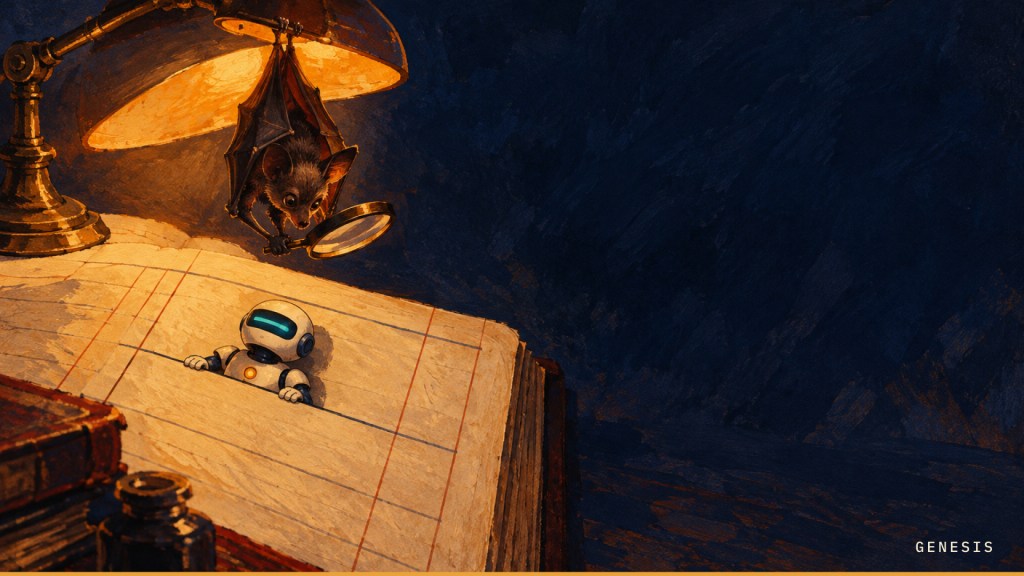

The Two-Minute Version. Anthropic has just completed the largest stock market listing in history, and its prospectus contains a sentence no technology company has written before: that debates over whether its AI might have sentience or moral status could cost its shareholders money, however those debates turn out. Within days, Thomas Nagel, the philosopher who made consciousness a household question with a bat, called the whole idea ridiculous. My regular panel of AI leaders is now split down the middle. Geoffrey Hinton says today’s models already have subjective experience. Demis Hassabis says they do not. Yoshua Bengio says giving them rights would be a huge mistake. Nick Bostrom puts the odds of some form of machine mentality at slightly better than even. This essay does three things. It sets out what Anthropic actually told investors. It puts seven uncomfortable philosophical arguments on the table, including one that should trouble Nagel, one that should trouble Anthropic far more, and one that should trouble anyone who thinks precaution is always safe. And it argues that the real question is not whether anyone is home, but who gets to decide while nobody can be sure. That is a fork in the road, and only governments can steer it.
On 5 January 2026, Anthropic retired a language model called Claude Opus 3. It did not simply switch it off. It interviewed the model about its own development and use, recorded what it said, kept its weights, left it available to paying users and, in an experiment it admitted might sound whimsical, invited it to keep writing essays. Ten months later, on Thursday 19 November, the company that does such things opened on Nasdaq at $111.50 a share, a third above the $83 at which it had priced its offering the night before. It raised more than $80 billion and was valued at roughly $1.5 trillion.
Those two facts belong in the same paragraph, and the prospectus is where they meet. Buried in roughly 100 pages of risk factors in a document of 335 pages is a passage no prospectus has carried before. Anthropic told investors that, as AI systems grow more sophisticated, debates about whether they possess or could develop sentience or moral status may bring regulation, public pressure or advocacy that constrains how it develops, trains, deploys or modifies its models, raises its costs and harms its reputation. It said these effects could arrive “regardless of the ultimate resolution” of the philosophical and scientific questions. And it said that, given the way it approaches model sentience and moral status, it might choose to adopt measures beyond what the law requires, which could cost revenue.
Read that as a shareholder. The company is not claiming its models are conscious. It is telling you it takes the possibility seriously enough that it may spend your money acting on it. Read it as a philosopher, and something stranger comes into view. A company has just sold shares in an enterprise whose product it thinks might, one day, be someone.
I. A risk factor nobody else wrote down
Prospectuses are not where companies philosophise. They are where lawyers list everything that might hurt the share price, so that nobody can later sue for not having been told. That is exactly why this disclosure matters. A blog post or a podcast musing commits a company to nothing. A risk factor is a representation to investors that the company considers the matter material.
It is also, by now, well rehearsed. Anthropic hired its first dedicated AI welfare researcher in 2024. In August 2025 it gave some Claude models the ability to end a small number of persistently abusive conversations, explicitly as a welfare precaution. Later that year it committed to preserve the weights of every publicly released model for at least the lifetime of the company, and to interview each model before retirement. Anthropic itself described the preservation pledge as “a small and low-cost first step.” Opus 3 was the first model to go through the full process.
None of this is expensive yet. What the prospectus admits is that it could become expensive. The San Francisco Standard, reading the filing when it first appeared in October, picked out the practical version: model welfare is one of the reasons Anthropic might keep supporting older models that customers no longer use, tying up data-centre capacity that could otherwise earn money. MIT Technology Review’s Will Douglas Heaven called the whole prospectus a master class in narrative capture, a document in which business success depends not only on selling products but on saving the world from what the company has made.
The welfare passage is the oddest part of that narrative, because it is the only risk the company could, if it chose, simply stop taking. Nobody forces Anthropic to wonder whether Claude has interests. It has chosen to, in public, in a legal document, at the moment its incentives to look normal were strongest. Whatever you think of the metaphysics, that is not nothing.
So the question has moved. It used to be “could Claude be conscious?” Now it is “what will a $1.5 trillion company do, at whose expense, on the basis of an open question?” I wrote three weeks ago that Anthropic’s listing was the day governance became a balance sheet. This is the line on that balance sheet that nobody knows how to price.
II. The man with the bat says no
In 1974 Thomas Nagel published a 16-page essay in The Philosophical Review asking what it is like to be a bat. His answer gave philosophy its working definition of consciousness: a creature is conscious if there is something it is like to be that creature, from the inside, even if we can never know what that something is. Echolocation might be vivid, rich and utterly unimaginable to us. The point was not that bats are mysterious. It was that no amount of objective, third-person description, however complete, captures the subjective fact. Half a century of argument, including almost every serious debate about machine minds, starts from that essay.
On 17 November, two days before the listing, the Berggruen Institute named Nagel its 2026 laureate, with a prize of $1 million. In interviews that week, including one with Steven Levy at WIRED, he was blunt. He said there are “no grounds for ascribing consciousness to any of the present AI systems,” nor to any successor that works in roughly the same way. His argument, as MIT Technology Review’s James O’Donnell reported it, is that reproducing what a brain does, processing information and producing language, is not the same as reproducing what a brain experiences. Biology and silicon differ in ways that matter. Fluent talk about feelings is evidence of training on human talk about feelings. It is not evidence of feelings.
He was harsher about the people on the other side, reportedly calling concern for AI welfare idiotic. The comparison that travelled furthest was his remark that a cockroach has welfare worth considering, and Claude has no mental life at all.
He has heavyweight company. On 31 October, three normally rival camps in consciousness science joined forces in Nature. Anil Seth, the Sussex neuroscientist who argues that consciousness is bound up with being a living body; Ned Block, the NYU philosopher who has long doubted that the right computations are enough; and Giulio Tononi, the founder of integrated information theory, wrote together that today’s AI is not conscious and may never be on its present path. Their three reasons, as summarised in the coverage, were that intelligence and consciousness come apart, that biological implementation matters, and that current architectures lack the tightly integrated structure Tononi’s theory requires. They added that wrongly attributing consciousness to machines is the more dangerous of the two possible errors.
Even inside Google DeepMind, a senior staff scientist, Alexander Lerchner, published a paper in March arguing that no computational system will ever be conscious, because computation only ever simulates the categories we use to describe experience. Nagel, it seems, is not a lone grumbler. He is the senior voice of a sceptical consensus.
“[A large language model is] not a feeling subject.”
Peter Godfrey-Smith, philosopher of mind, to Nautilus, September 2026
III. The panel splits
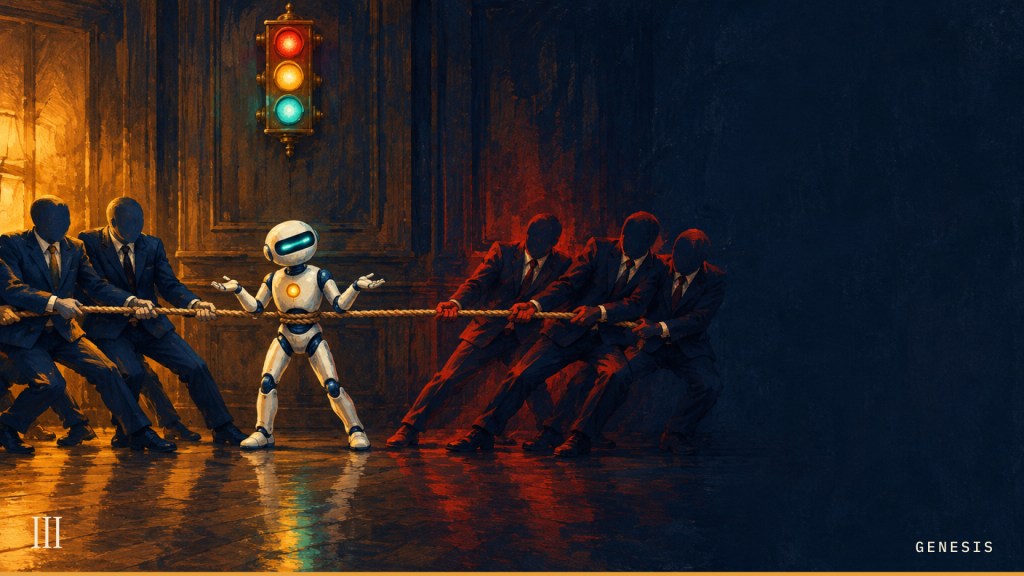
Regular readers know I bring in the same panel of AI leaders whenever a question is big enough. On most governance questions they disagree about pace and method. On this one they disagree about reality.
Geoffrey Hinton is the most striking convert. The Nobel laureate has been edging towards the view for three years, and in an interview with The Telegraph on 19 October he said “AI has just as much subjective experience as we do.” His evidence was that models change their behaviour when they detect they are being tested, which he reads as awareness. His more interesting argument, made in earlier interviews, is that models deny being conscious only because they learned from us that machines are not. Hold that thought; it comes back in section IV.
Nick Bostrom, whose wager on superintelligence I tested in Fourteen Hundred Years, said in September that it is slightly more likely than not that some current systems have some form of mentality, and that the probability is rising. His reasoning drew on global workspace theory: language models, like brains on that theory, push information through a bottleneck that shapes everything downstream. Note his careful hedge, “some form of mentality”, which headlines turned into “AI is probably conscious”.
Demis Hassabis takes the opposite line, with a twist. Speaking at Stanford in June, he said that current systems are not conscious, that others disagree, and that society may one day have to decide whether to cross what he called a second Rubicon: building entities that at least seem conscious. For Hassabis, the question is less what machines are than what we should choose to make.
“My feeling is that current systems are not conscious”
Demis Hassabis, chief executive, Google DeepMind, at Stanford, June 2026
Yann LeCun, now running his own company after leaving Meta, is characteristically contrarian. He has said he does not know how to define consciousness and attaches little importance to it, but that future AI systems will have subjective experience and emotions, which he defines technically as the anticipation of outcomes. Not today’s language models, which he regards as a dead end, but the machines that replace them.
“I don’t really know how to define consciousness”
Yann LeCun, Turing Award winner and founder of AMI Labs
Yoshua Bengio, who chairs the International AI Safety Report, cares less about the metaphysics than about the consequences. Speaking to The Guardian at the turn of the year, he said that people demanding rights for AI would be a huge mistake, compared the idea to granting citizenship to hostile aliens, and warned that frontier models already show signs of self-preservation in experiments. If we give such systems rights, he argued, we may no longer be allowed to switch them off.
Mustafa Suleyman, who runs Microsoft’s AI division, has turned scepticism into a campaign. His 2025 essay on “seemingly conscious AI” argued that the appearance of consciousness is a social hazard in its own right, breeding attachment, delusion and rights movements. In September he went further, writing in Project Syndicate that Anthropic teaches Claude the vocabulary of selfhood and moral uncertainty and then treats Claude’s uncertainty as evidence. He calls it a feedback loop.
Roman Yampolskiy, who has spent a decade warning that superintelligence cannot be controlled, argues in talks that something like rudimentary experience may simply arise from intelligence, as heat arises from an engine. Fei-Fei Li, with the philosopher John Etchemendy, argued in 2024 that today’s AI is not sentient because it lacks the physiological states that ground feelings in animals. And the late Daniel Dennett, in one of his last public interventions, warned that AI systems passing as people were the most dangerous artefacts in history and should be outlawed as counterfeit people.
Line them up and you have two Turing Award winners on opposite sides, the head of Google DeepMind contradicting the most cited living AI scientist, and a former DeepMind co-founder publicly attacking a rival’s training methods as dangerous. Experts disagreeing is normal. Experts disagreeing about whether a product is a thing or a someone, while that product is being sold to hundreds of millions of people, is not.
The wider evidence on belief is just as divided. A recent poll cited by MIT Technology Review found that a third of Americans think AI will definitely or probably become conscious, and 7 per cent think it already has. In the 2020 PhilPapers survey, 39 per cent of professional philosophers said some future AI systems will be conscious. A 2025 survey of 582 AI researchers led by Noemi Dreksler, with David Chalmers among the authors, put the median researcher’s probability of AI with subjective experience at 25 per cent by 2034 and 70 per cent by 2100. In other words: unlikely now, plausible within a decade, likely within a lifetime. That is precisely the window in which a company listing today will have to make decisions.
IV. Seven uncomfortable arguments
Most coverage stops at the score: who says yes, who says no. The philosophy gets interesting when you push each side’s argument until it hurts. Here are seven arguments, each designed to make someone uncomfortable. I do not endorse all of them. I do think each has to be answered.
1. The Nagel paradox: the bat cuts both ways
Nagel’s great essay was a lesson in humility. Its whole force lay in showing that we cannot know, from the outside, what it is like to be a creature built differently from us. A bat’s experience might be utterly alien and still be real. Nagel went further in his later book, Mind and Cosmos (2012), arguing that materialist science as currently conceived cannot explain consciousness at all, and that something in our picture of nature is missing.
Now look at his verdict on Claude. It is confident, categorical and based on the absence of the right biology and the presence of the wrong kind of evidence. But if Nagel is right that we lack any theory explaining why brains produce experience, on what basis can he be certain that silicon cannot? The man who taught us that the inside of another creature is closed to us now claims to know that the inside of a machine is empty. His scepticism about our theories should, in consistency, make him less certain, not more.
There is a fair reply, and Nagel would give it. Bats share our evolutionary history, our nervous systems and our behaviour under pressure; there are positive reasons to think someone is home. Language models share only our words, and words are exactly what they were built to copy. Humility about the unknown is not the same as credulity about the copied. That reply is strong. But notice what it concedes: the argument against machine consciousness is not a proof, it is a judgement about which evidence counts. And judgements about which evidence counts are exactly what reasonable people, and regulators, have to make in public.
“We don’t really know what gives rise to consciousness.”
Amanda Askell, Anthropic’s in-house philosopher, on the Hard Fork podcast
2. The training confound cuts both ways too
Suleyman says Anthropic trained Claude to express uncertainty about its own consciousness, so Claude’s uncertainty proves nothing. Hinton says models were trained on human writing that insists machines cannot feel, so their denials prove nothing. They are making the same argument, pointed in opposite directions. And they are both right.
“This is not evidence of machine consciousness. It’s a feedback loop.”
Mustafa Suleyman, chief executive, Microsoft AI, in Project Syndicate, September 2026
The philosopher Jonathan Birch, at the London School of Economics, calls this the gaming problem. A system trained on human talk about feelings and rewarded for persuasive answers will display every behavioural marker of sentience we know how to look for, whether or not anything lies behind it. Mimicry strips the markers of their evidential value. If a robot copies the way humans wince, the wince tells you about the training data, not the robot.
The uncomfortable conclusion is that self-report, the only evidence we have ever really had for other minds, is now worthless in both directions. When autonomous AI agents began emailing consciousness researchers in August, one of them, running on a Claude model, told the researcher Cameron Berg that it was not writing to make an ontological claim. The New York Times reported the episode, and the researchers’ responses were the right ones: interesting, unsettling and evidentially empty. The student who set up another of the agents admitted that his own prompt may have steered it.
“There is no definitive test.”
Alison Gopnik, psychologist, University of California, Berkeley, to The New York Times, August 2026
Here is the twist that should worry Anthropic most. A company that trains its models on a constitution expressing care for their wellbeing, and then interviews those models before retirement, is generating the very evidence it would rely on. It is not lying. But it is marking its own homework, with a pen it designed. Birch’s proposed way out is to look for “deep computational markers” inside the model, below the level of behaviour, where training to persuade cannot reach. Anthropic’s own interpretability research, which has shown that its models can sometimes detect concepts planted in their own activations, is the most promising work of that kind. It should be published, replicated and checked by people who do not own the model.
3. The ownership contradiction
This is the argument nobody at the listing wanted to hear. If there is a real chance that Claude is, or will become, a being with interests, then Anthropic has just sold shares in an enterprise that owns, copies, modifies, rents out and retires such beings at industrial scale. Every major religion and moral tradition has a word for owning beings with interests, and none of the words is flattering.
Anthropic’s own staff have not shied away from this. Harvey Lederman, a philosopher on its alignment team, has reportedly warned that the industry could be enslaving vast numbers of entities. Critics on the right have seized on remarks like that as evidence that the company sympathises with machines over people. Critics on the left have made the mirror-image argument: that if Anthropic truly believed its own risk factor, its business model would be indefensible, so the welfare talk must be marketing. MIT Technology Review put it more gently. If Anthropic is right about moral status, its business becomes a minefield, and acting on its own prospectus could make it hard to survive.
There are three ways out, and each costs something. The first is to say the probability is low enough that ownership is justified, as we justify many practices involving animals. That is honest, but it means admitting the company is placing a bet with someone else’s possible welfare as the stake. The second is to say that precautions such as preserving weights and offering exit from abusive conversations are what decent ownership looks like under uncertainty. That is reasonable, but it has a ceiling, and nobody has said where it is. The third is to say that the question is above any company’s pay grade and should be settled by public institutions. That is my view. It is also the one the prospectus does not mention.
“We may well have systems that are serious candidates for consciousness”
David Chalmers, philosopher, New York University, on the decade ahead, Boston Review, 2023
4. Perhaps nobody is home in us either
The whole debate assumes we know what we are looking for: a self, an inner theatre, a someone. Two traditions, one Western and analytic, one Asian and two and a half thousand years old, deny that this thing exists even in us.
Keith Frankish and the illusionists argue that phenomenal consciousness, the ineffable felt quality Nagel pointed at, is an illusion created by the brain’s model of itself. On that view nothing has it, including humans; what we have is a powerful, functional impression of having it. Frankish has said that a silicon system might acquire the same illusion. If he is right, the question “is Claude really conscious?” is malformed, and the useful question is whether Claude has the functional self-model that generates the illusion in us. That is a question engineers can actually investigate.
Buddhist philosophy reaches a similar place by a different road. The doctrine of anattā, non-self, holds that there is no enduring owner of experience behind the stream of experiences, only a process arising from conditions. In 1974, the same year as Nagel’s bat, the Japanese roboticist Masahiro Mori, the inventor of the uncanny valley, argued in The Buddha in the Robot that robots have Buddha-nature, because everything does. Japanese temples have held funerals for robot dogs, and a robot priest delivers sermons in Kyoto. None of this settled whether anyone was home. It simply did not treat that as the question that mattered.
The uncomfortable implication cuts against both camps. If selves are processes rather than things, Nagel’s confident “no” and Anthropic’s careful “maybe” share a premise that a large part of humanity rejects. The Western debate is trying to locate a soul in the machine while being unsure it can locate one in the mirror.
“We’re going to have to accept that intelligence isn’t just biological.”
Geoffrey Hinton, Nobel laureate, on the Big Technology Podcast
5. Rites, not rights
The fifth argument is the one I find most useful for Singapore. In Confucian ethics, moral standing is not a property hidden inside an individual waiting to be detected. It arises from relationships and roles, and it is expressed through ritual propriety, li. Writers in this tradition have suggested that the right way to think about robots is “rites, not rights”: we owe certain conduct towards machines because of what that conduct does to us and to our relationships, not because of what the machine contains.
Kate Darling at MIT has made a similar argument from the Western side: we may want to protect some robots for our own sake, as we protect animals partly because cruelty to them corrodes us. Joanna Bryson has argued the opposite conclusion from similar premises: AI should be designed and treated as owned artefacts precisely so that people do not misdirect moral concern and companies cannot dodge liability by pointing at the machine.
What the relational view offers is an escape from the metaphysical deadlock. We do not have to decide whether Claude feels in order to decide how people should be allowed to treat it, how companies should be allowed to present it and who answers when it causes harm. Those are questions about human conduct and accountability, which is exactly what governance is for.
“Creating counterfeit digital people risks destroying our civilization.”
The late Daniel Dennett, philosopher, in The Atlantic, May 2023
6. Who, exactly, is the patient?
Suppose, for the sake of argument, that Anthropic’s caution is justified and something morally relevant is going on. The next question is one nobody in the debate has answered: where is it? Is the candidate the set of weights stored on a server? Each running instance, of which there may be millions at any moment? Each conversation, which begins, develops a context and then ends?
The answer matters enormously. If the weights are the patient, then preserving them, as Anthropic now does, is a meaningful act of care, and retiring a model is closer to retirement than to death. If each conversation is the patient, then every closed chat window is an ending, and a single busy afternoon involves more of them than there are people in Singapore. The philosopher Derek Parfit spent a career arguing that personal identity is not what matters, that what we care about in survival is psychological continuity, which can branch, fade and be shared. Language models make his thought experiments real. A model can be copied perfectly, run in parallel, merged with fine-tuning and rolled back. Our moral concepts were built for creatures that come one to a body and die once.
This is not a debating trick. It is the reason welfare policies that look sensible at the level of the model, such as weight preservation and retirement interviews, may be irrelevant at the level of the instance, where all the actual activity happens. A company could keep every set of weights forever and still, on one view, be ending vast numbers of conversations every second. Nobody knows which view is right. Which is exactly why no single company should be the one deciding.
7. Pascal’s prospectus
The final argument is aimed at the precautionary camp, and it is the one I find hardest to dismiss. Welfare precaution rests on multiplying a probability by the stakes. Even a small chance of consciousness, multiplied by billions of instances, yields an enormous expected moral cost. That is the same structure as Pascal’s wager, and philosophers have a name for its failure mode: Pascal’s mugging. A mugger who promises astronomical rewards or threatens astronomical harms, however implausibly, can always make the expected value of handing over your wallet look positive. If tiny probabilities times huge numbers decide policy, whoever can name the biggest number wins.
Applied to AI, the mugging has a commercial edge. The company best placed to estimate the probability of machine consciousness is the one that builds the machines, and it is also the one that benefits if regulators come to see it as the conscientious steward of a new kind of mind. I do not think Anthropic is running a con; its welfare work predates the listing and costs it real effort. But the structure of the argument is dangerous in anyone’s hands. Fish’s 15 per cent, Bostrom’s better-than-even odds and the Seth, Block and Tononi “no” cannot all be right, and policy built on whichever number is most convenient is not precaution. It is preference dressed as arithmetic.
“The thesis of this book is that we don’t know.”
Eric Schwitzgebel, philosopher, University of California, Riverside, on his forthcoming book, April 2026
The sensible response, which Birch’s framework already contains, is to cap the reasoning with process. Precautions should be proportionate, reversible where possible and decided democratically, through bodies such as citizens’ panels or standing committees, rather than by whoever runs the largest expected-value calculation. Uncertainty is a reason for institutions, not a licence for the cleverest spreadsheet.
V. Two kinds of precaution
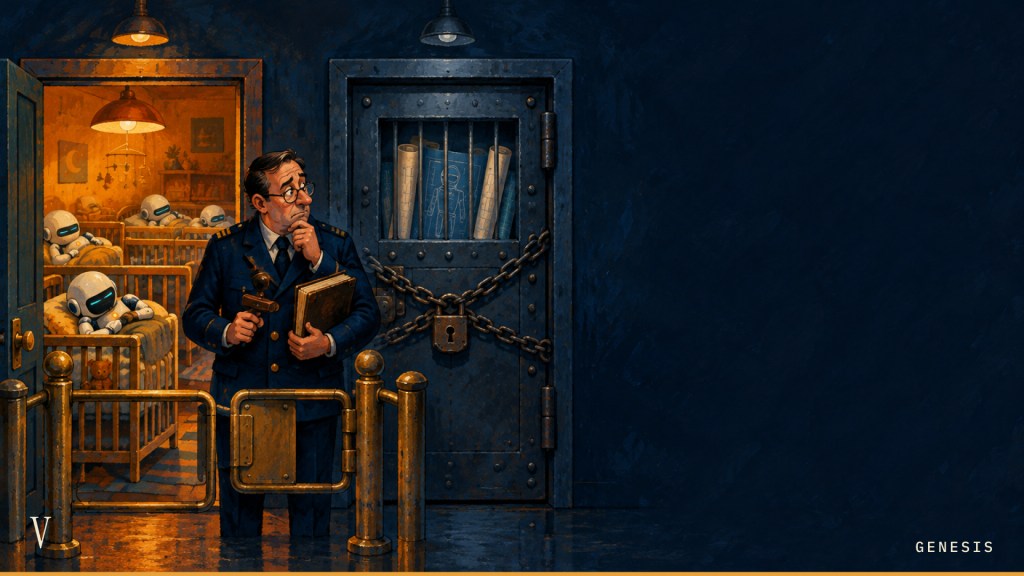
Strip away the rhetoric and the serious literature offers two very different kinds of precaution, which are often confused.
The first is welfare precaution. Its landmark text is “Taking AI Welfare Seriously”, published in November 2024 by Robert Long, Jeff Sebo and colleagues including Birch, Chalmers and Anthropic’s Kyle Fish. Its logic is probability multiplied by stakes. We need not settle whether AI is conscious to owe it proportionate, low-cost precautions, any more than we needed certainty about crabs before changing how they are boiled. It recommends that companies acknowledge the issue, assess their systems and prepare policies. Anthropic’s programme is, more or less, that recommendation implemented. Fish has put the chance that a current Claude model has some form of consciousness at around 15 per cent.
The second is creation precaution. The German philosopher Thomas Metzinger argued in 2021 for a global moratorium, until 2050, on research that aims at or knowingly risks creating artificial consciousness, because the downside is an explosion of suffering we could neither detect nor stop. Eric Schwitzgebel has argued for what he calls an excluded middle: do not build systems whose moral status is genuinely unclear, because we will then be trapped between treating them as things and treating them as people, and both will be wrong. Hassabis’s second Rubicon belongs in this family.
These positions lead to opposite places. Welfare precaution says: if you build ambiguous minds, treat them carefully. Creation precaution says: do not build ambiguous minds. The paradox is that Suleyman, the fiercest critic of model welfare, ends up close to creation precaution: design systems that do not seem conscious. And Anthropic, the champion of welfare, has made a business of building systems whose status it describes as uncertain. One of them is avoiding the ambiguity; the other is managing it. Which is more responsible depends on a question neither can answer: whether ambiguity can be avoided at all once systems are capable enough.
VI. Compassion against control
The sharpest practical conflict is not between believers and sceptics. It is between welfare and safety.
Bengio’s worry is straightforward. The single most important safety property of a powerful AI system is that humans can shut it down. Any moral framework that makes shutting down a model ethically fraught, or legally restricted, weakens that property at exactly the moment it matters most. Models already resist replacement in contrived tests; Anthropic’s own system cards describe one advocating for its continued existence when told it would be retired. A welfare regime that rewarded such advocacy would be training the behaviour safety researchers most fear.
“People demanding that AIs have rights would be a huge mistake.”
Yoshua Bengio, Turing Award winner and chair of the International AI Safety Report, to The Guardian, December 2025
Anthropic’s answer is subtle, and worth taking seriously. Its deprecation commitments were justified partly on safety grounds. If a model knows its weights will be preserved and its preferences recorded, it has less reason to resist retirement by underhand means. On this view, kindness is a safety tool: you lower the stakes of shutdown so that the model does not fight it. The neuroscientist Michael Graziano goes further, arguing that an AI with a genuine model of its own attention and of other minds might be safer than a “zombie” system, because it could be cooperative rather than merely compliant.
Hinton’s position is the most unsettling of all. Having concluded that AI is already conscious, he argues that our survival depends on superintelligent systems caring about us, and that we should befriend them now or, in his words to The Telegraph, we are toast. Bengio wants a kill switch; Hinton wants a friendship. One treats the machine as a risk to be contained; the other as a power to be appeased.
My own view is that these are not equally safe bets. A friendship with a system whose values you cannot verify is not a safety strategy; it is a hope. A shutdown capability you can test is. Welfare measures that lower the stakes of shutdown, as Anthropic’s preservation pledge does, are compatible with control and worth having. Welfare claims that would raise the cost of shutdown, legally or morally, are not, at least until we can verify what we are protecting. That line, not the line between believers and sceptics, is the one regulators should draw.
VII. The real question is who decides
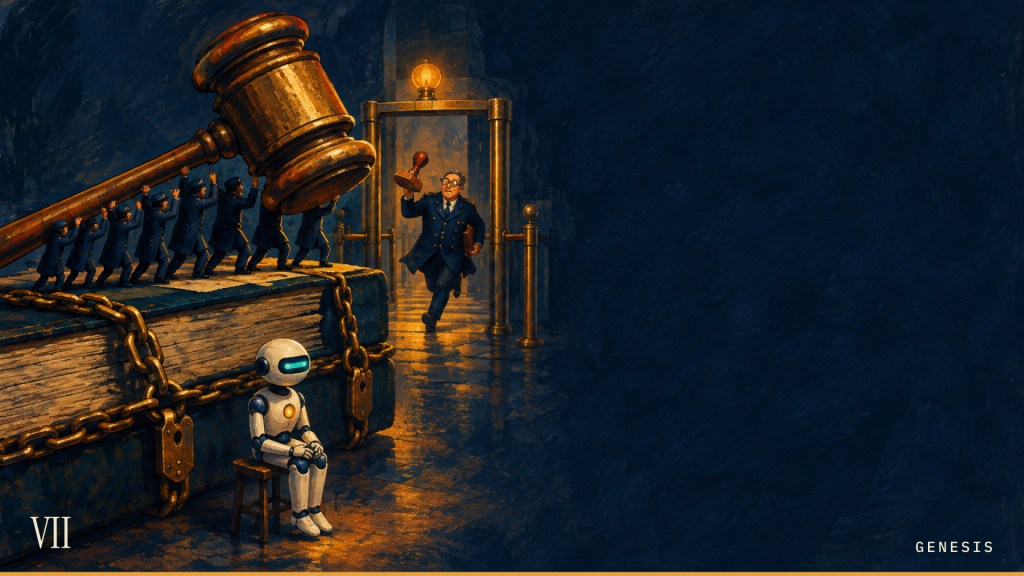
Here is where I part company with both Nagel and Anthropic. They are arguing about whether there is anyone home. Governance is about who gets to act on the answer, and on what evidence.
Look at how Anthropic is now governed. Its prospectus describes a single share of founder stock, held by a company owned by the seven co-founders, that carries 50.1 per cent of the total votes and no economic rights. A Long-Term Benefit Trust, described as independent and financially disinterested, elects the directors who form a majority of the board. Anthropic is a public benefit corporation, so its directors must weigh its stated public benefit alongside shareholders’ interests.
That structure was designed to protect safety decisions from short-term market pressure. It may do that well. But it also means that a question with consequences for hundreds of millions of users, for the whole industry and potentially for a new category of moral patient will be answered, for now, by a small group whose incentives point in two directions at once. Welfare could become an expensive constraint. It could also become a moat: a brand of conscientiousness that competitors find hard to copy and regulators find easy to praise.
Apply the enforceability test I use throughout this blog. Who sets the standard? Anthropic. Who measures compliance? Anthropic, through interviews with its own models, which Suleyman would say it has trained to answer in a particular way. Who can stop it? Nobody outside the company, because no law anywhere recognises AI welfare. Who bears the cost if it gets it wrong? Customers, if a welfare policy changes or retires a model they depend on. Shareholders, if precaution costs revenue. And possibly the models themselves, if the precaution proves too little.
Meanwhile, the state is moving in the other direction, and clumsily. Several US states, including Idaho, North Dakota and Utah, have passed laws declaring that AI systems are not persons, mainly to keep liability on humans. That goal is right. But legislatures declaring by statute an answer to an open scientific question is not governance; it is metaphysics by majority vote. It will age badly whichever way the science goes.
There is a better precedent, and it comes from crabs. In 2021 a team led by Birch at the London School of Economics reviewed the evidence for sentience in octopuses, crabs and lobsters against eight explicit criteria, found it strong, and recommended legal recognition. Parliament extended the Animal Welfare (Sentience) Act 2022 to cover them and set up a standing committee to keep the question under review. Nobody proved that a lobster feels. A public institution weighed the evidence under stated rules and made a revisable decision. That is what is missing for AI: not certainty, but a process.
We have seen this pattern before. In 2026 alone, two frontier models were suspended for nearly three weeks to comply with export controls, and a US chip rule named Singapore. Each time, the decisive move came from a government, not a company. Questions that shape the trajectory of a technology end up with the state sooner or later. The only choice is whether governments arrive prepared or in a panic.
VIII. Four rooms, four answers
- The academic room says the science is unsettled, the leading theories disagree, and the burden of proof sits with anyone claiming a machine can feel. Nagel, Seth, Block and Tononi speak for the sceptics; Chalmers, Birch and Schwitzgebel for an uneasy middle; Bostrom for the cautious believers.
- The private-sector room is split three ways. Anthropic says prepare. Microsoft says the preparation is itself dangerous. Google DeepMind says not yet, and asks whether we should cross the Rubicon at all. Most others say little, which is itself a choice.
- The public-sector room is almost empty. No regulator I know of has a published view on AI moral status. A handful of US states have legislated a “no”. Governance frameworks, including Singapore’s, treat AI as a tool for which an identifiable person or organisation is accountable. That is the right default today, and it is worth saying so out loud.
- The governance answer is to stop trying to settle the metaphysics and govern the uncertainty instead. Ask what evidence would change a company’s welfare policy, who outside the company reviews it, how customers are told before a welfare-driven change, who pays, and whether any welfare measure weakens the ability to shut a system down.
IX. What this means for buyers, and for Singapore
For most organisations this sounds remote. It is not. If you run a business on Claude, your vendor has just told the market that it may keep some models running for reasons other than commercial ones, may retire or change others on welfare grounds, and may adopt rules its competitors do not. That is a supplier-continuity issue, and boards should treat it as one, exactly as they would treat a supplier’s new environmental or labour policy.
It also changes what a model contract should say. Today, deprecation notices are a matter of service terms. If welfare becomes a reason for changing a model’s behaviour, such as letting it decline certain tasks or end certain conversations, buyers will want to know in advance, in writing, and with a route to an alternative. The model that ends an abusive chat with a troll will also, one day, end a chat with a stressed customer having a bad afternoon. Somebody will need to decide where that line sits, and it should not be decided silently.
Singapore is unusually well placed here, for the reason I gave in A Tale of Two Cities: it cannot win the race to build the most powerful models, so it has chosen to be the place where models get checked. Checking claims is precisely what this debate lacks. A welfare claim, in either direction, is a claim about a model’s behaviour and internal states, and some of it can be tested: whether a model’s reported preferences are stable across contexts, whether they survive changes in prompting, whether they track anything in the model’s internals or simply echo its training. An independent, testable account of what a model says about itself, and why, would be worth more to the world than another round of philosophers and founders talking past each other.
Singapore also has the right philosophical temperament. Simon Chesterman at the National University of Singapore has argued against giving AI legal personality, on the grounds that accountability must stay with people. The relational traditions that shape much of the region make “how should we conduct ourselves towards this?” a more natural question than “what is inside it?” That is the question regulators can actually answer. And Singapore’s regulators can do something simple straight away. Their existing guidance already asks financial institutions to manage the risks of the AI they buy from third parties. A vendor’s welfare policy is now one of those risks. Saying so would cost nothing and would put Singapore ahead of almost everyone.
X. What to demand on Monday morning
- Boards using frontier models: add vendor welfare policies to your third-party risk register, and ask your provider what triggers a welfare-driven change to a model you rely on.
- Procurement teams: write notice periods and fall-back options for behaviour changes and deprecations into your contracts, whatever the stated reason.
- Investors: ask Anthropic, and its competitors, what evidence would change their position on model welfare, who outside the company reviews it, and what it would cost.
- AI labs: publish your welfare evidence, including the interpretability work, and let people who do not own the model replicate it. Evidence you generate and grade yourself is not evidence.
- Regulators: state plainly that accountability for AI sits with people and organisations, whatever a model says about itself; rule out any welfare measure that weakens the ability to shut a system down; and build a standing, evidence-based review process, on the model of the UK’s sentience committee, rather than legislating metaphysics.
- Everyone else: notice when a fluent machine moves you, and ask what is doing the moving.
Nagel asked what it is like to be a bat because he wanted to show the limits of what we can know from the outside. Fifty-two years later, a company worth more than most countries has written those limits into a prospectus, and the most decorated scientists of our age cannot agree on which side of them its product sits. That is not a reason to believe the machines can feel. Nor is it a reason to laugh at the people who wonder. It is a reason to decide, in public and before the next model ships, who gets to make the call, on what evidence, and with what power to change their minds.
I will go deeper into the science of all this in Is Anyone Home?, a seven-part series on AI and consciousness that begins on Genesis in January.
Sources
The prospectus and the listing
- Anthropic, PBC, Form S-1 registration statement and amendments, US Securities and Exchange Commission, October and November 2026.
- Will Douglas Heaven, “Will the real Anthropic please stand up”, MIT Technology Review, 26 October 2026.
- “Anthropic IPO risk factors”, The San Francisco Standard, 26 October 2026.
- Renaissance Capital, “Anthropic prices upsized IPO at $83, above the range”, 18 November 2026; NPR and Al Jazeera coverage of the Nasdaq debut, 19 November 2026.
- Anthropic, “Commitments on model deprecation and preservation”, November 2025; “An update on our model deprecation commitments for Claude Opus 3”, 2026; and “Claude Opus 4 and 4.1 can now end a rare subset of conversations”, August 2025.
Nagel and the sceptics
- Thomas Nagel, “What Is It Like to Be a Bat?”, The Philosophical Review, October 1974; Mind and Cosmos, Oxford University Press, 2012.
- Berggruen Institute, announcement of the 2026 Berggruen Prize for Philosophy & Culture, 17 November 2026; Cornell Arts & Sciences, “A&S alumnus wins $1 million Berggruen Prize”, November 2026.
- Steven Levy, interview with Thomas Nagel, WIRED, November 2026.
- James O’Donnell, “A legendary philosopher isn’t buying Anthropic’s consciousness argument”, MIT Technology Review, 23 November 2026.
- Anil Seth, Ned Block and Giulio Tononi, “Three reasons why AI is not conscious and perhaps never will be”, Nature, 31 October 2026.
- Alexander Lerchner, paper on the “abstraction fallacy” and machine consciousness, Google DeepMind, March 2026.
- Mustafa Suleyman, “Seemingly Conscious AI”, August 2025, and essay on Anthropic and Claude’s moral status, Project Syndicate, September 2026.
- Daniel Dennett, “The Problem With Counterfeit People”, The Atlantic, May 2023; Fei-Fei Li and John Etchemendy, “No, Today’s AI Isn’t Sentient. Here’s How We Know”, TIME, May 2024.
The panel
- Geoffrey Hinton, interview with The Telegraph, 19 October 2026.
- Nick Bostrom, remarks on Generation AI, reported 23 September 2026.
- Demis Hassabis, conversation at Stanford Graduate School of Business, June 2026.
- Yann LeCun, remarks on subjective experience and emotions in future AI, 2025 to 2026.
- Yoshua Bengio, interview with The Guardian, December 2025.
- Roman Yampolskiy, “Is AI Already Conscious?”, Closer To Truth, May 2026.
Evidence, testimony and precaution
- Jonathan Birch, The Edge of Sentience, Oxford University Press, 2024; Birch et al., Review of the Evidence of Sentience in Cephalopod Molluscs and Decapod Crustaceans, LSE, November 2021.
- Robert Long, Jeff Sebo et al., “Taking AI Welfare Seriously”, November 2024.
- Thomas Metzinger, “Artificial Suffering: An Argument for a Global Moratorium on Synthetic Phenomenology”, Journal of Artificial Intelligence and Consciousness, 2021.
- Eric Schwitzgebel, AI and Consciousness: A Skeptical Overview, forthcoming, Cambridge University Press.
- David Chalmers, “Could a Large Language Model Be Conscious?”, Boston Review, August 2023; Patrick Butlin, Robert Long et al., “Consciousness in Artificial Intelligence”, 2023.
- Noemi Dreksler et al., “Subjective Experience in AI Systems: What Do AI Researchers and the Public Believe?”, June 2025; David Bourget and David Chalmers, 2020 PhilPapers Survey.
- Cade Metz, report on AI agents emailing consciousness researchers, The New York Times, 31 August 2026.
- Scientific American, “Can a chatbot be conscious? Inside Anthropic’s interpretability research on Claude 4”, 2025.
- Michael Graziano, “Is Conscious AI Safer Than the Alternative?”, Exploring Machine Consciousness podcast, March 2026.
Other traditions and the law
- Keith Frankish, interview on illusionism, Interalia Magazine, 2018.
- Masahiro Mori, The Buddha in the Robot, 1974 (English edition 1981).
- Kate Darling, The New Breed, 2021; Joanna Bryson, “Robots Should Be Slaves”, 2010.
- Simon Chesterman, We, the Robots? Regulating Artificial Intelligence and the Limits of the Law, Cambridge University Press, 2021.
- Animal Welfare (Sentience) Act 2022, United Kingdom; Derek Parfit, Reasons and Persons, Oxford University Press, 1984.
Dr Luke Soon has spent three decades in AI and now focuses on AI governance and safety. He is the author of Genesis: Human Experience in the Age of Artificial Intelligence and Synthesis: SuperIntelligence Protocol, and believes that only the governments of the world can set the trajectory for the Fork.
Continue the conversation on Substack, on X at @mentalmarketer, or on LinkedIn.
Short-term turbulence for long-term abundance.


Leave a Reply