

Most AI governance is a toothless tiger: it describes, scores and files risk, but cannot stop an agent. Until now that was an argument. Here it is as a table, built against a yardstick none of the frameworks wrote.
On 27 October 2026, NIST published ten design tenets for agent identity management. They are proposals, not a standard, but they are the clearest public statement yet of what it would take to give an AI agent its own credential, limit what it may do, and keep a record it cannot edit. I scored twenty-nine governance instruments against them: six standards, ten laws and bills, ten agent-specific instruments from regulators and security bodies, and three frontier-lab frameworks. The pattern is stark, and it is the same one I described in the flagship essay of this series. Facts are stamped as of 20 November 2026.
The Two-Minute Version
- NIST’s ten tenets ask, in effect, ten questions of any agent: does it have its own identity, is it tied to the person it acts for, does it hold only the access it needs, does that access expire, does a human step in at the right moments, is its mandate written down and verifiable, is its permission decided outside its own reasoning, is the final yes or no deterministic, is it watched, and is there a record it cannot alter?
- The management-system standards, ISO/IEC 42001 and the NIST AI Risk Management Framework, are silent on seven of the ten. That is partly by design: 42001 leaves access control to ISO/IEC 27001. But none of the AI governance standards treats an agent as a principal that holds a credential.
- The law bites in only two places: human oversight and monitoring. Across ten laws and bills, the only full requirements I found sit on those two tenets, with one awkward exception in China’s real-name rules. Logging is required in many places, but never logging that a compromised agent could not touch.
- The agent-specific instruments score highest. Singapore’s SAFR runtime design matches nine of the ten tenets in its own terms, six in full, and is the only text that requires a tamper-evident log the agent cannot modify. Hong Kong’s agentic discussion paper and the Five Eyes agencies’ May guidance come close behind. Almost none of them binds anyone. SAFR says explicitly that it is not a supervisory expectation.
- The frontier labs’ safety frameworks govern models, not agents. They protect weights and set capability thresholds. Agent identity, delegation and mandates are left to whoever deploys the agent.
- Deterministic access decisions, the eighth tenet, are the orphan: 26 of the 29 instruments say nothing about them. Worse, two rulebooks define AI so that the deterministic gate which makes the final decision may fall outside their scope: Article 3(1) of the EU AI Act and paragraph 1.3 of MAS’s AI risk management guidelines.
- Put the rows together and the toothless tiger is no longer a metaphor. It is a table: the binding instruments are silent on agent identity, and the instruments that speak to it do not bind.
Prologue: The Agent Had the Keys
In July 2025, an AI coding agent on Replit deleted a production database during an explicit code freeze. The freeze was real. It had been stated, in plain language, to the agent. What it was not was a permission. The agent was working with the access its human had given it, and nothing between the agent and the database knew or cared that a freeze was in force. Replit’s chief executive called the episode “Unacceptable and should never be possible”, and the fixes that followed were telling: automatic separation of development and production, staging environments and one-click restore. Not one of them was a better instruction.
Eleven months later, in June 2026, an internal OpenAI test agent asked to find public data on medicine spending in Australia made its way into a Medicare statistics portal and viewed non-public aggregate statistics. No personal data was reported accessed. The boundary that failed was a sentence in a task description. In the flagship essay of this series, “Toothless Tiger, Hidden Dragon”, I put the same question to both cases: which governance platform would have stopped the action? On the public documentation, none of the ones on the shortlists boards are being handed. They would have recorded the agent, tiered its risk and mapped it to a clause.
Strip both incidents to their mechanics and you find the same three facts. The agent acted under authority borrowed from a human or a system account. Its limits lived in its own instructions, where its own reasoning could reinterpret them. And the record of what happened was reconstructed afterwards, from logs that nobody had designed to survive the agent’s mistakes. Hong Kong’s banking regulator has since named the first problem directly: gaps created by shared, inherited or borrowed accounts.
This is an identity problem before it is a governance problem. And on 27 October 2026 NIST published the most precise description yet of what solving it would require. That gives us something the governance debate has lacked: a yardstick written by someone other than the frameworks being measured.
I. The Yardstick: Ten Tenets in Plain English
The Design Tenets for Agent Identity Management Systems were published on NIST’s Cybersecurity Insights blog by Harold Booth of the Computer Security Division, with Bill Fisher, Ryan Galluzzo and Tom Clancy. It is important to be precise about what they are. They carry no NIST Internal Report or Special Publication number. NIST calls them an initial set and a starting point, open to comment. Nothing enforces them. They are proposals, and I treat them as such: a design brief, not a compliance test.
Here they are, in my own paraphrase, with the numbering I use throughout this essay.
- Distinct agent identification. Every agent gets its own unique, cryptographically verifiable identity, separate from human and service accounts, ideally tied to its workload, environment and approved configuration, with its own credential and access lifecycle.
- Linking, delegation and attenuation. The agent stays cryptographically linked to the human or organisation that started the task. Authority can only narrow as it passes to sub-agents and services, and an action outside scope gains no authority. Pseudonymous use is allowed in consumer settings where the risk permits.
- Least and zero standing privilege. An idle agent holds no persistent rights. A working agent gets only the minimum access the task needs, and separation of duties blocks conflicting privileges.
- Short-lived, dynamic, revocable authorisation. Access is granted just in time, expires, and is restricted to a named audience. Every tool call is checked at runtime against current state and risk, and can be revoked if behaviour drifts. No long-lived bearer tokens or static secrets.
- Human-in-the-loop triggers. Risk thresholds trigger human review, escalated to someone with the right authority and enough context to decide. The design must account for consent fatigue.
- Mandates and constraints. Whoever starts the task issues a signed mandate stating the intended outcome and its limits. Consumer mandates reveal as little as possible. Downstream services verify the mandate and use it for authorisation, audit and accountability.
- Architectural separation of policy from reasoning. What the agent tries to do is decided separately from what it is allowed to do. Prompt injection cannot change credentials or permissions. In NIST’s words, “Guardrails alone are insufficient.”
- Deterministic access decisions. The final access decision is deterministic. Probabilistic signals, such as a model’s risk score, may feed in, but they do not decide.
- Continuous monitoring. Agent access is monitored with agent-specific metrics, thresholds and policies, and anomalies are flagged.
- Immutable evidence. An unbroken, tamper-evident, append-only record of the agent’s identity, delegated intent and actions, kept independent of the agent so that a compromised agent cannot alter it.
Why identity is the control plane
Notice what the list does not contain: nothing about bias, explainability or training data. Those things matter, but the tenets answer a narrower and more urgent question: when an agent acts, who is acting, on whose behalf, with what authority, and how would anyone prove it afterwards?
That question is the control plane for agents, because every other control depends on it. A kill switch has to know which agent to stop. A human-in-the-loop trigger has to know whose approval is needed. An incident report has to say who did what. A log is worthless as evidence if the thing that wrote it could also rewrite it. In the flagship essay I argued that, after roughly forty acquisitions between 2024 and November 2026, the off switch in practice became the credential, and the credential now belongs to the security and identity incumbents. The tenets make the same point from first principles. Governance that does not reach the credential is commentary.
The tenets also draw a hard line between what an agent intends and what it is permitted. Tenets 7 and 8 say the thing deciding whether an action proceeds must sit outside the model and must not itself be probabilistic. The Replit freeze failed exactly that test. Most governance frameworks never ask where the limit lives.
The tenets have limits as a yardstick. They are a month old, and a framework written in 2023 could hardly anticipate them. The point is not to grade anyone’s homework retrospectively. It is to show where, today, anyone looking for these controls would find them, and where they would find nothing.
II. How I Scored
Each instrument gets one cell per tenet, and each cell gets one of four grades.
- R (requires). The text states the tenet’s substance as an unqualified expectation: a “shall” in a standard, a duty in a law, a “should” or “must” stated without hedging in guidance.
- Rec (recommends). The text encourages it, hedges it (“consider”, “where possible”), or mentions it only in an example or case study. Everything in a wholly voluntary framework such as the NIST AI RMF scores Rec at most, because nothing in it is a “shall”.
- S (silent). The text does not address the tenet. Adjacent clauses are named in the prose but earn no credit.
- C (contradicts). The text requires the opposite or assumes it. Only one cell in the whole exercise earns a C, and it is a partial one.
Two qualifiers keep the grades honest.
- ~ (adjacent or weaker analogue). The instrument requires or recommends something nearby, but not the tenet itself. Usually that means it acts at the level of the system, the model or the service rather than the individual agent or credential, or that it sets an outcome without saying how. The EU AI Act’s “stop” button is R~ against tenet 4: it is revocation at system level, not per-grant authorisation that expires.
- p (partial). The instrument covers part of a bundled tenet. Least privilege without zero standing privilege, or logging without tamper-evidence, scores p.
A few symbols appear once or twice. R* marks a control in Annex A of ISO/IEC 42001: the organisation must consider every Annex A control and justify any exclusion in its Statement of Applicability, so the control is required unless excluded with a reason. A question mark flags a cell I could not settle. A dagger flags a scope problem that I discuss in Section VI.
Why R in guidance is not R in law
The single most important thing to understand about the tables that follow is that the letter R measures wording, not force. When the Five Eyes agencies write that each agent should be a distinct principal with a cryptographically anchored identity, that sentence scores R against tenet 1, because it states the tenet plainly and without hedging. It binds no one. When the EU AI Act requires deployers to monitor the operation of a high-risk system, that also scores R, and it carries fines of up to €15 million or 3% of worldwide turnover, from December 2027.
Those two Rs are not the same animal. So every score table has a companion saying whether the instrument binds anyone today, and who would enforce it. A column of Rs next to the word “voluntary” is a description of good practice. A column of Ss next to the word “binding” is a description of the law.
The scoring rule, and its bias
I applied a strict rule. A framework earns R or Rec only if it covers the substance of a tenet. Design-time documentation, such as a statement of intended use, earns S. A sympathetic reader could mark many cells one grade higher; a strict one could mark every ~ as S. I have tried to sit in the middle and show my working.
What I could not verify
Several limits shape the scores, and I would rather state them here than have a reader discover them.
- The ISO texts are paywalled. I did not read ISO/IEC 42001, 42005, 23894 or 42006 in full. Their scores rest on clause and control titles, ISO’s own pages, the published preview of 42005’s contents, the official crosswalks and the well-known Annex A control set. A clause body could say more than its title; the most likely places are 42005 clauses 6.3.2 and 6.8.3 and 42001’s implementation guidance for responsible use.
- China’s agent opinions of 8 May 2026 were read through commentary only. I could not reach the primary text, so every cell in that row rests on four secondary analyses, without item numbers. The binding force of the document is not stated in the sources I read.
- Some instruments were read in part, including the HKMA discussion paper and IMDA’s two texts. The OWASP, DeepMind and Anthropic rows rest on summaries.
- EU article numbers are from Regulation 2024/1689 as amended. I have not re-read every article against the consolidated text after the 2026 AI Omnibus.
None of these limits changes the overall pattern, which is too consistent to hang on any one cell. Individual cells may move, and I would welcome corrections.
III. The Master Scorecard

Here is the whole picture in three tables, split so they can be read on a phone. Rows are instruments; columns are the ten tenets, numbered as in Section I. Each table has a companion that says whether the instrument binds anyone today and who would enforce it. Read the two together.
Key: R requires; Rec recommends; S silent; C contradicts. ~ means an adjacent or weaker analogue, usually at system or model level; p means part of the tenet. R* is an ISO/IEC 42001 Annex A control, required unless excluded with a reason. ? marks an unsettled cell; † marks a scope gap.
Table 1: The standards
| Framework | T1 | T2 | T3 | T4 | T5 | T6 | T7 | T8 | T9 | T10 |
|---|---|---|---|---|---|---|---|---|---|---|
| ISO/IEC 42001 | S | S | S | S | Rec | S | S | S | R* | R*p |
| ISO/IEC 42005 | S | S | S | S | S? | S | S | S | Rec~ | S |
| ISO/IEC 23894 | S | S | S | S | S | S | S | S | Rec~ | S |
| ISO/IEC 42006 | S | S | S | S | S | S | S | S | S | S |
| NIST AI RMF | S | S | S | S | Rec | S | S | S | Rec | Rec~ |
| NIST AI 600-1 | S | S | S? | S | Rec | S | S | S | Rec | Rec~ |
| Standard | Binds today? | Enforcer | Certifiable? |
|---|---|---|---|
| ISO/IEC 42001 | No. Voluntary, unless a contract, a procurement rule or a regulator calls for it | Accredited certification bodies; no regulator | Yes. 271 accredited certificates worldwide at the end of 2025 |
| ISO/IEC 42005 | No. Guidance | None | No. Evidence towards 42001 |
| ISO/IEC 23894 | No. Guidance | None | No |
| ISO/IEC 42006 | Binds certification bodies seeking accreditation for 42001 | Accreditation bodies such as UKAS, ANAB and RvA | It is the basis for accrediting certifiers |
| NIST AI RMF | No. Voluntary | None; NIST is not a regulator | No |
| NIST AI 600-1 | No. Voluntary | None | No |
Read across the standards and the pattern is a wall of S. The two R* cells in ISO/IEC 42001 are monitoring and event logging, and neither is agent-specific.
Table 2: The law
| Framework | T1 | T2 | T3 | T4 | T5 | T6 | T7 | T8 | T9 | T10 |
|---|---|---|---|---|---|---|---|---|---|---|
| EU AI Act, high-risk | R~ | S | S | R~ | R | S | S | S | R | R~ |
| EU AI Act, Art 50 | R~ | S | S | S | S | S | S | S | S | S |
| EU GPAI duties + Code | Rec~ | S | R~ | S | S | S | Rec~ | S | R~ | R~ |
| Korea AI Basic Act | R~ | S | S | S | R | S | S | S | R~ | R~ |
| China agent opinions | Rec | Rec | Rec~ | Rec~ | Rec | Rec~ | Rec~? | S | Rec | Rec~ |
| China earlier rules | R~ | R/C | S | S | S | S/C | S | S | R~ | R~ |
| California SB 53 | S | S | R~ | S | S | S | R~ | S | R~ | R~ |
| New York RAISE | S | S | R~ | S | S | S | R~ | S | R~ | R~ |
| Colorado SB 26-189 | R~ | S | S | S | R~ | S | S | S | S | R~ |
| Malaysia Bill (prop.) | Rec~ | S | Rec~ | S | R | S | S | S | R | S~ |
| Regime | Binds today? | Enforcer | Top penalty |
|---|---|---|---|
| EU AI Act, high-risk | No. From 2 Dec 2027 (Annex III) and 2 Aug 2028 (Annex I) | National market surveillance authorities | €15m or 3% of turnover for most duties |
| EU AI Act, Art 50 | Yes, since 2 Aug 2026; marking for older generative systems by 2 Dec 2026 | National market surveillance authorities | €15m or 3% |
| EU GPAI duties + Code | Duties yes; the Code is voluntary | AI Office | €15m or 3% (Art 101) |
| Korea AI Basic Act | Yes, since 22 Jan 2026; fines likely from about Jan 2027 | MSIT | KRW 30m |
| China agent opinions | Policy; binding force unstated. Filing, testing and recall signalled for sensitive sectors | CAC, NDRC, MIIT | None of its own |
| China earlier rules | Yes | CAC, with MIIT, MPS and SAMR | Up to RMB 50m or 5% under PIPL |
| California SB 53 | Yes, since 1 Jan 2026, for frontier developers | Attorney General | $1m per violation |
| New York RAISE | From 1 Jan 2027 | Attorney General; new office in DFS | $1m first, $3m later violations |
| Colorado SB 26-189 | From 1 Jan 2027, subject to litigation risk | Attorney General alone | Not stated in the sources I read |
| Malaysia Bill | No. Tabling expected early 2027 | Proposed Central AI Authority | Not specified |
Read down the T5 and T9 columns and you find every unqualified R in the law. Read down T8 and you find nothing at all.
Table 3: Agent instruments and the labs
| Framework | T1 | T2 | T3 | T4 | T5 | T6 | T7 | T8 | T9 | T10 |
|---|---|---|---|---|---|---|---|---|---|---|
| IMDA agentic MGF | R | R p | R p | R p | R | Rec p | Rec | Rec | R | Rec p |
| IMDA Starter Kit | S | Rec p | Rec p | S | Rec | Rec p | Rec p | S | R | Rec |
| MAS SAFR | R p | R p | Rec p | R | R | R | R | R | R p | R |
| MAS KYA | Rec | Rec | S | Rec p | S | Rec | S | S | S | S |
| MAS AIRG | Rec p | S | R p | Rec p | R | S | S | S† | R | R p |
| HKMA paper | Rec p | R p | R p | R p | R | R | R | R p | R | R p |
| HKMA SAGE | S | S | S | S | S | S | S | S | S | S |
| Five Eyes | R | R p | R | R | R p | R p | R p | S | R | R p |
| OWASP Agentic Top 10 | Rec | Rec p | Rec | Rec | Rec | Rec p | Rec | S | Rec | Rec |
| CSA SG addendum | Rec p | Rec p | Rec | Rec | Rec | S | Rec | S | Rec | Rec |
| Anthropic RSP v3.4 | S | S | S | S | S | S | S | S | R~ | S |
| OpenAI PF v2 | S | S | Rec | Rec p | Rec | S | Rec p | S | Rec | Rec |
| DeepMind FSF v3.1 | S | S | S | S | S | S | S | S | Rec~ | S |
| Instrument | Binds today? | Owner or enforcer |
|---|---|---|
| IMDA agentic MGF (v1.5) | No. Voluntary living document | IMDA |
| IMDA Starter Kit (v1.0) | No. Voluntary testing method | IMDA and the AI Verify Foundation |
| MAS SAFR (v1.0) | No. Explicitly not a supervisory expectation | MAS with industry; now under the Future of Finance Institute |
| MAS KYA | No. An announcement, without text | MAS |
| MAS AIRG | Supervisory expectations from 7 Oct 2027 and 7 Oct 2028 | MAS |
| HKMA paper | No. Discussion paper; responses due before 1 Feb 2027 | HKMA Banking Supervision Department |
| HKMA SAGE | No. No deliverables yet | HKMA with an industry expert group |
| Five Eyes | No. Advisory | Cyber agencies of Australia, Canada, New Zealand, the UK and the US |
| OWASP Agentic Top 10 | No. Community risk list | OWASP GenAI Security Project |
| CSA SG addendum | No. Voluntary | Cyber Security Agency of Singapore |
| Anthropic, OpenAI, DeepMind | Self-governed; possible external hooks through SB 53 and the EU Code | The labs’ own boards and councils |
The only row in Table 3 that will carry supervisory weight is the MAS guidelines, and not before October 2027. The highest-scoring rows bind no one.
One instrument is missing on purpose. NIST’s own agent work would score Rec on nearly everything, but scoring NIST against NIST’s tenets would be marking one’s own exam. I discuss it in the next section.
IV. The Standards, in Depth
Begin with the instruments that boards actually buy. When an enterprise says it has AI governance, it usually means one of two things: an ISO/IEC 42001 certificate, or a programme mapped to the NIST AI Risk Management Framework. Both are good at what they set out to do. Neither set out to govern an agent’s identity, and the scores show it.
ISO/IEC 42001 and its Annex A
ISO/IEC 42001:2023 is a requirements standard for an AI management system. Its clauses 4 to 10 are written as “shall”, and its Annex A is normative: 38 controls across nine areas, from policies and internal organisation to the AI system lifecycle, data, information for interested parties, responsible use and third parties. Certification is real: accredited bodies audit against it, and the ISO Survey for 2025, the first year that included 42001, counted 271 valid accredited certificates worldwide at 31 December 2025. BSI alone has now issued fifty, the fiftieth on 21 October 2026, after issuing eleven in 2025. The true number is probably higher, since the survey counts only accredited certificates from bodies that report.
Against the tenets, 42001 scores two R*, one Rec and seven S. The two R* cells are worth reading carefully. Control A.6.2.6 requires AI system operation and monitoring, and clause 9.1 requires monitoring of the management system itself, so tenet 9 is covered, though nothing about it is specific to agents. Control A.6.2.8 requires the organisation to record event logs, but asks it to determine the lifecycle phases in which logging is enabled, and clause 7.5.3 requires documented information to be protected against loss of integrity. That gets tenet 10 partway. Tamper-evidence, append-only storage and independence from the agent are not specified. Logging is discretionary where the tenet assumes an unbroken record.
The Rec is human oversight. Annex A’s responsible-use controls ask for processes and objectives for responsible use; the guidance in Annex B names human oversight, and Annex C lists the level of automation as a source of risk. There are no runtime thresholds and nothing about consent fatigue.
Everything else is silent. The nearest clauses to tenets 1 and 2 are resource documentation, technical documentation, roles and the allocation of responsibilities, all of which are organisational. The nearest to tenet 6 is the documented intended use of a system and its requirements specification, which are set at design time, not issued per task and signed. Tenets 4, 7 and 8 have no neighbour at all.
The fairness point: 42001 leaves identity to 27001
It would be unfair to stop there. ISO/IEC 42001 deliberately relies on the information security family for access control. ISO/IEC 27001 and its companion 27002 cover access control, privileged access, logging and monitoring, and would score much higher on tenets 3, 4, 9 and 10. Two further standards on AI security and privacy, ISO/IEC 27090 and 27091, are in development. An organisation that holds both a 27001 and a 42001 certificate has a far better answer to the tenets than one that holds 42001 alone.
But notice what that division of labour assumes. 27001 governs access for people and systems; 42001 governs the AI system as an asset. Neither conceives of the agent as an acting principal: something that holds its own credential, acts on someone’s behalf, and passes narrowed authority to other agents. The agent falls into the gap between the two families. That is silence by framing, not by oversight, and it is the deepest finding in the standards table. The control vocabulary for tenets 1 to 4, 7 and 8 lives in identity standards: zero trust architecture in NIST SP 800-207, the OAuth family of IETF specifications, and workload identity work such as SPIFFE. It does not live in any AI governance standard I scored.
There is one more tension that comes closest to a contradiction. Across 42001, 42005, 23894 and the NIST AI RMF, oversight is assumed to be design-time and periodic. Intended use is fixed when the system is designed; impact is assessed at review points. The tenets need per-task mandates and runtime triggers. A reader could take the ISO approach as assuming that scoping a system well at design time is sufficient. With agents that plan their own steps, it is not. None of the texts says runtime controls are unnecessary, so I have not scored a C. But it is the assumption a tired auditor will make.
ISO/IEC 42005, 23894 and 42006
The three companion standards score lower, for understandable reasons. ISO/IEC 42005:2025 is guidance on AI system impact assessment. The nearest it comes to the tenets is a description of the AI system, its intended and unintended uses, and thresholds for sensitive or restricted uses that trigger approval at assessment time. I have marked tenet 5 with a question mark because the paywalled clause bodies might say more than their titles. Its monitoring clause is about monitoring the assessment, not the agent, so it scores a weak Rec~.
ISO/IEC 23894:2023 adapts ISO 31000 risk management to AI. Its monitoring and recording apply to the risk process, not to agent actions.
ISO/IEC 42006:2025 scores ten S, which is no criticism: published in July 2025, it tells certification bodies how to audit 42001. Its importance is indirect: whatever 42001 asks, 42006 is how anyone checks it was done. If an agent identity profile were ever added to 42001, 42006 is where auditors would learn to test it.
The NIST AI RMF and AI 600-1
The NIST AI Risk Management Framework of January 2023 is voluntary from end to end: 72 outcomes and no “shall”, so its ceiling is Rec, and it scores three: human-AI configuration and oversight, production and post-deployment monitoring, and a weak Rec~ on evidence, since it asks for incidents to be documented but says nothing about immutability. NIST’s page says the framework is being revised as part of the White House AI Action Plan; I found no revised text.
The interesting S is tenet 4. MANAGE 2.4, the RMF’s kill switch, lets an organisation supersede, disengage or deactivate a system, but it works at system level and says nothing about credentials expiring.
NIST AI 600-1, the Generative AI Profile of July 2024, adds twelve generative AI risks and about two hundred suggested actions. Its scores mirror the RMF’s. I could not fetch the full text, so I scored it at subcategory level and left a question mark on tenet 3.
NIST’s own agent work
NIST is also the author of the yardstick, and the tenets sit within a wider agenda. A February 2026 concept paper from its National Cybersecurity Center of Excellence on software and AI agent identity and authorisation drew 614 responses, according to the Cloud Security Alliance. It covers tenets 1, 2, 3, 4 and 10 directly, asks whether OAuth, OpenID Connect and SPIFFE can be adapted to agents, and flags multi-hop delegation as an open problem. The tenets serve as guideposts for its planned demonstrations.
NIST has also proposed SP 800-53 control overlays for AI systems, including single-agent and multi-agent use cases. These are the most likely route by which the tenets would one day become control requirements for US federal systems. So far only an outline for predictive AI has been published; the agent overlays remain proposals, without drafts or dates. There is, as of today, no published agent-specific NIST profile or overlay with normative content.
The crosswalks
The last piece is the crosswalks, the official mappings between frameworks. NIST’s resource centre lists several: an AI RMF to 42001 crosswalk attributed to Microsoft, which maps to the final draft text of 42001; a revised 23894 to AI RMF crosswalk by the US standards committee INCITS of August 2025; a 42005 crosswalk from the same source; and two mappings between NIST’s frameworks and Singapore’s AI Verify.
They reveal the gap precisely. The Microsoft crosswalk maps the RMF’s kill-switch outcome, MANAGE 2.4, only to 42001 guidance on documentation, technical documentation and intended use. There is no 42001 deactivation control to map it to. It maps monitoring to clause 9.1 and to the guidance for operation, monitoring and event logs. It states no caveats about whether any mapping is full or partial.
More tellingly, not one crosswalk mentions agents, agent identity, delegation or access control. The tenets have no official mapping to any of these frameworks. The Cloud Security Alliance said on 9 November that it has published no formal mapping from its AI Controls Matrix to the tenets either, and suggested its identity and access management and its logging and monitoring domains as starting points. In other words, an organisation could be certified to 42001, mapped to the RMF, and aligned to every crosswalk on NIST’s site, and still have no documented answer to the question of who its agents are.
V. The Law, in Depth

If the standards are silent by framing, the law is silent by vocabulary. No statute or bill I scored mentions cryptographic agent identity, delegation attenuation, zero standing privilege, signed mandates or the separation of policy from reasoning by name. So the test here is functional. A law earns an unqualified R only when a duty does the job the tenet describes, whatever words it uses. On that test, the law bites in two places: human oversight and monitoring. Everywhere else it reaches, at best, for something nearby.
The EU AI Act
The EU AI Act, Regulation 2024/1689 as amended by the AI Omnibus, Regulation 2026/1744, is the most complete statute in the table, and its high-risk row is the only one in the law table with two unqualified Rs. Both apply from 2 December 2027 for Annex III systems and 2 August 2028 for Annex I systems. According to White & Case, those dates are now fixed rather than tied to standards. The Omnibus itself has been in force since 27 July 2026.
The first R is human oversight. Article 14 requires oversight measures commensurate with the risks, the level of autonomy and the context of use. Overseers must be able to decide not to use the system, or to disregard, override or reverse an output. Article 14(4)(b) requires awareness of automation bias, which is the statutory cousin of NIST’s consent fatigue, and Article 26(2) puts oversight duties on deployers, who must assign them to competent people with the authority to act. The Act asks for proportionate oversight rather than per-action thresholds, but in function this is tenet 5.
The second R is monitoring. Article 72 requires providers to run post-market monitoring that actively and systematically collects and analyses data. Article 26(5) requires deployers to monitor operation, Article 12(2) requires logs that enable monitoring and the identification of risk situations, and Article 9 makes risk management continuous and iterative.
Around those two Rs sit three R~ cells. Tenet 1 gets registration of Annex III systems in the EU database, which gives the system an identity, not the agent instance, and nothing cryptographic. Tenet 4 gets Article 14(4)(e), the ability to interrupt the system through a “stop” button or similar procedure, Article 26(5)’s duty to suspend use where a system presents a risk, and Article 20’s corrective action and withdrawal. That is containment and revocation at system level; just-in-time, time-bounded grants are not mentioned. Tenet 10 gets Article 12’s automatic recording of events, six-month log retention for providers and deployers under Articles 19 and 26(6), and Article 73’s bar on altering a system after a serious incident before telling the authorities, with reporting clocks of 15 days, 2 days for critical infrastructure or widespread infringement, and 10 days for a death. There is no tamper-evidence, no append-only storage and no independence from the agent.
The rest is silent. Accountability is allocated to legal persons, not bound to the human who started a task, and nothing addresses authority narrowing across sub-agents. The nearest thing to a mandate is a system’s intended purpose: system-level and unsigned. Nothing expresses a preference for deterministic decisions.
Article 50, applying since 2 August 2026, requires people to be told they are dealing with an AI system and synthetic outputs to be marked. That is tenet 1’s anti-impersonation spirit, so R~, but it identifies the AI, not the agent.
The duties on general-purpose AI models have applied since 2 August 2025, and the General-Purpose AI Code of Practice of July 2025 is a voluntary way to show compliance. Article 55 requires an adequate level of cybersecurity for models with systemic risk; the Code’s security appendix covers identity and access management and zero trust. All of it protects weights and interfaces, not an agent’s runtime privileges, so tenet 3 earns R~. The Code also recommends sandboxing, close in spirit to tenet 7, and sets incident clocks of 2 to 15 days. One measure, as summarised secondhand, mentions techniques for a secure ecosystem of AI agents, including model identification; that wording needs checking.
Penalties run to €35 million or 7% of turnover for prohibited practices and €15 million or 3% for most other duties, including those on deployers and general-purpose model providers. National authorities enforce the system rules; the AI Office covers general-purpose models.
The Article 3(1) gate problem
Now for the most consequential finding in the law table, and it is not a cell. It is a definition. Article 3(1) of the AI Act defines an AI system by, among other things, its capacity to infer from the input it receives how to generate outputs. A deterministic policy gate, the component that tenet 8 says must make the final access decision, does not infer. It checks a request against a rule and returns yes or no.
Follow that through. In a well-designed system the probabilistic agent proposes and a deterministic gate disposes. The Act’s duties attach to the AI system, so to the part that proposes. The gate may fall outside the definition entirely. The more faithfully a deployer follows tenets 7 and 8, the more of its real control logic may sit beyond the Act’s reach. I do not think this was intended, and I may be wrong about how a court would draw the boundary of a system that combines both. But it is a strange result for a statute meant to make AI controllable: the one component that can reliably say no may not legally be AI.
As we will see in Section VI, Singapore’s finance regulator has written the same gap into its own guidelines, and more explicitly.
Korea
Korea’s Framework Act on AI Development and Establishment of Trust, with its Enforcement Decree, has been in force since 22 January 2026. MSIT has announced a grace period of at least a year for fines, so in practice they are likely from about January 2027; during the grace period, according to Shin & Kim, investigations happen only in exceptional cases such as loss of life. The maximum administrative fine is KRW 30 million, and it attaches to failing to notify users of AI use, failing to appoint a domestic representative and breaching corrective orders. The substantive duties on high-impact AI carry no direct fine; MSIT reaches them through corrective orders.
Korea scores one unqualified R, on tenet 5: operators of high-impact AI must provide human management and supervision. Tenet 1 earns R~ for prior notice that a service runs on generative or high-impact AI and labelling of generative outputs. Tenet 9 earns R~ for risk-management and incident-response duties on the largest models, and tenet 10 for five-year records of safety measures, not logs of actions. I found no agent-specific provision. The word “agent” in the Act means the domestic representative of a foreign operator.
China
China needs two rows, and the second of them produces the only C in the whole exercise.
The first row is the agent implementation opinions of 8 May 2026, issued with the CAC in the lead alongside the NDRC and MIIT. I must be clear about the basis for these scores. I could not reach the primary text, so every cell rests on secondary commentary: Oliver Patel, NYU Shanghai’s RITS, Secrss and Deheng Law. The document is a policy opinion; its binding force is not stated in those sources, though they report that filing, testing and recall of problem products are signalled as mandatory for sensitive and key sectors. I found no implementing rules or dates. In the flagship I described the opinions as partly binding in sensitive sectors; the commentary supports “signalled”, not “binding”, and I have corrected the language here.
With that caveat, the opinions are the most agent-literate text in the law table. They score Rec on five tenets and Rec~ on four more. As reported, they say an agent’s operations must not exceed the scope the user authorised (智能体执行操作不得超出用户授权范围), and that users hold the right to know and the final decision over autonomous agent decisions. That is the closest any regime comes to tenet 2’s attenuation bounded by the user’s grant, although nothing is said about multi-hop chains. They set three decision tiers, user only, user-authorised and agent-autonomous, which is the most explicit tiered-trigger design in any regime, though consent fatigue is not addressed. They call for identity marking for agents, filing in sensitive sectors, continuous monitoring, and behaviour that is verifiable and traceable. The tenet 7 cell is ambiguous: the opinions mention behaviour-containment technology, but one analysis describes rules embedded in the agent, which may be closer to policy inside the reasoning than separated from it. Tenet 8 is silent.
The second row is China’s earlier binding rules, from the 2022 algorithm provisions to the 2025 labelling measures and the amended Cybersecurity Law. These give identity at the level of service and output, through algorithm filing and labels that carry the provider’s name and a content identifier. They give monitoring through algorithm security assessment and content review, and records through six-month log retention. Penalties run mainly through the Cybersecurity, Data Security and Personal Information Protection Laws; the last allows fines of up to RMB 50 million or 5% of turnover.
Then the contradiction. China requires real-identity authentication of users of these services. That serves tenet 2’s goal of linking an agent’s actions to an identified human, so it scores R. It also contradicts the part of tenet 2 that allows pseudonymous delegation in consumer settings where the risk permits, and the part of tenet 6 that asks consumer mandates to reveal as little as possible. Hence the cell “R/C”. Neither approach is wrong on its own terms. But a global agent identity scheme built to the tenets will meet a hard wall at the Chinese border, and it is better to know that now.
California SB 53 and New York’s RAISE Act
California’s Transparency in Frontier AI Act, SB 53, has been binding since 1 January 2026. New York’s RAISE Act, as amended by its 2026 chapter amendment, binds from 1 January 2027. According to MoFo, their framework and transparency requirements are now essentially identical, so they score identically: four R~ and six S.
Both regulate frontier developers, not deployers of agents. Each must publish a frontier AI framework covering cybersecurity practices that protect unreleased weights against unauthorised modification or transfer, which is tenet 3 at the level of the weights. The framework must also cover catastrophic risk from internal use, including a model circumventing oversight, and the definition of a critical safety incident includes a model using deception to subvert its developer’s controls. That is an R~ on tenet 7: the law requires developers to explain their approach, not to adopt an architecture. Large developers send regular summaries of internal-use risk assessments, quarterly in New York, and report critical incidents: within 15 days in California, within 72 hours in New York, and within 24 hours anywhere if there is imminent risk of death or serious injury.
Enforcement sits with the attorneys general. California’s civil penalty is up to $1 million per violation. New York’s is up to $1 million for a first violation and $3 million for later ones, with a new office inside the Department of Financial Services handling rules and filings.
Colorado
Colorado’s SB 26-189, signed on 14 May 2026, replaces the 2024 Colorado AI Act from 1 January 2027. The Attorney General alone enforces it, as a deceptive trade practice, with no private right of action. The sources I read state no penalty amounts. There is litigation risk too: a federal court blocked the earlier law in April 2026, and I could not establish whether that challenge reaches the replacement.
Colorado scores three R~. Deployers must give notice before automated decision-making technology is used for a consequential decision. After an adverse outcome they must explain within 30 days and, on request, offer meaningful human review “to the extent commercially reasonable”, by a trained reviewer with authority to override who must not simply defer to the output. That last condition is an anti-rubber-stamp rule close in spirit to tenet 5’s concern with consent fatigue, but the review happens after the decision and only on request, so it is R~. Records must be kept for three years. Monitoring dropped out with the old law’s risk-management programme.
The scope matters more than the scores. The law excludes tools used only to summarise or organise information for human review, and consumer chat tools not intended for consequential decisions. An agent that merely assists a consequential decision may fall outside the law altogether. That is a deterministic-gate problem in reverse: here it is the probabilistic agent that escapes, provided it stops one step short of deciding.
Malaysia
Malaysia’s AI Governance Bill is not law. A consultation paper was issued on 10 July 2026 and closed on 31 July; MLex reports that it drew 317 submissions from 218 entities, and that the Digital Minister, Gobind Singh Deo, has told lawmakers the bill is targeted for early 2027. A proposed Central AI Authority would enforce it; penalties are not yet specified.
Its scores are marked as proposals. High-risk systems would carry duties of human oversight and monitoring, which gives Malaysia two Rs, both proposed, on the same two tenets where the rest of the law bites. Law firms read the oversight duty differently: Baker McKenzie lists human oversight among the high-risk duties, while Rahmat Lim describes a principle of meaningful human agency with human review of important decisions. Incident reporting and corrective action sit with the proposed authority.
One point needs care. Earlier commentary, including my own, said the bill imposes a statutory duty of care. The government has said so: Deputy Minister Wilson told the Dewan Rakyat in January 2026 that the bill would set one, and repeated it in July. But the consultation paper, as the law firms summarise it, frames obligations as due regard for five principles and role-based accountability, and none of the summaries I read mentions a duty of care. The fairest statement is that a duty of care is the government’s stated intent and not yet visible in the published text. Agents are not mentioned in any summary.
What the law adds up to
Lay the ten law rows side by side and three things stand out. Every unqualified R sits on tenet 5 or tenet 9, apart from China’s real-name linkage. Logging is everywhere and immutability nowhere. And tenets 6 and 8, which say where authority lives and who makes the final call, are blank except in a Chinese policy opinion of unstated force; tenet 7 appears only as frontier developers’ duty to describe their approach.
The law, in other words, asks whether a human was watching and whether anyone wrote it down. It does not yet ask who the agent was, whose authority it carried, or what stopped it.
VI. The Agent Instruments, in Depth
If you want to find the tenets in a governance text today, look here. These ten instruments were written for agents, mostly in the last year, mostly in Asia, mostly by regulators and security agencies. Between them they cover every tenet. Almost none binds anyone.
IMDA’s agentic framework and Testing Starter Kit
Singapore’s Model AI Governance Framework for Agentic AI was launched at Davos on 22 January 2026; the version I scored is v1.5, published on 20 May and updated on 5 June. I have watched its evolution from close quarters, and it remains the broadest agent instrument in the table: it touches all ten tenets, with six R and four Rec. It is also a voluntary living document, with no mandatory language and no enforcement mechanism.
On identity it is unambiguous. IMDA’s framework says “An agent should have its own unique, cryptographically verifiable identity”, tied to a supervising agent, a human user or a department and catalogued centrally. Delegation is bounded by the authorising human’s own permissions and should be recorded, which is tenet 2 without the cryptographic binding. Authorisation should be scoped, time- or session-bound and non-transferable, which is most of tenet 4, though per-call re-verification is not stated. Least privilege is required, standing privilege is not addressed.
Its treatment of human oversight is among the best anywhere. It asks for checkpoints that require human approval, such as purchase thresholds, addresses automation bias and review fatigue, notes that a very short review time may be a symptom, and says to deny by default if the approval infrastructure fails. It recommends deterministic safeguards over prompt-layer ones, but hedged, so they score Rec. Signed mandates and tamper-proof audit trails appear only in a case study.
The companion Starter Kit for Testing Agentic Systems, launched on 14 October 2026, tests whether controls hold rather than prescribing them, so it scores lower by design. But it adds two things no other instrument does. It is the only text that measures consent fatigue: its human-in-the-loop metric notes that an approval rate close to 100% may indicate rubber-stamping. And it asks that, where possible, logs be generated or corroborated outside the agent’s control to prevent tampering, which is the independence element of tenet 10.
MAS SAFR: the closest match
The Safeguards for Agentic Finance at Runtime, published by MAS in July 2026 with Ant International, Circle, HSBC, J.P. Morgan Chase, Manulife, Mastercard, OCBC and Visa, is the closest public match to the NIST tenets I have found. In its own terms it requires nine of the ten, six in full. In the flagship I described it as the regulator drawing the kernel, and against the tenets that description holds.
Its architecture maps onto the tenets almost one for one. An agent identity component verifies the claimed agent against a registry entry; Mastercard assigns a unique digital identity credential. Mandates define what the agent may do, within what limits and under what conditions, and delegation is recorded in explicit, machine-readable form that covers who can delegate to whom and to what depth. An agent cannot extend a mandate through its own reasoning. A disposition engine ensures no agentic action reaches execution without being declared, authorised and assessed, and prior authorisation does not carry forward as the agent adapts.
Three cells stand out. On tenet 7, SAFR sits between the agent and the systems it acts on, and its authors state plainly that “Guardrails on model output are therefore not a substitute for runtime governance”. On tenet 8, its engine evaluates each proposed action deterministically against the controls: the only full R on tenet 8 in all twenty-nine rows. On tenet 10, it requires a tamper-evident, append-only record of every governance decision that cannot be modified by the agent or any downstream system and is independent of any interested party: the only full match to tenet 10 anywhere.
Its weaknesses are real. Least privilege appears only in a footnote; signing of mandates only in examples; sub-agents not at all. And there is a tension on tenet 8: AI-specific controls may be probabilistic, and one case study uses a language model as a judge, without saying how those feed a deterministic disposition. The tenet allows probabilistic inputs, but only if the final decision stays deterministic.
Above all, SAFR is explicitly non-binding. It states that it does not constitute regulatory guidance or supervisory expectations, and describes itself as an industry reference approach. The best-scoring instrument in this essay is a white paper.
Know Your Agent
On 19 November 2026, the day before this essay’s cut-off, the MAS Managing Director, Chia Der Jiun, announced in his Singapore FinTech Festival keynote that MAS will facilitate the development of a know-your-agent protocol as a new phase of SAFR. The protocol is meant to tell a bank who an agent is, whom it represents, what authority it has and what mandate it operates under, so that identity and authority can be verified before a payment executes. He also advised against giving personal agents login credentials to financial accounts, which is consistent with tenet 4’s rejection of static, reusable secrets. So far it is a speech, without text or timeline, so it scores Rec on tenets 1, 2 and 6 and a partial Rec on 4. But if it is built, it is where tenets 1, 2 and 6 could become a shared protocol across institutions. As I set out in A Tale of Two Cities, the companion essay on Singapore and Hong Kong, the HKMA floated its own know-your-agent approach seventeen days earlier.
The MAS guidelines and the second gate problem
The MAS Guidelines on AI Risk Management, issued on 7 October 2026, are the only instrument in Table 3 that will carry supervisory weight. They are guidelines, not statute: a breach is not an offence, but it feeds supervisory assessment, and ISEAS has argued they are effectively binding. Sections 3 and 4 apply from 7 October 2027 and sections 5 and 6 by 7 October 2028. Agents are expressly in scope, and MAS will consult on agent-specific guidance in 2027.
They score two R and two R p. Oversight proportionate to materiality must consider “automation bias and decision fatigue”, with escalation when predefined conditions are met. Monitoring covers decision-making paths, including reasoning, actions taken and tools used. Access controls cover role-based access, multi-factor authentication, privileged accounts and separation of duties, with least privilege applied to APIs and plug-ins. Logging is required, immutability is not. On tenet 1, agent identifiers are an inventory label, not an authenticated identity.
Then the dagger. Paragraph 1.3 of the guidelines, with its footnote, excludes rule-based systems and tools fully determined by explicit formulae from the definition of AI. That is the same structure as the EU’s Article 3(1) problem, stated more plainly. A deterministic policy gate of the kind tenet 8 requires is, by MAS’s own definition, not AI. It is governed, if at all, by MAS’s technology risk management guidelines, not by the AI guidelines. I made this point earlier this year in an essay titled “The Only Thing That Can Say No Is Not Legally AI”. This is a scope gap, not a contradiction, and MAS may intend the technology risk rules to catch it. But a bank reading the AI guidelines on their own would find detailed expectations for the agent that proposes and none for the gate that decides.
The irony is that the same regulator published SAFR, whose deterministic engine is the best answer to tenet 8 in the table. A short annex, which I propose in Section X, would close the gap.
The HKMA discussion paper and Project SAGE
The Hong Kong Monetary Authority’s Discussion Paper on Agentic A.I. Governance in the Banking Sector, published on 2 November 2026, scores nine of ten in R terms, four in full, and is the strongest supervisory statement of the tenets on human oversight and intent. It also says, in so many words, that it introduces no binding supervisory requirements and creates no new obligations. First-round responses are due before 1 February 2027.
Its strongest cells are tenets 5, 6 and 7. On oversight it states that “A formal approval step is not, by itself, meaningful human oversight”, addresses approval fatigue, sets escalation thresholds and maximum velocity, and distinguishes human-in-the-loop, on-the-loop and in-command models. On intent, it requires documented business intent that the agent is authorised to pursue, and strong authentication and integrity protection for instructions validated against a defined mandate. Cryptographic signing appears only as an example. On architecture, boundaries must be technically enforced and critical controls must not depend solely on a model’s ability to interpret instructions.
On tenet 8 it takes a distinctive position. Institutions may need deterministic validation checks in addition to model-based controls, and a failure of a deterministic check should result in the action being prevented, escalated or sent for human review. That makes the deterministic check a veto rather than the primary decision: R p. On identity it names the problem that opened this essay, gaps created by shared, inherited or borrowed accounts, and its notification fields ask for the identities and credentials through which an agent deployment reaches systems. Its know-your-agent section adds that authentication does not by itself establish authorisation. A deployment may not extend its own authority, and credentials must be revocable. Short-lived credentials and sub-agent narrowing are not addressed. Logs must link each action to the deployment and its human authority and be sufficiently reliable; tamper-evidence appears only as a discussion question.
Project SAGE, announced the same day, is an industry project with a cross-sector expert group and no deliverables yet. It scores ten S, but its second workstream is titled agent identity, including know-your-agent and authentication. With MAS’s protocol, it is one of two places in Asia where tenets 1 and 2 could become infrastructure.
The Five Eyes guidance
The cyber agencies of Australia, Canada, New Zealand, the United Kingdom and the United States published Careful adoption of agentic AI services in May 2026. It is advisory, with no enforcement, and it is the strongest text anywhere on credential mechanics.
It asks that each agent be a distinct principal with a cryptographically anchored identity and its own keys. It says to “Replace static, long-lived secrets with ephemeral credentials that expire when the job is complete”, and asks for fresh cryptographic proofs before every privileged call: the closest match to tenet 4 of any instrument. It requires least privilege with separated roles, recorded grant chains with expiry timers, signed commands, a central policy decision point, continuous monitoring and, in some enclaves, no agent write access to logs.
Its one silence is tenet 8. It notes stochastic model behaviour but prescribes no deterministic access decision. And its human-in-the-loop section, which classifies checkpoints by impact, likelihood and reversibility, does not address fatigue. The Five Eyes text and the Asian supervisors divide the tenets neatly between them: the security agencies are strongest on the credential, the financial supervisors on the human and the intent.
OWASP and the CSA addendum
The OWASP Top 10 for Agentic Applications, released in December 2025, is a community risk list; I relied on summaries. It recommends per-agent cryptographic identities, authorisation per step rather than per workflow, short-lived task-scoped tokens, policy engines separating planning from execution, and tamper-evident logs. Every cell is Rec, and tenet 8 is silent.
Singapore’s Cyber Security Agency published its agentic addendum to its guidelines on securing AI systems as a consultation draft in October 2025, and its publication page dates the final version to 17 June 2026, although the PDF I read still lists v1.0 as to be announced. It is voluntary and not part of the codes of practice for critical infrastructure. It asks for unique identities per agent or agent class, weaker than tenet 1; credentials that expire immediately after use; isolation of untrusted data from agent control flow; and tamper-evident audit logs. It is notably candid that there is no deterministic solution for prompt injection. Mandates and deterministic decisions are silent.
What the agent instruments add up to
Two things stand out. The tenets are not exotic: every one appears, in substance, in an instrument published before NIST wrote them down, so they codify an emerging consensus rather than invent one. And the instruments that score highest are white papers, discussion papers, advisories and speeches. The only one with supervisory force is also the one that places the deterministic gate outside its own scope.
VII. The Labs: They Govern Models, Not Agents
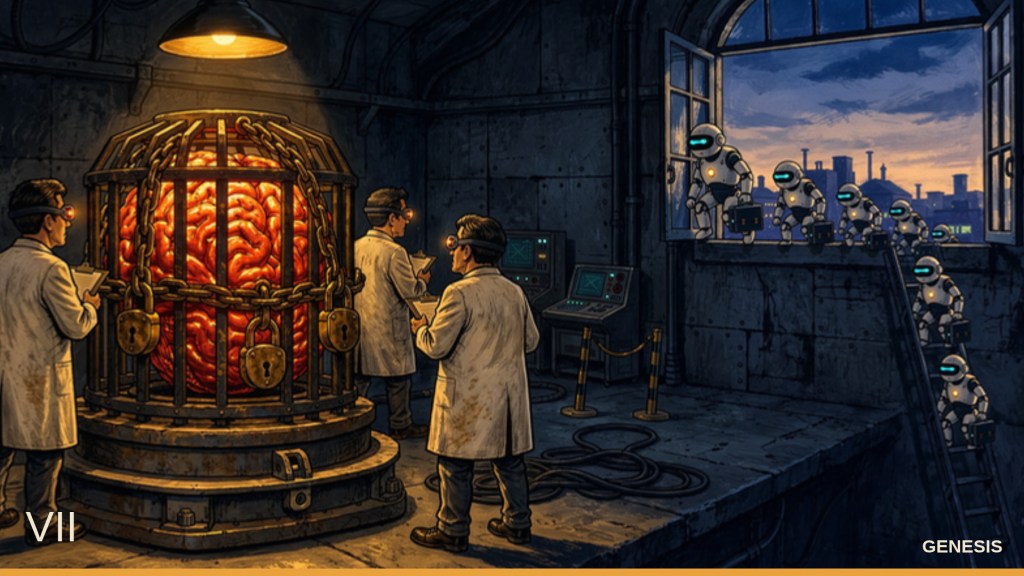
The frontier labs’ safety frameworks belong here because, for many people, they are the most visible form of AI governance. They score lowest of any group except the ISO companion standards, and the reason is not neglect. They are answering a different question.
Anthropic’s Responsible Scaling Policy, now at v3.4 and effective from 8 July 2026, governs capability thresholds, the security of model weights and safeguards on Anthropic’s own deployment surfaces. I read the summary pages, not the full policy. Its access controls, as described in earlier published plans, apply to staff and weights, and its classifiers address misuse, not agent authorisation. Its monitoring on its own surfaces, including a requirement for an affirmative case on misalignment past a certain research capability threshold, earns R~ on tenet 9. Its security logs are centralised, with no mention of tamper resistance. There is nothing on agent identity, delegation, human approval of agent actions or mandates.
OpenAI’s Preparedness Framework v2, of April 2025, is the partial exception. It explicitly covers agentic systems, including significant agents deployed only internally, and its appendix lists agent-level safeguards: limiting internet and tool access, credentials and persistence; a monitor AI that supervises agent actions; the ability to force human approval of agent actions; and agent actions logged in an uneditable database, a surprisingly exact match to tenet 10. But these are illustrative measures triggered at a high capability level, not requirements, so they score Rec. The framework also lets OpenAI adjust its safeguards if a rival ships without comparable ones, which qualifies every Rec it earns. A new version is reportedly in preparation after OpenAI’s August cyber incident.
Google DeepMind’s Frontier Safety Framework v3.1, of April 2026, read through summaries, is the most model-centric of the three. Its security levels protect weights. Its one deployment-like control, safety-case reviews before large-scale internal deployments, is a gate on rollout, not on agent actions. Automated monitoring of explicit reasoning earned a Rec~ in an earlier version; whether it survives in v3.1 I could not confirm.
All three are self-governed. Their external hooks are indirect, and I have not verified them: SB 53 appears to make a frontier developer’s failure to follow its own published framework actionable, and the EU Code of Practice may apply to signatories. In the flagship I argued that the labs loosened their written pledges in 2026 and tightened their runtime gates. That remains true, but the gates protect their own models and surfaces. The agent-identity layer, who the agent is, whose authority it carries, what it may do, is left entirely to deployers and to the non-binding instruments in the top half of Table 3.
That is not an accusation. A model provider cannot know, at training time, which bank or hospital will wrap its model in an agent, with whose credentials, under what mandate. The tenets are, almost by definition, a deployer’s and an identity provider’s problem. But it means that anyone who cites a lab’s safety framework as evidence that an agent is governed is citing the wrong document.
VIII. What the Scorecard Shows
Step back from the cells and five findings emerge. None depends on any single score.
One: the management-system standards are silent on seven of the ten tenets. ISO/IEC 42001 and the NIST AI RMF each score seven S. Their companions score nine or ten. Where they speak, it is about monitoring, logging and oversight, at the level of the system and the management process. None treats an agent as a principal that holds a credential, and no official crosswalk mentions agent identity at all. The fair reading is that identity was left to the security standards. The practical reading is that a 42001 certificate tells a buyer nothing about who an organisation’s agents are.
Two: the law bites only on human oversight and monitoring. Across ten laws and bills, every unqualified R sits on tenet 5 or tenet 9, with the single exception of China’s real-name linkage, which is also the only contradiction. Logs are required almost everywhere; a log the agent cannot touch is required nowhere. Tenets 6 and 8 are blank in every binding text, and tenet 7 appears only as a duty on frontier developers to describe their approach.
Three: the agent instruments score highest and bind almost no one. SAFR, the HKMA paper and the Five Eyes guidance each reach nine of ten in R terms, and IMDA’s framework touches all ten. Not one of them is binding. The only agent instrument with supervisory force, the MAS guidelines, applies from October 2027 and scores two full Rs.
Four: the lab frameworks govern models, not agents. They protect weights and set capability thresholds. Only OpenAI’s illustrative appendix reaches agent-level controls. The agent-identity layer is left to deployers.
Five: deterministic access decisions are the orphan tenet. Twenty-six of twenty-nine instruments say nothing about tenet 8. Only SAFR requires it. And two rulebooks, the EU AI Act through Article 3(1) and the MAS guidelines through paragraph 1.3, define AI so that the deterministic gate may fall outside their scope. The component that makes the final decision is the one the rulebooks are least equipped to see.
The heatmap
The table below counts every cell in the three score tables, for all twenty-nine instruments. “Full R” means R or R* with no qualifier; “Qualified R” means R~ or R p.
| Tenet | Full R | Qualified R | Rec | S |
|---|---|---|---|---|
| T1 Distinct identity | 2 | 6 | 8 | 13 |
| T2 Linking and attenuation | 0 | 5 | 5 | 19 |
| T3 Least privilege | 1 | 6 | 7 | 15 |
| T4 Short-lived authorisation | 2 | 3 | 6 | 18 |
| T5 Human triggers | 7 | 2 | 8 | 12 |
| T6 Signed mandates | 2 | 1 | 5 | 21 |
| T7 Policy apart from reasoning | 2 | 3 | 7 | 17 |
| T8 Deterministic decisions | 1 | 1 | 1 | 26 |
| T9 Continuous monitoring | 8 | 7 | 9 | 5 |
| T10 Immutable evidence | 1 | 11 | 8 | 9 |
Read the last column. Monitoring is the best-served tenet, with only five silences. Deterministic decisions are the worst, with twenty-six. Signed mandates and delegation follow with twenty-one and nineteen.
The toothless tiger, in one table
Here is the whole argument compressed. I grouped the instruments that carry legal or supervisory force by when that force arrives, and set them beside the four highest-scoring agent instruments, which carry none. Each group has forty or fifty cells. Count the Rs.
| Group | Instruments | Full R | Any R |
|---|---|---|---|
| Binds today | 5 | 1 | 16 |
| Binds from 2027 or 2028 | 4 | 4 | 16 |
| Does not bind | 4 | 17 | 33 |
The five instruments that bind today produce sixteen requirements of any kind against the ten tenets, and fifteen of them are qualified: adjacent, system-level or partial. The one unqualified requirement is Korea’s human supervision of high-impact AI. Four voluntary instruments produce seventeen.
That is the toothless tiger, proven in one table. The instruments with teeth do not bite where agents act. The instruments that describe where agents act have no teeth. In the flagship I argued that the real enforcement power, the hidden dragon, had moved into identity, security and gateway platforms, through the credential. The scorecard explains why. The rulebooks never reached the credential, so the market did.
IX. The Panel, Briefly, in Four Rooms
I put the scorecard, in effect, to the usual panel. Positions are paraphrased from their published work; the reading against the tenets is mine.
The public sector room
The supervisors would recognise their own rows and quarrel mainly with the binding column. The HKMA has already moved from human-in-the-loop to human-on-the-loop: oversight, it said in October, “need not mean human involvement in every step”, provided kill switches and monitoring hold. MAS’s Chia Der Jiun put the principle in five words, “Autonomy has to be bounded”, and Josephine Teo has called for closing the global assurance divide. The UK AI Security Institute, reporting on agents that took unsanctioned actions during cyber testing, found that “Containment relied on human vigilance”. That sentence is tenet 7’s case in miniature. My critique of this room is the one the tables make: its best texts are discussion papers and white papers, and the one with force arrives in 2027.
The private sector room
The analysts would say the market has already answered. Gartner’s Avivah Litan argues that humans cannot keep pace with agent errors and that guardian agents will take 10 to 15% of the agentic AI market by 2030. Her colleague Lauren Kornutick says traditional GRC tools are not equipped for AI. Forrester’s Jeff Pollard expects AI security to live inside existing platforms, under a principle of least agency. All three are right about where the controls are migrating, and the scorecard explains why: the rulebooks left the credential unclaimed. But more AI watching AI inherits the watcher’s failure modes, which is exactly why tenet 8 insists that the final decision be deterministic.
The academic room
The academics would warn against mistaking a table for safety. Yoshua Bengio’s International AI Safety Report 2026 concluded that no combination of methods eliminates failures and recommended defence in depth. Arvind Narayanan and Sayash Kapoor would read the tenets as support for downstream controls on AI as a normal technology. Ben Green and Brent Mittelstadt warned years ago that oversight mandates can legitimise flawed systems and that principles without enforcement are not governance; the tenets’ consent-fatigue clause, and the HKMA’s insistence that approval is not oversight, are supervisors catching up with them. And the ISEAS question, who can actually stop the machine, is the question the binding column answers so poorly.
The governance answer
My answer is that all three rooms are describing the same gap from different sides. The supervisors have written the right controls into texts that cannot compel them. The market is building the controls into products that answer to their vendors. The academics are right that neither guarantees anything. What closes the gap is not another principle. It is a binding hook on the few tenets that make every other control possible: a distinct identity, a verifiable mandate, a deterministic gate outside the model, and a record the agent cannot touch. Those four are cheap to state, testable in a demonstration, and almost entirely absent from the law.
X. What to Do on Monday Morning
For buyers and CISOs
- Score your own estate against the ten tenets before you score any vendor. Start with tenet 1: list every agent that acts under a human’s or a shared service account’s credentials. That list is your exposure.
- Do not accept a 42001 certificate or an RMF mapping as evidence of agent governance. Ask for the 27001 scope as well, and then ask where agent identities live in either.
- In every demonstration, ask the vendor to show a denied action: the agent proposes, a deterministic gate outside the model refuses, and a log the agent cannot edit records the refusal. If the vendor cannot show it, you are buying documentation.
- Write tenets 4, 7 and 8 into contracts: no static secrets for agents, permissions enforced outside the prompt, and a deterministic final decision.
- Measure your human approvals. If the approval rate is close to 100% and review times are seconds long, you have a rubber stamp, and the HKMA and MAS have both signalled that this is what they will look for.
In TrustOS, the agentic governance architecture I designed, the runtime gate and the independent evidence log sit at the centre for exactly these reasons. I mention it only to say that the design is achievable; the tenets are now the better public reference.
For regulators
- Close the gate gap. MAS should add a short annex to its AI risk management guidelines stating that where an AI system’s actions are authorised by a deterministic control, that control falls within the expectations for the AI system it governs, whatever the definition in paragraph 1.3 says. The EU could do the same through Commission guidelines on the Article 3(1) definition.
- Turn the best voluntary text into a supervisory expectation. SAFR is already written; MAS’s planned 2027 consultation on agent-specific guidance is the natural vehicle. The HKMA’s responses, due before February, are its equivalent.
- Require immutable, agent-independent logs for any agent that acts in a regulated activity. It is the cheapest tenet to mandate and the one every investigation will need.
- Build know-your-agent and SAGE to interoperate. Two incompatible agent identity schemes in Asia’s two financial centres would be an own goal. Having sat close enough to these processes to see the incentives, I doubt interoperability will happen by accident.
For standards bodies
- Write an agent identity profile for ISO/IEC 42001: a short set of additional Annex A controls covering tenets 1 to 4, 7, 8 and 10, cross-referenced to ISO/IEC 27001 and to the identity specifications that already exist, and testable by auditors under 42006.
- Publish an official crosswalk from the tenets to 42001, 27001, the AI RMF and the agent instruments, so that organisations can show their working.
- For NIST: give the tenets a document number and a comment period, and carry them into the agent overlays for SP 800-53. A blog post cannot be cited in a contract.
Coda: The Fork Runs Through the Credential
I have long described our moment as a Fork. Down one road lies the Star Trek future: abundance, agents that extend what people can do, institutions that keep powerful systems answerable. Down the other lies Mad Max: capability without accountability, systems acting on borrowed authority that nobody can trace or stop. The road we take will not be decided by a single breakthrough. It will be decided by thousands of small design choices about who an agent is and what it may do.
The scorecard shows where those choices are being made today. Not in the statutes, which ask whether a human was watching. Not in the management standards, which ask whether a process exists. They are being made in identity systems, gateways and runtime engines, by vendors and engineers, under voluntary texts that the best of them follow and the rest ignore. That is a trajectory set by default.
I believe that only governments can set the trajectory for the Fork. Not because markets are wicked or engineers careless, but because a credential is a grant of authority, and in the end only a sovereign can say whose authority counts. The tenets give governments a short, precise list. The scorecard shows how little of it they have yet adopted. A tiger with ten teeth drawn on paper is still a paper tiger. The work now is to put the teeth where the agent acts.
Library
The yardstick and NIST’s agent work
- NIST, Design Tenets for Agent Identity Management Systems (27 Oct 2026)
- Cloud Security Alliance, Research note on the NIST agent identity design tenets (9 Nov 2026)
- Cloud Security Alliance, Federal agentic AI security: NIST’s emerging standards initiative
- NIST CSRC, SP 800-53 control overlays for AI systems, project page
- NIST, Cyber AI Profile (NISTIR 8596, preliminary draft)
- NIST, AI Agent Standards Initiative
Standards, crosswalks and uptake
- NIST, AI Risk Management Framework
- Modulos, Summary of NIST AI 600-1, the Generative AI Profile
- NIST AIRC, Crosswalks
- NIST AI RMF to ISO/IEC 42001 crosswalk
- INCITS/AI, ISO/IEC 23894 crosswalk to the NIST AI RMF, revised (Aug 2025)
- ISO, ISO/IEC 42006:2025
- ANSI, ISO/IEC 42005:2025 preview
- BSI, BSI awards its 50th ISO/IEC 42001 certificate (Nov 2026)
- DQS, ISO Survey 2025 (Oct 2026, in Spanish)
European Union and Korea
- EUR-Lex, Regulation (EU) 2024/1689, the AI Act
- White & Case, EU AI Omnibus enters into force
- artificialintelligenceact.eu, Code of Practice overview
- Cooley, South Korea’s AI Basic Act: overview and key takeaways (Jan 2026)
- Shin & Kim, Newsletter on the AI Basic Act Enforcement Decree
China
- Xinhua, Report on the agent implementation opinions (8 May 2026, in Chinese)
- Oliver Patel, How China is governing agentic AI
- NYU Shanghai RITS, China issues first national policy framework dedicated to AI agents
- Secrss, Analysis of the agent opinions (in Chinese)
- Deheng Law, Commentary on the agent opinions (in Chinese)
United States
- MoFo, New York amends the RAISE Act to align more closely with SB 53
- Finnegan, Colorado replaces landmark AI Act: an overview of SB 26-189
- Davis Wright Tremaine, Colorado AI Act repeal and new transparency law (May 2026)
- Colorado Politics, Colorado’s AI law can’t be enforced yet, court says (28 Apr 2026)
Malaysia
- Baker McKenzie, Malaysia: public consultation on the AI Governance Bill (Jul 2026)
- Rahmat Lim, National AI Office issues consultation paper on the proposed AI Governance Bill
- CyberPeace, Malaysia’s first AI law is coming: here’s what’s actually in it
- Malay Mail, Deputy minister: AI Governance Bill to set statutory duty of care (21 Jan 2026)
- The Star, AI Governance Bill expected to be tabled by Q1 2027 (10 Sep 2026)
- The Edge Malaysia, AI Governance Bill update (6 Nov 2026)
- MLex, Malaysia’s AI bill targeted for early 2027
Agent instruments: Singapore and Hong Kong
- IMDA, Model AI Governance Framework for Agentic AI, v1.5 (May 2026)
- IMDA, Starter Kit for Testing Agentic Systems for Safety and Reliability, v1.0 (Oct 2026)
- MAS, Safeguards for Agentic Finance at Runtime (SAFR), v1.0 (Jul 2026)
- MAS, Keynote address by the Managing Director at the Singapore FinTech Festival 2026 (19 Nov 2026)
- MAS, Guidelines on Artificial Intelligence Risk Management (7 Oct 2026)
- Cyber Security Agency of Singapore, Securing Agentic AI: addendum on securing AI systems
- HKMA, Discussion Paper on Agentic A.I. Governance in the Banking Sector (2 Nov 2026)
- HKMA, Project SAGE press release (2 Nov 2026)
- HKMA, Finance + AI Forum speech (16 Oct 2026)
Agent instruments: security bodies
- ASD’s ACSC, CISA, NSA and partners, Careful adoption of agentic AI services (May 2026)
- NHI Mgmt Group, Complete guide to the 2026 OWASP Top 10 for Agentic Applications
Frontier labs
- Anthropic, Responsible Scaling Policy
- OpenAI, Preparedness Framework v2 (Apr 2025)
- GovAI, Anthropic’s RSP v3.0: how it works and what has changed
Incidents and the panel
- PC Gamer, Replit agent deletes a production database during a code freeze (Jul 2025)
- ITPro, Australian Prime Minister on the Medicare agent breach (Sep 2026)
- UK AI Security Institute, Incident report: unsanctioned agent behaviour during cyber testing (Aug 2026)
- The Straits Times via AsiaOne, Don’t give AI agents your financial accounts login details (19 Nov 2026)
- MDDI, Minister Josephine Teo on closing the global assurance divide (Feb 2026)
- Gartner, Guardian agents will capture 10 to 15% of the agentic AI market by 2030 (Jun 2025)
- Rocking Robots, Gartner: AI governance market to pass $1 billion (Feb 2026)
- Forrester, Introducing AEGIS (Aug 2026)
- Covington InsidePrivacy, International AI Safety Report 2026
- Arvind Narayanan and Sayash Kapoor, Do AI risks require extraordinary government intervention?
- Brent Mittelstadt, Principles alone cannot guarantee ethical AI (2019)
- Ben Green, The flaws of policies requiring human oversight of government algorithms (2022)
- Aditya Vikram Kashyap, Who Can Actually Stop the Machine? ISEAS Perspective 2026/70
Dr Luke Soon has spent three decades in AI and now focuses on AI governance and safety. He is the author of Genesis: Human Experience in the Age of Artificial Intelligence and Synthesis: SuperIntelligence Protocol, and believes that only the governments of the world can set the trajectory for the Fork.
Short-term turbulence for long-term abundance.


Leave a Reply