

Artificial intelligence learned the hard things first: chess, calculus, translation, the bar exam. It left for last what a toddler does without thinking, which is to see a cup, pick it up and not fall over. That inversion is the origin story of physical AI, and the best protection anyone has against mistaking a fluent demo for a working machine.
Part 1 of No Undo Button, an eight-part series on physical AI.
The Two-Minute Version
- In 1948 Alan Turing described a thinking machine with cameras, microphones, wheels and hands, judged it probably the “sure” way to machine intelligence, and set it aside as impractical. AI then built a brain without a body for three generations. What the industry now calls “physical AI” is the field walking back to the branch it parked.
- The body was always the hard half. Moravec’s paradox (1988) observes that what humans find hard, such as chess and exams, is comparatively easy for machines, while what a one-year-old finds easy, such as seeing, grasping and balancing, is hard. Language models have made the “adult” half cheap. That is exactly why the toddler half is now the frontier.
- Every era of robotics has learned this and then forgotten it: Shakey, the five-hour room crossing, Brooks’s rebellion, two AI winters, the falling humanoids of DARPA 2015, ASIMO’s twenty years without a job, Boston Dynamics’ three owners in eight years.
- The vision-language-action (VLA) moment, dated to Google’s RT-2 on 28 July 2023, is real: robots can now follow plain-language instructions in rooms they have never seen. But on DeepMind’s own evaluations of its July 2026 humanoid model, as summarised by secondary sources, a robot ties a rubbish bag 44 per cent of the time and sweeps into a dustpan 32 per cent of the time. Foundation models changed the software. They did not change the physics.
- There is no internet of touch. Robot data is manufactured one human-hour at a time, and the industry’s answer, paying people to teleoperate robots, is itself the measure of the gap.
- Read every claim through three words: SHIPPED, DEPLOYED, WORKING. The robots with a clean “working” record are narrow and boring: a caged arm, a vacuum disc, a biped moving totes. Almost everything shaped like a person is still somewhere between shipped and deployed.
- The world a robot acts on has no undo button. This series argues that assurance must therefore rest on a physical gate before the action, a record of what was ruled and a named human answerer, not on what the model says it intends.
- My view: be long on physical AI AND sceptical of every timeline. History rewards patient money, narrow useful machines and honest measurement. It punishes demos.
I. The Robot That Aces the Interview and Fails the Dishwasher
On 30 July 2026 Google DeepMind released Gemini Robotics 2. For the first time a single model controlled an entire humanoid, legs, torso, arms and fingers, under one policy. In the demonstration an Apptronik Apollo 2 was asked to put a watering can into the green bin on the bottom shelf, and it walked, picked up, carried and placed. The model sits on top of Gemini, one of the most capable language systems in the world, the kind of system that passes professional examinations and explains the thermodynamics of a kettle in four languages. Interview it for a job as a household assistant and it would ace the interview.
Then look at DeepMind’s own evaluations, as relayed by secondary write-ups (the DeepMind blog itself does not print the percentages). With a five-fingered, 22-degree-of-freedom hand, the robot unscrewed a light bulb 92 per cent of the time and screwed one in 36 per cent of the time. It tied a rubbish bag 44 per cent of the time, sealed a ziplock bag 40 per cent and swept into a dustpan 32 per cent. Whole-body picking succeeded 76.3 per cent of the time from a shelf, 68.4 per cent from a table and 45.7 per cent from the floor. DeepMind itself said movement speed still needs to advance, and the whole-body model remains available only to early-access testers. These are single tasks in a lab, not uptime in a home. That is why they matter: they are the frontier lab telling us where the frontier is.
Figure AI, valued at $39bn in September 2025, offers the other half of the picture. In January 2026 it released a four-minute video in which its Figure 03 humanoid, running the company’s Helix 02 model, unloaded a dishwasher autonomously and without resets, according to Figure. Months earlier TIME had watched a Figure 03 load a dishwasher, then freeze on a towel-folding task and need resets. A company demonstration is not a household service record, and Figure has no disclosed revenue. So here is the robot of November 2026 in one image: a machine that can discuss the dishwasher better than you can, and that no one can yet show emptying yours every evening. It aces the interview and fails the dishwasher.
This is not a new problem created by bolting language models onto robots. It is the oldest problem in the field. It was named in 1988, demonstrated in 1979 and foreseen in 1948, when Alan Turing wrote a report called “Intelligent Machinery”. In it he imagined a machine fitted out like a crude person, with television cameras for eyes, microphones for ears, loudspeakers for a voice, wheels for legs and servo-driven hands, that might learn about the world as a child does. He judged it, in words Rodney Brooks later drew attention to, “probably the ‘sure’ way of producing a thinking machine”. Then he put it down as too slow and impractical, and proposed instead to see how far one could get with a brain that had more or less no body, working on games, codes, mathematics and language.
That was AI’s founding fork, and the field took the disembodied branch. Chess programs, theorem provers, expert systems, search engines and finally the large language model all descend from Turing’s practical decision. It was a good decision. It produced a technology that can draft a contract and write the code that runs a bank, none of which requires picking up a cup.
Seventy-seven years later, on 6 January 2025, Jensen Huang told the audience at CES in Las Vegas that the next wave was “physical AI”, and that the ChatGPT moment for general robotics was just around the corner. NVIDIA launched Cosmos, a platform of world foundation models for generating the synthetic data robots lack. In 2026 Huang went further: physical AI had arrived, and every industrial company would become a robotics company. In Washington in October 2026 he put the problem in terms Moravec would have recognised, saying most AI does not understand physics, friction or cause and effect, abilities that “children and even our pets have”.
Note what the phrase is and is not. “Robotics” is the engineering discipline, dating from the 1960s. “Embodied AI” is the academic research programme of intelligence situated in a body that learns by acting. “Physical AI” is vendor framing, above all NVIDIA’s, from January 2025 onward, and it has no legal or standards-body definition; every vendor stretches it differently. It is also commercially convenient for a company whose chips run the simulations, train the models and sit inside the robots. But the phrase names something real. Physical AI is AI returning to the branch Turing set aside, carrying the enormous brain it grew on the other path. The question is whether that brain makes the body easy, or whether the body remains what it has been for a hundred years: the hard part.
My answer is the foundation of this series. The body was always the hard half. Foundation models changed what a robot’s software can attempt, and this essay honours that change in measured terms. They did not repeal touch, friction, heat, battery chemistry or the absence of physical training data at anything like language scale. And the stakes are different in kind. A bad paragraph can be deleted. A fall, a crush or a wrong grip on a frail arm cannot. In the physical world a 44 per cent success rate is not a product, and even 99 per cent is a hazard if the remaining 1 per cent involves a person. Singapore, which has the second-highest density of industrial robots on earth and is ageing fast, has more reason than most places to get this history straight.
II. Before Robots: Automata, Cybernetics and the First Promises
In Čapek’s play the manufactured workers are flesh, not tin, built to labour without complaint, and they end by taking over the factory that made them.
After Karel Čapek, R.U.R. (1920), paraphrased
The robot was named before it was built. Karel Čapek’s play R.U.R., Rossum’s Universal Robots, was written in 1920 and premiered at the National Theatre in Prague on 25 January 1921. The word was coined by his brother Josef, a painter, from the Czech robota: drudgery, forced labour. Čapek’s robots were biological, manufactured workers, and the drama is about ownership, mass production and revolt. Čapek went on to attack dictatorship, drew the Gestapo’s hostility and died on Christmas Day 1938.
So the first robot story was a labour story. It was not about consciousness or the metaphysics of mind. It was about who does the drudgery, who owns the worker and what happens when the worker can be manufactured. A century later the humanoid industry pitches exactly that, rebranded as labour as a service. Part 3 follows the fiction; here it is enough that the word arrived carrying an economic argument that has never left it.
The made, moving figure is much older than the word. Centuries of clockwork automata, built for courts, churches and fairs, had shown that mechanisms could mimic life with startling grace. But automata were theatre. They followed a cam or a drum of pins and did exactly one thing, with no senses and no way to correct themselves. What turned the automaton into the ancestor of the robot was an idea about feedback.
In 1948, the year of Turing’s report, Norbert Wiener published Cybernetics: Or Control and Communication in the Animal and the Machine. His thesis was that sensing, feedback and control are common to animals and machines. A thermostat, a gun director and a hand reaching for a glass all measure the gap between where they are and where they want to be, and act to close it. Every servo arm and every balancing humanoid descends from that loop. If Turing gave us the disembodied brain, Wiener gave us the vocabulary of the body. When I describe to boards the shift from prompts to loops, and from loops to loop governance, I am describing cybernetics with a language model as the controller. Once a loop runs on its own, the governance question follows from the architecture: who sets its goal, and who can see inside it?
The first free-roaming machines built on those ideas came from Bristol. In 1948 and 1949 the neurophysiologist William Grey Walter, at the Burden Neurological Institute, built two three-wheeled robots, Elmer and Elsie, which he classed as Machina speculatrix. They were tortoises with a light sensor, a touch sensor and the equivalent of two neurons. They used phototaxis to wander and to find their way back to a recharging hutch, and later versions were shown at the 1951 Festival of Britain. They had no map and no plan, yet their behaviour looked purposeful, even playful. Placed before a mirror with a light on its shell, one began, in the description Nautilus recounts, “flickering, twittering, and jigging like a clumsy narcissus”.
Two lessons from the tortoises would lie dormant for decades. Rich behaviour can emerge from simple sensing and acting in the real world, without an internal model. And humans read minds into moving things, a theme Part 7 takes up. By 1950 the roots were three strands: from Prague the robot as manufactured labour, from Wiener the body as a feedback loop, from Bristol the provocation that intelligence might be something a body does rather than something a brain computes. Even Isaac Asimov’s Three Laws, first set out in his 1942 story “Runaround”, were rules for a machine that did not yet exist. The laws came before the robots. The robots, when they came, came without minds.
III. Moravec’s Paradox, Stated Properly
The first serious attempt to give a robot a mind was made at the Stanford Research Institute. Between 1966 and 1972, with DARPA funding, a team led in part by Charles Rosen built Shakey, the first mobile robot to combine perception, planning and action. It looked at its rooms with a camera, built a model of them, planned with the STRIPS planner and pushed boxes about. It was named, Rosen said, because “it shakes like hell and moves around”. Its legacy is extraordinary and almost none of it is about the body: the A* search algorithm, the Hough transform, the visibility-graph method and STRIPS itself. In 1970 Life called it the first electronic person. It was slow, brittle and confused by moving obstacles, a pattern that would recur.
Shakey set the template later called Good Old-Fashioned AI: sense, model, plan, act. It is the natural architecture for a brain designed on the disembodied branch, because it treats the body as an input and output device for a reasoning engine. The trouble is that the world does not hold still while you reason about it. The most vivid proof came from Stanford in 1979, when the Stanford Cart, a wheeled platform carrying a television camera, crossed a chair-filled room without human help. It took about five hours. It moved in spurts of about a metre and paused for ten to fifteen minutes each time to think. The researcher who got it across was Hans Moravec.
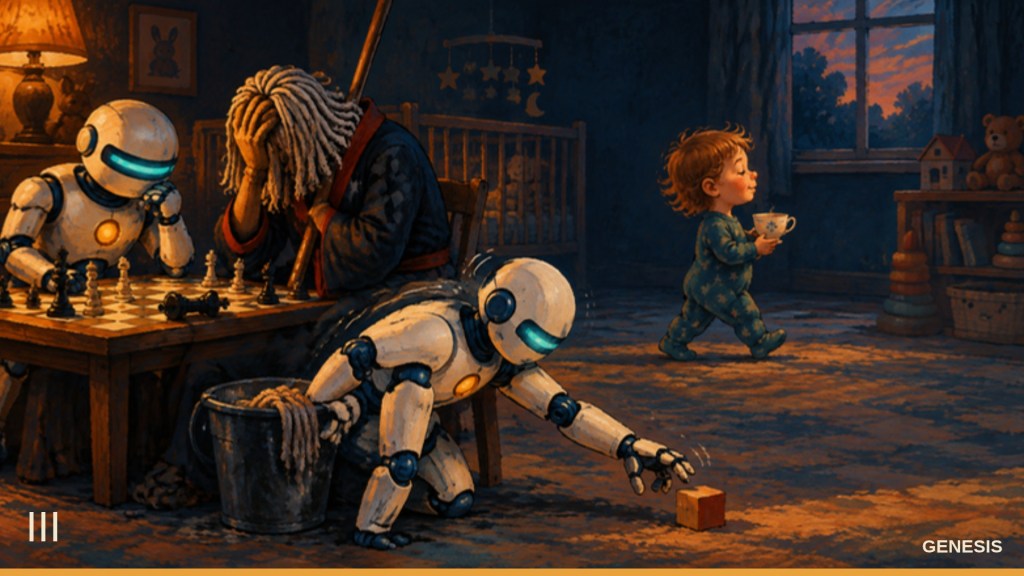
Five hours to cross a room that a toddler crosses in seconds, carrying a toy. By then computers played respectable chess. In his 1988 book Mind Children, Moravec named the inversion. It is comparatively easy, he wrote, to make computers show adult-level performance on intelligence tests or at draughts, and difficult or impossible to give them “the skills of a one-year-old” in perception and mobility. (The wording is verified across several secondary sources; some render the game as “checkers and chess”, a variant I could not resolve against the book.) Marvin Minsky made the same point in The Society of Mind in 1986, and Steven Pinker later compressed it: the hard problems are easy and the easy problems are hard.
Moravec’s explanation was evolutionary. Seeing, grasping and balancing encode hundreds of millions of years of evolved experience, running on vast neural machinery below awareness. Arithmetic and chess are a thin, recent cultural veneer that we perform clumsily and consciously. Because we feel the effort of the veneer, we mistake it for the essence of intelligence; because we do not feel the effort of the foundation, we think it trivial. Machines designed by humans inherit our blind spot.
Fairness requires a caveat. The computer scientist Arvind Narayanan has argued in a 2025 to 2026 fact-check that the paradox has never been empirically tested, has no predictive power about which problems will turn out easy or hard, and rests on a dubious evolutionary story. Deep learning, he notes, changed the cost of perception after Moravec wrote. I accept the criticism. The paradox is a framing observation, not a law of nature, and this essay uses it as one.
Read that way, it is still the single most useful idea for anyone trying to understand physical AI. Language models have made the “adult” skills spectacularly cheap. What they have not made cheap is the toddler’s. A robot that can explain the physics of a folded shirt in fluent prose still struggles to fold one reliably. The paradox has not been solved. It has been sharpened: the easy problems have been solved so thoroughly that the hard ones stand alone, and that is where the money is going. Each new technique, from image recognition in 2012 to deep reinforcement learning, made one slice of the toddler’s repertoire tractable and left the rest, especially touch, contact, force and recovery from error, more conspicuous. I expect VLA models to repeat the pattern. They narrow the paradox. They do not abolish it.
IV. Brooks and Behaviour-Based Robotics: Intelligence Without Representation, and Its Limits
If Shakey was the establishment, Rodney Brooks was the rebellion. In 1986 the Australian roboticist at MIT published “A Robust Layered Control System for a Mobile Robot” in the IEEE Journal of Robotics and Automation, introducing the subsumption architecture. It did away with the central planner and the central world model. A robot would instead have layers of simple behaviours running in parallel, each connecting perception directly to action: the lowest layer avoids obstacles, the next wanders, the next seeks a goal, and higher layers subsume lower ones. Brooks demonstrated it on robots called Allen, Herbert and the six-legged Genghis.
His 1991 paper “Intelligence without Representation”, in Artificial Intelligence, drew the conclusion: explicit models of the world get in the way, and it is better to use the world as its own model. The popular slogan, “the world is its own best model”, is a shortening of that sentence, not a verbatim quotation. His companion essay, “Elephants Don’t Play Chess” (1990), has one of the best titles in computer science. An elephant navigates, forages, remembers and cooperates without anything resembling symbolic reasoning. Intelligence, Brooks argued, is grounded in physical interaction. This was Grey Walter’s tortoise given a research programme, and quietly a return to Turing’s parked branch.
The rebellion produced a product. In 1990 Brooks co-founded iRobot with Colin Angle and Helen Greiner, and in September 2002 iRobot unveiled the Roomba, a disc that cleaned a floor by reacting: bump, turn, spiral, follow the wall. A million were sold by 2004, and iRobot had sold more than thirty million home robots by 2020. The Roomba deserves more respect than it gets. It did one job, was cheap enough to buy on impulse, was harmless when it failed, did not need to be perfect, and had the right shape for its task, which was not a person’s. Nobody wanted a humanoid pushing a vacuum cleaner. They wanted the vacuum cleaner to drive itself.
Now the coda. On 14 December 2025 iRobot filed for Chapter 11. It is to be taken over by Shenzhen Picea Robotics, its own contract manufacturer. The company that turned an MIT rebellion into a household object ended up owned by the Chinese factory that built it. The ideas came from Cambridge, Massachusetts; the margins, the manufacturing know-how and finally the brand went to Shenzhen. Part 4 tells that story at national scale.
Behaviour-based robotics had real limits. Stacked reflexes are superb for wandering and vacuuming and weak at tasks that need memory, sequence and intention: making tea, assembling a gearbox, helping an elderly person from chair to toilet in a particular order, in a particular bathroom. Brooks was right that a stored, ageing internal model is a liability. He was wrong, in the strict form, that representation could be dispensed with. Practical systems became hybrids, a reactive layer to keep the body safe and a deliberative layer to decide what to do. Today’s VLA models are the synthesis: a huge learned representation from web pretraining, coupled directly and at high frequency to fresh sensor readings. Figure describes Helix as a slow “System 2” that reasons and a fast “System 1” that moves; NVIDIA’s GR00T and DeepMind’s Gemini models use similar dual designs. The debate is no longer representation against no representation. It is where the representation lives and how fast it is refreshed.
Brooks is now the most prominent sceptic of the humanoid boom, and his credentials are unmatched. He began building humanoids at MIT in 1992. His later company, Rethink Robotics, delivered thousands of Baxter and Sawyer upper-body humanoids to factories between 2012 and 2018; one Sawyer in Oregon was shut down in late 2025 with 35,236 hours on its clock. In September 2025 he argued that believing humanoids will do the manual work humans do “any time within decades is pure fantasy thinking”, as reported in secondary coverage. His point is that demonstration data lacks force feedback and touch, and that the human hand has about 17,000 touch receptors. In his predictions scorecard of 1 January 2026 he forecast that deployable dexterity will remain far behind human hands beyond 2036, advised people to stay at least three metres from a full-size walking robot, and predicted plenty of humanoids in fifteen years that look like neither today’s humanoids nor humans: wheels, several arms, specialised sensors. The man who did most to put the body back into AI is the loudest voice saying the body is still hard. That is not a contradiction. It is what experience looks like.
V. The Industrial Detour: Arms Behind Fences
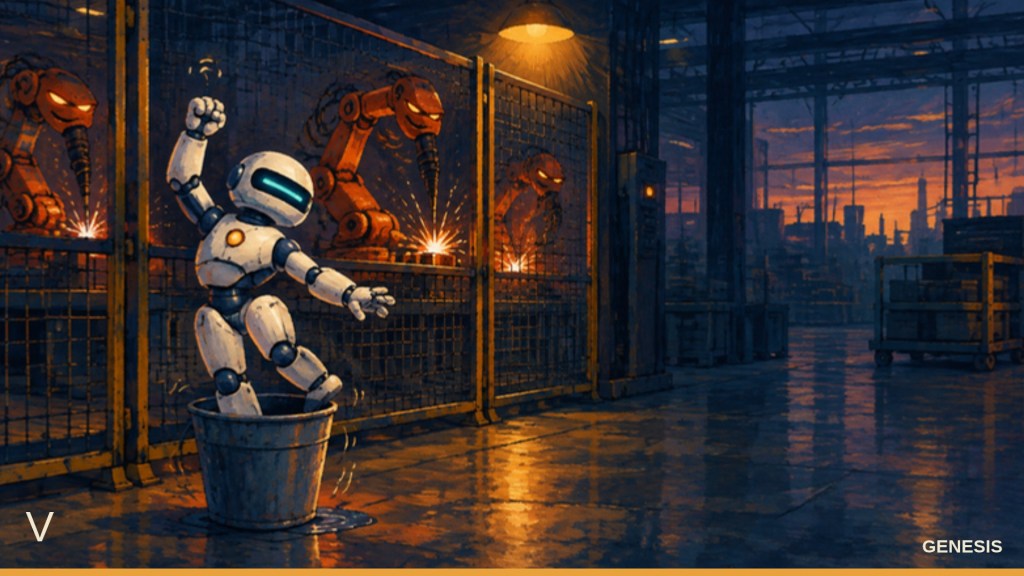
The first robot to earn a living did not see, walk or think. It lifted hot metal. George Devol filed a patent for “Programmed Article Transfer” on 10 December 1954, granted on 13 June 1961. With Joseph Engelberger he founded Unimation, and in 1961 the first Unimate went to work at General Motors in Ewing Township, New Jersey, handling die-cast parts. It did one thing, in one place, in a cell built around it. The intelligence was in the environment, designed by engineers, not in the machine.
Here is the fact I wish every humanoid investor would pin above their desk. The Unimate was first sold to GM in 1960. Unimation did not turn a profit until 1975: about fourteen years from first sale to first profit, for a machine doing a simple, valuable job in the most structured environment industry could offer. The industrial robot became one of the great commercial successes of the century, and it still took a decade and a half to make money.
The centre of gravity moved east fast. Kawasaki licensed Unimation’s technology in 1968 and built the Kawasaki-Unimate 2000, Japan’s first domestic industrial robot, in 1969. FANUC and Yaskawa began making robots in 1974. Within a decade Japan had become what later writers called the robot kingdom. The popular explanation is cultural, Astro Boy against Frankenstein. Honda’s ASIMO team was reportedly asked to model its robot on Astro Boy and aimed for a “partner for people”. But the anthropologist Jennifer Robertson has shown that Japan’s robot optimism was also constructed by ministries and corporations, and tied to demographic policy. The stronger explanation is the boring one: industrial policy, tight labour markets and firms that could make precise machines. Robot adoption follows economics more than folklore.
Europe supplied the shape. In 1973 KUKA’s FAMULUS became the first articulated robot with six electromechanically driven axes, the layout that now dominates industry. About a year later ASEA, now ABB, presented the IRB 6 with an internal microprocessor; its first units went into production in January 1974. By then the recipe for the industrial robot was complete: electric drives, six joints and a computer inside the arm.
Meanwhile the ambition to build general-purpose embodied intelligence went through two winters. In Britain, Sir James Lighthill’s report, published in 1973, judged that AI, and robotics in particular, had failed its grandiose objectives, citing the combinatorial explosion; British funding was cut to all but two universities, and DARPA moved money away from undirected AI research. A second winter followed the collapse of the expert-systems boom and the specialised Lisp-machine market around 1987. (The phrase “AI winter” itself dates from 1984.) What did not winter was automation. The arms kept selling. The winters hit general-purpose embodied intelligence, not robots that did one thing well, and that distinction is the most important lesson of the period.
Where did it lead? On the International Federation of Robotics’ figures for 2023, robot density, industrial robots per 10,000 manufacturing employees, stood at 1,012 in Korea, 770 in Singapore, 470 in China, 429 in Germany and 419 in Japan. Singapore was second in the world. People who think of us as a financial centre are surprised. They should not be. Our semiconductor, precision-engineering, pharmaceutical and electronics plants are among the most automated anywhere. We have lived in the robot century for decades without noticing, because industrial robots live behind fences. That is Singapore’s real advantage in physical AI: not that we will invent the humanoid, but that we know how to run automated operations, measure them and govern them.
Outside the fence
Whenever robots left the fence, the paradox reasserted itself in public. At DARPA’s first Grand Challenge, on 13 March 2004 in the Mojave, no vehicle finished; Carnegie Mellon’s Sandstorm went furthest, 7.32 miles, before sticking on a rock. Stanford’s Stanley won the 2005 race in 6 hours 54 minutes, and Carnegie Mellon’s Boss won the 2007 Urban Challenge. The DARPA Robotics Challenge Finals, in Pomona on 5 and 6 June 2015 after Fukushima, were won by KAIST’s DRC-HUBO, which completed all eight tasks in 44 minutes 28 seconds. The world remembers the compilation videos of expensive humanoids toppling over doors and steps: Moravec’s paradox as slapstick.
Honda’s ASIMO, unveiled in 2000, could run, hop on one leg, sign and pour a drink. Its last upgrade came in 2011 and it gave its final regular performances in March 2022, after about twenty years. It never found a job. Boston Dynamics, whose videos persuaded the public the body had been solved, tells the same story through its owners: Google bought it on 13 December 2013; SoftBank agreed to buy it in June 2017; Hyundai completed a controlling-stake purchase on 21 June 2021 at a $1.1bn valuation. The hydraulic Atlas, introduced in 2013 with DARPA funding, was retired on 16 April 2024 and an all-electric Atlas unveiled the next day. At CES on 5 January 2026 a production Atlas was shown, with all 2026 deployments committed to Hyundai’s robotics application centre in Savannah and to Google DeepMind, now its AI partner. Hyundai plans to use Atlas for parts sequencing from 2028 and assembly by 2030, and plans a US factory able to build 30,000 a year. Three owners in eight years, and Google back as the brain supplier, by contract, nine years after selling the body: the business case for a general-purpose humanoid has been the hardest part of all.
What did the factories teach? Structure the environment and the robot can be simple. Safety came from separation: arms were fenced because power, speed and mass made contact dangerous, and the humanoid pitch is precisely to remove the fence. And payback is slow even for the right machine. The hard part of robotics is everything outside the cell, and the humanoid is an attempt to leave the cell entirely.
VI. The Learning Turn: From Programmed Motion to Learned Policy
For most of the century, motion was programmed: an engineer specified a welding arm’s trajectory joint by joint. The learning turn replaced specification with a policy, a neural network mapping what the robot senses to what its motors do, learned from data.
Two moments from outside robotics made it possible. On 30 September 2012 a Toronto team, Alex Krizhevsky, Ilya Sutskever and Geoffrey Hinton, won the ImageNet competition with AlexNet, at 15.3 per cent top-5 error against 26.2 per cent for the runner-up, training on two NVIDIA gaming GPUs. It proved that learned features beat hand-crafted ones at scale, and it largely solved the perception half of the toddler’s repertoire. Then on 30 November 2022 OpenAI released ChatGPT. It did not invent the language model; it gave it an interface and a public, reaching a million users in five days. Robotics has had no equivalent adoption event. No robot product has had a ChatGPT moment, whatever the keynotes say.
Inside robotics, a marker is “End-to-End Training of Deep Visuomotor Policies” by Sergey Levine, Chelsea Finn, Trevor Darrell and Pieter Abbeel (posted 2015, published 2016), which mapped raw camera images directly to motor torques, with networks of about 92,000 parameters, on tasks such as screwing a cap onto a bottle. Tiny by today’s standards, enormous in idea: perception and control learned together with no hand-built model in between.
On 16 October 2019 OpenAI showed a robot hand solving a Rubik’s Cube one-handed with policies trained only in simulation. Its technique, automatic domain randomisation, varied the simulated physics so widely that reality looked like one more variation. It remains the iconic sim-to-real result. Then OpenAI walked away, closing its robotics group in July 2021. Wojciech Zaremba explained that “there was actually some components missing”, and has elsewhere said the missing piece was enough real-world data. OpenAI later invested in robot makers, partnered with Figure (until Figure ended the partnership in February 2025), rebuilt a robotics team from late 2024 and, according to secondary reporting, created an in-house OpenAI Robotics division in May 2026. Sam Altman was reported in September 2026 as saying OpenAI would definitely build a humanoid. It has shipped no robot. The leading AI lab of the decade left the body, built the most capable language models in the world, and came back: Turing’s fork in miniature.
Simulation became the industrial bet. NVIDIA’s Isaac tools run thousands of simulated environments in parallel; its Newton physics engine was built with Google DeepMind and Disney; Cosmos, by NVIDIA’s account, was trained on 20 million hours of video. Google DeepMind’s Genie 3 generates interactive worlds. Simulation is now good enough to pretrain and to generate useful synthetic data. It is not good enough, on its own, to produce a policy that works first time on contact-rich manipulation, and every serious programme combines simulation with real data. The gap is widest where it matters most. Locomotion transfers well, which is why robot videos are full of running and kung fu. Fine handwork, which depends on friction and deformation at a fingertip, transfers poorly. Ken Goldberg calls simulation notoriously unreliable for manipulation; Stanford’s 2026 Emerging Technology Review, in a chapter led by Allison Okamura, says simulations add data but lack real-world complexity.
A third route is to learn the physics rather than simulate it. Meta’s V-JEPA 2 (11 June 2025), pretrained on more than a million hours of video and then about 62 hours of robot data, achieved 65 to 80 per cent zero-shot pick-and-place of new objects in unseen labs, yet video models scored at or close to chance on Meta’s intuitive-physics test, where humans score 85 to 95 per cent. Yann LeCun left Meta in November 2025, regarding language models as a distraction, and founded AMI Labs, headquartered in Paris with offices in New York, Montreal and Singapore, which raised $1.03bn in March 2026 to build world models that learn the rules of the physical world in an abstract representation. One of the field’s biggest bets on machine understanding of the physical world has a desk on our island. It also completes a three-act story: Shakey’s hand-built world model, Brooks’s refusal of any model, and today’s learned world model.
VII. The VLA Moment: Language Models Acquire Hands
If one moment marks the disembodied branch reaching across to the embodied one, it is 28 July 2023. That day Google DeepMind posted “RT-2: Vision-Language-Action Models Transfer Web Knowledge to Robotic Control”, by Brohan and 53 co-authors including Karol Hausman, Sergey Levine and Chelsea Finn. The trick was disarmingly simple. Each continuous movement was cut into 256 bins and written out as ordinary text tokens. A vision-language model was then fine-tuned on robot trajectories and web tasks at the same time, so that it emitted actions in the same stream as words. The paper named the category: vision-language-action, or VLA, models.
Across about 6,000 real-robot trials, success on unseen scenarios rose from 32 per cent for its predecessor RT-1, a 35-million-parameter transformer trained on 13 robots over about 17 months in an office kitchen, to 62 per cent. RT-2 could act on instructions that never appeared in robot data: pick up something that would help with a headache, or use a rock as an improvised hammer. That is the conceptual breakthrough. Web knowledge transferred into the gripper.
The paper was also honest about its limits, and they are the origin story in miniature. Web pretraining did not give the robot new physical motions; its skills stayed within the range of its robot data. Generalisation moved from the motion to the meaning: new objects and symbols, not new movements. And the largest model, 55 billion parameters, ran at one to three decisions a second from a bank of cloud TPUs, too slow for fast or delicate work. The brain had arrived. The body was still where it was.
From there the pace became dizzying. Open X-Embodiment (October 2023) pooled about a million episodes from 22 robot types across 21 institutions, and showed that a model trained on many bodies did better on each. Physical Intelligence, founded in March 2024 by Hausman, Levine, Finn and others, released π0 on 31 October 2024: a vision-language model of about 3 billion parameters plus a 300-million-parameter “action expert” producing continuous movements at up to 50 a second, a key departure from RT-2’s text tokens. The company called it “the most capable and dexterous generalist robot policy to date” and open-sourced it in February 2025. Successors followed: π0.5 in April 2025, generalising to unseen homes; π0.6 in November 2025, with reinforcement learning from real experience; and π0.7 on 16 April 2026, a steerable model that can be coached in plain language. Critics asked whether one celebrated air-fryer result reflected generalisation or near-duplicates in training data, robotics’ version of benchmark contamination, and the authors acknowledged the ambiguity.
The big platforms followed. Figure announced Helix in February 2025 and Helix 02 in January 2026. Google DeepMind launched Gemini Robotics on 12 March 2025, adapting to new tasks with about 100 demonstrations, then an on-device version in June 2025, and Gemini Robotics 2 in July 2026. NVIDIA released GR00T N1 in March 2025 as the first open humanoid foundation model and previewed GR00T N2 at GTC in March 2026, claiming it succeeds at new tasks more than twice as often as leading VLAs, without benchmark details. AgiBot announced GO-2 in April 2026, claiming to beat π0.5 and GR00T without publishing scores.
What changed, in measured terms? Four things, each documented. Language became the interface: robots can be instructed in plain English and draw on web knowledge of what is graspable or fragile without hand-coding. Skills transfer across bodies with a few hundred demonstrations; DeepMind’s On-Device 2 model (July 2026), by the company’s own evaluations as summarised by a secondary source, adapted to a new two-armed robot from fewer than 200 examples, lifting success from 24.4 to 75.6 per cent. Robots sustain multi-minute tasks such as laundry and espresso. And the stack collapsed: one model replaced a pipeline of separate perception, planning and control modules. The bottleneck moved from perception to data, dexterity, reliability and safety.
What has not changed matters as much. No lab has published factory-grade reliability, 99 per cent or better, on dexterous tasks. Every lab reports success on its own tasks, robots and scenes, so cross-lab comparison is largely meaningless; there is no shared, independent benchmark. No humanoid company publishes uptime, intervention rates, mean time between failures or gross margin. An editorial autonomy ladder, loosely modelled on driving levels, helps: Level 0 is puppeteered; Level 1 is autonomous on scripted tasks in a fixed cell, the industrial arm; Level 2 is autonomous on varied tasks with a human on call, where most humanoids sit; Level 3 is autonomous in a defined domain with rare interventions, which factory pilots claim without publishing the data; Level 4, open-world home autonomy, is occupied by no one. The VLA moment moved the field from Level 1 towards Level 2. The step to a measured Level 3 is what would justify today’s valuations, and history says it is the slowest step of all.
Physical Intelligence is the cleanest test of how markets price that step. It raised $400m at $2.4bn in November 2024 and $600m at $5.6bn a year later; in October 2026 Bloomberg reported talks at about $20bn. It has no disclosed revenue; a beta programme for outside developers opened only on 13 October 2026. Robotics start-ups raised nearly $14bn in 2025. These valuations price an option on a GPT moment for bodies. Perhaps it will come. But remember Unimation’s fourteen years, and that the GPT moment for language arrived only after the internet had spent decades writing down the training data.
VIII. The Data Problem: There Is No Internet of Touch
Language models trained on something humanity spent centuries producing and the internet two decades digitising: a written record of how people describe the world. There is no record of how people touch it. Nobody uploaded the forces in their fingertips while buttoning a shirt, or the adjustments of a carer’s grip as a patient shifts their weight. Text is scraped. Robot data is manufactured, one human-hour per robot-hour, on hardware that breaks.
Ken Goldberg made this the core of a widely cited Science Robotics paper on 27 August 2025. The text and images behind today’s vision-language models, he calculated, would take a human about 100,000 years to read or view, against about a year’s worth of data in the largest robot dataset. On paired vision and action data his verdict was blunt: “Those data do not exist on the internet.” The 100,000-year figure is a rhetorical comparison inside an argument, not a measurement. What it captures is the order of magnitude, and every other estimate agrees. Frontier language models train on trillions of tokens; Open X-Embodiment, among the largest open robot datasets, holds just over a million trajectories. DROID, a major open dataset, took 50 collectors across 13 institutions twelve months to gather 76,000 trajectories.
Totals are contested. An industry estimate reported by Reuters in August 2026 put the world’s real-world robot data at about 500,000 hours, against roughly 100 million said to be needed. Generalist AI says its GEN-0 model alone was pretrained on more than 270,000 hours, and Xiaomi reportedly trained a 2026 model on more than 100,000 hours. These do not reconcile, and nobody knows how much robot data exists. The people who need it agree there is not enough.
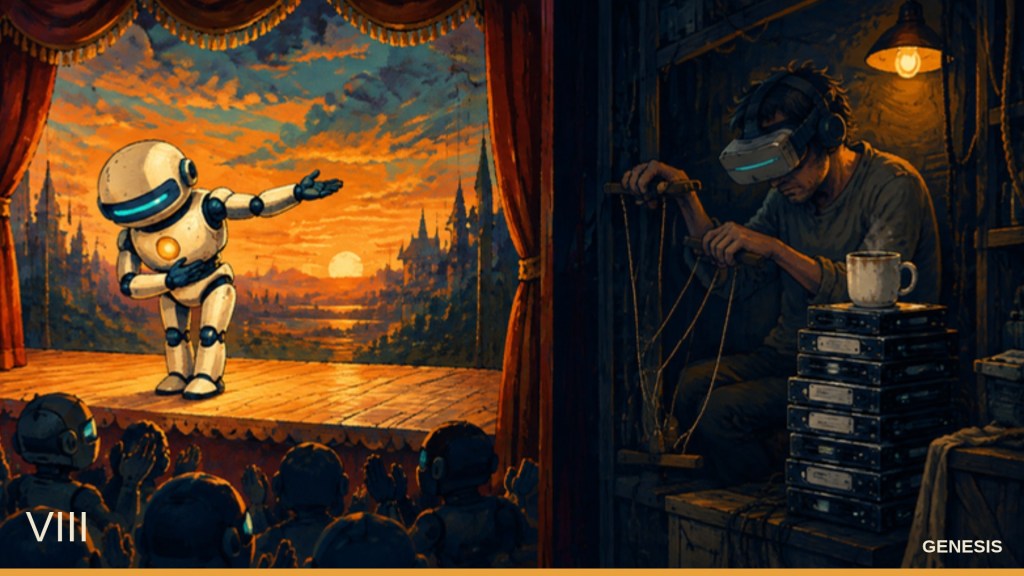
So the industry manufactures data with human labour, all of the following routes at once. Teleoperation at scale: OpenAI opened a San Francisco facility in February 2025 where operators run robot arms around the clock in three shifts. Cheap rigs: ALOHA, a bimanual teleoperation set-up costing under $20,000, made two-armed data affordable. Gloves and handheld grippers that record people doing tasks without a robot; Sunday Robotics’ chief executive Tony Zhao says “Data has always been the biggest bottleneck in robotics.” Synthetic multiplication: NVIDIA says GR00T N1 stretched 88 real hours into 827 with generated trajectories. And human video, whose embodiment gap, a human body is not a robot body, has not been convincingly bridged.
China has industrialised the process. By end-2025 it had at least 30 robot data-collection centres, recruiting collectors on social media at about RMB 20 an hour. NPR visited one in Deqing, 86,000 square feet of mock kitchens, hotel rooms and factory lines staffed by VR teleoperators and human “resetters”, and reported that most of the tens of thousands of humanoids sold in China have gone to training firms like it rather than productive work. Reuters found a novice trainer may need about 300 attempts to produce one usable movement.
Teleoperation also sits inside products. 1X’s NEO home humanoid, offered from October 2025 at $20,000 or $499 a month, has an “Expert Mode” in which a 1X employee pilots it through virtual reality, with the owner’s approval, when it cannot finish a task, seeing inside the home as it does. Its chief executive has been open about this. As of November 2026 no independent source had confirmed a paid delivery to an ordinary consumer, and 1X has not disclosed operator minutes per robot. At Tesla’s October 2024 “We, Robot” event, the Optimus robots serving drinks were teleoperated by humans, as Bloomberg and others confirmed. Rule of thumb: unless a video says fully autonomous, real speed and uncut, assume some mix of teleoperation, speed-up and editing.
None of this is scandalous. Teleoperation is a legitimate way, perhaps the only way, to bootstrap a body, and the accelerationist case rests on it: deploy, collect, retrain, and every robot in the fleet learns what one learned. But it changes what a buyer buys. A robot that needs a human on call is a Level 2 machine with a remote worker attached, and the worker, the video of your home and the question of who is accountable come with it. The data problem is also a labour, privacy and governance problem; Parts 2, 6 and 8 take each up.
IX. The Bottlenecks That Remain, and the Promise in the Shape
Even with unlimited data the body would be hard, because it is materials, motors, sensors and energy, each with its own physics.
Dexterity, not walking, is the gating constraint. Analysts no longer treat walking as the gating issue for pilots. Hands are. Tesla missed its target of 5,000 Optimus units in 2025, with hand design blamed; Musk admitted on the October 2025 call that the dexterous hand was especially difficult. Gemini Robotics 2’s own numbers show the cliff: 92 per cent unscrewing a bulb, 32 to 44 per cent on tying, sealing and sweeping. Broker analysis reported in secondary sources puts hands at a large share of a humanoid’s bill of materials; I treat those figures as estimates. The hand, not the leg, decides the unit economics.
Touch. Allison Okamura, who has spent a career on haptics and soft robots, is sceptical that simulation captures real contact, and expects robot brains to improve faster than robot bodies. By one hand survey reported second-hand, fewer than half of humanoid hands have fully integrated tactile sensing. Fingertip sensors are improving fast, but taxel data must reach the policy quickly enough to change the grip and must survive repeated contact. A robot that cannot feel how hard it grips must be too gentle to be useful or too strong to be safe, and that trade-off bites hardest in hospitals and homes.
Safety and certification. Industrial arms were made safe by fences. Walking humanoids remove the fence and add falling. Amazon, which piloted Agility Robotics’ Digit, reportedly told Agility it could not scale a balancing robot without years of safety certification; Agility designed its next model, Digit 5, to work alongside people without a barrier. That is the clearest evidence that standards and insurance, not demos, gate deployment next to people. A former Figure safety lead’s lawsuit alleging dangerous impact forces is disputed by Figure and untested in court.
Energy, heat and cost. Motors that can lift a person draw power and make heat; batteries that feed them are heavy. Okamura has said a home humanoid might need charging every hour; I could not verify runtime figures for any named humanoid. Stanford’s 2026 review lists high costs, inefficient energy use and safety concerns as what limits adoption. Prices are falling, mainly through Chinese supply chains, but Okamura warns that onshoring components would send costs sharply higher, and the rare earths in actuators are mined and processed mainly in China. The cheap humanoid is a Chinese humanoid (Part 4).
Now set these next to the shape. A humanoid’s form is a claim. Hands imply dexterity; a face implies understanding; human height implies it belongs among us. I call this the promise in the shape. The shape is chosen for good reasons, since our buildings and tools are designed for human bodies, but it also sells, inviting us to assume competence the hands, touch, batteries and safety record have not earned. Okamura put it plainly in February 2026: “Most humanoid robots, they don’t deliver on that promise.”
The test of the promise is the ledger. Shipped means units left the factory. Deployed means units at a named customer’s site. Working means units doing a named task, for stated hours, with output a third party can see. Here is the ledger as of November 2026.
| Programme | Shipped | Deployed | Working (third-party evidence) |
|---|---|---|---|
| Unimate (1961) | Yes | General Motors, New Jersey | Yes: die-cast handling; maker profitable from 1975 |
| Roomba (2002) | Over 30 million iRobot robots by 2020 | Homes | Yes, one narrow task; maker filed for Chapter 11 in December 2025 |
| ASIMO (2000) | Demonstration units | Stages and showrooms | No productive job in about 20 years |
| Agility Digit | Small numbers; Agility’s 2025 net sales about $1.8m | GXO (paid contract since 2024); nine committed customer deployments in all | Yes, narrow: over 100,000 totes moved at GXO; over 65,000 hours across deployments (company figures) |
| Figure 02 at BMW | Pilot units | BMW Spartanburg, 11 months | Partly: over 1,250 hours and 90,000 parts loaded (company and customer reported); one task; no intervention data |
| Figure 03 | Over 350 delivered by April 2026 (company claim) | Returned to BMW June 2026 | Disputed: an October 2026 report relaying BMW says the test ended and no Figure robot now works in its plants |
| Boston Dynamics Atlas | 2026 output committed | Hyundai and Google DeepMind | Not yet: Hyundai plans sequencing from 2028 |
| Tesla Optimus | No official count; a few hundred by mid-2025 (estimate) | Internal factories | Musk, January 2026: not yet used in its factories in any material way |
| 1X NEO | Production reportedly under way | No independently verified consumer delivery | Relies on remote operators; minutes undisclosed |
| Unitree humanoids | Over 5,500 in 2025 (filing) | Mostly research and education buyers | 73.6% of Jan to Sept 2025 revenue from research and education; 9.0% industrial |
The pattern is plain. The machines with a clean “working” column are the boring ones: an arm in a cage, a disc that vacuums, a biped moving totes. Figure at BMW is the strongest sustained humanoid pilot in the West, and it is one task, a handful of robots and about 1,250 hours over eleven months. Absence of published uptime and intervention data is the finding; it is not proof the numbers are bad. But buyers, regulators and investors are entitled to ask, and history says to wait for the answer.
X. The China Thread: From 863 to the STAR Market
A Western telling runs from Čapek to Unimate to Boston Dynamics, with Japan as a chapter. That now misses the main plot. Part 4 examines China’s rise; here are its roots.
Jiang Xinsong, whom Chinese state media call the father of Chinese robotics, led the Shenyang team that built China’s first industrial robot system, SZJ-1, in 1982. On 3 March 1986 China launched the 863 Program, which began as a letter from four scientists to Deng Xiaoping, approved within two days; its grants helped carry robotics from laboratory to industry. Jiang’s former doctoral student Qu Daokui founded Siasun in 2000 as a spin-off of the Shenyang institute, and in 2009 it became China’s first listed robotics company. In May 2015 Made in China 2025 made robotics a priority, targeting a domestic share of China’s industrial-robot market of 50 per cent by 2020 and about 70 per cent by 2025; local firms held about a third in 2018, up from about 5 per cent a decade earlier. In August 2016 Midea secured 94.55 per cent of KUKA, the maker of FAMULUS, at a €4.6bn valuation, over warnings from German politicians about know-how flowing east. European technology-sovereignty politics woke up to robotics that year.
Scale followed. By 2023 China’s robot density of 470 had overtaken Germany and Japan. Its industrial-robot exports reached ¥6.29bn in the first half of 2026, to 141 countries and regions. In humanoids, counts disagree because definitions do: the IFR counts about 7,000 full-size humanoids sold worldwide in 2025 for commercial use (taller than 140 cm), Omdia about 13,300 to 14,600 general-purpose embodied robots, a Chinese industry source about 17,000, and Reuters about 20,000, some 95 per cent Chinese. Every count puts China far ahead; Western makers report in hundreds and talk about capacity. Beijing’s first humanoid half marathon, in April 2025, was won in about 2 hours 40 minutes while other entrants fell near the start; every robot was remote-controlled. In April 2026 more than 300 robots ran, about 40 per cent navigating autonomously: a genuine year of progress, staged as national theatre.
Unitree listed on Shanghai’s STAR Market in August 2026, with offline subscription demand around 2,760 times the shares offered, and its shares reportedly opened 629 per cent higher. It shipped more than 5,500 humanoids in 2025 on revenue of ¥1.70bn and is a rare profitable maker. But its own filing shows most humanoid revenue came from research and education, and Chinese government entities spent at least $230m on humanoids and equipment in the first half of 2026. Some of China’s humanoid demand is the state buying robots to generate the data robots need. That is circular demand, and it may still be sound industrial strategy. The iRobot coda belongs here too: from Jiang’s SZJ-1 to Unitree’s listing took 44 years, and China learned the industrial era’s lesson, that the body is won in the factory and the supply chain, more thoroughly than anyone.
XI. A Century of Machines That Move, at a Glance
| Date | Event |
|---|---|
| 25 Jan 1921 | Čapek’s R.U.R. premieres in Prague; “robot” coined by Josef Čapek |
| 1948 | Turing’s “Intelligent Machinery” sets aside the embodied route; Wiener publishes Cybernetics; Grey Walter’s tortoises (1948 to 1949) |
| 1961 | First Unimate at work at General Motors |
| 1966 to 1972 | Shakey at SRI: A*, the Hough transform, STRIPS |
| 1973 | KUKA FAMULUS; Lighthill Report published |
| 1974 | ASEA IRB 6 in production; FANUC and Yaskawa begin robot production |
| 1979 | Stanford Cart crosses a room in about five hours |
| 1982 | China’s first industrial robot system, SZJ-1 |
| 1986 | Brooks’s subsumption paper; China’s 863 Program (3 Mar) |
| 1988 | Moravec’s Mind Children |
| 1990 | “Elephants Don’t Play Chess”; iRobot founded |
| 2000 | Honda unveils ASIMO |
| Sep 2002 | iRobot unveils the Roomba |
| 13 Mar 2004 | First DARPA Grand Challenge: no finisher |
| 30 Sep 2012 | AlexNet wins ImageNet |
| 13 Dec 2013 | Google acquires Boston Dynamics |
| Jun 2015 | DARPA Robotics Challenge Finals; KAIST wins |
| Aug 2016 | Midea secures 94.55 per cent of KUKA |
| 16 Oct 2019 | OpenAI’s hand solves a Rubik’s Cube, trained in simulation |
| Jul 2021 | OpenAI closes its robotics group |
| 30 Nov 2022 | ChatGPT released |
| 28 Jul 2023 | RT-2 names the vision-language-action model |
| 31 Oct 2024 | Physical Intelligence releases π0 |
| 6 Jan 2025 | Huang frames “physical AI” at CES |
| 14 Dec 2025 | iRobot files for Chapter 11; to be acquired by its Chinese manufacturer |
| 5 Jan 2026 | Production Atlas unveiled at CES |
| Mar 2026 | LeCun’s AMI Labs, with a Singapore office, raises $1.03bn |
| 30 Jul 2026 | Gemini Robotics 2: one model controls a whole humanoid |
| Aug 2026 | Unitree lists on the STAR Market |
XII. The Usual Panel, and the Sceptic I Must Answer
| Voice | Position | What it means |
|---|---|---|
| Alan Turing (1948) | Embodiment is probably the surest route to a thinking machine, but impractical for now | Physical AI is the parked branch, not a new idea |
| Hans Moravec (1988) | Adult reasoning is easy for machines; a one-year-old’s perception and mobility are hard | The frame language models sharpened rather than solved |
| Arvind Narayanan | The paradox is untested and has no predictive power | Use it as a framing observation, not a law |
| Rodney Brooks | Deployable dexterity stays far behind human hands beyond 2036; future humanoids will not look human | Embodiment’s founder is its sharpest sceptic on form and timing |
| Ken Goldberg | A vast data gap; close it by deploying narrow, useful robots | Flywheels from real work, not leaps from demos |
| Allison Okamura | Single-task assistive devices in five to ten years; humanoid home carers perhaps 20 to 25 | She disputes the timing, not the destination |
| Jensen Huang | Physical AI has arrived; simulation and world models will supply the data | The infrastructure bet, from the infrastructure seller |
| Yann LeCun | Language models are a distraction; machines need learned world models | The body needs a different kind of brain, not just a bigger one |
| Sergey Levine and Physical Intelligence | Generalists trained on many bodies plus real-world reinforcement learning will generalise as language models did | The strongest scientific case for the bulls |
| Elon Musk and Brett Adcock | Optimus and AI will be most of Tesla’s future value (Musk); the data loop is compounding (the vendor camp) | The accelerationist pitch, against a record of slipped targets |
The sceptic this part must answer is the accelerationist, at full strength. Scale has ended paradoxes before: speech, translation and Go were each “decades away” until more data and compute arrived. The VLA recipe is that recipe applied to bodies: pretrain on the web, add teleoperated, simulated and human-video data, refine with reinforcement learning across fleets in which every robot’s experience improves every other. Huang’s platform play, open humanoid models on NVIDIA’s simulators and chips, is the infrastructure. Costs are falling quickly. On this view Moravec’s paradox was always about data, and the data is coming.
My answer: right about the direction, wrong about the clock, and the history is the reason. The recipe has worked where the task is narrow, the environment structured and the cost of error low: the caged arm, the vacuum, the tote mover and, as Part 5 shows, the surgical and hospital robots that are narrow, supervised and measured. It has not yet worked where the task is open, the setting a home and the cost of error a person. Speech, translation and Go had what robotics lacks: data that already existed or could be generated perfectly by self-play. Touch has no internet, and simulation is weakest where hands meet things. Robot scaling laws are asserted and plausible, not established: no public exponents, no independent replication, no shared evaluation. The record matters too. Optimus was targeted at 5,000 units in 2025; a few hundred were built by mid-2025, and in January 2026 Musk said it was “still in the R&D phase”.
And the camps agree on more than their rhetoric suggests. Structured, single-task deployments in factories and warehouses are real today. The home is the hardest domain. Safety and reliability, not demo capability, gate scale. No one has yet shown a general-purpose humanoid doing unattended, varied, high-tolerance work. Brooks, Moravec and Okamura are not a “never” camp; they dispute form, timeline and economics. The disagreement is how far the current trajectory generalises, not whether the first step happened. And even if the accelerationists are right about capability, capability is not assurance. A robot that succeeds 95 per cent of the time in a home is a remarkable machine and a serious hazard, because the other 5 per cent happens in a world with no undo button.
XIII. What the Origin Story Teaches the Present
The body is slow money. Fourteen years to profit for Unimation; twenty years without a job for ASIMO; three owners in eight years for Boston Dynamics; production Atlas sequencing parts in 2028; a robot-brain company at about $20bn with no disclosed revenue. Brooks’s rule of thumb, as reported, is that a technology needs ten years or more beyond lab demonstrations to become cheap and reliable enough for the real world. Valuations are long-duration bets dressed in short-duration language.
The boring robot wins first. The robots with a working record are narrow and often not humanoid. Brooks expects future “humanoids” on wheels; Okamura expects single-task devices first; Goldberg wants narrow robots deployed now to build the data. Three people describing one pattern.
Every prophecy of imminence has been premature. Shakey was the “first electronic person” in 1970. Optimus targets have slipped every year. Figure’s home timeline moved from 2025 to 2026 to 2027. None of these people were fools. The body keeps turning out harder than the brain makes it look.
Ownership is the barometer. Google bought Boston Dynamics and sold it; Midea bought KUKA; iRobot’s manufacturer bought iRobot. Capability flows to whoever controls the factory and the supply chain.
The paradox has moved, not vanished. The reasoning half is cheap. Touch, force, recovery from error and safe contact with people are now the whole of the problem. That makes this the most interesting moment in robotics, and the most dangerous moment to confuse fluency with competence.
The rooms
In the public sector, fund the boring robot and the shared benchmark: independent test beds, intervention-rate reporting and teleoperation disclosure, not only demonstrations. Singapore, second in robot density, with long experience of running automated plants, ports and hospitals, could host such test beds for ASEAN. In the private sector, use the ledger: ask for shipped, deployed and working, and price the gaps. In academia, publish the numbers the market does not want, as DeepMind’s evaluations did, and build the benchmarks that make comparison meaningful.
The governance answer is the standard I set out in “The No That Cannot Hold”, which Part 2 restates for bodies. A gate before the action: a control that stops a movement at the moment of action, independent of the model’s goodwill, its network connection and its last update. Industrial robotics already knew this; its gates were fences and emergency stops, and they worked because they did not depend on the robot’s intelligence. A record of what was ruled: force, position, video, the model version running and whether a human teleoperator was in control. And a named answerer, accountable when the robot gets it wrong. Apply the enforceability test to any humanoid pitch: in most, today, the gate is software, the record is proprietary and the answerer is missing. I declare my interest: I build runtime governance through TrustOS and have a commercial stake in this argument. The evidence stands without it.
Which hands Part 2 its question. Language models gave robots the ability to plan in words. They did not give them the ability to be reliably stopped. If the body is this hard to make capable, why are we making it authoritative, able to act on people in homes and hospitals, before we can make it reliably stoppable? A model that says no and moves the arm anyway is not under control.
XIV. What Would Change My Mind
- An independent, shared benchmark run by a third party in real buildings, showing a humanoid at Level 3 autonomy with published mean time between interventions over months of work.
- Robotics scaling laws published with fitted exponents and replicated independently, showing dexterous success climbing predictably with data. That would turn the accelerationist forecast into evidence and shorten my timelines.
- One humanoid deployment with disclosed unit economics, hours, tasks, interventions and cost per task, paying back against human labour or a narrow robot within a few years. One audited case would outweigh a hundred videos.
XV. Could Not Verify
In keeping with the series rule, here is what this essay could not pin, or could pin only as a claim.
- Gemini Robotics 2 success rates are DeepMind’s own evaluations relayed by secondary sources; the DeepMind blog read for this research does not print them. They are single lab tasks.
- Moravec’s exact wording (“checkers” or “checkers and chess”) could not be resolved against Mind Children. Turing’s phrase is as quoted by Brooks. “Elephants Don’t Play Chess” was not read in full. Brooks’s September 2025 essay and “Three Laws” are reported via his scorecard and secondary coverage.
- Figure and BMW accounts conflict: company and customer figures for the Figure 02 pilot, a single-source report of 40 Figure 03 units in June 2026, and an October 2026 report relaying BMW that no Figure robot now works in its plants. The Helix 02 dishwasher video is a company demonstration.
- Humanoid counts do not reconcile: IFR about 7,000, Omdia 13,300 to 14,600, a Chinese industry source about 17,000 and Reuters about 20,000 for 2025, by different definitions. Claims of more than 40,000 Chinese humanoids delivered in H1 2026 are a single executive claim and are not used here.
- Tesla has published no Optimus production count. 1X claims of a sold-out first year and US home shipments are unverified. Atlas’s price and Hyundai’s 25,000-unit plan are estimates or plans.
- π0.7’s size is reported differently (about 5 billion parameters in the arXiv paper; 7 billion in a secondary summary); I follow the paper. Robot data totals (500,000 hours worldwide against GEN-0’s 270,000) conflict, and Goldberg’s 100,000-year figure is rhetorical.
- Dexterity estimates from broker and survey research (hand share of cost, grasp success on tools, hand reliability) were not read in primary form. Humanoid battery runtimes could not be verified. No humanoid programme was found to publish uptime, intervention or sustained grasp-success rates; absence of publication is the finding, not proof the rates are bad.
XVI. What to Demand on Monday Morning
Boards
- For any robot proposal, ask for the ledger, shipped, deployed, working, and which column the vendor’s evidence sits in.
- Ask for the intervention rate and who the intervening human is. If it is not measured, the robot is not ready for your people.
- Prefer the narrow robot with audited hours to the general robot with a demo reel.
Governments and regulators
- Fund independent test beds and a shared embodied-AI benchmark; Singapore and ASEAN partners are well placed to host one.
- Require disclosure when a robot is teleoperated, and where the operator sits.
- Make gate, record and answerer conditions of public procurement for robots that work near people.
Engineers
- Publish failure rates with success rates, and report uncut, real-speed autonomy separately from assisted runs.
- Keep the physical gate independent of the model: emergency stops, force limits and monitored standstill that work when the network and the language model do not.
Investors
- Underwrite on Unimation time, not ChatGPT time; treat anything faster as upside.
- Discount circular demand: robots bought by states or data firms to generate training data are not robots doing paid work.
Citizens and families
- Before a robot enters your home, ask whether a stranger can see through its eyes, and who answers if it hurts someone.
- Treat the human shape as a promise to be tested, not a capability to be assumed.
XVII. Coda: The Branch We Parked
Turing was right twice in 1948. A body was probably the sure way to a thinking machine, and it was too slow and impractical to start there. For seventy-five years the second judgement held, and the field grew a brain of astonishing power on the branch he chose. Now the brain has come back for the body, and the first judgement is being tested at last.
I am optimistic about where this ends. The long frame is abundance: machines that take the drudgery Čapek named, that help care for the ageing societies of Singapore, Japan and China, that work where people should not have to. That is the Star Trek branch of the fork I keep returning to. But the century of machines that move is a history of the body humbling the brain, and those who did best in it measured honestly, built narrowly and governed early. The robot that aces the interview and fails the dishwasher is not a failure. It is a reminder. The world has no undo button, and the body was always the hard part.
Disclosure: I co-authored IMDA Singapore’s Model AI Governance Framework for Agentic AI, and I have a commercial interest in TrustOS.
Library
Roots: the word, cybernetics and the first robots
- Linda Hall Library, “Karel Čapek”, Scientist of the Day
- University of Sussex Reframe, “R.U.R. (Rossum’s Universal Robots)”
- Nautilus, “The Tortoises That Inspired Modern Robotics”
- Rodney Brooks, on Turing’s 1948 “Intelligent Machinery”, rodneybrooks.com
The industrial era and the challenges
- Wikipedia, “Unimate”
- AllAboutLean, “KUKA FAMULUS”
- International Federation of Robotics, “China Overtakes Germany and Japan in Robot Density”, Business Wire (20 Nov 2024)
- Wikipedia, “DARPA Grand Challenge”
- Scientific American, “Korean Robot Takes Home $2M Prize in DARPA Challenge” (Jun 2015)
- Japan Times, “Honda’s ASIMO robot retires” (28 Mar 2022)
- Japan Times, “ASIMO steps closer to Honda’s Astro Boy goal” (24 Oct 2007)
- Jennifer Robertson, “Robo sapiens japanicus”, University of California Press (2017)
AI meets the body
- Wikipedia, “Shakey the robot”
- Computer History Museum, “Shakey”
- Stanford AI Lab, “The Stanford Cart”
- Wikipedia, “Moravec’s paradox”
- AI History Blog, “Elephants Don’t Play Chess” (1990)
- Wikipedia, “iRobot”
- TechCrunch, “Hyundai completes deal for controlling interest in Boston Dynamics” (21 Jun 2021)
- Engadget, “Boston Dynamics unveils production-ready Atlas at CES 2026” (Jan 2026)
The learning turn and the VLA moment
- Levine, Finn, Darrell and Abbeel, “End-to-End Training of Deep Visuomotor Policies”, JMLR (2016)
- OpenAI et al., “Solving Rubik’s Cube with a Robot Hand”, arXiv (16 Oct 2019)
- The Robot Report, “OpenAI is restarting its robotics research group” (2024)
- Open X-Embodiment Collaboration, “Open X-Embodiment”, arXiv (13 Oct 2023)
- Physical Intelligence, “π0: Our First Generalist Policy” (31 Oct 2024)
- Physical Intelligence, “π0.7”, arXiv (16 Apr 2026)
- Google DeepMind, “Gemini Robotics brings AI into the physical world” (12 Mar 2025)
- Robozaps, “Gemini Robotics 2” (Jul 2026)
- NVIDIA, “CES 2025: Jensen Huang keynote” (6 Jan 2025)
World models and simulation
- Meta AI, “V-JEPA 2 world model and benchmarks” (11 Jun 2025)
- Built In, “AMI Labs: Yann LeCun’s world-model start-up” (2026)
Data, bottlenecks and sceptics
- Ken Goldberg, “Good Old-Fashioned Engineering Can Close the 100,000-Year Robot Data Gap”, Science Robotics (27 Aug 2025)
- Let’s Data Science, summary of Reuters on China’s humanoid production (27 Aug 2026)
- The Standard, “China’s embodied AI boom fuels demand for human-collected training data” (19 Aug 2026)
- NPR via WUNC, “Circuit training: how China is teaching humanoid robots to do useful things” (15 Sep 2026)
- Engadget, “1X NEO is a $20,000 home robot that will learn chores via teleoperation” (Oct 2025)
- TIME, “Figure 03 humanoid reveal” (Oct 2025)
- 36Kr, relaying Forbes on Figure and BMW (Oct 2026)
- Stanford Emerging Technology Review, “Inviting soft robots into our homes” (Allison Okamura)
- Stanford Emerging Technology Review 2026, “Robotics” (Jan 2026)
- Hoover Institution podcast, “The Robots Are Taking Over?” (Feb 2026)
Valuations
- The Next Web, “Physical Intelligence in $20bn valuation talks” (28 Oct 2026)
- Bloomberg Law, “Figure AI valued at $39 billion” (16 Sep 2025)
The China thread
- AIWiki, “Siasun”
- CNBC, “China wants to build robots to overtake its rivals. It’s not there yet” (17 Aug 2018)
- Phys.org, “China’s Midea nears stake in German robot maker KUKA” (Aug 2016)
- Shanghai Stock Exchange, on Unitree’s listing (11 Aug 2026)
- Reuters via Arab News, on the 2026 Beijing robot half marathon (19 Apr 2026)
Primary papers, critiques and deployment records
- Arvind Narayanan, “Fact-checking Moravec’s paradox”, AI as Normal Technology
- Rodney Brooks, “Intelligence without Representation”, Artificial Intelligence 47 (1991)
- Rodney Brooks, “Predictions Scorecard, 2026 January 01”
- Robotics and Automation News, “Rodney Brooks says humanoid robots matching human skills is pure fantasy” (1 Oct 2025)
- J. R. Delaney, “Deep dive: the 1973 Lighthill Report”
- Wikipedia, “AlexNet”
- Brohan et al., “RT-2: Vision-Language-Action Models Transfer Web Knowledge to Robotic Control”, arXiv (28 Jul 2023)
- Black et al., “π0: A Vision-Language-Action Flow Model for General Robot Control”, arXiv (31 Oct 2024)
- Figure AI, “Production at BMW”
- CommsTrader, “Agility Robotics co-founder on its Nasdaq debut and lessons from Amazon” (Nov 2026)
- Inside Deep Tech, “Unitree humanoid robot filing” (2026)
- Tesorb, “Tesla Optimus reality check: demonstrated versus unproven” (2026)
Luke Soon is an AI futurist and author of Genesis: Human Experience in the Age of Artificial Intelligence and Synthesis: SuperIntelligence Protocol. He co-authored IMDA Singapore’s Model AI Governance Framework for Agentic AI.


Leave a Reply