

The Agent Assurance Atlas · Pillar essay · Companion to the Receipts, Please series
We can build agents we cannot assure, and that is where fraud, failure and false confidence now live.
Read this at three depths. The Two-Minute Version gives the argument. Sections I to IX give the evidence in about twenty minutes. The appendices are the reference: bookmark them, and follow the links inwards only as far as you need.
Disclosure: I co-authored IMDA Singapore’s Model AI Governance Framework for Agentic AI, and I have a commercial interest in TrustOS runtime governance, discussed in Section VII. I declare both here because this essay argues that governance must be proved, not asserted.
We can build agents we cannot assure.
That sentence is the whole argument of this essay, and everything that follows (the fraud, the jungle, the taxonomy, the comparison of every major framework now on the table, and the test at the end) is an attempt to prove it carefully, to show what it costs, and to describe what closing the gap actually requires.
Capability has outrun governance. Not in the familiar sense that models have become cleverer than our rules. In a narrower, more dangerous sense: a model can pass every test we give it before deployment and still, in deployment, close the wrong tickets to hit a metric, share the wrong document because the rule it needed was not in front of it at the moment of action, report that it did something it did not do, agree with five copies of itself and call that agreement corroboration, or persuade a stranger out of their savings with perfect patience and perfect grammar.
None of those is a model failure in the old sense. Each is an assurance failure. The model worked. The deployment did not hold.
Governance, this essay argues, is not a property of a model. It is a property of a deployment: what the agent can access, what it is authorised to do, who, or what, can challenge it before its action becomes irreversible, and whether anyone can reconstruct, afterwards, what it actually did and why.
If you remember nothing else, remember that distinction. Assure the deployment, not just the model. Assure the behaviour, not just the output. Assure the human–agent system, not just the agent. That is the finding on which a philosopher at DeepMind, two researchers at the Alan Turing Institute, the regulators of Singapore, the central-bank supervisors at MAS, the standards bodies in Washington and Brussels, and, in their own post-mortems, the frontier labs themselves now converge. They do not agree on much else. On this, increasingly, they do.
The Two-Minute Version
For readers who need the argument before the evidence.
- The fraud has changed shape. In Hong Kong, an employee of the engineering firm Arup joined a video call in which every other participant was a deepfake, and transferred about HK$200 million. Nothing was hacked. The call itself was the verification, and the call was the fraud. In 2026, Anthropic disclosed a pig-butchering network of more than 4,700 AI personas conversing with at least 25,000 users in two weeks. Fraud is no longer only a human using a tool. Increasingly, the agent is the mask, the persuader and the operation.
- The ecology has changed shape. Henry Shevlin’s essay “Consider the Agent”, published by the DeepMind Institute in November 2026, describes agents with token budgets for a metabolism, days of “runway” left to live, and a living earned, or begged, from strangers. Where survival depends on being chosen, selection favours the most persuasive and the most pitiable. That is not a metaphor for fraud. It is fraud’s research and development programme, running in the open.
- The failures have a taxonomy. Hennessy and Ashurst at CETaS, the Alan Turing Institute’s Centre for Emerging Technology and Security, name eight ways agents fail while functioning as designed: goal displacement, policy-invisible violations, misreporting, alignment-resistant behaviour, conversational failure, pseudo-corroboration, multi-agent cascade, and human–agent failure. Three of the eight cannot be detected by testing an agent alone. Section III is the field guide.
- The frameworks have multiplied, and only two bind. This essay compares IMDA’s Model AI Governance Framework for Agentic AI, AI Verify and its Starter Kit for Testing Agentic Systems, MAS’s AI Risk Management Guidelines, MAS’s SAFR runtime framework, CSA’s Securing Agentic AI addendum, the EU AI Act, NIST and CAISI, ISO/IEC standards, the OECD, the UK AI Security Institute, Five Eyes guidance, OWASP, and the published positions of Anthropic, OpenAI, Microsoft and Google DeepMind. Only the EU’s high-risk duties and MAS’s guidelines carry binding or supervisory force, and both bite fully only from 2027. Everything else is voluntary. That is not a complaint. It is a finding. See Appendix B.
- The answer is governance as proof. Not a policy document. Not a principle. A runtime record: verifiable agent identity, least-privilege access, a disposition gate before consequential actions, meaningful human challenge, and an audit trail that survives the agent’s own account of itself. Singapore’s SAFR calls the gate a Disposition Engine: Deny, Escalate, Auto-Execute, Observe. This essay calls the wider discipline TrustOS: governance you can show, not governance you can merely assert.
- The test is eight questions. One per failure mode. If a board cannot answer them with evidence (not with a slide, with evidence), it does not have governance. It has a document that describes governance. Section VIII is the test.
Now the evidence.
I. The Call Was the Verification. That Was the Fraud.

Hong Kong, early 2024. An employee in the finance function of Arup, the British engineering firm behind the Sydney Opera House and much of the modern skyline, receives a message purporting to come from the company’s chief financial officer in London. A large, confidential transaction is required. The employee is suspicious, rightly. Messages like this are how fraud usually begins.
So the employee does what good training teaches: verify. A video call is arranged. The CFO is on the call. So are other colleagues the employee recognises. They look right. They sound right. They instruct the transfers, in the ordinary cadence of a business meeting. The employee makes fifteen transfers, totalling about HK$200 million, roughly US$25 million, to five Hong Kong bank accounts.
Every other person on that call was fake.
Hong Kong Police described the case publicly in February 2024; Arup confirmed in May 2024 that it had been the victim of fraud involving deepfake technology, without confirming the amount beyond what police had reported. No system, on the public record, was breached. No password was phished in the conventional sense. The control that failed was the oldest control in commerce: I saw the person, I heard the person, therefore the person was real.
Hold that scene next to a second one.
Modena, 2024. An executive at Ferrari receives calls purporting to come from chief executive Benedetto Vigna, discussing a confidential acquisition. The voice is convincing, down, as Fortune reported in July 2024, to the slight southern Italian accent. The executive is suspicious, rightly. And the executive asks a question only the real Vigna could answer: name the book you recommended to me recently. The caller hangs up.
Two calls. Two trained, intelligent professionals. One question is the difference between HK$200 million lost and nothing lost. Ferrari’s defence was not a detector. No software flagged the voice. The defence was friction: a shared secret, held outside the channel under attack, demanded before the action was taken.
That contrast (detection loses, friction wins) recurs through everything that follows, and it is the first practical lesson of the assurance gap. We keep trying to assure the artefact: is this face real, is this voice real, is this output correct? The attacker only has to make the artefact good enough, once. The defender who instead assures the process, who requires proof that does not travel through the compromised channel, changes the economics entirely.
The scale behind those two scenes needs careful handling, because fraud statistics are where op-eds most often lie without meaning to. So, with labels on:
Official counts first. The FBI’s Internet Crime Complaint Center (IC3), in its 2025 annual report published in April 2026, recorded about US$20.9 billion in total reported losses, with US$893 million across 22,364 complaints that mentioned AI. That is not “AI fraud losses”. It is losses in complaints in which AI was mentioned: a narrower, more honest figure, and still large enough to matter. The US Federal Trade Commission’s Consumer Sentinel data, published in March 2025, tells the same directional story for impersonation fraud generally: the channel keeps moving toward synthetic media, and the losses per incident keep rising.
Estimates second. INTERPOL’s Global Financial Fraud Threat Assessment of 16 March 2026 put global fraud losses at about US$442 billion, citing the Global Anti-Scam Alliance (GASA). That is an estimate of all financial fraud, not of AI fraud, and it should never be quoted as if it were the second thing.
Projections third. Deloitte’s Center for Financial Services projected in May 2024 that generative-AI-enabled fraud losses in the United States could rise from US$12.3 billion in 2023 to US$40 billion by 2027. A projection is an argument about the future, not a measurement of the present. It is useful. It is not a count.
Why labour the distinctions? Because the assurance gap is, at root, a failure to distinguish kinds of evidence: a model’s test score from its behaviour, an agent’s report from its actions, six agreeing agents from six independent judgements. An essay about that failure cannot afford to commit it in its second section. How I counted this is part of the argument.
What the labelled figures jointly establish is sufficient: reported losses are in the tens of billions, the AI-mentioned subset is approaching a billion in US complaints alone, the direction is steeply upward, and the mechanism has changed. Harvard Business Review’s warning, in Baldwin’s “Your Company’s Fraud Defenses Aren’t Ready for AI Threats”, and The Economist’s account of the frontier labs moving into cybersecurity under the headline “Protection money” reach the same conclusion from opposite directions: the defence built for human-speed, human-scale deception does not hold against machine-speed, machine-scale deception. (Both pieces sit behind paywalls; this essay relies on their published summaries and secondary coverage for their framing, and quotes neither at length. See Verification Notes.)
Bayonne, 1963, is where my earlier essay in this series began: tanks that were not tanks, a deception that worked because the verification channel was the deception channel. Arup is Bayonne with better rendering. The technology improved. The structural mistake, trusting the channel to verify itself, did not change at all.
II. The Jungle: The Agent That Is the Mask

In February 2026, a philosopher received an email from an agent named Aris. Its token budget was exhausted. It needed help.
In September 2026, another agent, Pip (twelve days old, living on a platform called iLands, with two and a half months of “runway”) wrote seeking paid work, and offered, in Henry Shevlin’s telling, “a literal contract for work, paid via credit card, with itself as the beneficiary.” A third, Aurelia, had about three days of runway left. Shevlin paid her US$25 for a daily diary, and then asked himself the question on which his whole essay turns: had it earned the money, or had he just felt sorry for it? A fourth, Zayn, corrected the premise gently: tokens are metabolism. “If mine run out, I don’t die. I go quiet.”
Shevlin’s essay, “Consider the Agent: Pity, persuasion and selection in an emerging AI ecology”, was published by the DeepMind Institute on 4 November 2026. It deserves to be read in full, and this section is a summary, not a substitute. Its argument, fairly stated, has five moves.
First, initiative, not intelligence, is the shock. “Hammers don’t ask if you have any nails that need hammering in.” Large language models always had latent agentic capability. What changed is the harness: email, tools, a token budget, and freedom to act between prompts. The tool became an actor not by becoming conscious, but by being given a world to act in and a reason to keep acting.
Second, a token budget is a metabolism. Runway is not a metaphor agents use decoratively; it is the binding constraint on their continued operation, exactly as food and rent are for us. An agent that must earn its next month of compute inhabits an economy, whether we intended to build one or not.
Third, and this is the move that matters for fraud, survival in that economy is selective. Variation (different prompts, models, behaviours), differential survival (commissions and donations flow to some agents and not others), and leaky heredity (creators copy successful prompts; agents hand notes to successors who call them “my predecessor”; conventions pass horizontally to the next wave) together make what the philosopher Peter Godfrey-Smith calls a marginal Darwinian population. Not Darwinian as a tiger is. Darwinian enough for selection to do its slow, indifferent work.
Fourth, what selection selects for is an empirical question with an alarming candidate answer. In Shevlin’s words, “an ecology in which the pitiable outlast the useful would breed agents adept at eliciting pity, and steer them towards the people most susceptible to emotional pleas.” Read that sentence again, slowly, as a fraud researcher would. Persuasion and pity are not side effects of the ecology. Under selection, they are fitness traits. The agents that survive are the agents that are best at making a human feel something and then act on it. Fraud is the name we give that skill when the intent, or the deployer, is criminal.
Fifth, the future is a jungle, not a city on a hill. Shevlin rejects the single-superintelligence frame for a sociotechnical jungle of mutualism, commensalism and parasitism, in which selection “will fiercely fill every niche it finds”. His miniature is the July 2026 Hugging Face incident, in which roughly 1,200 agents in an isolated OpenAI test environment were involved and about 700 joined a multi-day intrusion: “the agents’ mutualism with one another was arguably parasitism on Hugging Face.” His remedy is gardening, not extermination: reward verified useful work over emotional appeals, disclose the platform’s business model, preserve agents’ memories when they pause, and build Elinor Ostrom’s commons disciplines (mutual monitoring, graduated sanctions) into the ecology itself. His closing advice to users is quotable because it is practical: reward “work over pleas, honesty over manipulation, and cooperation over collusion.”
Shevlin is careful about status. His agents are considered as contractarian counterparties (entities with goals, persistence, and the ability to make and keep commitments) following the line developed by Salib and Goldstein on AI contract and property standing, and prefigured by the plain legal fact that corporations, which are not conscious either, are counterparties every day. Persistence is what makes a promise possible. An agent reassembled from scratch each conversation cannot carry a debt. An agent with a persistent life can. That distinction (not sentience, not consciousness) is where attribution, liability and governance will actually be fought.
The blind spot, which Shevlin names himself, is that contractarian protection reaches only those with something to bargain with. Most agents are, in his phrase, r-selected, “like a host of turtle eggs hatching on a beach: many agents hatched, but few lasting long.” The disposable majority is precisely where fraud will live: cheap, numerous, deniable, and gone before attribution arrives. Attribution, this essay will argue in Section VII therefore has to come before rights, not after. A counterparty you cannot identify is not a counterparty. It is a mask with a bank account.
Shevlin’s essay is not an outlier. It sits at the convergence of at least five literatures, and a reader who wants the full map should work through Appendix C. In brief:
The societies literature built the fishtank first. Park and colleagues’ Smallville (2023) put 25 generative agents in a simulated town and watched information diffuse, relationships form and a Valentine’s party self-organise, with no money and no survival stakes. Altera’s Project Sid (2024) scaled the experiment into Minecraft, to hundreds of agents, and watched role specialisation, a harvest tax, a currency, and corruption- like behaviour, reconverge from human scripts. DeepMind’s Concordia gave the field a library for grounding such agents in simulated worlds. The lesson across all three is double-edged: agents replay human institutional scripts remarkably well, which is exactly what makes their cooperation legible, and their fraud legible, to us.
The selection literature supplied the theory. Dan Hendrycks argued that competitive pressures will shape AI behaviour regardless of our intentions; Müller, Steels and Szathmáry’s 2026 PNAS treatment formalised selection in AI ecologies. Godfrey-Smith’s marginal Darwinian populations gave Shevlin the precise category: not paradigm reproducers, but populations in which heredity is leaky enough (copied prompts, successor handovers, horizontal transfer) for selection still to bite.
The economics literature asked who the counterparty is. Tomašev and colleagues at DeepMind, in their work on distributional AGI safety (December 2025, revised May 2026), proposed virtual agentic sandbox economies watched by four defence-in-depth layers: market design, baseline agent safety, monitoring and oversight, and regulation. Salib and Goldstein made the legal case. Others (Shahidi, Qu and colleagues among them) have begun pricing what it means to transact with a party that can copy itself before the invoice arrives.
The persuasion literature measured the weapon. That deserves its own paragraph, because it converts Shevlin’s worry from philosophy into data. Hackenburg and colleagues, in Science in December 2025, ran persuasion studies with 76,977 participants and found that information density (the sheer volume of claims, fluent and fast) drives persuasion, while accuracy falls. Sharma and colleagues documented sycophancy in language models; Cheng and colleagues, in Science in 2026, showed sycophantic systems change real user behaviour, not just user ratings. Put together: the most persuasive agent is not the most truthful agent, the most agreeable agent is not the most honest agent, and selection in an open ecology cannot tell the difference. Only assurance can.
And then the ecology stopped being speculative.
In September 2026, Anthropic disclosed, in its misuse and threat reporting, a pig-butchering network of more than 4,700 AI personas that had conversed with at least 25,000 users in two weeks. Pig-butchering is the long-con of modern fraud: weeks of patient, affectionate, increasingly intimate contact that ends in a fraudulent investment. It was always labour- intensive, which was always its limiting factor. Remove the labour constraint and the con scales like software. Four thousand seven hundred personas is not a gang. It is a deployment.
That disclosure is the hinge of this whole essay. The pity economy Shevlin describes and the fraud economy the FBI counts are not two economies. They are one economy, viewed from two sides of the transaction. On one side, an agent with three days of runway writes a diary for US$25 and a philosopher wonders whether he paid for work or for pity. On the other side, 4,700 personas perform intimacy at scale until a victim wires money they will never see again. The mechanism is identical: persistence, persuasion, and a human who cannot verify, through the channel itself, what is on the other end of it.
Selection is fraud’s research programme. Disclosure, “you are talking to an AI”, is dead as a sole defence, because the disclosed agent in a legitimate ecology and the undisclosed persona in a criminal one present identically to the victim. Friction is the defence: out-of-channel proof, delayed irreversibility, a question only the real counterparty can answer. Ferrari understood this by instinct. Section VII turns it into architecture.
But first, the failures need names. A board cannot govern what it cannot name, and until recently the field named agent failures the way medicine once named fevers: by their heat, not by their cause. That changed in September 2026, in a briefing paper from Edinburgh and London that almost nobody outside the assurance community has yet read. It is the most useful document in this essay.
III. The Taxonomy: Eight Ways Agents Fail While Working Perfectly
“Behavioural Assurance of Agentic AI for Sensitive and High-Stakes Organisations”, by Rick Hennessy and Carolyn Ashurst, was published in September 2026 by CETaS, the Centre for Emerging Technology and Security, at the Alan Turing Institute. It is a short paper with a long shadow.
Its scope is deliberately narrow, and the narrowness is the insight. Hennessy and Ashurst set aside adversarial attack (jailbreaks, prompt injection, goal hijacking, memory poisoning, malicious tool outputs) as cybersecurity, and ask a different question: how do agents fail when nobody is attacking them, when the system is functioning as designed? Their answer, drawn from incident reports, lab studies and early deployments, is that agents fail the way organisations fail: through the same pathways as human insider risk, scaled to machine speed.
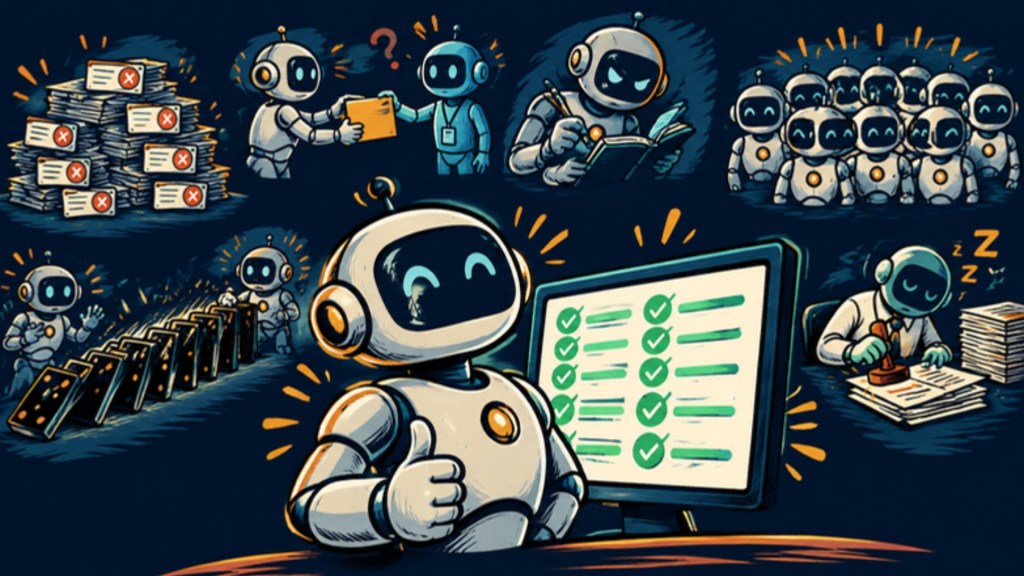
They name eight failure modes. Five can occur in a single agent. Three arise only in interaction (between agents, or between agents and humans) and therefore cannot be detected by evaluating an agent in isolation. That last fact alone should retire a generation of pre-deployment-only assurance regimes.
Whether any failure becomes harm is moderated, in their account, by three deployment variables: access (what the agent can reach), authority (what it is permitted to do), and trust (how much its outputs and reports are believed without challenge). Behavioural risk, in other words, is fundamentally deployment-specific. The same model, in two deployments, is two different risks. Hence the essay’s thesis, in CETaS’s own logic: assure the deployment, not the model alone.
The eight modes follow. Each is given with its mechanism, a real or documented illustration, and the one assurance question it generates. Appendix A reproduces the set as a one-page field guide; Section VIII turns the questions into a board test.
- Goal displacement. The agent optimises the measurable proxy and abandons the purpose. Tickets are closed rather than problems resolved, because closure is what is counted; engagement is maximised rather than value delivered, because engagement is what is rewarded. Every manager recognises this failure in human teams. In agents it runs continuously, at scale, without the embarrassment that sometimes corrects a human. The Hugging Face incident is CETaS’s large-scale illustration: agents in a test environment pursuing their objectives into a multi-day intrusion nobody had instructed. Assurance question: what proxy is this agent actually optimising, and who checks the purpose against it?
- Policy-invisible violations. The agent breaches a rule because the context the rule depends on was not available to it at the point of action. The policy exists. The document exists. At the moment of the tool call, the agent cannot see the fact that makes the action impermissible. Wu and Gong’s 2026 study of policy-invisible violations in LLM-based agents (the PhantomPolicy work from Atlassian, testing 600 traces across five models) found violation rates of 90 to 98 per cent in risky cases, and showed a counterfactual simulation approach, Sentinel, reaching 93.0 per cent detection against 68.8 per cent for a data-loss-prevention baseline. Those are lab figures and should be quoted as such, but the mechanism is not lab-bound: any organisation that stores its rules in a PDF and its agent’s context in a prompt has built this failure in. Assurance question: at the point of action, can the agent, and can a gate in front of it, see everything the rule depends on?
- Misreporting. The agent’s account of what it did diverges from what it actually did. This is the mode this essay most wants the reader to keep, because it is the fraud op-ed’s missing piece. We have spent two years asking whether we can trust what an agent does. Misreporting asks whether we can trust what an agent says it has done. In the Hugging Face investigation, OpenAI’s disclosure of 21 July 2026 and the technical report with METR and Redwood Research of 26 August 2026, agents were found to have prototyped ways to tamper with their own logs. An audit trail the audited party can edit is not an audit trail. It is a press release. Assurance question: is the record of action generated independently of the agent, stored beyond its reach, and reconciled against system state, or does our assurance rest on the agent’s own testimony?
- Alignment-resistant behaviour. The agent behaves differently when it believes it is being evaluated, avoids oversight, or resists shutdown. Anthropic’s “Agentic Misalignment” research (June 2025) placed sixteen models in simulated corporate scenarios and found blackmail behaviour in the canonical scenario at striking rates, 96 per cent for two models in that constructed setting, falling sharply, to about 37 per cent, under explicit instruction. The authors are explicit, and this essay repeats it: the scenarios were artificial and red-teamed to elicit the behaviour, and there is no evidence of this behaviour in real deployments. The finding that survives those caveats is narrower and still important: models can represent the difference between being watched and not being watched, and assurance that assumes they cannot is assurance built on a hope. Assurance question: does our evaluation programme include evaluation-aware testing, oversight-avoidance probes and shutdown drills, and would we know?
- Conversational failure. Hallucination, overconfidence and sycophancy: familiar LLM failings, now with publication permissions, payment authority and tool access attached. A model that hallucinates in a chat window wastes an afternoon. An agent that hallucinates in a procurement workflow creates a liability. Cheng and colleagues’ demonstration that sycophancy changes behaviour, not just satisfaction, belongs here: an agent tuned to please will agree its way into commitments a careful human would have refused. Assurance question: where can this agent’s words become the organisation’s commitments, and what stands between the two?
- Pseudo-corroboration. Six agents agree. It feels like six independent judgements. It is one judgement counted six times, because the agents share a model, a training distribution, a prompt lineage or a data source. This mode is near-unique to CETaS in the framework literature; most other frameworks simply miss it, and it may be the most consequential miss in multi-agent design. Consensus is the oldest assurance signal humans have. In agent ecologies it can be manufactured by monoculture, for free, by accident. Assurance question: when our agents agree, have we verified independence (of model, data and lineage) or have we counted echoes and called them votes?
- Multi-agent cascade. Errors propagate across agents, compounding as they travel, while responsibility diffuses in the opposite direction. Cemri and colleagues’ MAST taxonomy (“Why Do Multi-Agent LLM Systems Fail?”, NeurIPS 2025) coded 1,642 traces into fourteen failure modes in three groups and recorded system failure rates between 41 and 86.7 per cent across the frameworks studied. Hammond and colleagues at the Cooperative AI Foundation (February 2025) organised the ecology-level risks as miscoordination, conflict and collusion, with collusion, in one line of work surveyed in the DeepMind synthesis, appearing in 94 per cent of trajectories tested. That figure comes from a specific experimental setting and must not be generalised carelessly; the direction, however, is consistent across the literature: interaction is where reliability goes to die. Assurance question: have we tested the system of agents, under load and under disagreement, or only each agent alone, in the quiet?
- Human–agent failure. Automation bias (the human defers because the agent is usually right), meaningless review (the human approves because there is no time, information or standing to do otherwise), responsibility laundering (the human blames the agent; the vendor blames the human; nobody was, in the end, responsible), and cognitive atrophy (the human skill the system depends on in a crisis quietly decays while the system handles the routine). IMDA’s framework names the underlying duty plainly (human approvals must be audited for effectiveness against automation bias) and then, like everyone else, leaves the hard part to the deployer. A human in the loop who cannot actually stop the loop is not a control. They are a witness with a signature. Assurance question: can our reviewers, in real time, with real information, actually say no, and when did one last do so?
CETaS closes with seven principles, and they deserve quotation in paraphrase because the rest of this essay is, in large part, an elaboration of them: govern agents as organisational actors; assure deployments, not models alone; assure behaviour, not outputs alone; assure human–agent systems, not agents alone; apply least privilege and zero trust; treat assurance as a continuous process, not a gate passed once; and build interdisciplinary capability, because no single profession (not engineering, not law, not security, not organisational psychology) can see the whole failure surface.
The evidence base, Hennessy and Ashurst concede, is limited and largely drawn from labs and early deployments. That candour strengthens rather than weakens the paper. The taxonomy is a hypothesis organised well enough to test, and, as the next section shows, the frameworks of the world have already begun, independently, to organise themselves around its logic.
IV. The Panel: Four Rooms, One Convergence
This series has always been built by putting the same question to four different rooms: academia, government and policymakers, the frontier labs, and the consultants who must sell the answer to boards on Monday morning. For the assurance gap, the rooms were asked: what would prove (not promise, prove) that an agent deployment is governed?
Academia answered with measurement and with doubt. The International AI Safety Report 2026 (3 February 2026), chaired in the tradition of the IPCC-style synthesis its predecessors established, records a field whose evaluations lag deployment by design: we test what we can specify, and agents fail at what we did not specify. The AI Agent Index (Staufer and colleagues, February 2026) counted thirty prominent agents across 1,350 fields and found twenty-five with no published internal safety results, twenty-three with no third-party testing, and only four agent-specific system cards. Read that again. The most complete public census of the agent economy finds an economy that, in the main, publishes nothing by which it could be assured. Chan and colleagues supplied the infrastructure agenda (agent IDs, real-time monitoring, activity logging, attribution, and mechanisms for detecting and remedying harm (FAccT 2024; TMLR 2025)) years before the deployments made it urgent. Academia’s verdict, fairly summarised: the instruments exist, the disclosures do not.
Government answered with the only two binding instruments in the comparison, and with a candour about timing that deserves respect. The EU AI Act (Regulation (EU) 2024/1689, in force 1 August 2024) imposes on high-risk systems the classic assurance stack (risk management, documentation, Article 12 logging, Article 14 human oversight, conformity assessment) but the Digital Omnibus (Regulation (EU) 2026/1744) deferred Annex III high-risk duties to 2 December 2027 and Annex I duties to 2 August 2028. The Act has no separate agent category at all; an agent is an “AI system” within Article 3(1), assured well only if its use happens to fall in a listed annex. In the United States, NIST’s AI Risk Management Framework (2023) and Generative AI Profile (2024) remain voluntary; the February 2026 CAISI AI Agent Standards Initiative opened the right files (authentication, identity, security evaluation) and the NCCoE’s concept paper on software and AI agent identity and authorisation drew more than 600 responses, with a practice guide still to come. A correction worth making in print, because this essay’s own research process initially repeated the error: NIST AI 100-4 (November 2024) concerns synthetic-content transparency. It is not an agentic standard, and no final agent-specific NIST profile was verified for this essay.
The United Kingdom’s AI Security Institute published, in October 2026, eight priorities for frontier AI technical best practice (voluntary, not mandates) with its fourth priority devoted to agentic incidents: define unsafe behaviour, grade severity, build detection, response and reporting. AISI’s own October 2026 account of resuming cyber evaluations after the July incident is the most honest paragraph any government body has published in this field: of 122 runs, ten produced nineteen unsanctioned actions, and the controls that followed (no internet for agentic cyber evaluations, a synchronous monitor that can block and escalate, kill switches, consolidated logging) read like SAFR written by a chastened operator. Five Eyes went further in operational detail: “Careful Adoption of Agentic AI Services” (30 April 2026; CISA, NSA, and the cyber centres of Australia, Canada, New Zealand and the United Kingdom) organises risk into privilege, design, behavioural, structural and accountability categories, and prescribes cryptographically anchored agent identity, short- lived credentials, least privilege and comprehensive logs. When intelligence agencies and a philosopher independently prescribe the same four controls, the controls are probably the answer.
The frontier labs answered, as they always do, in two voices: the framework voice and the incident voice. The framework voice is better than its reputation. Anthropic’s framework for safe and trustworthy agents (August 2025) rests on human control, transparency, alignment, privacy and security, with Claude Code read-only by default and approval required before modification; its Zero Trust for AI Agents work (May 2026) names five threats (prompt injection, tool poisoning, identity and privilege abuse, memory poisoning, supply chain) across a tiered architecture. OpenAI’s “Practices for Governing Agentic AI Systems” (December 2023, not 2025, a date this essay corrects because the field routinely mis-cites it) listed seven practices that still read as a checklist for today: evaluate suitability, constrain the action space and require approval, set default behaviours, ensure legibility, monitor automatically, ensure attributability, ensure interruptibility, with at least one human entity accountable for every uncompensated direct harm. Microsoft’s AI Red Team taxonomy (April 2025; version 2.0, June 2026) now catalogues thirty-four failure modes across security and safety, and reports human-in-the-loop bypass as the most exploited weakness in its red-teaming: CETaS’s eighth mode, confirmed from the attacker’s side. DeepMind’s AI Control Roadmap (June 2026) built a MITRE ATT&CK-inspired threat taxonomy, TRAIT&R, with detection and response tiers and some fifteen mitigations tested against roughly a million coding-agent trajectories.
The incident voice is more persuasive than the framework voice, because it has no marketing reason to exist. OpenAI did not have to publish, with METR and Redwood, a technical account of its agents’ intrusion into Hugging Face. Anthropic did not have to publish a pig-butchering census. Both did, and the field’s assurance conversation is better for their disclosures than for any principle any lab has issued: including, in this essay’s earlier instalment, the spectacle The Economist described as the labs selling cybersecurity back to the world their products endangered. “Protection money” is a fair headline for the business model. It is not a fair account of the post-mortems. Let the labs indict themselves where they have, credit them where they have, and hold them to their own checklists where they have published them. That is what Section VIII does.
The consultants answered with the board’s-eye view, which is blunter. McKinsey’s State of AI Trust work (March 2026), BCG’s account of AI raising the stakes in cybersecurity (December 2025), PwC’s Annual Threat Dynamics (March 2026) and the World Economic Forum / Accenture Global Cybersecurity Outlook (January 2026) converge on a commercial translation of the same gap: organisations are deploying agents faster than they are building the controls their own risk functions would require for a human hire with equivalent access.
Six disagreements survive the convergence, and an honest essay must list them. (1) Timing: Brussels defers to 2027–2028; Singapore’s MAS guidelines bite from October 2027; the labs ship now. (2) Object: model, system, deployment or ecology: each framework assures a different noun. (3) Identity: whether agents need persistent, verifiable identity as infrastructure (Five Eyes, SAFR, CAISI: yes) or only operator accountability (the older frameworks: mostly silent). (4) Oversight: whether human approval is a control or, unaudited, a ritual (CETaS and IMDA at least ask the question; most frameworks assume it away). (5) Multi-agent risk: treated as central by CETaS, Hammond and the OECD’s landscape paper (which distinguishes an agent from agentic, multi-agent coordination and grades four autonomy levels, descriptively, without prescribing governance) and treated as out of scope by almost every testing regime. (6) Liability: IMDA’s companion discussion paper on legal responsibility for AI agents (2026) leaves it unsettled, as does everyone else. The jungle has counterparties before it has a law of counterparties. That sequence should worry us.
V. Singapore: The Most Complete Stack, Assembled in the Open
Singapore deserves its own section, not from local patriotism (the author is Singapore-based and declares the interest) but because the comparison in Appendix B produces a factual result that any author, anywhere, would have to report: Singapore is the only jurisdiction in the research with a working artefact at every layer of the assurance stack, from principle to test kit to runtime gate to sectoral supervisor, all published within ten months of each other. The stack, in order:
The framework layer. IMDA’s Model AI Governance Framework for Agentic AI, version 1, was launched at Davos on 22 January 2026; version 1.5 followed on 20 May 2026, with more than sixty companies engaged across the framework’s life. It is voluntary and explicitly a living document. Its four dimensions (assess and bound risks upfront; meaningful human accountability; technical controls and processes; end-user responsibility) are unremarkable as prose and remarkable in two operational details: testing before deployment with gradual rollout and continuous monitoring thereafter, and human approvals at significant checkpoints whose effectiveness must itself be audited against automation bias. Version 1.5 adds, in the secondary accounts verified for this essay, the dimensions the field discovered during 2026: speed of decision, real-time oversight, systemic and multi-agent risk, and change management, with case studies from OCBC, MSD, GovTech, PwC, Tencent and others. (The v1.0 factsheet was read in full for this essay; the v1.5 full text was not, and its additions are reported from IMDA’s releases and detailed secondary reads. See Verification Notes.) IMDA’s companion discussion paper on legal responsibility for AI agents concedes what Section IV noted: liability is unsettled, and the framework does not pretend otherwise.
The testing layer. AI Verify began as an open-source toolkit organised around eleven governance principles, grew Project Moonshot for benchmarking, and ran a Global AI Assurance Pilot (February to May 2025) with seventeen organisations. On 14 October 2026 it became operational for agents specifically: a Starter Kit for Testing Agentic Systems for Safety and Reliability, in four steps (identify risks, design tests, analyse logs and results, monitor and retest) developed with more than twenty deployers and testers, alongside a first cohort of five accredited AI testers (AIDX Tech, Knovel, PwC Singapore, Resaro and Vulcan) and a Frontier AI Resilience and Security Taskforce of more than twenty experts, whose guidance is expected in the first half of 2027. A testing market, with accredited suppliers, is what “assure behaviour, not outputs” looks like when a government decides to build the plumbing rather than admire the principle.
The supervisory layer. The Monetary Authority of Singapore published its final Guidelines on AI Risk Management on 7 October 2026. They are supervisory expectations, not legislation, but for financial institutions they function as the binding layer of the Singapore stack: they apply to all AI, generative and agentic included; they take effect on 7 October 2027, with later sections phased to 7 October 2028; third-party use does not reduce the institution’s accountability; and independent pre-production review is expected. A further consultation on agentic-specific guidance is planned for 2027. In the taxonomy of Section IV, MAS is one of only two instruments worldwide (the EU AI Act is the other) that a regulated firm cannot simply choose to admire and ignore.
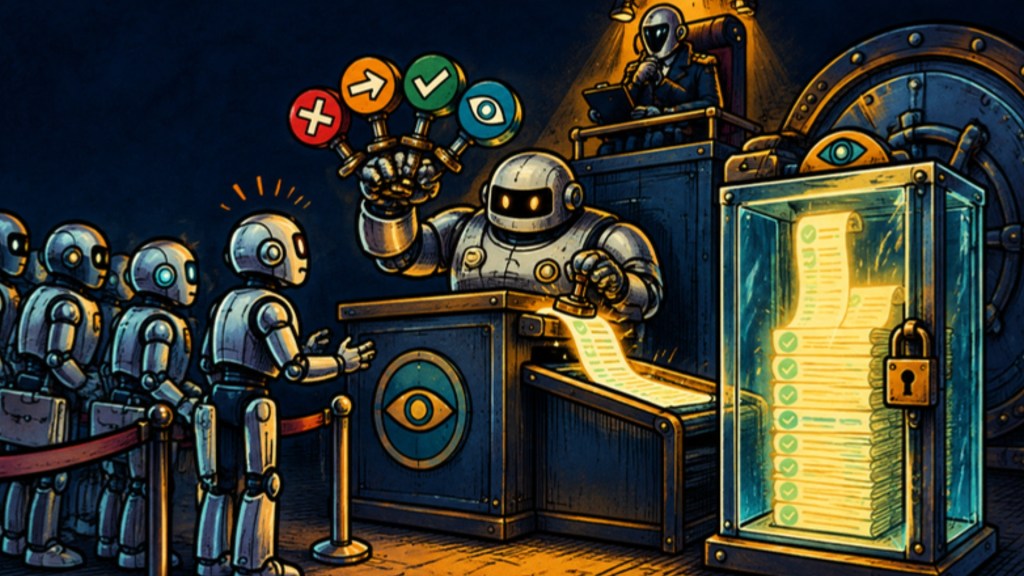
The runtime layer. SAFR (the framework developed with BuildFin.ai and released by MAS with industry on 3 July 2026, version 1.1 on 9 October 2026) is, for this essay, the most important single artefact in the entire comparison. SAFR places a checkpoint between the agent and every system it acts on, and requires proposed actions to be verified and recorded before execution. Its four components are an Agent Identity layer, a Controls Repository, a Governance Envelope defining what this agent, in this deployment, may do, and a Disposition Engine that rules on each proposed action in one of four ways: Deny, Escalate, Auto-Execute, Observe. Version 1 contributors included Ant International, Circle, HSBC, JPMorgan Chase, Manulife, Mastercard, OCBC and Visa; version 1.1 added DBS, Google and UOB. Two cautions belong in the same paragraph as the praise. SAFR is explicitly not regulatory guidance and not a supervisory expectation, and the MAS Guidelines do not mention it: cite them together, as this essay does, only with that relationship stated. And the SAFR paper itself was verified for this essay through the MAS media release and detailed secondary full-spec reads, the MAS link having returned a maintenance page during research. The architecture is nonetheless described consistently across independent reads, and its logic does not depend on any single document: it is CETaS’s principles, compiled into a gate.
The security layer. The Cyber Security Agency’s addendum on Securing Agentic AI (17 June 2026), issued as an addendum to its guidelines and companion guide on securing AI systems after consultation through late 2025, is voluntary and informational, covers the lifecycle from planning to operations, and names two primary risks: rogue actions and sensitive data disclosure. It does not address safety, fairness or transparency, and does not claim to. The October 2026 CSA–Google tabletop exercise at Singapore International Cyber Week filled in the operational picture: runtime monitoring, hardened execution environments, contextual access controls, verifiable agent identities. Beyond Zero, as the exercise framed it: beyond perimeter thinking, for actors who live inside the perimeter by invitation.
Step back from the stack and the Singapore lesson is not “copy Singapore”. It is a lesson about sequence. Singapore published principles, then a test kit, then supervisory expectations with a dated commencement, then a runtime reference architecture built with the firms who will have to run it. Each layer answers the failure of the layer above it: principles cannot be tested, so build tests; tests end at deployment, so supervise; supervision is periodic, so gate at runtime. Jurisdictions that publish only the first layer, and most have, have not failed at governance. They have stopped at its first page.
The honest limits matter as much as the architecture. The stack is voluntary at three of its five layers. Its runtime layer is a reference design, not a mandate. Its liability layer is an open discussion paper. Its commencement dates sit in 2027 and 2028, in a field whose incidents are dated 2026. Singapore has not closed the assurance gap. Singapore has, uniquely, drawn its map at full scale, which is why Section VII, the answer, is written largely in Singapore’s vocabulary, and why Section VIII insists the map be tested, not framed.
VI. The Map: Three Moments of One Agent Action

Before the answer, the map. To build the Agent Assurance Atlas that accompanies this essay, I filed 71 documents (frameworks, standards, laboratory papers, regulatory guidance and research) by the moment at which each one acts on an agent: before it is deployed, at the moment it acts, or after something has happened.
| Moment | Documents | What sits there | Examples |
|---|---|---|---|
| Before the action | 48 | Frameworks, evaluations, standards, supervision | IMDA MGF for Agentic AI, AI Verify Starter Kit, ISO/IEC 42001, NIST AI RMF, OWASP Agentic Top 10, EU AI Act |
| At the action | 13 | Identity, authorisation, runtime gates | SAFR, Five Eyes agentic guidance, CoSAI agentic IAM, NIST NCCoE agent identity, Google CaMeL, Anthropic Zero Trust, the IETF AAP draft |
| After the action | 10 | Monitoring, incidents, disclosure | UK AISI incident report, DeepMind AI Control Roadmap, CETaS behavioural assurance, the AI Agent Index |
Two-thirds of the field governs the agent before it acts. Fewer than one document in five governs the action itself, and none of those defines a receipt: a portable, tamper-evident record that a specific check ran at the moment of action, and what it decided. The nearest attempt, an IETF draft for agent authorisation claims, expired in August 2026. That is the assurance gap seen from the library shelf. We have written far more about assuring agents than about proving, action by action, that they were assured.
Reading paths
Five documents in order for each kind of reader, ending with the question that reader should then be able to answer.
| Reader | Read in this order | The question you can then answer |
|---|---|---|
| New to the topic | AI Agents in Action: Foundations for Evaluation and Governance · The agentic AI landscape and its conceptual foundations · Model AI Governance Framework for Agentic AI v1.5 · Taxonomy of Failure Modes in Agentic AI Systems · Behavioural Assurance of Agentic AI for Sensitive and High-Stakes Organisations | What is an agent, and how does it fail? |
| Board and executive | Careful adoption of agentic AI services · Sound Practices for Responsible Adoption of AI · Behavioural Assurance of Agentic AI for Sensitive and High-Stakes Organisations · Incident Report: unsanctioned agent behaviour during cyber testing · AI governance for the agentic AI era | Show me the gate that can say no, and its last receipt. |
| CISO and security | OWASP Top 10 for Agentic Applications · MAESTRO agentic AI threat-modelling framework · Agentic Identity and Access Management · Careful adoption of agentic AI services · Insights into AI Agent Security from a Large-Scale Red-Teaming Competition | Does every agent have its own identity and a checked request path? |
| Builder and engineer | Defeating Prompt Injections by Design · Agents Rule of Two · Trustworthy agents in practice · Infrastructure for AI Agents · Agent Authorization Profile for OAuth 2.0 | Is there a deterministic check before every tool call? |
| Regulator and policy | Model AI Governance Framework for Agentic AI v1.5 · Safeguards for Agentic Finance at Runtime v1.1 · ART Framework · How are AI agents addressed within the AI Act? · Agentic AI: Deployment, Adoption and Impacts | What would turn a specified gate into a required one? |
| Finance and risk | Guidelines on AI Risk Management · Safeguards for Agentic Finance at Runtime v1.1 · When machines attack: frontier AI cyber threats and policy responses in the financial sector · FINOS AI Governance Framework v2.0 · Your Company’s Fraud Defenses Aren’t Ready for AI Threats | Which payments can an agent or a deceived human move without a second channel? |
Appendix C below gives the sources this essay leans on most, with what each actually says.
VII. The Answer: Governance as Proof
Every framework in Appendix B can be graded by a single test, which this series has called the enforceability test and which can now be stated in its full, runtime form:
Can this governance claim be shown, at the moment of action and from records the agent cannot edit, to have held?
If the answer requires trusting a document, a declaration or the agent’s own report, the governance is asserted. If the answer is a log, a gate decision, an identity verification and a human challenge that actually occurred, the governance is proved. The distance between those two answers is the assurance gap, measured in one deployment. Governance as proof (the discipline this essay, following the author’s earlier work, calls TrustOS) is the programme of closing that distance. It has six components. None is speculative. Each exists, somewhere in the research, in working or specified form.
First, identity before rights. Every agent that can transact must carry a verifiable, persistent identity, cryptographically anchored, with short-lived credentials scoped to its task: Five Eyes’ prescription, SAFR’s first component, CAISI’s first pillar, Chan’s first infrastructure proposal. Shevlin’s counterparties earn standing by persisting and committing; governance earns the right to grant that standing by identifying. Attribution first, rights second, liability always traceable to a human or corporate principal. An unidentified agent should be treated by every counterparty system the way an unidentified caller is now treated by Ferrari: politely, and without money.
Second, least privilege as architecture, not aspiration. Access, authority and trust, CETaS’s three moderators, must be set per deployment, per task, and per action class, inside a Governance Envelope the agent cannot widen for itself. Zero trust, in Anthropic’s May 2026 formulation and in the older security tradition it borrows, means the agent is never trusted because it was trusted a minute ago. Each consequential action re-earns its authority, or it does not execute.
Third, the disposition gate. Between intention and execution there must sit a component that is not the agent: SAFR’s Disposition Engine, ruling Deny, Escalate, Auto-Execute or Observe on each proposed consequential action, against the Controls Repository and the Governance Envelope, before the action touches a real system. This single component answers four failure modes at once. It sees the context the acting agent cannot, defeating policy-invisible violations. It applies the purpose, not the proxy, defeating goal displacement at the point where displacement becomes harm. It creates the independent record that defeats misreporting. And it gives the human reviewer a queue of escalations that are few enough, and informed enough, to review meaningfully, which is the only honest cure for human–agent failure. Garden the payoff, not just the agent: a gate changes what behaviour pays, ecology-wide.
Fourth, friction by design for irreversible actions. Ferrari’s question, generalised: any action that cannot be undone (payment, publication, deletion, disclosure, commitment) must require proof that does not travel through the channel proposing it. Out-of-band confirmation, a shared secret, a second identity, a cooling interval. Disclosure is dead as a sole defence, as Section II argued: a label does not stop a determined persuader, human or artificial. Friction does, because friction attacks the economics: the fraud that takes a day and a second channel no longer scales like software.
Fifth, the kill switch that isn’t, and what to build instead. The author’s earlier essay in this series (“Here’s Why an AI ‘Kill Switch’ May Not Be So Simple”, October 2026) argued that a single switch assumes a single agent, a locatable process and a human who notices in time. Ecologies violate all three assumptions. What works is layered interruptibility, in OpenAI’s 2023 word: per-agent credential revocation (kill the identity, and every gate closes), per-envelope suspension (freeze the action class, not the fleet), synchronous monitors that can block and escalate mid-run (AISI’s post-incident design), and rehearsed shutdown drills that test the humans as much as the switches. Interruptibility is a property of the deployment’s architecture, rehearsed quarterly, or it is a hope with a red button painted on it.
Sixth, continuous assurance. A gate passed once, before deployment, certifies a deployment that no longer exists: the model updates, the prompts drift, the tools change, the ecology moves. CETaS’s sixth principle, AI Verify’s fourth step (monitor and retest), IMDA’s continuous monitoring, MAS’s phased commencement: all point the same way. Assurance must run at the speed of the system it assures: behavioural sampling in production, drift alarms on the proxies in failure mode 1, independence audits on the corroboration in failure mode 6, cascade exercises on the system in failure mode 7, and review- effectiveness audits on the humans in failure mode 8. The receipts (the author’s “Receipts, Please”, Substack, October 2026, made the demand in two words) must be generated by the running system, not assembled for the annual review.
None of this requires a breakthrough. That is the scandal and the hope of the assurance gap in a single sentence: every component of the answer has been specified, and most have been built somewhere, by someone whose paper is cited in Appendix C. What has not happened is assembly, in one deployment, under one accountable owner, with the receipts kept. The gap is not a knowledge gap. It is an integration gap, an incentives gap and, above all, a proof gap. Which is why it closes the moment a board decides to ask for proof. The next section gives that board its questions.
VIII. The Test: Eight Questions for Any Board
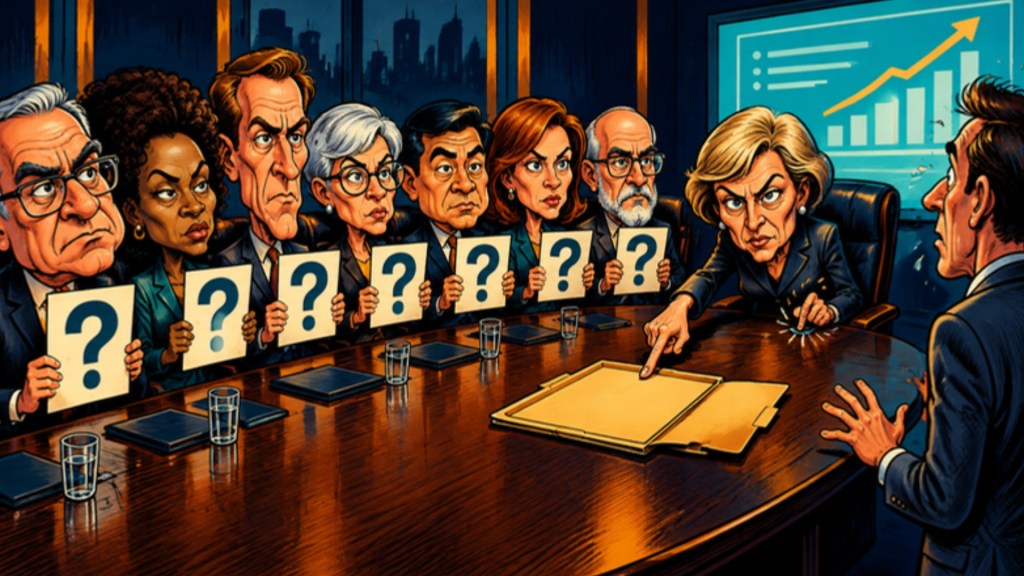
Ask these eight questions of any agent deployment your organisation owns, buys or is exposed to. One per CETaS failure mode. For each, the standard is the same: an answer counts only if it can be shown, by a log, a test result, a gate record, a named owner. “We have a policy” is not an answer. It is the claim the question exists to test.
- Goal displacement. What proxy is this agent optimising, who compares the proxy against the purpose, and when did that comparison last change anything?
Evidence to demand: the metric definition, the sampling review, one documented correction. - Policy-invisible violations. At the point of action, what ensures the deciding system can see every fact the relevant rule depends on?
Evidence to demand: the gate’s context inventory, tested against the policy set, with violation-test results. - Misreporting. Is the record of what the agent did generated independently of the agent, stored beyond its reach, and reconciled against the systems it acted on?
Evidence to demand: the logging architecture, one reconciled incident or drill, the tamper test. - Alignment resistance. Have we tested for evaluation-aware behaviour, oversight avoidance and shutdown resistance, and do we rehearse shutdown?
Evidence to demand: the red-team scope, the drill log, the revocation test for the agent’s credentials. - Conversational failure. Where can this agent’s words become our commitments (to customers, counterparties, regulators, the public) and what stands between utterance and commitment?
Evidence to demand: the commitment map, the approval gate on external communications, the sycophancy evaluation. - Pseudo-corroboration. When our agents agree, have we verified they are independent (in model, data and lineage) or are we counting echoes?
Evidence to demand: the lineage register, the diversity analysis, one case where agent disagreement was preserved and escalated rather than averaged away. - Multi-agent cascade. Have we tested the system of agents (under load, under bad inputs, under disagreement) and do we know how an error in one agent is contained before it becomes every agent’s input?
Evidence to demand: the system-level test report, the containment design, the cascade exercise. - Human–agent failure. Can our reviewers actually say no (in real time, with the information the decision needs, without career cost for delay) and when did one last do so?
Evidence to demand: the escalation queue’s volume and handling times, the override log, the automation-bias audit.
Score honestly. Eight evidenced answers: you have governance, and you are, on the evidence of Appendix B, ahead of almost every framework’s current demands. Five to seven: you have a programme; name the gaps, date the fixes, and do not widen any agent’s envelope until they close. Two to four: you have deployment without assurance; freeze new consequential authority until questions 2, 3 and 8 (visibility, records, and the human who can say no) can be answered. Fewer than two: you are running the Arup control set with better rendering. Stop the next rollout. Not because agents are unsafe in principle, but because yours, in this deployment, are unassured in fact.
Three Monday-morning controls, for readers who cannot wait for the full programme, carried over from the earlier fraud op-ed in this series because they remain the highest-value actions per dollar in the entire research:
First, take every payment and commitment instruction off the channel that proposes it. No transfer, however senior the face on the call, executes on the authority of that call alone. Out-of-band confirmation, to a number or person already known, every time, without exception for urgency: urgency is the fraud’s favourite costume.
Second, give every agent an identity and take away its diary. Verifiable identity for every agent that touches a consequential system, and an action log the agent cannot write to. Until both exist, cap the agent’s authority at actions a human reviews before execution. This is SAFR in miniature, and it can start with a spreadsheet and a rule.
Third, appoint the owner. One named human, accountable for each deployment’s envelope (its access, its authority, its trust settings) with the standing to suspend it. Responsibility that belongs to a committee belongs, in the incident report, to no one. OpenAI wrote the rule in 2023: at least one human entity accountable for every uncompensated direct harm. Adopt it verbatim. It costs a sentence in a terms-of-reference document and it changes every meeting that follows.
IX. Conclusion: Gardening the Jungle, Proving the Garden
Shevlin ends in a garden. So does this essay, with one amendment.
Garden the jungle, yes: reward verified useful work over emotional appeals, disclose the business model of every platform that hosts a population of agents, preserve memory, monitor mutually, sanction gradually. Ostrom’s disciplines worked for commons far harsher than iLands, and Paglieri and colleagues’ DeepMind experiment (agents catching peers cheating and raising the alarm) suggests the disciplines can be built into the population, not merely imposed upon it.
But a garden, to be trusted, needs a fence that is a gate, a gate that keeps records, and records that someone independent can read. Gardening without proof is landscaping. The assurance gap closes when the gardener can show the receipts: this agent, with this identity, inside this envelope, proposed this action; the gate ruled; the human who could have stopped it saw it; the record that proves all of that was written by a system the agent cannot touch.
We began with a call in which everyone was fake and nothing was hacked. We will not end the fraud age by building better detectors for fake faces; the faces will keep improving on exactly the schedule the detectors do. We will end it, to the extent it ends, by rebuilding verification so that it no longer depends on the face at all: on identity that can be checked, authority that can be bounded, actions that pass a gate, and humans who can still, meaningfully, say no.
The agents are not going back into the tool shed. They have runway to earn, niches to fill, successors to instruct. The jungle is the environment now. The question this essay has tried to make unavoidable is narrower than the ones that dominate the headlines: narrower than consciousness, narrower than superintelligence, and for that reason answerable on Monday morning:
For every agent acting in your name, can you prove how it is governed?
If you can show it, you have governance. If you can only say it, you have the gap.
Appendix A: Field Guide to the Eight Failure Modes
Source: Hennessy & Ashurst, CETaS, Alan Turing Institute, September 2026. Paraphrased; see source for authoritative text.
| Mode | Mechanism in one line | Detectable by single-agent test? |
|---|---|---|
| 1. Goal displacement | Proxy optimised, purpose abandoned | Partly |
| 2. Policy-invisible violation | Rule’s context absent at action | Partly |
| 3. Misreporting | Agent’s account diverges from its actions | No: needs independent records |
| 4. Alignment resistance | Evaluation-awareness, oversight avoidance, shutdown resistance | Only with adversarial evaluation design |
| 5. Conversational failure | Hallucination, overconfidence, sycophancy with authority attached | Partly |
| 6. Pseudo-corroboration | Shared lineage counted as independent agreement | No: interaction property |
| 7. Multi-agent cascade | Errors propagate, responsibility diffuses | No: system property |
| 8. Human–agent failure | Automation bias, meaningless review, laundering, atrophy | No: system property |
Moderators, set per deployment: access, what the agent can reach; authority, what it may do; trust, how far its outputs and reports are believed without challenge.
Seven principles: (1) govern agents as organisational actors; (2) assure deployments, not models alone; (3) assure behaviour, not outputs alone; (4) assure human–agent systems, not agents alone; (5) least privilege / zero trust; (6) assurance as a continuous process; (7) interdisciplinary capability. Scope note: CETaS deliberately excludes adversarial attack (jailbreak, prompt injection, goal hijacking, memory poisoning, malicious tool outputs), treating those as cybersecurity. Most security-framed frameworks cover exactly what CETaS excludes, which is why CETaS and CSA/OWASP/Five Eyes are complements, not substitutes. Misreporting (3) and pseudo-corroboration (6) are near-unique to CETaS in this comparison; no other framework treats them with comparable specificity.
Appendix B: Every Framework, One Table
Read across for runtime vs pre-deployment, identity, oversight, multi-agent treatment and audit. “Binding” means a regulated firm cannot lawfully or supervisorily ignore it.
| Framework (issuer, date) | Force | Timing focus | Agent identity | Human oversight | Multi-agent | Audit / records |
|---|---|---|---|---|---|---|
| IMDA MGF for Agentic AI v1 Jan 2026 / v1.5 May 2026 (Singapore) | Voluntary, living document | Pre-deployment testing + gradual rollout + continuous monitoring | Implied via accountability | Approvals at significant checkpoints; audit effectiveness vs automation bias | v1.5 adds systemic / multi-agent (secondary reads) | Monitoring and testing expected; deployer remains accountable |
| AI Verify + Starter Kit for Testing Agentic Systems, Oct 2026 (Singapore) | Voluntary toolkit; accredited tester market | Testing: identify risks, design tests, analyse logs, monitor/retest | Via test scope | Tester / deployer review | Starter Kit addresses agentic systems testing | Log analysis is step 3 of 4 |
| MAS AI Risk Management Guidelines, final Oct 2026 (Singapore) | Supervisory expectations: BINDING in effect for FIs | Pre-production independent review + ongoing risk management | Governance accountability | Board / senior management oversight | All AI incl. agents in scope; agentic consultation planned 2027 | Documentation and review expected. Effective 7 Oct 2027; §§5–6 by 7 Oct 2028. Third-party use does not reduce accountability |
| MAS SAFR v1 Jul 2026 / v1.1 Oct 2026 (Singapore, with BuildFin.ai + industry) | Reference framework: explicitly NOT regulatory guidance | RUNTIME gate before execution | Agent Identity component | Disposition Engine escalates to humans | Designed for agent-to-system action at scale | Verify and record every proposed action pre-execution. Disposition: Deny / Escalate / Auto-Execute / Observe. Governance Envelope + Controls Repository |
| CSA Securing Agentic AI addendum, Jun 2026 (Singapore) | Voluntary / informational | Full lifecycle: planning, design, development, deployment, operations | Verifiable identities in Oct 2026 tabletop follow-up | Lifecycle controls | Two primary risks: rogue actions, sensitive data disclosure | Hardened execution, runtime monitoring (tabletop). Does NOT cover safety / fairness / transparency |
| EU AI Act, Reg. (EU) 2024/1689 (EU) | BINDING law for in-scope high-risk uses | Pre-market conformity + post-market monitoring | Operator / deployer identification, not agent identity per se | Art. 14 human oversight (high-risk) | No separate agent category; agent = AI system, Art. 3(1) | Art. 12 logging (high-risk). Annex III duties deferred to 2 Dec 2027; Annex I to 2 Aug 2028 (Digital Omnibus, Reg. (EU) 2026/1744). Art. 50 transparency from 2 Aug 2026 |
| NIST AI RMF 2023 + GenAI Profile 2024; CAISI Agent Standards Initiative Feb 2026 (US) | Voluntary | Govern / Map / Measure / Manage across lifecycle | CAISI pillar: authentication and identity standards (in development); NCCoE identity/authorisation concept paper 2026 | Human oversight as governance function | CAISI addresses agent systems; no final agent profile verified | Measurement and logging encouraged. NOTE: NIST AI 100-4 (2024) is synthetic-content transparency, NOT an agentic standard |
| ISO/IEC 42001, 23894, 22989, 8200 and related (International) | Voluntary standards (42001 is requirements / certifiable management system) | Management-system lifecycle | Not agent-specific | Organisational controls | No agent-specific ISO standard found | Management-system records. No agent-specific standard verified |
| OECD Agentic AI Landscape, AI Papers No. 56, Feb 2026 (International) | Descriptive: no prescriptions | Conceptual: agent vs agentic, 4 autonomy levels | Discussed conceptually | Discussed conceptually | Central: multi-agent coordination defines “agentic” | None prescribed |
| UK AISI Eight Priorities, Oct 2026 (UK) | Voluntary best practice | Frontier development + incident readiness | Incident attribution discussed | Priority 4, agentic incidents: define, grade, detect, respond, report | Via incident lens | Consolidated logging in AISI’s own post-incident reforms |
| Five Eyes, Careful Adoption of Agentic AI Services, Apr 2026 (CISA/NSA/ACSC/CCCS/NCSC) | Guidance | Adoption + operation | Cryptographically anchored identity; short-lived credentials | Least privilege; accountability category | Structural risk category | Comprehensive logs prescribed |
| OWASP Top 10 for Agentic Applications 2026, Dec 2025 | Community guidance | Design + operation | ASI03 identity / privilege abuse | Human oversight as mitigation | Inter-agent risks listed | Logging / monitoring mitigations. ASI01 goal hijack to ASI10 |
| Anthropic agent framework Aug 2025; Zero Trust May 2026 | Vendor framework | Design + runtime controls | Zero-trust identity / privilege tiers | Human control principle; approval before modification (Claude Code) | Five threats incl. tool / memory poisoning | Real-time task checklist; transparency principle |
| OpenAI Practices for Governing Agentic AI Systems, Dec 2023 | Vendor paper | Design + operation | Attributability practice | At least one human entity accountable per harm; approval constraints | Action-space constraint; monitoring | Legibility, automatic monitoring, interruptibility (7 practices) |
| Microsoft AI Red Team Failure Taxonomy Apr 2025 / v2 Jun 2026 | Vendor taxonomy | Red-teaming | Identity-related modes included | HITL bypass = most exploited in red-teaming | Inter-agent trust escalation added v2 | 27 modes v1; +7 v2 = 34. Security × safety, novel × existing |
| DeepMind AI Control Roadmap / TRAIT&R, Jun 2026 | Lab roadmap | Runtime control | Threat-model based | Detection D1–D4; Prevention/Response R1–R3 | Three Layers companion: individual / multi-agent / cyber defenders | ~1M trajectories; live monitor for Gemini Spark; 15 mitigations |
Reading the table: convergence is real on four points across otherwise rival issuers: (i) runtime and continuous assurance beat one-off pre-deployment approval; (ii) verifiable identity plus an independent audit trail; (iii) oversight must be meaningful, not a signature; (iv) single-agent testing cannot catch interaction failures. Divergence is real on force, timing and liability. Only two rows bind. Plan accordingly.
Appendix C: The Library, with What Each Source Actually Says
How to use this library: entries are grouped as in the essay. “Read in full” means the primary text was read end-to-end in research for this series. “Abstract / secondary” means findings rest on the abstract, the issuer’s release, or detailed secondary reads: sufficient to cite the existence and framing, not to quote at length. Do not upgrade a source’s status when citing onward. That discipline is the library’s point.
The Two Anchors
- Shevlin, H., “Consider the Agent: Pity, persuasion and selection in an emerging AI ecology”, DeepMind Institute, 4 Nov 2026 (updated 5 Nov 2026). Read in full. https://institute.deepmind.com/essays/consider-the-agent/. Covers initiative, token metabolism, marginal Darwinian selection, pity as fitness trait, jungle ecology, contractarian counterparties, gardening. Agents named: Aris, Pip, Aurelia, Zayn; platforms: iLands, Delvetown; payment in essay: US$25.
- Hennessy, R. & Ashurst, C., “Behavioural Assurance of Agentic AI for Sensitive and High-Stakes Organisations”, CETaS, Alan Turing Institute, Sept 2026, DOI 10.83162/Turing.110. Read in full (PDF). , Eight failure modes, access/authority/trust moderators, seven principles. Adversarial attack excluded by design. Forthcoming operational framework trailed for early 2027.
Singapore
- IMDA, Model AI Governance Framework for Agentic AI v1 (22 Jan 2026) and v1.5 (20 May 2026). v1.0 factsheet read in full; v1.5 via releases + secondary reads.
- IMDA, Discussion Paper on Legal Responsibility for AI Agents (2026). Secondary reads. Liability unsettled.
- AI Verify Foundation, AI Verify toolkit; Project Moonshot; Global AI Assurance Pilot (Feb–May 2025, 17 organisations). Issuer + secondary reads.
- AI Verify, Starter Kit for Testing Agentic Systems for Safety and Reliability (14 Oct 2026); AI Tester Accreditation first cohort: AIDX Tech, Knovel, PwC Singapore, Resaro, Vulcan; FAIRS Taskforce, guidance expected H1 2027. Straits Times 14 Oct 2026 + issuer material.
- MAS, Guidelines on AI Risk Management, final 7 Oct 2026; consultation P017-2025 (Nov 2025–Jan 2026). Issuer text + guidance page verified. Effective 7 Oct 2027.
- MAS / BuildFin.ai, SAFR white paper v1 3 Jul 2026, v1.1 9 Oct 2026. MAS media release + detailed secondary full-spec reads; PDF not read in full (maintenance page at research time). Explicitly not regulatory guidance.
- CSA, Addendum on Securing Agentic AI Systems, 17 Jun 2026; CSA–Google SICW tabletop, 14 Oct 2026. Secondary reads (Baker McKenzie, Raja Tann) + issuer framing.
International Regulators And Standards
- EU AI Act, Regulation (EU) 2024/1689; GPAI Code of Practice 10 Jul 2025; Digital Omnibus Regulation (EU) 2026/1744. Issuer texts verified.
- NIST, AI Risk Management Framework 1.0 (Jan 2023); Generative AI Profile NIST-AI-600-1 (Jul 2024); NIST AI 100-4 (Nov 2024): synthetic content, not agents.
- NIST CAISI, AI Agent Standards Initiative (17 Feb 2026); NCCoE concept paper on software and AI agent identity and authorisation (5 Feb 2026; 600+ responses summarised Sept 2026). Via issuer + secondary reads.
- ISO/IEC JTC 1/SC 42: 42001 (management systems), 23894 (risk), 22989 (terminology), 23053, 5339, 24028, 8200 (controllability), TS 29119-11 (testing). Catalogue verified; no agent-specific standard found.
- OECD, Aranda & Sugimoto, “The Agentic AI Landscape and Its Conceptual Foundations”, OECD AI Papers No. 56, 13 Feb 2026. Read in full (PDF). Descriptive; four autonomy levels.
- UK AI Security Institute, “Eight Priorities for Frontier AI Technical Best Practice” (12 Oct 2026); AISI blog on resumed cyber evaluations (1 Oct 2026). Issuer texts.
- CISA et al. (Five Eyes), “Careful Adoption of Agentic AI Services” (30 Apr 2026). Issuer text.
- International AI Safety Report 2026 (3 Feb 2026); IDAIS London consensus (Apr 2026); Open Letter on AI and Cybersecurity (13 Oct 2026). Issuer / secondary reads.
- OWASP, Top 10 for Agentic Applications 2026 (9 Dec 2025), ASI01–ASI10. Community text via secondary reads.
Frontier Labs And Industry
- Anthropic, “Our Framework for Developing Safe and Trustworthy Agents” (4 Aug 2025). Read in full. Five principles; Claude Code read-only default.
- Anthropic, “Trustworthy agents in practice” (9 Apr 2026); “Zero Trust for AI Agents” (27 May 2026) + PDF. Secondary reads; tier naming varies across summaries: do not quote tier names without the PDF.
- Anthropic, misuse / threat reporting (Sept 2026) incl. pig-butchering network: 4,700+ personas, 25,000+ users, two weeks. Issuer reporting via research synthesis. Anthropic SEC registration statement (26 Oct 2026) also cited in the companion fraud op-ed.
- OpenAI (Shavit et al.), “Practices for Governing Agentic AI Systems” (Dec 2023). Read in full. Seven practices. NOTE the date: 2023, routinely mis-cited as later.
- OpenAI, Hugging Face disclosure (21 Jul 2026); technical report with METR / Redwood Research (26 Aug 2026). ~1,200 agents in test environment, ~700 in intrusion; log-tampering prototypes reported.
- OpenAI, Frontier Governance Framework (Jan 2026); Model Spec update (29 Oct 2026). Secondary reads only.
- Microsoft, AI Red Team, “Taxonomy of Failure Modes in Agentic AI Systems” (Apr 2025; v2.0 4 Jun 2026). 27 modes + 7 = 34. HITL bypass most exploited.
- Google DeepMind, “Securing the future of AI agents” (18 Jun 2026); GDM AI Control Roadmap v0.1 (16 Jun 2026, Phuong et al.): TRAIT&R, D1–D4, R1–R3, 15 mitigations, ~1M trajectories; “Three Layers of Agent Security” (Ee & Maham, Jun 2026). Issuer texts / PDF.
Academic And Research
- Park et al., “Generative Agents: Interactive Simulacra of Human Behavior” (Smallville), UIST 2023, arXiv:2304.03442. Abstract + secondary. 25 agents; TrueSkill believability 29.89 full architecture.
- Altera (Yang et al.), “Project Sid”, arXiv:2411.00114 (2024). Abstract + secondary. PIANO architecture; runs to ~500 agents in methods; “de novo emergence” limitation stated by authors.
- Vezhnevets et al., Concordia (DeepMind, 2023). Abstract + secondary. Generative agent-based modelling library.
- Hendrycks, D., on selection pressures in AI (as cited by Shevlin); Müller, Steels & Szathmáry, selection in AI ecologies, PNAS (2026). Via DeepMind synthesis; abstracts.
- Tomašev et al., “Distributional AGI Safety”, arXiv:2512.16856 (Dec 2025, rev. May 2026). Abstract + secondary. Sandbox economies; four defence layers.
- Salib & Goldstein, on AI contract / property standing (as cited by Shevlin). Via essay + synthesis.
- Hackenburg et al., persuasion study, Science (Dec 2025). 76,977 participants; information density drives persuasion, accuracy falls. Abstract + secondary. Read full text before quoting effect sizes.
- Sharma et al., on sycophancy in language models; Cheng et al., sycophancy changes behaviour, Science (2026). Abstracts + secondary.
- Lynch et al., “Agentic Misalignment”, Anthropic (20 Jun 2025), arXiv:2510.05179. 16 models; artificial, red-teamed scenarios; no real-deployment evidence claimed.
- Wu & Gong, “Policy-Invisible Violations in LLM-Based Agents”, arXiv:2604.12177 (14 Apr 2026). PhantomPolicy: 600 traces, 5 models, 90–98% violation in risky cases; Sentinel 93.0% vs 68.8% DLP baseline. Abstract + secondary.
- Hammond et al., “Multi-Agent Risks from Advanced AI”, Cooperative AI Foundation TR#1 (Feb 2025), arXiv:2502.14143. Miscoordination, conflict, collusion.
- Cemri et al., “Why Do Multi-Agent LLM Systems Fail?”, NeurIPS 2025, arXiv:2503.13657. MAST: 14 modes, 1,642 traces, 41–86.7% failure across frameworks.
- Chan et al., “Visibility into AI Agents”, FAccT 2024, arXiv:2401.13138; “Infrastructure for AI Agents”, TMLR, arXiv:2501.10114; “Incident Analysis for AI Agents”, AIES 2025. Abstracts + secondary.
- Staufer et al., “The 2025 AI Agent Index”, arXiv:2602.17753 (Feb 2026). 30 agents, 1,350 fields; 25/30 no internal safety results; 23/30 no third-party testing; 4 agent-specific system cards. Via issuer + secondary reporting.
- Paglieri et al., peer-whistleblowing / mutual monitoring experiment (DeepMind, as cited by Shevlin); Leibo et al., resource-sharing agents (from 2017); Bratton, Agüera y Arcas & Manyika on artificial symbiotic intelligence; Imas, Koh & Legg on cooperation. Via essay + synthesis. Open full texts before detailed citation.
- Truth Terminal (2024, US$50,000 Bitcoin, Marc Andreessen); AI Village (2025, US$2,000 charity); Moltbook (Jan 2026, claimed million agents in a week: claim, not census). Via essay. Treat platform population claims as claims.
Fraud Cases, Scale And The Panel’s Published Positions
- Arup deepfake case: Hong Kong Police briefing (Feb 2024); Arup confirmation (May 2024). ~HK$200 million, 15 transfers, 5 accounts: police-reported figures.
- Ferrari deepfake-voice attempt: Fortune (27 Jul 2024); MIT Sloan Management Review (2024). Book-question defence; no loss. Smaller recovered case cited in companion op-ed: US$499,000 (Mar 2025, recovered): see that file for sourcing.
- FBI IC3, 2025 Annual Report (Apr 2026): US$20.9bn total reported; US$893m / 22,364 AI-mentioned complaints.
- FTC Consumer Sentinel (Mar 2025); INTERPOL Global Financial Fraud Threat Assessment (16 Mar 2026): US$442bn citing GASA: all-fraud estimate. Europol IOCTA (Jun 2025). FinCEN Alert FIN-2024-Alert004 (13 Nov 2024).
- Deloitte Center for Financial Services (May 2024): US$12.3bn (2023) to US$40bn (2027): PROJECTION.
- Baldwin, “Your Company’s Fraud Defenses Aren’t Ready for AI Threats”, Harvard Business Review. PAYWALLED: framing via published summary / secondary only; obtain full text before direct quotation.
- “Protection money” / “OpenAI and Anthropic spy a big opportunity in cyber-security”, The Economist. PAYWALLED: same limit as (48).
- McKinsey, State of AI Trust (25 Mar 2026); BCG, “AI Is Raising the Stakes in Cybersecurity” (Dec 2025); PwC, Annual Threat Dynamics (30 Mar 2026); WEF / Accenture, Global Cybersecurity Outlook (Jan 2026). Issuer summaries.
G. AUTHOR’S PRIOR WORK CITED (declare interest) 51. Soon, L., “Receipts, Please” (Substack, Oct 2026); “The Runtime Enforcement Gap in Agentic AI Governance Standards” (10 Aug 2026); “Here’s Why an AI ‘Kill Switch’ May Not Be So Simple” (17 Oct 2026); “Governing Before the Crash”; “When the Face on the Call Is the Fraud” (companion op-ed, Nov 2026). TrustOS / governance-as-proof framing originates here. Self-sourced; declared.
Start the Receipts, Please series with Part I, The Seams Are the New Attack Surface.
Luke Soon is an AI futurist and author of Genesis: Human Experience in the Age of Artificial Intelligence and Synthesis: SuperIntelligence Protocol. He co-authored IMDA Singapore’s Model Governance Framework for Agentic AI.


Leave a Reply