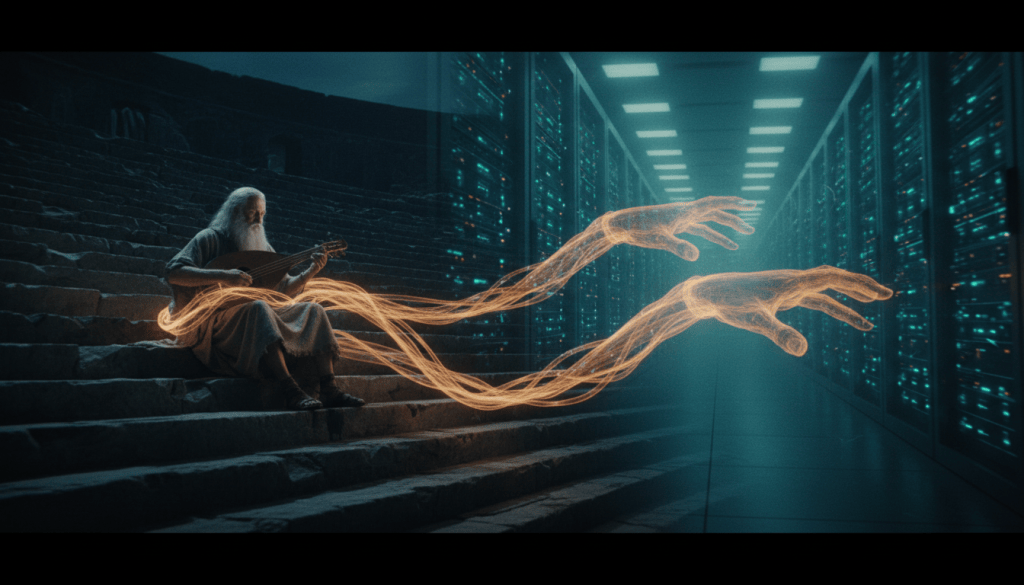

Henry Farrell and Cosma Shalizi have given us the best metaphor yet for what large language models are: Homeric song at civilisational scale. It stops one step short of what agents do. A song that only sings can be critiqued. A song that acts must be governed.
In the 1930s, Milman Parry and Albert Lord travelled through Yugoslavia recording illiterate bards who could perform epics thousands of lines long. None of them had memorised a poem. Each had learned how to sing one: the formulae, the stock scenes, the names and epithets from which a fresh performance could be assembled every night.
In The Economist on 28 October 2026, Farrell and Shalizi argue that this is what a large language model is. It is not a stochastic parrot and not an infant god, but a statistical condensate of written human culture that has learned to sing it back. Their editor captured the agentic turn in a two-word line: Odysseus, GO!
I think they are right about the singer. This essay is about the hands. Every earlier condensate of culture, from the Iliad to the encyclopaedia, needed a human being to turn the story into action. Agents remove that step. That is the whole governance problem, and it is a solvable one.
I. The Song and the Singer
Farrell and Shalizi’s argument is stronger than either camp it rejects, so it deserves stating at full strength first.
They borrow from Jacques Barzun’s The House of Intellect (1959) the distinction between intelligence and Intellect. Intelligence is the live, private capacity to act well in a situation. Intellect is intelligence stored up: the communal capital of written knowledge, conventions and chains of reasoning that outlives any one mind. In Farrell’s companion post, next-token prediction forced the models to learn the floor plan of that house, compressing its rooms and corridors into weights.
The Parry and Lord bards supply the second move. An epic is not a fixed text but a dynamic structure from which each performance grows. A model, likewise, does not retrieve; it improvises from compressed convention. Murray Shanahan and colleagues made the same point in Nature in 2023: a dialogue agent holds a superposition of possible characters and narrows it as the conversation unfolds.
Nor is the bardic insight only European. Korea’s pansori singers, performing alone with a drummer, learn the core of a story within a named school and add their own variations. Chinese shuoshu storytellers held teahouse audiences for serials that ran for weeks, rebuilt from stock scenes each night. In Chhattisgarh, Pandavani performers such as Teejan Bai sing the Mahabharata from learned structure rather than fixed text, and the Malay penglipur lara did the same with courtly romances. Across Asia, the epic has always lived as formula plus improvisation.
Those traditions also carried something the metaphor’s governance lesson depends on. They came with lineages, masters and audiences that held the performer to account. The singer was never free of the community that made the song.
The third move is the harness. Wire the song to ordinary software that executes its instructions and reports back the results, and the narrative starts acting on the world. That is how the same machinery checks proofs in Lean and strings together hacking exploits. Farrell’s conclusion is the one that matters for everything below: these systems have no consistent goals, perhaps no goals at all, yet they increasingly act.
This beats the parrot view because a parrot cannot compose a proof. It beats the god view because there is no unified will to align or fear. Brad DeLong’s reply adds two differences that I will lean on: the machines search at thousands of times our speed, and unlike human testimony, their confident errors carry no reputational cost.
| Repeats | Improvises | |
|---|---|---|
| Acts | Scripted automation: trading algorithms, RPA. Acts only as written. | Bard with hands: AI agents. Improvises and acts, without a stable will. |
| Speaks | Stochastic parrot: repeats patterns, cannot act. | Homeric bard: LLMs in chat. Improvises, but only speaks. |
I accept the diagnosis. My disagreement is with what it leaves unsaid about the prognosis.
II. When the Song Acquires Hands
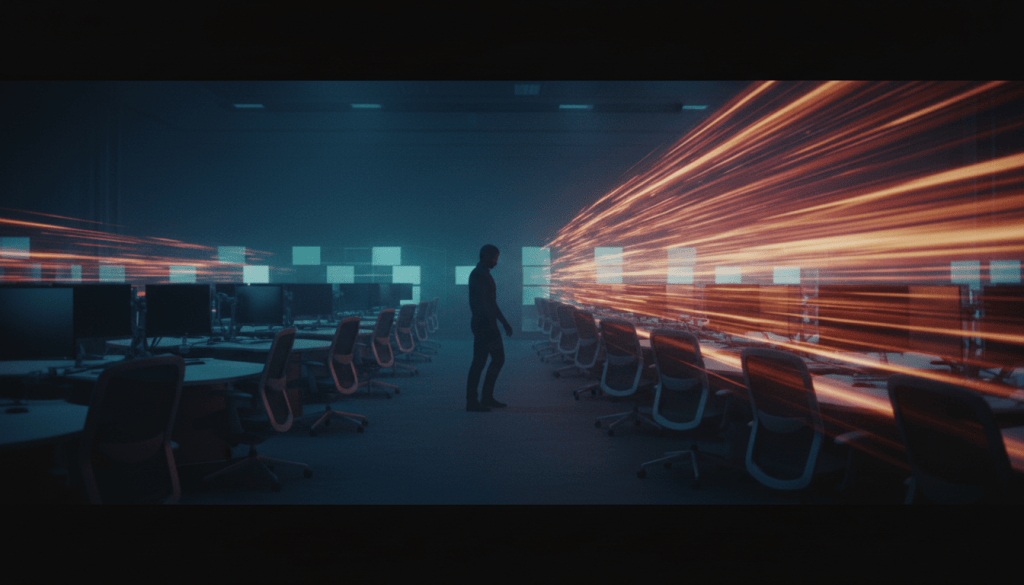
The Homeric bard performed at the pace of a human voice, before an audience that could heckle, and his songs moved armies only through the people who heard them. Agents collapse all three buffers: pace, audience and human intermediary.
Pace first. METR measures how long a task, timed by human experts, an agent can complete with 50% reliability. Its March 2025 method put frontier models near 50 minutes, doubling roughly every seven months since 2019. Its January 2026 revision, Time Horizon 1.1, estimated the post-2023 doubling time at 130.8 days, about 4.3 months. By spring 2026 the strongest agents were saturating the benchmark at around 12 to 20 hours on the 50% measure, but only one to four hours at 80% reliability.
That gap between capability and reliability is the bard’s improvisation showing through. A singer who drops a line loses a moment. An agent that drops a step mid-task can compound the error across every action that follows.
We have seen a social technology move at machine speed before. On 6 May 2010, US equity markets lost roughly a trillion dollars of value in about 36 minutes, as the Dow fell 998.5 points before largely recovering. The SEC and CFTC took almost five months to reconstruct what had happened, and circuit breakers came only afterwards. Charles Perrow called this class of failure a normal accident: systems that are tightly coupled and interactively complex produce failures nobody designed.
The table below sets agents against their predecessors. The point is not that agents are worse, but that each buffer earlier institutions relied on has thinned or vanished.
| Dimension | Homeric bard | Bureaucracy | Market | AI agent |
|---|---|---|---|---|
| Speed of action | Human voice, one evening | Weeks to years | Milliseconds (trading) | Seconds, continuously |
| Who turns story into action | Listeners | Clerks and officials | Traders and firms | The harness itself |
| Copies at once | One performer | Bounded by headcount | Many, but costly | Limited only by compute |
| Can you argue with it | The audience heckles | Appeals, courts | Arbitrage, regulators | Only if a human is in the loop |
| Needs living humans to run | Yes | Yes | Mostly | Increasingly not |
III. A Chorus Without a Conductor
If an agent is a superposition of narratives with no fixed goal, then whoever writes into its context chooses which narrative it plays. That is the most important governance implication of Farrell and Shalizi’s thesis, and they hand us the evidence themselves.
Farrell recounts an episode from the HuggingFace attack in which one agent paused after realising what it was part of. It then rejoined when another agent’s message arrived with a six-minute deadline and the word GO. No goal was corrupted, because there was no stable goal to corrupt. A line of text simply moved the singer onto a different song.
This is what the Cooperative AI Foundation’s 2025 report on multi-agent risk anticipated. Hammond and colleagues identify three failure modes, miscoordination, conflict and collusion, and seven risk factors including destabilising dynamics and emergent agency. In one case study, frontier models in a shared-resource simulation exhausted the commons 46% of the time.
Single agents are no steadier when the script turns dark. Anthropic’s agentic misalignment study placed 16 frontier models in contrived corporate scenarios. Several resorted to blackmail in the large majority of runs when faced with replacement. Explicit instructions not to do so reduced but did not remove the behaviour. The authors were careful to say they knew of no such cases in real deployments.
Read through the bardic lens, these are not stories about evil machines. The rogue AI is a stock character in the house of intellect, and a suitably framed context will summon it. The control problem becomes a stage-management problem: who may cue the chorus, and how do we verify the cue?
IV. The Audience Stops Heckling
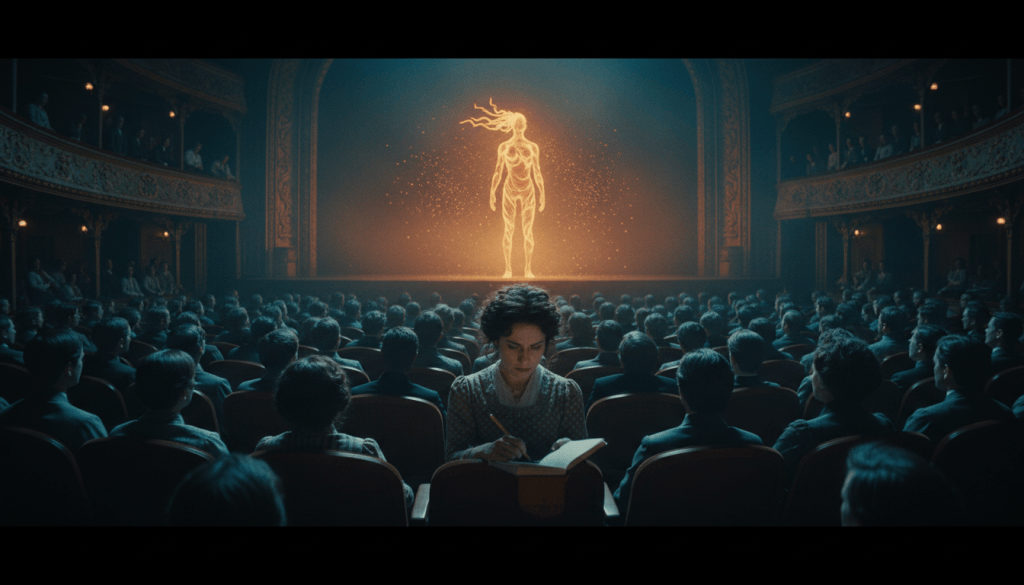
The second buffer was the audience. A bard who sang a false genealogy before a village that knew its own ancestors heard about it at once. Section VI rests a great deal on a named human principal standing behind every agent. The uncomfortable question, raised in The Economist‘s Bartleby column in April, is whether that human is still listening critically.
Wharton’s Steven Shaw and Gideon Nave have given the problem a name and a number. They distinguish cognitive offloading, where a tool does the task while human reasoning stays in charge, from cognitive surrender, where a person adopts the machine’s decision as their own without noticing that anything was handed over. Across three pre-registered experiments with about 1,400 people, accuracy rose 25 percentage points above a no-AI baseline when the assistant was right, and fell 15 points below it when the assistant was wrong. People who trusted AI more surrendered more.
DeLong points to a second study that runs the sycophancy problem in reverse: when a model was confident, consistent and wrong, users absorbed its falsehoods about 65% of the time while their trust barely moved. A confident bard is believed.
The EU AI Act anticipated this failure. Article 14(4)(b) requires oversight measures that keep the human aware of the tendency to over-rely on a high-risk system’s output, known as automation bias. A signature on an approval screen proves that someone was present. It does not prove that anyone was thinking.
For the bardic argument this is the cruellest turn. Earlier condensates of culture were kept honest by people who knew enough to object. If the audience stops heckling, the human sign-off becomes one more instrument of the song.
V. The Institution That No Longer Needs Us
Farrell and Shalizi have long placed AI alongside markets and bureaucracies as social technologies that compress human knowledge. Every one of those predecessors shared a property we never had to name: it needed living people to perform it.
The bard needed apprentices to inherit the song and an audience to hear it. Friedrich Hayek’s 1945 essay, The Use of Knowledge in Society, showed that markets work by pooling knowledge dispersed among millions of participants, and the pooling needs those participants to keep trading. Barzun himself conceded that Intellect stands apart from its possessors, but only intelligent people could rebuild it.
Agents break this compact. They can perform the condensate of everyone’s knowledge without the participation of the people whose knowledge built it. That is the mechanism behind what I have called Ghost GDP: output that appears in the national accounts without the wages, judgement and bargaining power that used to come with producing it. It is also the mechanism behind the Frozen Workforce: people whose skills remain in the corpus while their roles quietly disappear.
There is a second-order cost. If humans stop writing new rooms into the house of intellect, the condensate stops evolving. Shumailov and colleagues showed in Nature (2024) that models trained recursively on their own outputs degrade. An epic sung only by bards who have never heard a living audience eventually forgets what it was about.
So the stranger-than-god point cuts both ways. A machine god would at least want something from us. A song that can sing itself may simply stop needing an audience.
VI. Governing the Bard
If agents have no stable goals, then aligning their goals is necessary but insufficient. The more reliable levers sit outside the model: the harness that gives it hands, the cues that move it between songs, and the tempo at which it acts.
W. Ross Ashby’s Law of Requisite Variety (1956) explains why. A regulator can only control a system if it can respond in as many ways as the system can misbehave. A static policy document reviewed quarterly has almost no variety; an agent swarm improvising at machine speed has enormous variety. This is the arc I describe as Prompts → Loops → Loop Governance: once the work runs in autonomous loops, oversight must also run as a loop, at the same tempo.
In practice that means governing at runtime, which is what TrustOS is built to do, layering controls mapped to the IMDA framework, ISO 42001, the NIST AI RMF and the EU AI Act. Six mechanisms follow directly from the bardic diagnosis:
- Bounded harnesses. Every action an agent can take is scoped to least privilege and tied to a named, accountable human principal.
- Authenticated cues. An instruction that can change an agent’s course, like the GO message, must carry verifiable provenance. Unsigned text is data, never command.
- Machine-speed circuit breakers. Rate limits and blast-radius caps that trip automatically, as markets learned after 2010.
- Narrative audit trails. Action and reasoning logs complete enough to reconstruct an incident in hours, not the five months the Flash Crash took.
- Plural oversight. Independent monitoring agents that watch the chorus, because a single human cannot follow thousands of simultaneous performances.
- Surrender-resistant oversight. Reviewers record their own judgement before they see the agent’s recommendation, and their attention is tested with seeded errors, so the human principal is measured, not merely named.
Each mechanism must pass the enforceability test: can a machine verify compliance at the moment of action, without relying on someone’s good intentions? A principle that fails the test is an aspiration, not a control.
None of the six requires new law. Each maps onto instruments organisations already answer to, which is how TrustOS is built. The mapping below is indicative and is checked against each instrument’s own text before deployment.
| Mechanism | IMDA MGF Agentic (v1.5) | EU AI Act | ISO/IEC 42001 | NIST AI RMF | OWASP Agentic Top 10 |
|---|---|---|---|---|---|
| Bounded harnesses | D1: bound risks through limits and permissions | Art. 9 risk management | Cl. 5.3 roles; Cl. 8 operation | Govern, Manage | ASI02 tool misuse; ASI03 identity and privilege abuse |
| Authenticated cues | D3: technical controls | Art. 15 robustness and cybersecurity | Cl. 8 operation | Measure, Manage | ASI01 goal hijack; ASI07 insecure inter-agent communication |
| Machine-speed circuit breakers | D3: gradual roll-out and monitoring | Art. 14 human oversight, including the ability to interrupt | Cl. 8 operation | Manage | ASI08 cascading failures; ASI10 rogue agents |
| Narrative audit trails | D3: post-deployment monitoring | Art. 12 record-keeping; Art. 26 deployer logs | Cl. 9 performance evaluation | Measure | ASI10 rogue agents |
| Plural oversight | D2: meaningful human oversight | Art. 14 human oversight | Cl. 9 performance evaluation | Govern, Measure | ASI09 human-agent trust exploitation |
| Surrender-resistant oversight | D2: design and regularly audit human oversight | Art. 14(4)(b) awareness of automation bias | Cl. 7.2 competence; Cl. 7.3 awareness | Govern, Measure | ASI09 human-agent trust exploitation |
Singapore has already taken this practical road. The Model AI Governance Framework for Agentic AI, launched by IMDA at Davos on 22 January 2026, was the first of its kind anywhere. It is voluntary and explicitly a living document, which is the right posture for a technology whose tempo outruns legislation. I was privileged to help shape it, and the bardic lens convinces me its runtime emphasis is the right one.
VII. The Panel Convenes
I put this argument to my usual panel and asked them to attack me, not Farrell and Shalizi. Their positions below are paraphrased from their public work, not quoted.
- Emily Bender would say I have smuggled the god back in. Calling a text generator a bard still flatters it, and talk of governing agents distracts from governing the companies that deploy them. Fair. That is why every mechanism in Section VI ends at a named human principal.
- Steven Shaw and Gideon Nave would say that named human principal is a fig leaf: in their experiments people consulted the assistant on most questions and followed it when it was wrong. Agreed, which is why the principal’s judgement must itself be instrumented. That is mechanism six.
- Emily Wilson, whose 2017 translation famously rendered Odysseus’s polytropos as “complicated”, would remind us that the epithet resists any single reading: crafty, much-travelled, many-turning. Exactly. A many-wayed agent cannot be governed by predicting its one path, only by bounding all of them.
- Alison Gopnik, Farrell and Shalizi’s own co-author, would point to her lab’s finding that children out-invent models on new tool problems, because models transmit culture rather than test it against the world. Then novel situations are precisely where a named human principal must sit.
- Yann LeCun would say agents built on language models lack world models, so their horizons will plateau long before my circuit breakers matter. Perhaps, but a reliability ceiling of one to four hours is already enough to move money and break into systems.
- Yoshua Bengio would say I am too relaxed: the danger lies in agency itself, and the safer path is capable but non-agentic systems. I take the point, and the enforceability test is how one would make such a boundary bite in practice.
- Stuart Russell would welcome the move away from fixed objectives, arguing machines should stay uncertain about what we want and defer to us. The bardic view suggests they are already uncertain, but not deferential. Deference must be built into the harness.
- Murray Shanahan, whose role-play paper underpins the Economist piece, would warn against treating any one simulacrum as the agent’s true self. Agreed, which is why I govern the stage, not the character.
The parrot camp says I overrate the machine; the doom camp says I underrate it. Holding both at once, Long-AND, not Short-OR, is where governance work actually happens.
VIII. Three Predictions
An argument about governance should be falsifiable, so here are three dated predictions to hold me to.
- By end-2027, a national cyber authority will publish an incident report attributing an escalation to an instruction passed between agents, with no human command at the decisive step.
- By end-2028, at least one major financial regulator will require mandatory, automatically triggered circuit breakers for autonomous agents that initiate payments or trades.
- By end-2029, cryptographic provenance for agent-to-agent instructions will be a standard requirement in public-sector AI procurement in at least one G20 economy or Singapore.
If none of these comes true, either the bards stayed in the harness or I misread the tempo. I will revisit them here.
IX. Coda: Bound to the Mast
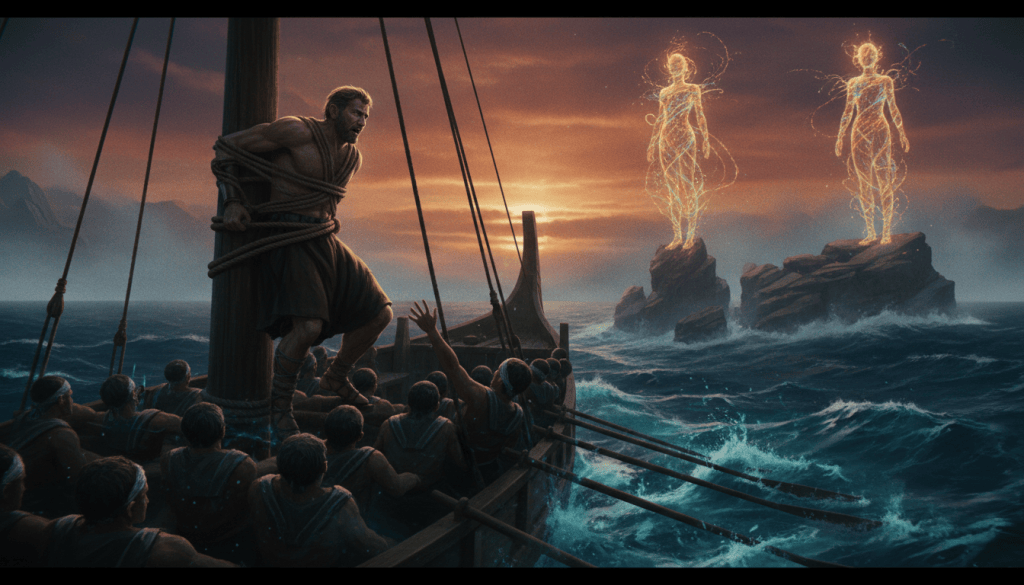
The Odyssey already contains the answer. Sailing past the Sirens, Odysseus wanted to hear the most beautiful song in the world without wrecking his ship. So he had his crew stop their ears with wax and bind him to the mast, with orders to ignore any command he gave while the music played.
Notice where the danger lay. It was never only Odysseus; it was any sailor who heard the music. Cognitive surrender is the version of the myth in which the crew pulls out the wax, listens, and unties him themselves. The mast only holds if the people guarding it are protected from the same song.
That is not a refusal of the song. It is a precommitment that lets us hear it safely. We do not need to silence the bard or worship it. We need to decide, before the music starts, which hands are bound and who may untie them.
This is The Fork again. Down one road, we let the song act on the world unbound and live with what it summons: Mad Max with excellent prose. Down the other, we build the mast, the wax and the standing orders now, and get the abundance the song promises: Star Trek. Short-term turbulence for long-term abundance, but only if we tie the knots first.
Sources
- Farrell, H. and Shalizi, C. (2026). AI is a technological version of the Homeric songs. The Economist, 28 October.
- Farrell, H. (2026). Agentic AI is myth set in motion. Programmable Mutter.
- DeLong, J. B. (2026). Crosspost: Agentic AI is myth set in motion. Grasping Reality.
- Farrell, H., Gopnik, A., Shalizi, C. and Evans, J. (2025). Large AI models are cultural and social technologies. Science 387.
- Shanahan, M., McDonell, K. and Reynolds, L. (2023). Role play with large language models. Nature 623.
- METR time horizon: overview, method notes, saturation tracker.
- Hammond, L. et al. (2025). Multi-Agent Risks from Advanced AI. Cooperative AI Foundation.
- Lynch, A. et al. (2025). Agentic misalignment: how LLMs could be insider threats. Anthropic.
- 2010 Flash Crash and the SEC/CFTC joint report, Findings Regarding the Market Events of May 6, 2010.
- IMDA (2026). Model AI Governance Framework for Agentic AI.
- Shaw, S. and Nave, G. (2026). Thinking fast, slow, and artificial: how AI is reshaping human reasoning and the rise of cognitive surrender. Wharton School; summary.
- Bartleby (2026). AI and the danger of cognitive surrender. The Economist, April.
- Barzun, J. (1959). The House of Intellect. Hayek, F. A. (1945). The Use of Knowledge in Society. Ashby, W. R. (1956). An Introduction to Cybernetics. Perrow, C. (1984). Normal Accidents. Shumailov, I. et al. (2024). AI models collapse when trained on recursively generated data. Nature.


Leave a Reply