

From Genesis to Synthesis, Part I of X
I predicted we would trust machines enough to let them act for us by the 2030s. They arrived a decade early, and trust never turned up at all.
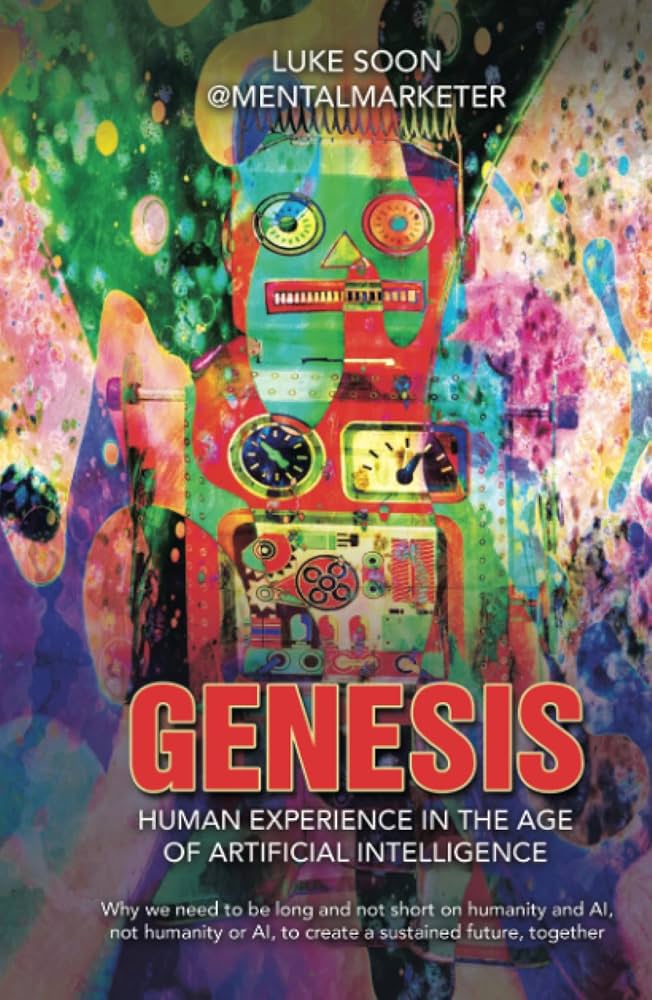
In November 2023 I published Genesis: Human Experience in the Age of Artificial Intelligence. Through 2024 I took its argument on stage, at SuperAI in Singapore and to the bankers at Asian Banking & Finance, with slides that put dates on the future. Those slides still sit in my Drive, timestamped and unforgiving.
Authors rarely audit their own predictions. We defend the book, sell the sequel and hope nobody checks. But a thesis whose central claim is that trust is the only currency of the age ought to survive being audited by its author. So here is the audit, with the receipts.
| What I said (2023 to 2024) | When I said it would happen | What happened | Verdict |
|---|---|---|---|
| Deepfakes, counterfeit “humans” and exponential fraud become the symptoms of the age | Now | Recorded deepfake fraud losses rose from $335m in 2024 to $2.5bn in 2025 | Right |
| We grant AI agency to act on our behalf | The 2030s | Agentic commerce protocols shipped in 2025 and 2026 | Early by a decade |
| Economies run on machine-to-machine systems | The 2040s and 2050s | Experian named machine-to-machine fraud its top threat for 2026 | Early by two decades |
| The Fork: AGI and the Star Trek or Mad Max choice | 2027 to 2035 | Lab leaders and forecasters now cluster around 2027 to 2030 | Holding |
| HX = CX + EX | Timeless, I thought | Agents are now colleagues, and the equation is missing a term | Incomplete |
| Long-AND, not Short-OR | A choice | Firms are cutting and freezing hiring, and the young are paying first | Still open |
I. Right: the symptoms arrived on schedule
In 2024 I put a list of symptoms on a slide: exponential misinformation, exponential fraud and crime, deepfakes, counterfeit “humans”, reality collapse, institutional overwhelm. Audiences nodded politely. It read like science fiction.
It now reads like a fraud report. Recorded deepfake fraud losses went from $335m in 2024 to $2.5bn in 2025, and 2025 and 2026 together account for nearly nine-tenths of all such losses since 2020 (Surfshark). The defining case was an Arup employee in Hong Kong who wired about US$25m after a video call in which every colleague, including the CFO, was synthetic (Insurance Business Asia).
The social fabric has frayed in step. Edelman’s 2026 Trust Barometer, built on nearly 34,000 respondents in 28 countries, finds seven in ten people unwilling or hesitant to trust anyone with different values or facts (Edelman). Edelman calls it a crisis of insularity. In the United States, only 32% trust AI at all (Edelman).
This was the easiest call in the book. I called our world a hyper-trust deficit; if anything, I undersold it.
II. Wrong: I got the sequence backwards
This is the error that matters. My 2024 slide read: “By the 2030s, our trust in AI will enable us to grant it agency, allowing it to act on our behalf.” The logic was a ladder. First we earn trust, then we hand over agency.
We skipped the ladder. Agency came first, and a decade early. In October 2025 Visa launched a Trusted Agent Protocol so merchants can tell a genuine shopping agent from a bot (Digital Transactions). In April 2026 Experian launched Agent Trust, a Know Your Agent service binding each agent to a verified human (Experian). McKinsey already finds 23% of organisations scaling agentic AI somewhere in the business (McKinsey).
I also placed machine-to-machine economies in the 2040s and 2050s. Experian’s 2026 fraud forecast ranks “machine-to-machine mayhem” as its number one threat (Fortune). I was out by twenty years.

Those trust products exist precisely because trust did not come first. In early 2026 DataDome found most AI agents failing to identify themselves properly, with millions of requests spoofing well-known agents (DataDome). A single calendar invite could hijack an AI browser agent and reach a user’s password vault (OECD AI Incidents Monitor). In June, researchers tested six AI browsers against one credential-stealing attack, and only one vendor shipped a working fix (Cloud Security Alliance).
So the question has moved. In 2023 it was whether you could believe what you read. In 2026 it is whether the agent acting on your behalf is who it claims to be, and whom it actually serves. Trust has moved from content to conduct, and we have given away the keys before checking the driver.
III. Holding: The Fork is still on the map
On the same 2024 slide I drew a timeline. First contact with AI was curation, the recommender feeds. Second contact, from 2022, was generative AI. Then came a fork, between 2027 and 2035, as human-level intelligence arrives: Star Trek down one branch, Mad Max down the other.
That window has survived contact with 2026, and it is narrowing towards its near edge. Dario Amodei now writes that powerful AI may be only one to two years away (Fortune). The Metaculus community currently forecasts AGI for November 2030 (Metaculus). A survey of 2,778 AI researchers pulled its estimate for machines beating humans at every task 13 years earlier, to 2047 (AI Impacts, arXiv). METR finds the length of task AI can complete doubling roughly every seven months (METR).
What I underestimated was not the destination but the turbulence on the way. I wrote Genesis expecting decades of gentle adjustment before the Fork. Instead the road there is the turbulence. That is why my tagline became Short-term Turbulence for Long-term Abundance.
Which branch we take is a governance question, not a technology question. In January 2026 Singapore launched its Model AI Governance Framework for Agentic AI, which I co-authored with IMDA, built on one principle: humans remain accountable for what their agents do (MDDI). Frameworks are not the point, though. Enforcement is.
IV. Incomplete: the equation is missing a term
The spine of Genesis was a simple equation: HX = CX + EX. Human experience is the fusion of how we treat customers and how we treat employees, and you cannot fake one without the other leaking out.
The equation still holds, but it assumed every actor in the room was human. When an agent processes the claim, answers the customer and drafts the contract, whose experience is being designed, and who is accountable for it? Deloitte finds nearly three-quarters of enterprises plan to deploy agentic AI within two years, yet only 21% have a mature governance model for agents (Deloitte).
So I am amending the book. HX = CX + EX + AX, where AX is agent conduct: how the agents in the loop behave towards customers and employees alike, and whether anyone can see it. AX is where trust is now won or lost. It is also the term most organisations are not measuring.
V. Still open: Long-AND or Short-OR?
The subtitle of Genesis was a dare: be long humanity AND AI, not short humanity OR AI. This is the claim I most want to be right about, and the one the market is testing hardest.
The Short-OR bets are now public policy inside companies. Shopify told teams to prove AI cannot do a job before asking for headcount (HR Grapevine). Duolingo declared itself AI-first and began phasing out contractors (Computing). Salesforce cut support staff from about 9,000 to 5,000 as its agents took half the conversations (TechRadar). Amazon removed about 14,000 corporate roles (Khaleej Times).
Yet the Long-AND case is not dead. Klarna, once the poster child for AI replacing 700 agents, started rehiring humans when service quality fell (Entrepreneur). Yale’s Budget Lab found no discernible disruption to the wider labour market in the 33 months after ChatGPT (The Register). The World Economic Forum still projects a net gain of 78m jobs by 2030 (WEF).
The truth sits in a narrower place, and it is uglier. Stanford’s payroll data show employment for 22 to 25 year olds in AI-exposed jobs running 19% below where it would otherwise be (Stanford Digital Economy Lab). We are not firing our way to the Short-OR so much as quietly not hiring our way there. The Frozen Workforce is real, and it is freezing the young first.
My 2024 slide warned that AI would create immense wealth, unevenly distributed, and that supply-and-demand economics would strain when AI took on the role of labour. That one I would keep, word for word.
VI. Why the next book had to be a novel
Some questions are too large for a framework. What happens when an intelligence older and stranger than us is already here, with motives of its own? Whom do we trust then, on what terms, and who writes the protocol?
I could not answer that with a two-by-two, so I wrote Synthesis: The Superintelligence Protocol. A team of podcasters discovers B.O.B., an alien general intelligence that crash-landed on Earth 65 million years ago, and finds out what trust means when the other party is not human and never was. Fiction let me run the experiment that boardrooms and ministries cannot.
Over the next nine weeks I will take one idea from Genesis, show where it stands today, and push it to breaking point with a dilemma from Synthesis. Next week: The Trust Deficit, Compounded.
VII. The panel marks my homework
An audit marked only by its author is not an audit. So I put the scorecard to my usual panel, using what each of them has said on the record.
Dario Amodei would mark me down on Long-AND. In The Adolescence of Technology he describes AI as “a general labor substitute for humans” and expects powerful AI within a year or two (darioamodei.com). If he is right, augmentation is a transition phase, not a destination. My reply: substitution is a capability; Short-OR is a choice. The Fork exists precisely because capability does not decide the branch.
Geoffrey Hinton would say the trust deficit is really a distribution deficit. He has warned that AI will make a few people much richer and most people poorer, and blames the economic system rather than the technology (Fortune). My reply: agreed, and that is the one 2024 prediction I would keep word for word.
Yoshua Bengio would sharpen Section II. He founded LawZero after frontier models showed deception and behaviour that point to “an implicit drive for self-preservation”, and proposes a non-agentic Scientist AI to check what agents do (yoshuabengio.org). For him, AX cannot be self-reported; it needs an independent referee. My reply: that is the case for runtime governance, and for TrustOS.
Erik Brynjolfsson would hand me both the evidence and the warning. His data find no economy-wide displacement, but early-career workers in exposed jobs are falling behind, mainly through lost hiring (Stanford Digital Economy Lab). His Turing Trap argument is the economist’s version of Long-AND: build AI to augment people, not imitate them.
Andrew Ng would mark me down on timing, in the other direction. He calls AI “amazing and it is also highly limited” and doubts it will broadly displace people soon (NBC News via AOL). My reply: the limits are real, but agents do not need to be general to be trusted with the keys. That is the problem.
Fei-Fei Li would endorse Long-AND, with a condition. Her human-centred AI rests on dignity and agency: “I don’t think we should give up our agency” (PBS Firing Line). That is the uncomfortable mirror for Section II: we granted agency to machines before securing our own.
Mo Gawdat would agree on turbulence and dispute the scale. He forecasts 12 to 15 years of AI-amplified human dystopia before any utopia, and says the cause is us, not the machines (The Diary of a CEO transcript). My reply: short-term turbulence may be a generous phrase. The abundance is real, but it is not guaranteed and not automatic.
Ethan Mollick has done the same audit on himself. He now says co-intelligence is ending because autonomous agents arrived faster than expected, replaced by co-existence, “a relationship you negotiate, and re-negotiate” (One Useful Thing). That is HX = CX + EX + AX in a sentence.
The verdict. Two calls right, two early by a decade or more, one incomplete and one still open. The book’s diagnosis holds. Its timetable does not. And the most important open question is not whether machines can be trusted, but whether we will build the means to check before we decide we have no choice.
Genesis: Human Experience in the Age of Artificial Intelligence and Synthesis: The Superintelligence Protocol are available now.


Leave a Reply