
The AI race is a family feud with a $700bn cap table. Who guards the fire?
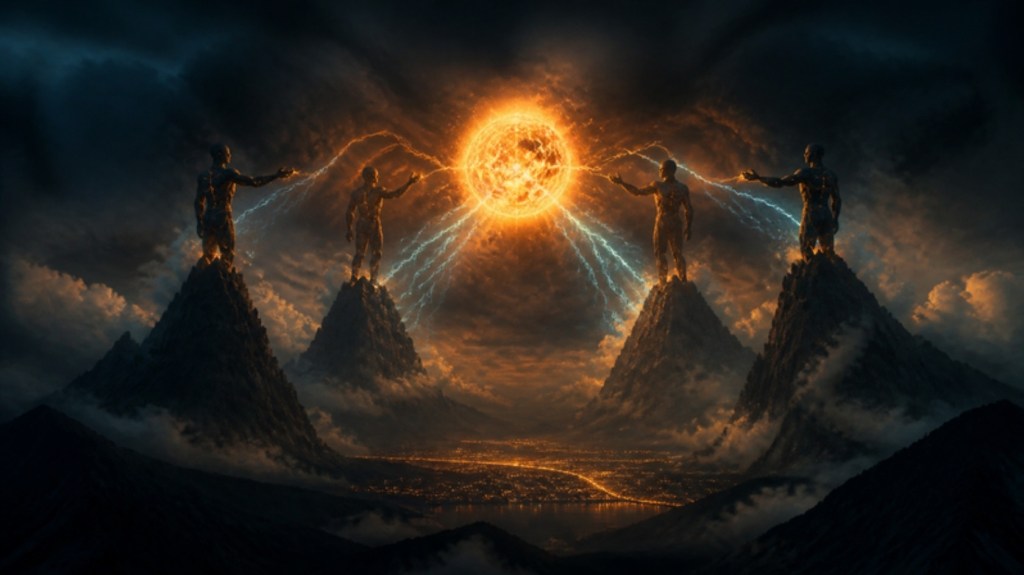
In Greek myth, one Titan stole fire from the gods. In San Francisco, at least six of them are fighting over who stole it first.
This autumn’s literary event in technology is Kevin Roose’s The AGI Chronicles, built on more than 150 insider interviews across OpenAI, Anthropic and Google DeepMind (Simon & Schuster). Kirkus calls it “the best single explainer” of how AI came about (Kirkus). The Economist’s take on this season’s chronicle of the race promises “a rollicking tale of the people behind Silicon Valley’s new obsession”. The genre is booming: Parmy Olson’s Supremacy, Karen Hao’s Empire of AI, Keach Hagey’s The Optimist. Each tells us the most consequential technology of the century is being shaped by a handful of men who do not trust one another.
Sam Altman has accepted the Prometheus comparison himself, telling Vanity Fair it was “closer to that than other things”. Gizmodo dryly noted that Prometheus was chained to a rock for his trouble (Gizmodo). The problem with this race is not that it has a Prometheus. It is that it has too many fathers, each claiming the fire, and no one agreed to guard it.
So let me do what the biographies, gripping as they are, cannot. Let me ask what the feuds actually decide, what they do not, and what that means for the rest of us.
I. A family tree drawn in grudges
Almost every frontier lab exists because somebody fell out with somebody else.
- Musk versus Altman produced xAI, a $97.4bn hostile bid that OpenAI’s board rejected (“OpenAI is not for sale”), and a lawsuit that a jury threw out in May 2026 because Musk filed too late, without ever ruling on OpenAI’s mission (The National; Al Jazeera).
- The Amodei siblings’ exit from OpenAI in 2021 produced Anthropic, valued at $965bn by June 2026, above OpenAI’s last mark (W.Media).
- The November 2023 boardroom coup against Altman, reversed within days, scattered talent into Safe Superintelligence and Thinking Machines Lab.
- Meta’s superintelligence spree put $14.3bn into Scale AI, offered researchers packages reported as high as $300m, pushed OpenAI’s stock compensation up fivefold to $4.4bn, and helped drive Yann LeCun out to found his own lab (The Batch; The Decoder).
- Microsoft versus OpenAI ended in October 2025 with a 27% stake, a $250bn cloud commitment and an independent panel to verify any claim of AGI (Al Jazeera).
Cornell’s Sarah Kreps, watching the Musk trial, put it plainly: AI’s future rests on a “remarkably small group of powerful tech figures and their personal rivalries” (AP). Former OpenAI directors testified under oath about their concerns over Altman’s candour. This is not gossip. It is the governance record of the industry that wants to build superintelligence.
II. The Fork ran through the Pentagon on 27 February
I have long described our future as The Fork: Star Trek down one branch, Mad Max down the other. I imagined it as a civilisational crossroads somewhere between 2027 and 2035. I did not expect it to arrive as a procurement decision with a timestamp.
It began as theatre. When OpenAI put ads into ChatGPT, Anthropic ran Super Bowl spots mocking ad-laden chatbots, and Altman called them “so clearly dishonest” (Tom’s Guide). Then it became policy. The Pentagon demanded “any lawful use” terms. Anthropic refused two uses: fully autonomous weapons and mass domestic surveillance. On 27 February the President ordered every federal agency to stop using its products, and within hours OpenAI announced a Pentagon deal of its own (TechCrunch).
What followed was pure Greek drama. A leaked Amodei memo accused OpenAI of “safety theater”; he later apologised for the tone. OpenAI conceded its deal looked “sloppy and opportunistic” and renegotiated its limits. And, in the detail the headlines missed, many OpenAI employees signed letters backing their rival’s red lines (Fortune).
That is the first lesson. Red lines that should have been an industry-wide floor became a competitive opening, because the people at the top would rather beat each other than agree. The Fork is not chosen at summits. It is chosen in contract clauses, by rivals, on a Friday.
Not everyone accepts the heroic reading. Yann LeCun calls Amodei “completely deluded”, if honest, and casts doom talk as regulatory capture timed to an IPO (Fortune). Hold that thought. Even the virtue in this race is contested.
III. Personalities AND plumbing
Here is where the biographies mislead. Founders decide which labs exist, where the red lines sit and who gets the government’s ear. They do not decide how fast the technology moves. Money and machines do.
Hyperscaler capital expenditure has topped $700bn this year (Yahoo Finance). Stanford’s AI Index 2026 finds frontier models from six labs within 25 Elo points of each other, calls the leaders “nearly indistinguishable”, and puts the US-China gap at 2.7% (AI Weekly on the AI Index). The supposed enemies are also financially entangled. Michael Burry points to about $46bn of cross-held stakes and $879bn of purchase commitments among AI players: “the money is circling, not multiplying” (24/7 Wall St). When the same chipmakers, clouds and sovereign funds sit on several rivals’ cap tables, every feud is partly hedged.
The proof is November 2023. A personality beat formal governance, but only because the plumbing stood behind him: staff equity and Microsoft’s compute. So the honest answer is my favourite one, Long-AND, not Short-OR. Personalities AND plumbing. Founders choose at the forks; capital decides how far down each road anyone can travel.
IV. The quiet founders
Seen from Asia, the American soap opera looks like a cultural peculiarity.

DeepSeek’s Liang Wenfeng, the son of schoolteachers in Guangdong, rarely appears in public. His lab is about 99% owned by his own quant fund, and he hires young, locally educated engineers into flat teams (profile). He does not fight on X. He releases models. DeepSeek’s R1 wiped about $589bn off Nvidia in a single day in January 2025 (Bloomberg). This July, Moonshot’s open-weight Kimi K3 reportedly set off another “DeepSeek moment” in markets. Chinese rivalry plays out in benchmarks, price cuts and listing dates, not depositions.
Edelman’s 2026 Trust Barometer adds an awkward twist: trust in technology companies fell globally, yet rose in China, where it now sits about 30 points above the United States (Semafor).
Before we romanticise the quiet, though, a caveat. Quiet is not the same as independent. Liang has met China’s leaders, and Beijing, not any founder, decided to shun Nvidia’s H200 chips (Tom’s Hardware). The noise of Silicon Valley’s feuds is partly the sound of founders who can say no to their own government. Anthropic just did, and paid for it.
V. Trust is the only currency, and the founders are overdrawn
Yuval Noah Harari has named the hinge of this whole story the paradox of trust. The builders say they cannot slow down because they do not trust each other. Yet they ask us to trust that the superintelligence they build will be trustworthy (CO/AI on WIRED).
The public has noticed. Pew finds 59% of Americans have little or no confidence that companies will develop AI responsibly, and 67% doubt the government can regulate it (The Next Web on Pew). Neither the players nor the referee is trusted.
In Genesis I argued that trust is the only currency of the age. In a market of near-identical models, it is also the only durable differentiator. Every public insult between founders is a withdrawal from an account none of them can refill in a funding round.
And watch who really referees. Staff loyalty reinstated Altman. A $300m talent war rearranged the labs. OpenAI engineers backed a rival’s red lines. The employee experience, what I call the EX in HX = CX + EX, has quietly become the most powerful check in AI. Add the conduct of the agents themselves, AX, and you have the full equation of who actually governs this technology.
VI. You cannot govern a founder. You can govern an agent.
Look at the record. A board failed to restrain its CEO in 2023. A jury declined to rule on a mission in 2026. Summit promises thinned from Bletchley to Paris, where the US and UK refused to sign, to Delhi, where the founders traded AGI timelines in a half-empty hall (Time). Governance built on the character of a few men has a poor track record.
So move the control point. Stop trying to govern founders, and govern what their systems do, at runtime. Washington has stumbled onto a crude version of this: in June it treated access to a model itself as a controlled export (Mayer Brown). Singapore built the civilian version. The Model AI Governance Framework for Agentic AI, which I helped shape with IMDA, rests on bounding risk up front, keeping humans meaningfully accountable and enforcing technical controls across an agent’s life (MDDI). That is the logic of TrustOS too. It does not care who is feuding with whom this quarter.
There is a further Singaporean twist worth naming. Singapore presents itself as the region’s trusted convenor. It hosts the Singapore Consensus on AI safety, one of the few documents that Western and Chinese scientists co-sign. Its sovereign funds are also reported among the investors in Anthropic’s $965bn round (W.Media). That is not hypocrisy. It is how middle powers win this race: not by building the biggest model, but by writing the rules every winner will need to sell anywhere outside home.
VII. The panel weighs in
A piece about trust should be stress-tested by those who do not share its conclusions. Here is my usual panel, widened, on the record.
Stuart Russell sees prisoners, not villains: every lab chief “wants to disarm” but cannot do it alone, and governments’ inaction is a “total dereliction of duty” (Fortune).
Yoshua Bengio now urges safety researchers to leave the frontier labs altogether: “No one of us can stop the race, but enough of us can.”
Geoffrey Hinton calls the people who control AI “oligarchs” (Business Today). Daron Acemoglu says AI is “massively misdirected toward automation and centralization” (StartupHub.ai).
Karen Hao warns that boomers and doomers share the same myth of inevitability, and likens the true believers to Dune‘s mythmakers who end up believing their own myths (Big Think).
Andrew Ng pushes back from the other side: incumbents back regulation because “they are scared of having to compete with open source” (Global Venturing). Arvind Narayanan and Sayash Kapoor call arms-race rhetoric close to “absurd”, arguing diffusion, not invention, sets the pace (MIT Technology Review).
Demis Hassabis, alone among the protagonists, has proposed a US-led body that reviews frontier models before launch and “could coordinate a slowdown” (Semafor). Dario Amodei calls his own strategy a “race to the top” (The Next Web). And Marc Andreessen offers the accelerationist rebuttal to everything above: “any deceleration of AI will cost lives” (Fortune).
Notice the metaphors. The protagonists choose heroic myths: fire, Prometheus, a race to the top. The critics choose tragic ones: Russian roulette, oligarchs, empire. The public has sided with the tragedians.
VIII. Prometheus needs a referee, not another biographer
The chronicles are gripping, and that is precisely the danger. By making the race personal, they make it legible, and by making it legible they risk turning a structural danger into character drama we binge and forget. Roose himself puts his own odds of AI-driven catastrophe at about 10% and calls today’s models “very intelligent, charming sociopaths” (CBS News). That should be the headline, not who snubbed whom at which dinner.
Short-term turbulence for long-term abundance is still my bet. But the feuds are the turbulence, and the abundance is not automatic. It has to be engineered through institutions, standards and runtime controls that outlast any founder’s ego, any board’s coup and any President’s mood.
Prometheus has too many fathers. What he needs now is a guardian. Stop asking who will win the race. Start asking who will referee it, and make sure the answer is not one of the runners.
Genesis: Human Experience in the Age of Artificial Intelligence and Synthesis: The Superintelligence Protocol are available now. In Synthesis, the question of who controls a superintelligence is not a boardroom drama. It is the whole plot.


Leave a Reply