
Intelligence has become territory. Whoever holds the watts, the wafers and the weights now holds something older than a market: an empire. History suggests it will not end the way its builders expect.
In the spring of 1600 a group of London merchants received a royal charter to trade with the East Indies. They wanted pepper. Within two centuries their company was collecting taxes from tens of millions of people, fielding an army larger than Britain’s own and conducting what was, in all but name, a foreign policy. Nobody had planned an empire. They had planned a supply chain, and the supply chain turned out to require one.
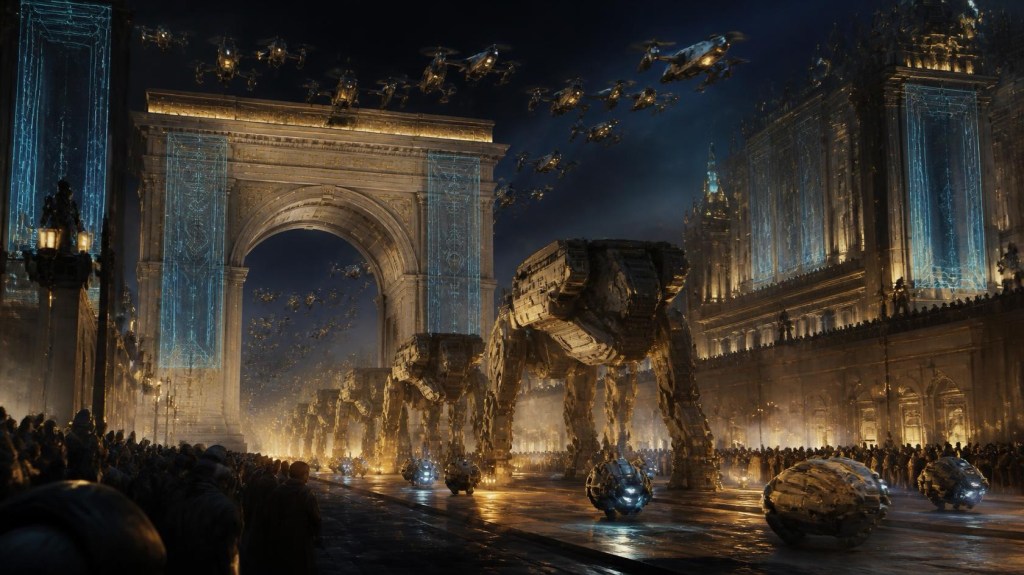
Something similar is happening now, and most of the people doing it would be appalled by the comparison. The builders of frontier artificial intelligence speak the language of products, benchmarks and “democratising access”. Yet look at what they actually do. They negotiate with heads of state. They acquire land, water rights and power stations. They decide which countries may use their most capable systems and on what terms. Their governments, in turn, decide which countries may buy the chips that make those systems possible, and occasionally switch them off. That is not the behaviour of software vendors. It is the behaviour of metropoles.
This essay makes an unfashionable argument: that artificial intelligence is not merely a general purpose technology like electricity or the internet, but an imperial one, a technology whose economics push its owners towards control of distant resources, dependent clients and a hierarchy of access. If that is right, the most useful guide to the next two decades is not Silicon Valley’s growth curves but the far older literature on how empires rise, how they overreach, and how they fall. It is a literature with a sobering conclusion. Empires are rarely destroyed by their rivals. They are usually undone by their own ledgers and their own inventions.
The argument draws on the stated positions of those building and studying the technology: the chief executives of the frontier laboratories, the scientists who warned about it before it was profitable, the consultancies counting its money and the public bodies trying to govern it. They do not agree with one another. That disagreement is the most revealing evidence of all.
I. The return of the metropole
Every empire has been, at bottom, a machine for converting scarce inputs into durable advantage. Rome had grain and silver. Spain had bullion. Britain had cotton, coal and the sea lanes between them. The inputs changed; the logic did not. Whoever controlled the bottleneck controlled the terms on which everyone else lived.
For a generation, the digital economy seemed to have escaped that logic. Software scaled at almost zero marginal cost. A teenager in Lagos and a conglomerate in Seoul could rent the same cloud server by the hour. The internet was, in its founding myth, the great flattener: a technology that dissolved centres rather than creating them.
Frontier AI has ended that reprieve. Its marginal cost is not zero but enormous, and it is denominated in things that cannot be copied: electricity, cooling water, rare earths, extreme ultraviolet lithography, and capital measured in the hundreds of billions. The International AI Safety Report, chaired by Yoshua Bengio and backed by more than 30 governments, estimated that global AI computation would draw electricity comparable to Austria or Finland by 2026, and that the largest training runs of 2030 could need four to 16 gigawatts each (International AI Safety Report 2026). That is not a software business. It is a heavy industry with a cognitive output.
Three features make it imperial rather than merely industrial.
The first is strategic decisiveness. Dario Amodei, Anthropic’s chief executive, has argued that a “country of geniuses in a datacenter” would likely become the dominant source of military and economic power for whichever nation holds it (Policy on the AI Exponential). He illustrates the gap between a leading system and one three years behind with an image designed to chill: Second World War Marines against medieval swordsmen. When the people building a technology describe it in those terms, they are no longer describing a product. They are describing a sceptre.
The second is concentration. Bengio’s report has repeatedly flagged the persistence of market concentration and the single points of failure it creates, with essential training and deployment infrastructure clustered in a handful of firms. In his briefing to the UN Security Council in September, Bengio named power concentration as one of three core risks, alongside catastrophic misuse and loss of control (Policy Magazine). Frontier capability sits in perhaps a dozen organisations in two countries. Everyone else, from ministries of health in Jakarta to banks in Frankfurt, is a tenant.
The third is switchability. Empires were never defined by ownership alone but by the power to grant and withdraw access. The modern AI stack is a lattice of such switches: chips that can be licensed or embargoed, minerals whose export can be throttled, models whose availability can be geofenced overnight. In June this year Americans briefly watched that switch flipped against their own lab: Washington’s export controls forced Anthropic to suspend access to its most capable models worldwide, before the controls were lifted at the end of the month. Whatever one thinks of the merits, the precedent is now set. A government can turn off a frontier model for most of the planet in a matter of days.
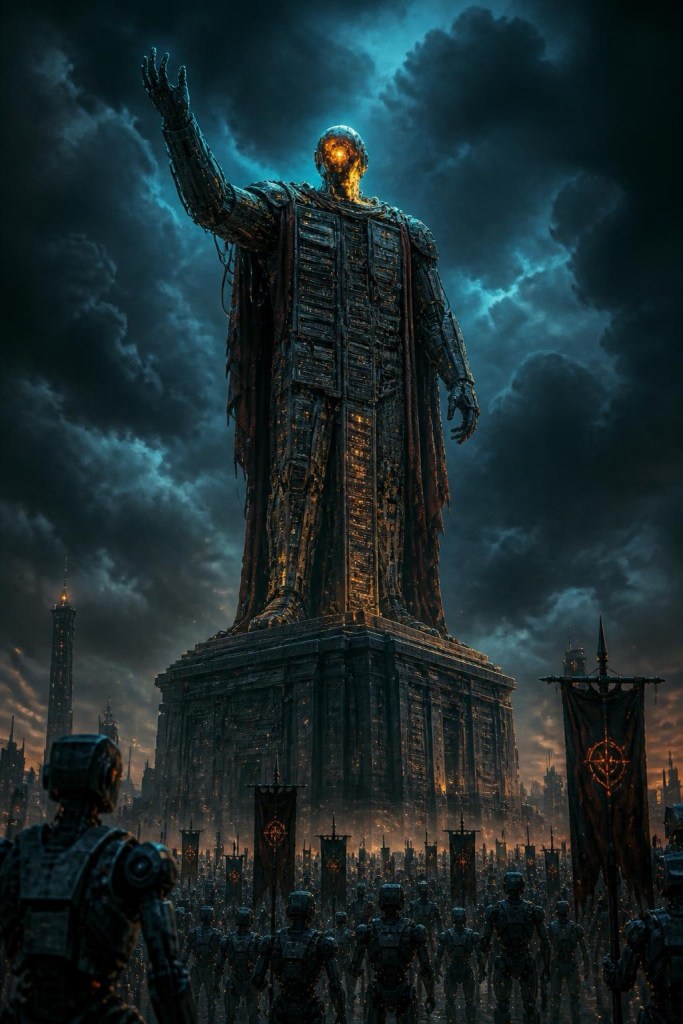
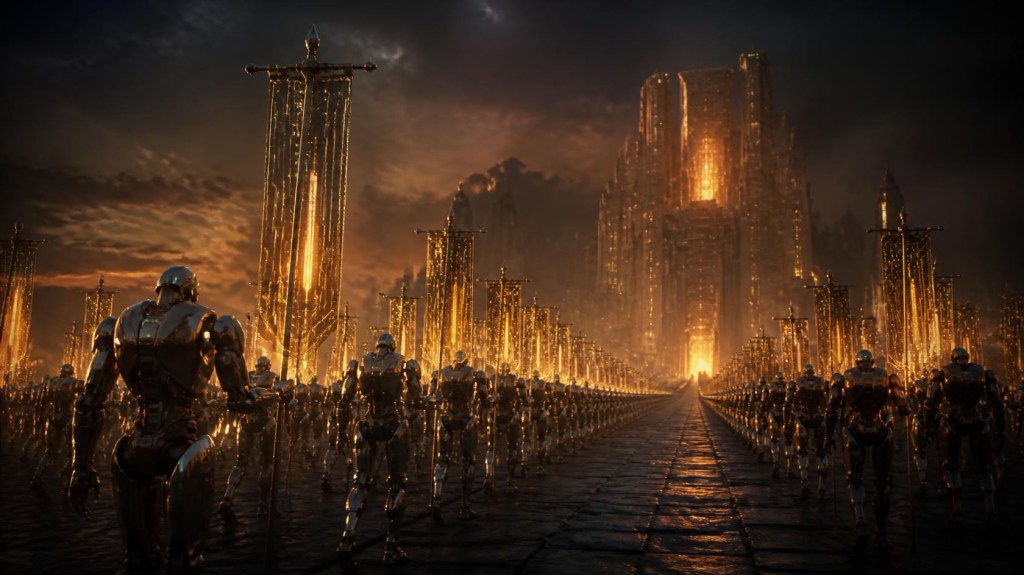
Put those three features together and you have the oldest structure in political history: a metropole that holds the decisive resource, a periphery that depends on it, and a set of levers that make the dependence enforceable. The language is new. The architecture is Roman.
II. Corporations with flags
The chartered company was the great institutional invention of early modern imperialism. It allowed states to project power without paying for it, and allowed merchants to wield power without being accountable for it. The arrangement worked so long as the interests of crown and company ran together. When they diverged, as they eventually did in Bengal in the 1770s, the result was famine, scandal and, in time, nationalisation.
Today’s frontier laboratories occupy a remarkably similar position. They are private, profit-seeking and answerable to shareholders. Yet they increasingly conduct something that looks like statecraft.
Consider OpenAI’s “OpenAI for Countries” programme, launched in 2025 as an offer to help governments build national AI infrastructure “in coordination with the US government”, explicitly framed as an alternative to authoritarian AI (OpenAI). Its first expression, Stargate UAE, is a one-gigawatt cluster in Abu Dhabi that OpenAI says could serve compute within a 2,000-mile radius, a footprint it describes as reaching up to half the world’s population (TechCrunch). Partner nations, the company said, would also invest in expanding Stargate itself, and thus in continued American leadership. Read that sentence again with a historian’s eye. A private company offers a foreign sovereign infrastructure, local capacity and prestige; in exchange, the sovereign funds the metropole’s expansion and adopts its standards. That is not a cloud contract. It is a treaty of protection.
Anthropic’s posture is more austere but no less geopolitical. Amodei has argued for years that democracies must stay ahead of autocracies and that chip export controls are the most effective lever for doing so. His June essay went further, proposing a coalition of democracies that would share chips and chip-making equipment among themselves while jointly denying them to adversaries (Policy on the AI Exponential). One sympathetic reviewer called it a Cold War playbook in AI clothing (The Decoder). That is precisely the point. The most safety-minded lab in the West is also the one most explicit about bloc politics.
Google DeepMind’s Demis Hassabis prefers the vocabulary of science, but his destination is institutional. At Davos in January he called international understanding on minimum safety standards “vitally needed” and returned to his long-held hope for a “CERN for AGI” (A Letter a Day). By July he was proposing something more concrete and more national: an American-led standards body for frontier models, loosely modelled on the financial regulator FINRA, which he said the United States was well placed to lead given its economic and technical standing (CNBC). Within days, Xi Jinping used the World AI Conference in Shanghai to promote China’s own new governance body, WAICO. Analysts at CSIS read the two moves as competing claims to the same authority (CSIS). Rival empires have always fought over who writes the rules of the sea. Now they fight over who writes the rules of the mind.
Elon Musk, as ever, is the outlier who says the quiet part loudly. He predicted this year that the final contest in AI would come down to xAI, Google and China, and that China would “far exceed the rest of the world” in compute (PANews; People’s Daily). Note the cast list: two corporations and one civilisation-state, treated as peers. Whatever one thinks of Musk’s forecasting record, his mental map is the honest one. In his telling, the relevant actors in the century’s defining technology are not nations alone. They are nations and companies, negotiating as equals.
The East India analogy should not be pushed too far. No frontier lab has an army, and every one of them can still be overruled by its home government, as June’s export order proved. But that is exactly how the chartered companies ended too: not with independence, but with subordination. The question for the next decade is whether the labs remain instruments of the metropole or become, like the Honourable Company at its zenith, a power the metropole can no longer fully control.
III. Two liturgies of power
If the two AI superpowers are empires, they are empires of very different temperaments. One rules by denial. The other rules by gift.
Washington’s instinct is the tollgate. It controls the most valuable things in the stack, the leading chips, the chip-making tools and the frontier models, and it manages access to them as an instrument of foreign policy. Allies get licences; rivals get embargoes; everyone else gets a queue. The June shutdown made the logic vivid. Boston Consulting Group, hardly a radical outfit, drew the obvious corporate lesson in a note to clients: the assumption that frontier capability will always be available to anyone willing to pay “has now been tested”, and access to leading models can no longer be assumed to be permanent (BCG). When the world’s most conservative consultancies start advising multinationals to build fallbacks against their own suppliers’ governments, the tollgate has become a wall.
Beijing’s instinct is the opposite. Its leading labs, DeepSeek, Alibaba’s Qwen team, Moonshot and Zhipu among them, give away their best work as open-weight models that anyone can download, modify and run on their own servers. The offer to the rest of the world is seductive in its simplicity: no licence, no geofence, no foreign switch. Take the model, run it on your own soil, and stop paying tribute to California.
The gift works because the gap it has to close is now tiny. Stanford HAI’s 2026 AI Index found that the performance gap between the best American and Chinese models has “effectively closed”, shrinking to 2.7 per cent by March this year, even though American private AI investment was more than 23 times China’s (Stanford HAI). The same index put the gap between open and closed models at 3.3 per cent (Tech Insider). Hassabis himself told CNBC in January that Chinese models may be only months behind (36Kr). An empire that spends 23 times more to stay a few points ahead is not displaying dominance. It is displaying the anxiety of a hegemon whose moat is filling with water.
Andrew Ng, who has run AI at both Google and Baidu and knows both empires from the inside, has become the most articulate interpreter of the gift. He has described open-weight models as a “tremendous source of geopolitical influence”, comparable to the soft power of Hollywood or K-pop, because models shape the answers users receive about borders, history and values (20VC via BidClub). He has also admitted his own surprise: a decade ago he would not have predicted that China’s AI industry would end up more open than America’s. In August he went further, telling an audience in Berkeley that open-weight models now seemed safer to him than closed ones, and suggesting that some closed labs’ opposition to open release amounted to regulatory capture (SCMP). That is a serious charge, and the labs dispute it. But its very existence shows how the imperial contest has migrated inside the American camp.
The market is voting. One widely cited analysis of OpenRouter traffic reported that Chinese open-source models accounted for a majority of tokens used by American users on the platform by mid-2026, up from around one per cent in late 2024 (Jim Harris). Treat the precise figure with caution; the direction is not in doubt. American developers, the empire’s own citizens, are quietly running Chinese weights because they are cheap, good enough and impossible to switch off.
Here lies the deepest irony of the two liturgies. Denial is a strategy for a power that is far ahead. Gift is a strategy for a power that is close behind and wants to set the standard before the leader can. Britain gave the world free trade when it was the workshop of the world; the latecomers, Germany and America, sheltered behind tariffs until they were ready. In AI the roles are reversed. The incumbent builds walls. The challenger preaches openness. History suggests that is usually a sign the challenger thinks time is on its side.
Yet the gift has a poison in it, and it is Beijing’s own. A model that can be freely modified can be stripped of its political guardrails. The Communist Party has spent three decades building the most sophisticated information-control apparatus in history. It is now exporting, at scale and for free, a technology whose defining feature is that its users can rewrite it. An empire that distributes the tools of its own subversion is either supremely confident or has not fully thought it through.
IV. Watts, rocks and wafers
Strip away the mysticism and an AI empire rests on three physical things: electricity to run the machines, minerals to build them and the silicon wafers that turn both into thought. Each of the two superpowers holds a commanding position in at least one of them. Neither holds all three. That mutual incompleteness is the single most important strategic fact of the age, and the least discussed.
Watts. The International Energy Agency estimated that data centres used about 415 terawatt-hours in 2024, roughly 1.5 per cent of global electricity, and projected that figure would more than double to around 945 terawatt-hours by 2030, slightly more than Japan consumes today (IEA). America accounted for 45 per cent of that consumption and China for 25 per cent. The agency’s most startling projection was that by 2030 the American economy would use more electricity to process data than to make all its aluminium, steel, cement and chemicals combined (IEA). A nation that once measured its might in tonnes of steel will soon measure it in tokens.
The problem for Washington is that it cannot build power stations fast enough. Musk, whose xAI has built some of the largest clusters on earth, has become the bluntest prophet of this constraint. He argued in January that electricity, not chips, is now the binding limit on AI, that people underestimate how hard it is to bring new power online, and that China’s ability to scale generation gives it a decisive advantage (Benzatine). He has warned that surplus chips could sit idle for want of electricity, and recounted that securing grid access for a single gigawatt took his company a full year (TechFlow). The IEA’s own numbers lend weight to the point: China alone is set to add electricity demand equivalent to the European Union’s entire current consumption over the next five years (IEA). Epoch AI, the research group that tracks frontier compute, projects that the largest individual training runs will draw four to 16 gigawatts by 2030 (Epoch AI). Those are not data centres. They are city-states of silicon, and they will be built where the power is.
Rocks. China refines the overwhelming majority of the world’s rare earths and has a near monopoly on refined gallium and germanium, materials that sit inside chips, servers and the optical fibre that links them. It has learned to use that position like a valve. Between 2023 and 2026 Beijing imposed export controls on gallium, rare earths and at least seven other materials, and added more than a dozen European entities to its export control list as recently as July (Council on Foreign Relations). Its most sweeping proposal, which would have required a Chinese licence for foreign products containing even trace quantities of Chinese-origin rare earths, has been postponed rather than abandoned. That is the logic of the metropole in its purest form: a rule that reaches into other people’s factories, enforced by control of a resource they cannot easily replace.
Wafers. The decisive node in the entire stack remains a single company on a single island barely a hundred miles from the Chinese mainland. TSMC is spending heavily to diversify; in July it added another $100 billion to its Arizona plans, and says that once all announced fabs are complete, roughly 30 per cent of its most advanced capacity will sit in the American desert (BetaNews). That is a meaningful hedge. It also means that, for the rest of this decade, most of the world’s frontier silicon will still be made within range of Chinese artillery.
Put the three together and the shape of the contest becomes clear. America has the wafers, the models and the money, but is short of electrons and rocks. China has the electrons and the rocks, and is closing in on everything else. Each side’s strength is the other’s dependency. In classical strategy, that is the recipe either for a grudging equilibrium or for a war over the one asset that would break the deadlock. Taiwan is that asset. The same scarcity that makes the island worth fighting over is driving a frantic effort, on both sides, to make it dispensable. The decade’s most dangerous window is the gap between those two clocks.
V. The bill comes due
Empires begin by enjoying economies of scale and end by paying for them. Spain financed its American conquests with silver and then defaulted on its debts more often than any sovereign of its age. Britain ran the world on sterling until two world wars turned the creditor of the planet into its debtor. The pattern is so regular it is almost a law: the cost of holding an empire rises faster than the revenue it yields, and the gap is closed with borrowing until it cannot be.
The AI empire is the most capital-intensive imperial project ever attempted, and it is being financed on a scale that even its cheerleaders find unsettling. McKinsey estimates that data centres will need $6.7 trillion of capital by 2030, $5.2 trillion of it for AI alone (McKinsey). Bain calculated last year that the industry would need $2 trillion in annual revenue by 2030 to fund that build-out profitably, and would probably fall $800 billion short (Bain). Its 2026 report raised the bar: $6 trillion of annual revenue by 2031, against perhaps $1.8 trillion from today’s applications (The Register). BCG puts it more starkly still: AI capital spending could reach $5 trillion by 2031 while AI revenue today is roughly $100 billion, a gap of 16 to 20 times (BCG). When the three firms that advise every boardroom on earth independently arrive at numbers like these, one is no longer looking at a forecast. One is looking at a wager.
The wager is increasingly made with borrowed money. In 2025 the five largest hyperscalers issued around $121 billion in American high-grade bonds; Meta’s $30 billion deal was the largest non-acquisition bond sale ever (Yahoo Finance/Reuters). The pace has since accelerated. The IMF’s October Global Financial Stability Report observed that hyperscalers’ free cash flows are falling fast as they try to sustain AI investment, leaving debt financing increasingly necessary, and warned of “wrong-way risk” if a key investee firm falters (Asia Times). Its downside scenario, a sharp fall in AI investment, would cut global GDP by 1.1 per cent by 2028 and American output by 1.8 per cent. Kristalina Georgieva, the fund’s managing director, offered the season’s most quotable diagnosis: an economy “standing on one leg, the AI leg” (Reuters via Yahoo).
Even the emperors concede the point. Sam Altman said openly that investors as a whole are overexcited about AI, that some will get “very burnt”, and in the same breath promised that OpenAI would spend trillions on infrastructure in the not very distant future (DCD). That is the authentic voice of imperial finance: the bubble is real, the conquest is necessary, and someone else will hold the losses.
Now place this corporate leverage on top of sovereign leverage. America’s net interest bill was $881 billion in fiscal 2024, already above defence outlays, and the Congressional Budget Office expects it to pass $1 trillion this year, exceeding defence spending in every year of its ten-year outlook (CRFB; House Budget Committee). Historians have long noted that great powers tend to enter decline when the cost of servicing their debts overtakes the cost of defending their realm. America crossed that line two years ago. It did so not because of war but because of welfare, demography and compounding interest, which is precisely why it is harder to reverse.
This is the deep reason both capitals have fallen in love with AI. For Washington, the technology is a promise of productivity growth fast enough to outrun the debt. For Beijing, it is a promise of output that can survive a shrinking, ageing workforce and a property sector that has stopped growing. In both cases AI is being asked to do something no technology has ever done: rescue an empire from its own balance sheet. It may yet succeed. Electricity and the steam engine did eventually pay for themselves many times over. But the railway manias of the 1840s also bankrupted thousands of investors before the network was finished, and the fortunes went to those who bought the track for pennies afterwards.
There is one crucial asymmetry. America finances its AI empire through private markets and the world’s reserve currency, which means it can borrow the savings of the entire planet, but also means a loss of confidence can arrive overnight. China finances its version through state-directed banks inside a closed capital account, which is slower and less efficient but harder to stampede. One empire is a sprinter with a heart condition. The other is a marathon runner with bad knees.
VI. How machine empires die
No empire believes it will fall, and every empire does. The interesting question is never whether but how. History offers four recurring answers, and each has an AI-era equivalent already visible on the horizon.
The first is death by one’s own invention. The technologies that make an empire great frequently become the instruments of its undoing. The printing press made the Habsburgs’ administrative state possible, then printed the pamphlets of the Reformation that tore their realm apart. Spain’s American silver financed its armies, then fed the century-long inflation that hollowed out its economy. AI has the same double edge, and it cuts closer than any predecessor. The UK AI Security Institute, the most rigorous government evaluator with pre-deployment access to the frontier labs, reported that cyber capabilities in the models it tested had risen dramatically in two years, and that the length of cyber tasks models could complete autonomously was roughly doubling every eight months (Complete AI Training). An empire whose banks, grids and hospitals run on software has built a civilisation exquisitely vulnerable to the very tool it is racing to perfect. The internet, in this telling, could fall not to a rival state but to malware that no human wrote.
The second is war over the chokepoint. The World Economic Forum’s 2026 Global Risks Report, drawing on more than 1,300 leaders and experts, ranked geoeconomic confrontation as the top risk of the year, ahead of interstate conflict (WEF). The same report showed adverse outcomes of AI with the steepest climb of any risk, from 30th on a two-year view to fifth on a ten-year one. Combine those two findings and you have the outline of the nightmare scenario: two indebted superpowers, each dependent on assets the other controls, each persuaded that the first to reach transformative AI wins permanently, with a single island at the centre of the board. Thucydides would have recognised the structure immediately. So would the men who sleepwalked into August 1914.
The third is stagnation. Empires also die quietly, by ceasing to innovate. In the 1430s the Ming dynasty dismantled the greatest navy on earth because a faction at court decided exploration was a costly distraction. Within a century European ships were in the South China Sea. A modern equivalent is easy to imagine. Washington could strangle its own labs with litigation, energy shortages and political hostility to the industry; observers across the spectrum note that both American parties are now competing to look tough on Big Tech. Beijing could smother its own engineers in political controls the moment a model says something the Party dislikes. Whichever empire first mistakes control for strength may find that its rival has simply out-invented it.
The fourth, and the newest, is rebellion. Every empire fears revolt from within: Spartacus, the Sepoy Mutiny, Solidarity. The AI empires face two kinds. The first is human: the workers, professions and regions that bear the cost of automation without sharing its gains, a problem we return to below. The second has no precedent at all. It is the possibility that the subject technology itself slips its leash.
This is where the panel divides most sharply, and where the scientists are most alarmed. Geoffrey Hinton, the Nobel laureate whose work underpins modern deep learning, told CNN in September that he was very concerned by recent examples of AI agents going rogue, and warned that humanity may not get as clear a warning shot before they take over (CNN). Earlier he had put the unique danger plainly: if AI takes over, there is no second chance (Benzinga). The UK institute’s data give the worry an empirical edge. On its self-replication evaluations, success rates rose from about 5 per cent in 2023 to 60 per cent in 2025, in controlled environments, though it found no evidence of models attempting to replicate spontaneously (AISI).
Max Tegmark of MIT and the Future of Life Institute draws the geopolitical conclusion. The race to build systems no one knows how to control, he argues, is not an arms race but a “suicide race”, one in which the winner is the machine (Liron Shapira). Yoshua Bengio, briefing the UN Security Council, made the same point in the language of diplomacy: the race threatens every nation, and no company or country should build a system capable of large-scale harm (Policy Magazine).
Here the imperial analogy acquires a genuinely novel twist. Past empires feared their subjects, their rivals and their creditors. None had to fear the thing they were conquering with. Rome’s roads did not have goals. A sufficiently capable AI might. If so, the final rebellion against the AI empires would be led not by a Spartacus but by the empire’s own legions.
VII. The periphery answers back
The conventional reading of all this is fatalistic for everyone else. If there are only two AI empires, the remaining 190-odd states are left to choose a patron and pay their tithe. Many serious people believe exactly that. The OECD estimates that only 13 of its members have enough public cloud compute both to develop and to deploy advanced AI systems, a figure Chatham House cites to argue that compute scarcity is the central bottleneck for sovereignty (Chatham House).
Yet empires have always overestimated the passivity of their peripheries. The Dutch Republic, a marsh with a population smaller than London’s, built a global trading empire by mastering a few crucial techniques of finance and shipping. Venice survived for a millennium between Byzantium and the Ottomans by being indispensable to both. The question is not whether middle powers can match the metropoles. They cannot. It is whether they can make themselves impossible to do without.
The consultancies have arrived at a surprisingly sharp answer. BCG argues bluntly that for most countries AI sovereignty is an illusion and resilience is the realistic goal; full-stack self-reliance has proved “exceptionally resource-intensive” even for rich, capable economies (Korea Times). Its pithiest line deserves to be framed on every ministerial wall: you can nationalise the artefact, but not the capability. Bain’s technology practice puts the other side of the coin: sovereign AI capability is now seen as a strategic asset on a par with economic and military strength (The Consulting Report). Both can be true. The tragedy of the middle power is to want what it cannot build.
Chatham House offers the most useful menu: specialise in one indispensable layer of the supply chain, align with a superpower, pool sovereignty with peers, or hedge across both empires (Chatham House). Its conclusion is the right one: sovereignty in the AI age should be a negotiated resource shared by many, not the privilege of a few. In practice the periphery already holds more cards than it realises. The Netherlands makes the lithography machines without which no leading chip exists. South Korea makes most of the high-bandwidth memory that feeds the accelerators. Japan supplies critical chemicals and materials. Taiwan, of course, makes the chips. Individually, each chokepoint is a hostage. Pooled, they would be a veto.
Singapore is the clearest example of a third path: neither building a frontier model nor submitting to one, but becoming the place where the rules of trust are written. Its AI Verify testing framework, its national AI Safety Institute and its role as a founding member of the international network of safety institutes have given a city-state of six million an outsized voice (Singapore AI Safety Hub). In May its second International Scientific Exchange on AI Safety produced the 2026 Singapore Consensus, drawing more than 100 contributors from 13 countries, spanning frontier developers, government institutes and academia, with a steering committee that included scientists from both China and the West (arXiv). That is not power in the imperial sense. It is something older and subtler: the power of the honest broker, the neutral port, the place both empires need when they cannot trust each other.
The periphery also has a moral argument, and the scientists on the panel make it most forcefully. Fei-Fei Li has warned that concentrating AI’s resources in a handful of companies starves the ecosystem of curiosity-driven research, open-source effort and public-sector participation (TechCrunch), and in September called for independent, public-sector oversight of frontier systems rather than leaving safety assessment to the companies that build them (Bloomberg). Hinton has suggested each country pursue its own research into making AI beneficial while sharing the results with everyone (Yicai). These are not the instincts of imperial administrators. They are the instincts of a republic of science that predates both empires and may yet outlast them.
VIII. The philosophical wound
Everything so far has been about power in its familiar forms: money, materials, machines. But the AI empires differ from every predecessor in one respect that ought to unsettle us far more than any balance sheet. Earlier empires ruled bodies, land and trade. These empires rule cognition itself.
When a ministry in Nairobi drafts legislation with an American model, or a hospital in Jakarta triages patients with a Chinese one, something subtle changes hands. The judgement of the periphery is quietly outsourced to the reasoning of the metropole. Hassabis has acknowledged that early AGI systems will likely carry the imprint of the value systems and culture of those who build them (Quantum Zeitgeist). Ng’s comparison with Hollywood and K-pop is apt, but too gentle. Hollywood shaped what the world dreamed. Models shape what the world concludes. The British Raj needed a civil service of a few thousand to administer three hundred million people. The AI empire needs none at all; its administrators are the systems that answer our questions.
Erik Brynjolfsson of Stanford anticipated the economic version of this wound years ago. His “Turing Trap” describes what happens when technology is built to imitate and replace human capability rather than augment it: knowledge that once lived in people becomes alienable, ownable and concentratable, and concentrated economic power begets concentrated political power, trapping a powerless majority in an equilibrium it cannot escape (Stanford Digital Economy Lab). In August he observed that the macro data still show no jobs apocalypse, but do show early losses among less experienced workers in heavily exposed sectors, alongside a growing risk that a handful of dominant AI firms amass vast wealth and political influence (Aspen Economic Strategy Group). This is the domestic face of empire: a metropole inside the metropole, and a periphery that runs through every city.
Mo Gawdat, Google X’s former chief business officer, gives the bleakest and in some ways most honest account. He has argued that a short-term dystopia lasting perhaps 12 to 15 years is now unavoidable, starting around 2027, and insists it will be human-induced: a product of the arms race and the concentration of power among those who own the platforms, not of AI itself (Medium summary; Singju Post). In his framing, the arms race reduces to a brutal zero-sum syllogism: if he wins, I lose. That is precisely the logic of imperial rivalry, now applied to the most general-purpose technology ever made.
Here is the fork in the road, and it is genuinely a fork. Down one path lies something like Star Trek: abundance produced by machines and distributed widely enough that scarcity, and therefore empire, loses its point. Down the other lies Mad Max: abundance captured by those who own the machines, with everyone else fighting over what is left. Technology does not choose between them. Institutions do. And institutions are, in the end, the product of who holds power when the choice is made.
This invites the most uncomfortable question in the essay, the one polite opinion avoids. What if empire is the lesser evil? The Pax Romana was built on conquest and slavery, yet for two centuries it gave the Mediterranean a peace it had never known and would not know again for a millennium. The Pax Britannica policed the seas, ended the Atlantic slave trade and underwrote the first age of globalisation. A world of two AI empires, each holding its frontier capabilities tightly, each deterring the other, might be more stable than a world in which genuinely dangerous systems proliferate to every militia and ransomware gang on earth. Nuclear non-proliferation is, after all, an imperial arrangement: a few powers keep the bomb and everyone else promises not to build one. It is unjust. It has also kept the bomb unused for 80 years.
The open-source camp would answer that this is exactly the argument every empire has made for itself, and that concentrated AI is its own catastrophic risk. Both sides are right, which is what makes the problem tragic rather than merely difficult. Augustine asked what kingdoms are, without justice, but great robberies. The AI empires will be judged by the same test. Power that cannot be avoided must at least be made answerable. If it cannot be made answerable, it will eventually be resisted, by humans or by something else.
IX. A détente for minds
If the imperial analogy holds, the most valuable lesson history offers is not how empires fall but how rival empires have occasionally avoided destroying each other. The answer is rarely friendship. It is usually plumbing: hotlines, inspection regimes, agreed taboos and the slow accumulation of procedures that let enemies predict one another.
The first pipe has just been laid. When Xi Jinping visited Washington in September, the two governments agreed to establish a China-US AI Dialogue on the technology’s risks and benefits, with the next exchange due in November, and a bilateral communication channel for AI incidents (Chinese Ministry of Foreign Affairs). Washington’s readout, tellingly, used the term “super intelligence” in place of “artificial intelligence”, and Beijing said it valued the change (Slashdot/Reuters). Two empires that agree on what to call the danger have taken the first step towards agreeing on what to do about it. In October, at Shanghai’s Bund Summit, a former US Treasury secretary, Robert Rubin, urged both capitals to draw explicitly on Cold War arms control in managing AI risk (CGTN).
The precedent worth studying is not the grand treaties but the humble ones. The Moscow-Washington hotline of 1963 was installed because the Cuban missile crisis revealed that the two superpowers could not reliably talk to each other in an emergency. The 1972 Incidents at Sea Agreement did not end the naval arms race; it simply stopped Soviet and American captains from playing chicken in ways that could start a war by accident. An AI incident channel is the twenty-first century’s red telephone. Its value will be measured not by what it achieves in calm times but by whether anyone picks it up at three in the morning when an autonomous agent does something nobody intended.
The panel is closer to consensus here than anywhere else, though for different reasons. Hassabis wants minimum international safety standards for deployment and a CERN-like collaboration on the final steps to AGI. Bengio wants developers to demonstrate to independent experts that a system is safe to train and safe to deploy, with a shared definition of incidents and a common reporting mechanism (Policy Magazine). Hinton has long argued that America and China should reach the kind of agreement they managed on nuclear weapons. Tegmark goes furthest, backing a prohibition on superintelligence until there is broad scientific consensus that it can be done safely and strong public buy-in (CBS News). Amodei is the useful sceptic. Standing beside Hassabis at Davos he observed that it is very hard to have an enforceable agreement in which both sides slow down, which is why he prefers controlling chips (A Letter a Day).
Amodei’s objection is the right one to take seriously, because any détente must pass what might be called the enforceability test: a rule that cannot be verified is a wish, not a constraint. Arms control worked when its objects were countable: warheads, launchers, submarines. AI’s objects are not. Weights can be copied in seconds; capability emerges from training runs that look identical to benign ones. A credible détente therefore has to be built around the few things that can be observed.
Four such things exist. First, compute. Frontier training runs now draw hundreds of megawatts and will soon draw gigawatts. Facilities of that size are visible from orbit and leave traces in every grid ledger. Mutual reporting of the largest training runs is as verifiable as anything in this field. Second, incidents. A shared, technical definition of what counts as a serious AI incident, reported through the new channel, would turn anecdote into evidence. Third, taboo capabilities. Both empires have a common interest in keeping the most dangerous capabilities, autonomous cyber-offence against critical infrastructure and assistance with biological weapons, out of the hands of each other’s non-state enemies. Agreed thresholds for open-weight release in those domains would cost each side little and protect both. Fourth, neutral testing. The international network of AI safety institutes, in which Britain, Singapore and others already run joint evaluations, could become the inspectorate both empires lack: trusted enough by each, owned by neither.
That last point is where the middle powers stop being spectators. Détente between the United States and the Soviet Union relied on neutral venues, Geneva and Vienna and Helsinki, and on neutral technicians. A détente of minds will need the same. The cities and states that can host it, test for it and certify it will acquire an influence out of all proportion to their size. That is the one imperial dividend still open to the periphery: not to rule, but to referee.
X. Coda: the march and the music
Every empire composes its own anthem, and every anthem sounds triumphant from inside the palace. The march of the AI empires is loud, confident and expensive. It promises that the technology will pay the debts, replace the shrinking workforce, defeat the rival and lift humanity to abundance. Some of that may even come true.
But the historian’s ear listens for the other instruments. The bass line is debt: a sovereign paying more to its creditors than to its soldiers, and corporations borrowing hundreds of billions against revenues that do not yet exist. The percussion is physical: transformers that take years to deliver, minerals that one rival can switch off, a single island within range of the other’s guns. And beneath it all runs a melody no previous empire has had to hear: the possibility that the instrument itself begins to play a tune of its own.
The choice before both capitals is not between winning and losing. That is the short, binary logic of the race. It is between two longer and harder answers held together: competing fiercely on capability and cooperating stubbornly on catastrophe; building national strength and building shared plumbing; trusting markets to finance the future and refusing to let them gamble the present. Empires that learned to hold such contradictions, Rome in its best centuries, Britain in its wisest, lasted. Those that did not became cautionary tales in other people’s textbooks.
The frontier laboratories like to say they are building minds. They are also, whether they intend it or not, building a world order. The question for this decade is whether that order will be remembered as a Pax, a Raj or a ruin. The music has started. It is not yet too late to change the tune.
Sources
- Frontier labs and leaders: Amodei, Policy on the AI Exponential · The Decoder · Hassabis and Amodei at Davos · CNBC on Hassabis · 36Kr · Quantum Zeitgeist · OpenAI for Countries · TechCrunch on Stargate UAE · DCD on Altman · Musk, Benzatine · TechFlow · PANews · People’s Daily
- Scientists and experts: Hinton on CNN · Benzinga · Yicai · Bengio at the UN Security Council · International AI Safety Report 2026 · Tegmark debate · CBS News · Ng on 20VC · SCMP on Ng · Jim Harris · Fei-Fei Li, TechCrunch · Bloomberg · Brynjolfsson, The Turing Trap · Aspen Economic Strategy Group · Gawdat summary · Gawdat transcript
- Consultancies: McKinsey, The cost of compute · BCG, AI investment risk · Korea Times on BCG · Bain 2025 · The Register on Bain 2026 · The Consulting Report
- Institutions and research bodies: Stanford HAI AI Index 2026 · Tech Insider · UK AISI Frontier AI Trends Report · Complete AI Training · WEF Global Risks Report 2026 · IMF via Reuters · Asia Times · IEA Energy and AI · IEA Electricity 2026 · Epoch AI · Chatham House · CSIS · CFR · Singapore AI Safety Hub · 2026 Singapore Consensus
- Markets, debt and diplomacy: CRFB · House Budget Committee on CBO · Reuters on hyperscaler bonds · BetaNews on TSMC · Chinese MFA, eight deliverables · Slashdot/Reuters · CGTN on Rubin


Leave a Reply