

Across the region, people are strapping cameras to their heads and filming their chores so that robots can learn to do them. It is a lucrative side hustle with a short shelf life. What Southeast Asia does next will decide whether it is the world’s robot classroom or merely its cheapest supplier.
In a small town on the Indonesian island of Sulawesi, a 23-year-old man spends four hours washing dishes with a phone strapped to his forehead. He is not cleaning up after a party. He is being paid, by three different companies on three different continents, to record his hands from his own point of view: the grip on the plate, the angle of the sponge, the way water runs off a glass. His fingers come out wrinkled. The footage goes into a global pipeline that ends in the laboratories of companies building humanoid robots.
He is one of thousands. Across Southeast Asia and South Asia, gig workers are filming themselves folding laundry, chopping tomatoes, sweeping floors, making beds and sorting parcels. Rates run from roughly US$3 to US$10 an hour. Recent reporting from the region suggests that five or six hours of recording a day can bring in up to US$187 a month in extra income. In India, factory and warehouse workers are reportedly paid around US$2.62 an hour to film the very tasks that robots are being trained to take over. One large data company says it now collects some 60,000 hours of this video every month from up to 5,000 contributors.
It is easy to sneer at this, and easy to celebrate it. Both reactions miss what is actually happening. The robot data gold rush is real, it is putting money in pockets that need it, and it is running on borrowed time. The question for Southeast Asia is not whether the boom will end. It is what the region will have built by the time it does.

I have spent more than a quarter of a century building AI systems, and much of the past few years advising governments and companies across Asia on how to govern them. I have watched one wave of invisible AI labour wash through the region already. This one is different in an important way, and the difference is an opportunity, if anyone chooses to take it.
I. Why robots need our hands
The large language models that took the world by storm had an enormous advantage: the internet. Trillions of words, written by billions of people over three decades, were sitting there to be scraped. A chatbot learned to write by reading more text than any human could in a thousand lifetimes.
Robots have no such inheritance. There is no internet of movement. Nobody has spent thirty years uploading first-person recordings of how hands grip, lift, twist and pour. The physical world is the one domain where AI is starved of data, and that starvation is now the main constraint on an industry that investors have decided is the next great platform. Humanoid start-ups raised about US$8.7bn in venture funding in the first seven months of this year, nearly double the total for all of last year. Global shipments of humanoid robots reached roughly 19,000 units in the first half of 2026, up more than 270% on a year earlier, with full-year shipments projected near 60,000. One analyst forecast, much quoted and much doubted, puts more than a billion humanoids in use worldwide by 2050.
Those robots need to learn. There are three ways to teach them. The first is teleoperation: a human wears a rig and remotely drives a real robot through a task, producing exactly the data the machine needs. It is the gold standard and painfully expensive, because every hour of data requires an hour of a robot and an hour of a skilled operator. The second is simulation: build a virtual kitchen and let the robot practise millions of times. It is cheap at scale but stubbornly imperfect, because the real world is messier than any simulator. The third is to watch people. A camera on a human head captures the hands, the objects and the sequence of a task in its natural setting. The data is less precise than teleoperation, because a human hand is not a robot gripper. But it is cheap, abundant and full of the variety that robots need: a thousand different kitchens, a million different plates.
That third route is why a young man in Sulawesi is washing dishes for money. The robotics laboratories of America, China and Europe need variety, and variety is what the world’s homes and workplaces offer. Southeast Asia, with its large, young, connected and price-competitive workforce, has become one of the places where it is harvested.
II. The new ghost work
We have seen a version of this before. The first generation of AI was built on what researchers called ghost work: the hidden armies of people, often in Kenya, the Philippines, India and Latin America, who labelled images, transcribed audio, moderated violent content and rated chatbot answers so that the models could learn. Some of that work was decent. Much of it was poorly paid, precarious and psychologically punishing, and the workers rarely knew who their real client was. When the industry’s needs shifted, whole national workforces were dropped with little notice.

The robot data economy inherits some of those habits. Workers are paid by the hour or by the clip, through platforms that may charge a fee to withdraw small earnings. Most cannot see who buys their footage or what it will be used for. A robotics professor interviewed about the trade asked the obvious question: do contributors truly understand what their data is being used for? Filming inside a home raises privacy questions that a photograph of a street sign never did: the faces of children in the background, the medicine on the shelf, the layout of a house sold on to unknown third parties. The better data firms say they keep pay above local minimum wages and let contributors withdraw their data even after it has been sold. That is welcome. It is also voluntary, and unevenly applied.
Then there is the irony that no one can quite escape. In India, warehouse workers are filming their own jobs so that machines can learn to do them. The man in Sulawesi says he is happy with the work and does not feel exploited, and I take him at his word; for someone without other options, US$3 to US$10 an hour for washing dishes is a good deal. But there is something unsettling about an economy in which the people with the least bargaining power are paid by the hour to teach their own replacements, while the value of what they teach accrues to companies valued in the tens of billions.
This is not an argument against the work. It is an argument about who captures the value, and on what terms. Those terms are being set right now, mostly by default.
III. Why the gold rush is on borrowed time
Here is the uncomfortable economics. The very features that make Southeast Asian egocentric video attractive today, that it is cheap and plentiful, are the features that will make it worthless tomorrow.
The first sign is already visible. One of the largest data companies in the trade says it is moving away from video collected in low-cost countries, which it describes as having become “commoditised and de-valued”, and is focusing more on contributors in wealthier countries such as America and Canada. Cheap data attracts so much supply that its price collapses. The workers who rushed in first are discovering that their footage is now one more commodity in a glutted market.
The second threat is synthetic data. The leading chipmaker and several AI laboratories are building “world models”: AI systems that can generate realistic video of physical scenes and plausible robot trajectories from a handful of examples. Each year these models need fewer real demonstrations to produce useful training data. Researchers now describe world models explicitly as a “data engine” for embodied AI. If a machine can imagine a million variations of washing a plate after watching a hundred real ones, the market for the next million real ones shrinks.
The third threat is the robots themselves. As humanoids are deployed in factories and warehouses, they generate their own data, directly in the robot’s own body and sensors, which is exactly what the learning algorithms want. A fleet of a few thousand working robots, each recording every grasp, success and failure, soon produces more relevant data than any number of human videos. Human demonstration is the scaffolding. Once the building stands, the scaffolding comes down.
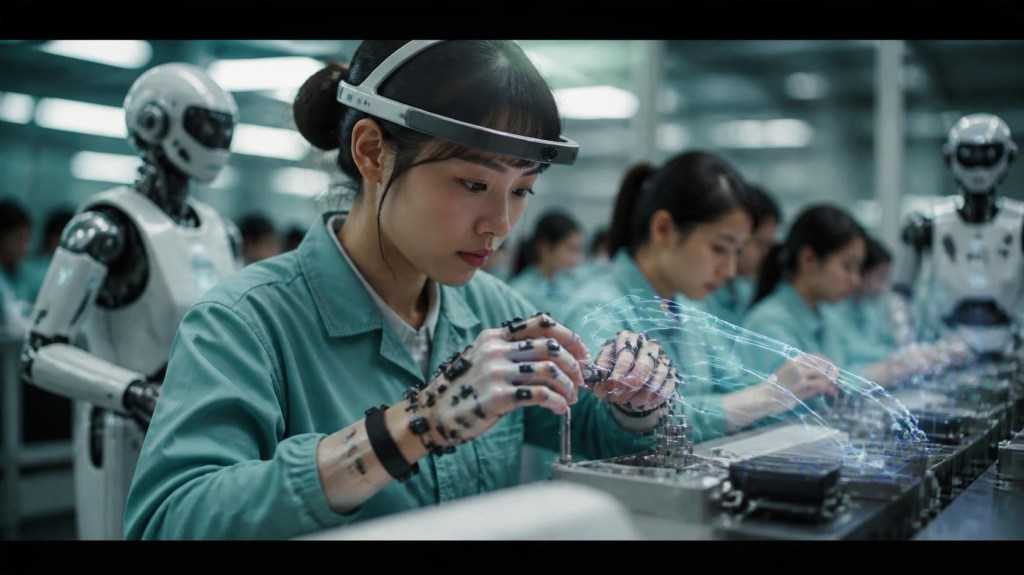
None of this means human data will disappear. It means the value will migrate. The regional commentary that accompanied the original reporting put it precisely: the real value is moving beyond video, towards capturing touch, force, motion, depth and the other signals that help robots understand how humans physically interact with the world. A video shows that a hand picked up an egg. It does not show how hard the fingers squeezed, how the wrist compensated for the weight, or the moment the shell nearly cracked. That tactile, force and motion data is what robots most lack and simulators most struggle to fake. It is also far harder to collect: it requires sensor gloves, motion-capture suits, depth cameras, calibrated studios, careful annotation and trained people.
In other words, the low end of this market is a race to the bottom that will be won by machines. The high end is a skilled trade that is only just being invented.
IV. Southeast Asia’s choice
This is where the region has a genuine choice, and a narrow window in which to make it.
The default path is the one Southeast Asia has walked before, in electronics assembly, in call centres and in the first wave of data labelling. The region supplies cheap, flexible labour for the lowest-value part of a value chain designed elsewhere, captures a sliver of the margin, and is quietly dropped when automation or a cheaper supplier arrives. On that path, the robot data boom becomes a footnote: a few years of side income, followed by a few lines in a report on how the work moved on.
The better path is to climb. Southeast Asia has real advantages in the high-value end of the robot data market, if it chooses to use them.
Variety is a strategic asset. Robots trained only in American and Chinese homes will fail in a Jakarta kitchen, a Hanoi street market or a Manila apartment. The region’s diversity of homes, workplaces, tools, foods and customs is exactly what robot makers need and cannot simulate. That diversity should be sold as a premium, not dumped at the commodity price.
Manufacturing is a ready-made laboratory. The region’s factories in Vietnam, Malaysia, Thailand and Indonesia already employ millions of people doing the dexterous, varied tasks that industrial humanoids are being built to learn. Instrumented properly, with consent, fair pay and the right sensors, those workplaces could become the world’s best source of high-quality manipulation data, and the people in them its best-paid data professionals.
Trust can be a product. Robot makers increasingly need to prove where their training data came from, that it was gathered lawfully and that the people in it consented. A region that can certify the provenance of its physical-AI data, rather than selling anonymous footage of unknown origin, will command a premium as regulation tightens. Singapore has spent years building testing and assurance infrastructure for AI models. The same instinct, applied to physical-AI data, could give the region a “trusted data” label worth paying for.
The skills ladder is visible. The man filming dishes today could, with modest training, be a teleoperator tomorrow, driving a real robot through tasks at many times the hourly rate; then a data quality specialist, then a robot trainer on a factory floor. The jobs at the top of this ladder are skilled, durable and well paid. The question is whether anyone builds the rungs.
Doing this would require investment that no individual gig worker can make: multimodal capture studios, sensor hardware, data standards, provenance systems, and training programmes. It is the kind of thing governments, universities and regional development banks exist to do. The region has done it before, when Singapore and Penang turned themselves from low-cost assembly bases into centres of semiconductor engineering. The playbook is not new. The urgency is.
V. A fair deal for the hands that teach
Whatever path the region chooses, the terms on which people sell their movements need setting now, before the market sets them by default. Five principles would go a long way.
- Informed, specific consent. Contributors should know who is buying their data, for what kind of system, and how long it will be kept. Blanket consent buried in an app’s terms of service is not consent.
- A real right to withdraw. The best firms already let contributors pull their data after it has been sold. That should be the standard, written into regional data-protection rules, not a voluntary courtesy.
- Privacy in the home. Filming inside homes needs clear rules on blurring faces, especially children’s, on what may be captured, and on onward sale. A recording of a family kitchen is not a stock photograph.
- Transparent pay and a share of the upside. Platforms should publish rates and fees plainly. And it is time to discuss data dividends: if a dataset of human movement becomes the foundation of a robot worth hundreds of thousands of dollars, the people who generated it have a reasonable claim to more than a one-off hourly wage. Collective bargaining through data cooperatives, or royalty models for high-value datasets, deserve serious experimentation.
- A ladder, not a dead end. Every company that buys human demonstration data should be encouraged, by procurement rules if necessary, to invest in training the people who produce it for the higher-skilled roles that follow.
None of this is radical. Most of it is how we already treat personal data, intellectual property and fair labour in other industries. The robot data trade has simply grown faster than the rules.
A 20th-century political philosopher distinguished between labour, which sustains life and leaves nothing behind, and work, which builds a durable world. The gig workers of Southeast Asia are, for now, selling their labour: hours of dishes and laundry that vanish into a dataset. But what they are teaching is something more durable: the accumulated know-how of human hands, the tacit knowledge of how to live and work in the physical world. That knowledge is about to be embodied in machines that will outlast every one of us.
The hands that teach the machines should not be paid like disposable hands. If Southeast Asia gets this right, it can be the world’s robot classroom: the place where physical AI learns how humans actually live, on fair and transparent terms, with the people who teach it rising alongside it. If it gets it wrong, it will have sold its most valuable asset, the variety and skill of its people, at the price of a side hustle, just before the machines learned they no longer needed to watch.


Leave a Reply