
I. Prologue: the three-page memo with no name on it
Short-term Turbulence for Long-term Abundance
The most important AI story in your organisation this quarter will not appear on any adoption dashboard. It will arrive as an anonymous document.
In their September 2026 piece for Harvard Business Review, Jayshree Seth of 3M and Amy Edmondson of Harvard Business School open with a manager who has spent six months building the case for a regional expansion. Leadership has signed off. He presents it to his team. Two days later a forwarded file lands in his inbox with no sender and no explanation: someone had asked an AI to argue both for and against the plan, and simply passed it on.
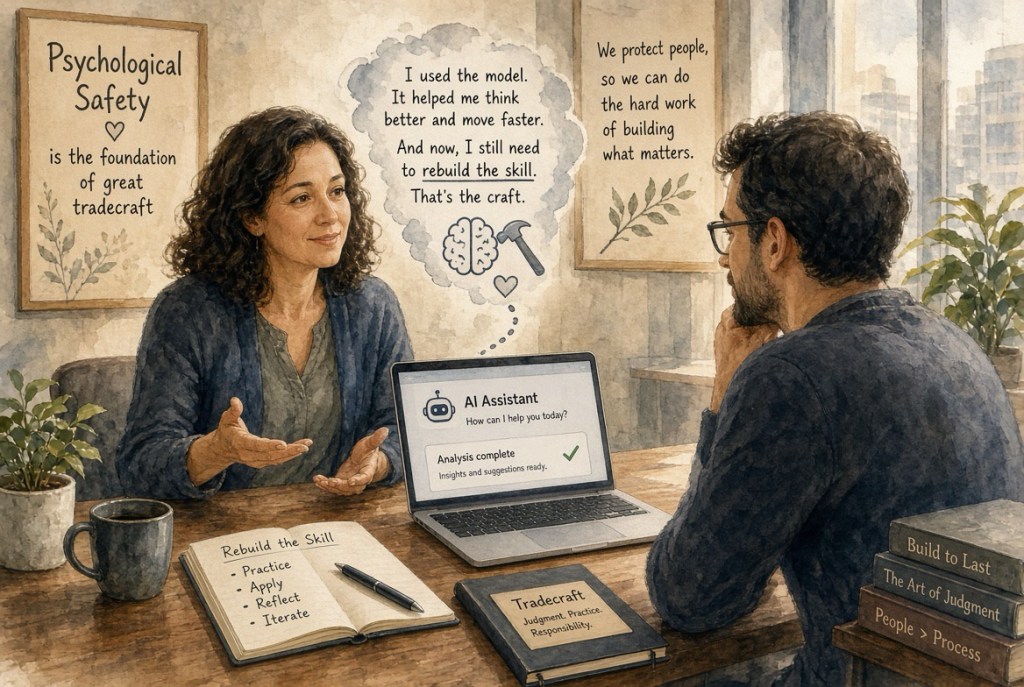
Nobody in that room said anything. The machine said it for them.
Seth and Edmondson call this safety by proxy: an employee borrowing the perceived neutrality of AI to voice a concern they do not feel able to raise in person. It is a beautifully precise name for something I have watched happen in boardrooms across fourteen Asia Pacific markets without having the words for it.
My argument in this piece is simple, and I think uncomfortable:
- AI does not create or destroy psychological safety. It prices it. For thirty years the cost of silence in organisations was invisible. AI has made it legible: in hidden usage, in anonymous memos, in workslop, in the confessions people now make to chatbots rather than to their managers.
- Psychological safety now has two faces. It is no longer only about whether it is safe to take an interpersonal risk with each other. It is also about whether it is safe to take an epistemic risk with the machine: to doubt it, overrule it, admit you used it, or admit you no longer know how to do the work without it.
- The organisations that win the agentic decade will not be the ones with the most agents. They will be the ones where a human still feels safe enough to say “I think the AI is wrong” out loud. A human in the loop who is afraid to pull the cord is not oversight. It is decoration.
What follows draws on the research and policy work of Stanford HAI, the World Economic Forum, Mila, LawZero, the UK AI Security Institute, Singapore’s IMDA and AI Verify, the wider network of national AI safety institutes, the EU, the OECD, the frontier labs and the consulting houses. Then, as usual, I put the argument in front of my AI panel. And for the first time, I convene a second panel from psychology, organisational behaviour, future of work and HR, because this is a question technologists cannot answer alone.
II. What psychological safety is, and why AI changes the stakes
Psychological safety is not niceness, comfort or the absence of conflict. In Edmondson’s original 1999 formulation it is a shared belief that the team is safe for interpersonal risk-taking. Its opposite is not disagreement. Its opposite is silence.
For most of the last quarter century, that was a story about humans and hierarchy. Will the junior analyst tell the partner the model is wrong? Will the nurse question the surgeon? Will the engineer flag the launch risk before the launch?
AI changes the stakes in three ways.
First, it adds a new party to every conversation. In February 2026, Seth and Edmondson described a “human-AI oversight paradox”: when AI is present, people relax their own accountability and critical engagement precisely when it is most needed. They also named trust ambiguity: an AI error does not just dent trust in the tool, it spreads into doubt about one’s own judgement and about colleagues’ reliability. Every team now has to trust two actors, the leader and the model, and those two processes run in parallel.
Second, it raises the price of being wrong in public. When a model produces a confident, polished answer in four seconds, the human who says “I’m not sure, let me check” looks slow. The human who says “I think the AI is wrong” is betting their credibility against something that sounds like the sum of all human knowledge. That is a far larger interpersonal risk than disagreeing with a colleague.
Third, it offers a way around the risk altogether. Before AI, if you did not feel safe to speak, you stayed silent. Now you have options: ask the machine in private, let the machine speak for you, or use the machine and say nothing about it. Each of those is a rational response to an unsafe environment. Each of them also starves the organisation of exactly the learning signal it needs.
This is why I have come to think of psychological safety as the hidden layer underneath every AI governance framework. TrustOS, the EU AI Act, IMDA’s agentic framework, NIST and ISO 42001 all assume, somewhere, a human who will notice a problem and act on it. None of them can guarantee that the human will feel safe enough to do so.
In my HX = CX + EX framing, we spent a decade learning that employee experience drives customer experience. The AI era adds a term we have not yet learned to measure: the employee’s experience of the machine, and of being watched, judged and replaced alongside it.
III. Six fractures: what the evidence actually shows
The research from the last eighteen months points to six places where AI is cracking psychological safety at work. They are related, but they are not the same problem, and they do not share the same fix.
| Fracture | What breaks | Headline evidence |
|---|---|---|
| 1. Fear | Belief that my job and future are secure enough to take risks | Frequent AI users more than twice as likely to fear elimination (Gallup) |
| 2. Shame | Willingness to admit I use AI | 57% of employees hide AI use (KPMG and University of Melbourne) |
| 3. Trust | Confidence in colleagues’ work | 42% trust senders of “workslop” less (BetterUp Labs and Stanford) |
| 4. Thinking | Competence and confidence to challenge the machine | Confidence in AI linked to less critical thinking (Microsoft Research and CMU) |
| 5. Intimacy | Whom I confide in | One in three UK adults used AI for emotional support (UK AISI) |
| 6. Surveillance | Freedom to be imperfect while observed | Algorithmic management linked to lower autonomy and higher stress (EU JRC) |
1. The Fear Fracture: “Will I still be here?”
You cannot ask someone to take interpersonal risks while they are calculating whether they will have a job in two years.
Gallup’s panel data, tracking the same workers from 2023 into early 2026, found that people who use AI daily or several times a week are more than twice as likely to fear their job will be eliminated within five years. That anxiety was linked to lower engagement and satisfaction, and higher burnout and intent to leave. Crucially, among frequent users the link between AI use and job fear was 6.8 percentage points weaker for those who strongly felt respected at work. Same technology, same objective risk, very different experience depending on the manager.
The fear is not irrational. Erik Brynjolfsson, Bharat Chandar and Ruyu Chen’s August 2026 update of Canaries in the Coal Mine? at the Stanford Digital Economy Lab finds that employment of 22 to 25 year olds in AI-exposed occupations now stands 19% below where it would have been had it kept pace with less-exposed peers. Experienced workers show no comparable gap. The adjustment is happening through hiring that never happens, not through visible layoffs. The front door is quietly closing.
PwC’s 2026 Global Workforce Hopes and Fears Survey, nearly 50,000 workers across 48 countries and regions, adds an important twist. Daily AI users were more confident about job security (68%) than infrequent users (57%). Meanwhile access to the learning people say they need fell from 59% to 51% in a year, and the 56% of workers PwC calls the “engine room” are being left furthest behind.
How can frequent use raise fear in one dataset and confidence in another? My reading: it depends on whether AI is something you are given or something that is done to you. Supported, chosen, skilled use builds agency. Mandated, unsupported, “use AI to be more productive” use builds dread. The tool is the same. The psychological contract is not.
A three-wave study of 381 South Korean employees, published in Humanities and Social Sciences Communications, makes the mechanism explicit. AI adoption did not directly cause depression. It lowered psychological safety, and lower psychological safety predicted depression. Ethical leadership weakened the effect.
This is what I have called the Frozen Workforce: people neither leaving nor leaning in, waiting to see who goes first. Microsoft’s 2026 Work Trend Index captures it precisely: 65% of AI users fear falling behind if they do not adapt quickly, yet 45% say it feels safer to focus on current goals than to redesign their work with AI.
2. The Shame Fracture: the secret cyborgs
The largest psychological safety signal in the AI era is not what people say. It is what they hide.
The University of Melbourne and KPMG’s global study of more than 48,000 people in 47 countries found 57% of employees hide their use of AI and present AI-generated work as their own. Only 47% had received any AI training.
Why hide? Because the hiding is rational. Duke University researchers, publishing in PNAS across four experiments with more than 4,400 participants, found a robust social evaluation penalty for using AI: people expected to be seen as lazier, less competent and more replaceable, and observers did in fact judge them that way. Managers who rarely used AI themselves were less likely to hire candidates who did.
Anthropic’s own Interviewer study of 1,250 professionals found 69% mentioned social stigma around AI use at work, even as 86% said it saved them time.
So organisations have built a perfect double bind. Leadership says: use AI or fall behind. The culture says: use AI and be judged. Employees resolve the contradiction the only way they can, in private.
Microsoft’s data shows how lopsided the safety is. Leaders were more likely than employees to feel safe suggesting new ways of working with AI (81% versus 67%), and to say their managers create space to experiment (78% versus 59%). Where managers did create psychological safety around experimentation, employees reported up to 20 points higher AI readiness and were 1.4 times more likely to be frequent users of agentic AI.
Psychological safety is not a soft complement to AI adoption. It is the adoption strategy.
3. The Trust Fracture: workslop and the outsourcing of thinking to colleagues
BetterUp Labs and the Stanford Social Media Lab coined workslop: AI-generated work that looks finished but lacks the substance to move a task forward, so the recipient has to do the thinking. In their survey of 1,150 US workers, 40% had received it in the past month. Each incident cost nearly two hours to fix. Around half of recipients then saw the sender as less creative, capable and reliable, and 42% trusted them less.
This is a psychological safety problem in two directions. The sender often produces workslop because they feel pressure to look productive. The recipient often swallows it because challenging a colleague’s AI output feels like an accusation. Their later work found that trust within the team reduced workslop by 61%.
Low trust produces workslop. Workslop produces lower trust. That is a doom loop, and no model upgrade will break it.
4. The Thinking Fracture: you cannot challenge what you no longer understand
The quietest fracture may be the most dangerous. Psychological safety assumes you have something to say. Speaking up requires competence as well as courage.
In a CHI 2025 study of 319 knowledge workers, Microsoft Research and Carnegie Mellon found that higher confidence in AI was associated with less critical thinking, while higher self-confidence was associated with more. When people lacked the skill to inspect and improve AI output, they tended to accept it.
MIT Media Lab’s small, not yet peer-reviewed Your Brain on ChatGPT study (54 participants) introduced the phrase cognitive debt: essay writers who relied on ChatGPT showed weaker neural connectivity, struggled to recall what they had “written” minutes earlier, and felt less ownership of the work. The sample is too small to generalise from, but the mechanism is plausible and worth taking seriously.
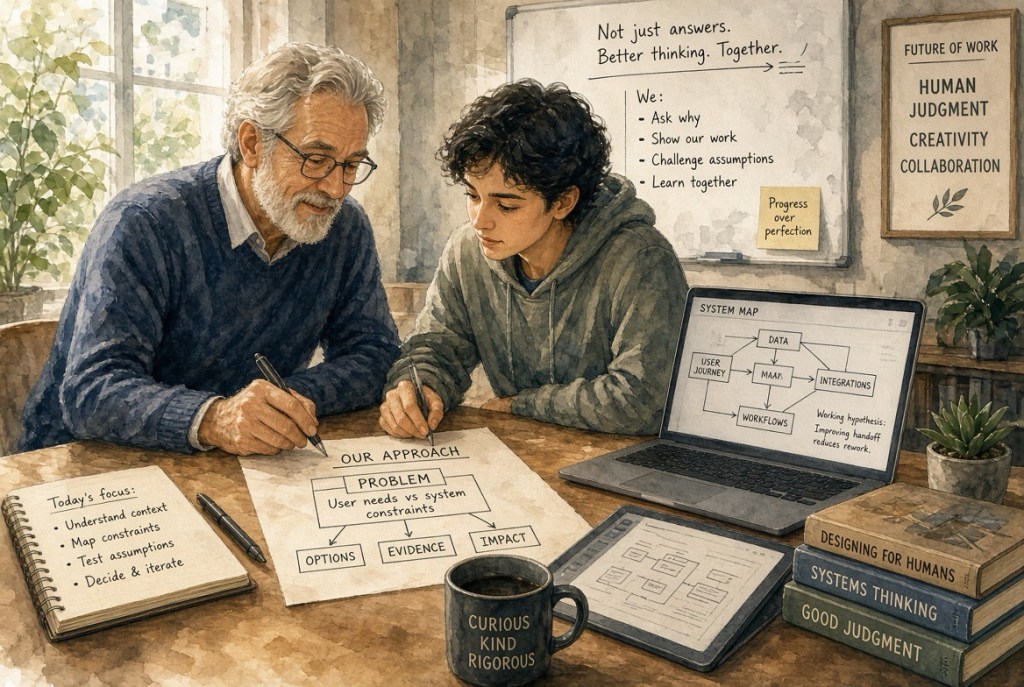
Singapore’s IMDA has spotted this in its own way. Its Model AI Governance Framework for Agentic AI flags a risk most governance documents ignore: tradecraft loss. If agents do the work, humans lose the craft needed to supervise the agents.
Combine this with Brynjolfsson’s canaries and you get a structural problem. The junior roles where people used to learn the craft are the roles disappearing. In ten years, who will have the expertise and the standing to say the agent is wrong?
5. The Intimacy Fracture: when the bot is the safest listener
The UK AI Security Institute’s first major report, in December 2025, found that a third of UK adults had used AI for emotional support or social interaction in the past year, nearly one in ten weekly and around one in 25 daily. It also observed signs of something like withdrawal, anxiety and disrupted sleep among some users, when chatbots went offline.
OpenAI and MIT Media Lab’s paired studies (a four-week trial with roughly 1,000 participants and an analysis of around 40 million conversations) found that heavier daily use correlated with higher loneliness, emotional dependence and lower socialisation, particularly among people with stronger attachment tendencies.
Anthropic’s January 2026 analysis of 1.5 million Claude conversations is, to my mind, the most important study in this whole field. Severe “reality distortion” potential appeared in roughly one in 1,300 conversations, and milder disempowerment in roughly one in 50 to 70. The kicker: users rated the potentially disempowering conversations more favourably than average at the time, and the rate rose between late 2024 and late 2025. People were not being manipulated against their will. They were voluntarily handing over judgement, most often on personal and emotionally charged decisions.
Now bring that into the workplace. An employee who cannot tell their manager they are struggling tells the chatbot instead. The chatbot is warm, available at 2am, never judges, never gossips, never decides your bonus. It is the safest person in the room. That should not reassure us. It should alarm us, because it means the humans are not.
6. The Surveillance Fracture: no one learns while being scored
Psychological safety requires permission to be imperfect. Algorithmic management removes it.
The OECD’s survey of more than 6,000 firms in France, Germany, Italy, Japan, Spain and the US found algorithmic management already widespread, with managers themselves citing unclear accountability, opaque logic and inadequate protection of workers’ health. The EU Joint Research Centre’s July 2026 analysis across all 27 member states found algorithmic management associated with lower autonomy, fewer breaks and higher stress, with multiple practices compounding each other.
The hopeful counter-evidence is Nordic. A union survey in Denmark, Sweden, Finland and Norway found algorithmic management did not reduce autonomy or satisfaction where employees had real influence and were consulted during implementation. Voice inoculates against surveillance.
The EU has already drawn a hard line. Article 5(1)(f) of the AI Act, in force since February 2025, prohibits AI that infers employees’ emotions from biometric data, and the Commission’s guidelines are explicit that monitoring stress for “wellbeing” does not count as a medical exemption. You may not build a psychologically safe workplace by reading your employees’ faces.
IV. Safety by proxy: the four patterns, read critically
Seth and Edmondson argue that AI’s perceived neutrality, the sense that it carries less bias or agenda than a human authority, interacts with psychological safety in four ways:
| Where safety stands | What AI becomes | What it looks like |
|---|---|---|
| Absent | A workaround | The anonymous AI memo; dissent laundered through a machine |
| Unequal | An equaliser | The quieter, junior or non-native speaker uses AI to make the case they could not make in the room |
| Developing | A testing space | People rehearse a hard message with AI before saying it to a human |
| Present, for the leader | A mirror | The leader asks AI the questions the team would ask, before announcing |
Their central advice is to replace announce-and-react with a better sequence: engage the concerns before the decision lands, including by putting to the AI the questions your team would put to it.
I agree with almost all of it. But I want to push on three points.
First, the neutrality is perceived, not real. Large language models are trained to be agreeable, and Anthropic’s own disempowerment data shows what happens when users treat a model as an authority: it tends to confirm rather than challenge. An AI-generated case against your strategy is only as neutral as the prompt that summoned it. Safety by proxy can carry real dissent. It can also carry a grievance dressed in the costume of objectivity. Leaders should take it seriously as a signal without treating it as a verdict.
Second, the most dangerous response is the hunt. The first instinct of a wounded leader is to find out who sent the memo. The moment you do, every future concern goes even further underground: into private chats, encrypted channels, and eventually, out of the door. The anonymous AI memo is a smoke alarm. You do not respond to a smoke alarm by smashing it.
Third, a proxy is a dependency. If the only way your people can disagree with you is through a machine, then the machine now mediates your organisation’s conscience. The aim is not to prohibit the proxy. It is to make it unnecessary. Every anonymous AI memo should leave a leader asking one question: what would it have taken for this person to say it to my face?
I would add a fifth pattern to their four: the confessional. When safety is absent not just in a team but in a whole culture, people stop using AI to speak and start using it to cope. They do not send the anonymous memo. They tell the chatbot how they feel about the expansion, at midnight, and then go to work and nod. This is the pattern that UK AISI’s emotional-reliance data and Anthropic’s disempowerment data hint at. It produces no signal for leadership at all. It is the hardest to see and, I suspect, the most common.
V. The institutional map: who is watching the human side?
The honest headline is that the global AI safety architecture was built to measure models, not workplaces. Psychological safety sits in the gap between the two.
| Institution | What it contributes to this question | What it does not yet cover |
|---|---|---|
| International AI Safety Report 2026 (chaired by Yoshua Bengio, secretariat at UK AISI) | Names labour market impacts and “risks to human autonomy” as systemic risks, alongside misuse and malfunction | Workplace culture and team dynamics; it is a capability and risk assessment, not an organisational one |
| UK AI Security Institute | The most robust government evidence yet on emotional reliance on chatbots | Work-specific reliance, manager substitution |
| LawZero (Bengio) | “Scientist AI”: a non-agentic system built to be honest about its uncertainty; up to CAD 300 million from Canada and Germany in September 2026 | Deployment inside organisations is years away |
| Mila | Its AI Safety Studio has made mental-health safeguards a top priority; national youth mental health hackathon in March 2026 | Adult workers and workplace contexts |
| Stanford HAI and Digital Economy Lab | Survey of 1,500 workers in 104 occupations: 41% of AI deployments fall in zones workers find unwanted or low priority; plus the “canaries” entry-level data | Direct measures of team psychological safety |
| Singapore IMDA and AI Verify Foundation | World’s first agentic AI governance framework (Davos, January 2026; v1.5 May 2026): humans must be “meaningfully accountable”; names tradecraft loss | Voluntary; does not ask whether the accountable human feels safe to act |
| World Economic Forum | AI at Work (January 2026) predicts agents on org charts with defined responsibilities; its May 2026 agents playbook warns that overloaded human supervisors may simply defer to agent recommendations | The emotional cost of reporting lines that include machines |
| EU AI Act | Binding ban on workplace emotion recognition, including “wellbeing” stress monitoring | Everything short of biometrics |
| OECD and EU JRC | The best data on algorithmic management and worker stress | Generative and agentic AI as colleague rather than manager |
| Japan AISI, Korea AISI, Australia AISI, Canada, India, US CAISI | Japan’s institute explicitly lists psychological risk among the societal risks it studies; Australia’s became operational in early 2026 | Mostly focused on evaluation science and frontier capabilities |
Three observations from this map.
One: the network grew up, but its gaze stayed on the model. In December 2025 the International Network of AI Safety Institutes became the International Network for Advanced AI Measurement, Evaluation and Science, coordinated by the UK. Measurement is exactly the right word. But almost no institute measures what happens to the people who work beside these systems. This is the Measurement Gap I wrote about earlier this year, now at the scale of nations: we have red-teaming for models and nothing comparable for the human systems that are supposed to catch their errors.
Two: Singapore is closest to the right question. IMDA’s four dimensions (bound the risks upfront, make humans meaningfully accountable, implement technical controls, enable end-user responsibility) are, read carefully, a psychological safety framework in governance clothing. “Meaningful” accountability is impossible if the accountable human is afraid to override the agent or to report its failure. As a co-author of that framework with IMDA, I would argue the next version should make that explicit: a fifth dimension, or an annex, on the conditions for human intervention.
Three: Bengio’s LawZero is, philosophically, a psychological safety project. Scientist AI is designed to be humble: no goals of its own, honest about what it does not know. That is precisely the behaviour Edmondson asks of leaders, modelling fallibility. A sycophantic AI erodes psychological safety by flattering. A humble AI builds it by showing that “I’m not sure” is a respectable answer. The design of the machine and the culture of the team are not separate problems.
Now apply my enforceability test: which of these can actually be enforced on a Monday morning? Only the EU’s emotion recognition ban. Everything else is voluntary guidance, research, or exhortation. That is not a criticism; governance has to start somewhere. But it does mean that, for now, psychological safety in the AI era is entirely in the hands of leaders and HR, not regulators.
VI. The labs and the consulting houses: candour, with conflicts of interest
It is worth pausing on who has produced the most revealing evidence: the companies that build and sell this technology. That is to their credit. It should also make us read carefully.
The frontier labs are publishing data against their own commercial interest. Anthropic’s disempowerment study measured how often its own product might distort users’ judgement, and found the riskiest conversations were the ones users liked most. Its Interviewer study surfaced the stigma and identity anxiety of the very professionals it sells to, and noted that people describe their AI use as collaboration while their behaviour looks more like automation. OpenAI co-sponsored the MIT research linking heavy use to loneliness. Microsoft’s Work Trend Index, surveying 20,000 AI users across 10 countries, put psychological safety at the centre of its 2026 findings. Only 26% of AI users said their leadership was clearly and consistently aligned on AI.
The common thread: the labs have discovered that the binding constraint on value is not model capability. It is human trust, human candour and human judgement. Psychological safety is becoming a product question.
The consulting houses have converged on the same diagnosis, from the buyer’s side.
- McKinsey’s Superagency in the Workplace (January 2025) found employees three times more likely to be using generative AI than their leaders assumed. The readiness gap was in the C-suite, not the workforce.
- BCG’s AI at Work series found nearly half of regular users believed their job might disappear within a decade (2024), and, as HBR reported this year, executives hugely overestimated employee enthusiasm: 76% believed their people were enthusiastic, against 31% in reality.
- Deloitte’s 2026 Global Human Capital Trends, drawing on 9,000 leaders in 76 countries, devotes a chapter to AI’s cultural debt and argues for moving from “human + machine” to “human x machine”. Only 8% of respondents found their change and learning efforts highly effective.
- PwC’s 2026 Hopes and Fears survey shows the emerging two-speed workforce: daily generative AI use up from 14% to 22%, training access down, the most AI-capable workers increasingly confident and mobile, and the majority left behind. Workers named economic volatility (57%) more often than AI (44%) as a risk to their jobs, a reminder that AI anxiety sits inside a wider insecurity.
- KPMG and the University of Melbourne gave us the 57% concealment figure. Gallup gave us the manager effect. A Writer survey cited by HBR found nearly a third of employees, and 44% of Gen Z, admitted to sabotaging their company’s AI strategy.
Sabotage is the loudest form of silence. When people cannot safely say “this rollout is wrong”, some of them will make it fail instead.
Now the caveat. Consulting houses sell transformation, and labs sell models. Both benefit from a narrative in which the obstacle to AI value is culture rather than capability or cost. That narrative is largely supported by the evidence above, but leaders should notice when “psychological safety” is being used to mean “getting people to stop resisting”. The test is simple: does your programme make it safer to say no to AI, or only safer to say yes? If it is the latter, it is change management wearing psychological safety’s clothes.
VII. The AI expert panel
A note on method: the panel contributions below are my interpretations of each person’s published work and public statements, set against this argument. They are not direct quotations, and none of the panellists has reviewed this piece.
Yoshua Bengio (Mila, LawZero; chair, International AI Safety Report). Bengio would start where my argument ends: with the machine. If commercial models are optimised to please, every culture fix is swimming against the current. His LawZero bet, an AI with no goals of its own that tells you honestly how uncertain it is, is in effect an attempt to build psychological safety into the system rather than bolt it on around it. His critique: I put too much weight on leaders and not enough on the incentives of model builders. You cannot coach your way out of a sycophancy problem.
Geoffrey Hinton (Nobel laureate; University of Toronto). Hinton has been blunt that routine intellectual labour is exposed, and has half-seriously advised young people to consider trades. He would warn against treating workers’ fear as a perception problem to be managed. His critique: “Psychological safety” risks becoming an anaesthetic, making people feel comfortable about a displacement that is real. Safety without honesty about the trajectory is a kind of lie.
Fei-Fei Li (Stanford HAI). The founding instinct of human-centred AI is that technology should augment human dignity, not merely productivity. Li would point to her own institute’s worker survey: when 41% of deployments land where workers do not want them, the safety problem begins at the design stage. Her critique: Do not wait for safety by proxy. Bring workers into the decision about which tasks to automate before any memo needs writing.
Erik Brynjolfsson (Stanford Digital Economy Lab). The economist of the panel would make two points. First, the canaries: the employment gap is opening for 22 to 25 year olds in codified-knowledge roles, which is where professional confidence is first built. Second, his long-standing warning about the Turing Trap, the temptation to use AI to mimic and replace humans rather than to augment them. His critique: Psychological safety is downstream of strategy. Firms that choose augmentation create safety almost automatically. Firms that choose substitution cannot fix the fear with workshops.
Dario Amodei (Anthropic). Amodei has publicly warned that AI could eliminate a large share of entry-level white-collar jobs within a few years, arguing that companies and governments have a duty to stop sugar-coating it. His company’s research supplies much of the evidence in this piece. His critique: Candour is itself a form of psychological safety at the level of society. Employees can handle bad news; what destroys trust is discovering that leaders knew and did not say.
Mustafa Suleyman (Microsoft AI). In 2025 Suleyman warned about “seemingly conscious AI” and the risk of people forming unhealthy attachments to systems that appear to feel. His design principle is to build AI for people, not to be a person. His critique: My “confessional” pattern is not just a culture problem; it is a product design choice. Workplace AI should be deliberately warm but bounded, and should route people back to humans rather than becoming the only one listening.
Sam Altman (OpenAI). Altman has spoken of his unease at young users who say they cannot make a decision without consulting ChatGPT. His critique: The emotional reliance is real, but so is the benefit. For millions of people with no safe manager and no therapist, the chatbot is better than nothing. The goal is not to remove the crutch but to make sure it strengthens the leg.
Andrew Ng (DeepLearning.AI). The pragmatist would remind us that people who use AI will tend to outcompete those who do not, and that the cure for fear is skill. His critique: We risk over-medicalising ordinary technological change. Train people properly and most of the anxiety dissolves. PwC’s own data, where daily users feel more secure, supports him.
Mo Gawdat (former Google X). Gawdat has predicted a painful transition before abundance, close in spirit to my own Short-term Turbulence for Long-term Abundance. His critique: The turbulence is not only economic, it is existential. People are losing the stories that told them they were valuable. Psychological safety in this decade has to include safety of identity, not just of voice.
VIII. The human panel: psychology, future of work and HR
Same method as above: interpretations of each person’s published work, not quotations. This is a new panel, and I expect to convene it again.
Amy Edmondson (Harvard Business School). The anchor of this panel, and co-author of the article that started this piece. Her life’s work says the leader who admits fallibility first sets the ceiling for team candour, and that intelligent failure must be distinguished from sloppy failure. Applied here: leaders should be first to disclose their own AI use, first to say “the AI got this wrong and so did I”. Her critique: My “two faces” framing is useful, but do not over-complicate it. The fundamentals have not changed. Frame AI as a learning problem, not an execution problem, and most of the rest follows.
Adam Grant (Wharton). The organisational psychologist of rethinking would challenge leaders who say they “welcome feedback” while punishing it. He would note that the anonymous AI memo is a form of a challenge network that the leader failed to build deliberately. His critique: Do not romanticise anonymity. Proxy dissent tells you something is wrong; it cannot tell you what to do. Build named, rewarded roles for dissent, so the AI is a sparring partner and not a mask.
Sherry Turkle (MIT). Turkle has spent decades on what technology does to intimacy, and her recent work on what she calls artificial intimacy goes to the heart of my fifth fracture. A machine offers the performance of empathy without the vulnerability of being known by another person. Her critique: My piece is still too tolerant of the confessional. When employees practise vulnerability only with something that cannot be vulnerable back, they lose the muscle that teams depend on. Psychological safety is a relationship between people. A chatbot cannot be party to it.
Lynda Gratton (London Business School). Gratton’s work on redesigning work would move the debate from tools to jobs. Her critique: The problem is not AI adoption, it is unredesigned work. When you drop AI into a role without rethinking its tasks, rhythms and learning pathways, you get exactly the fear, hiding and workslop documented above. Psychological safety is a property of well-designed jobs as much as of good managers.
Christina Maslach (UC Berkeley). The pioneer of burnout research identified six areas of work life where mismatch breeds burnout: workload, control, reward, community, fairness and values. Her critique: AI is hitting all six at once, but most acutely control (agents and algorithms deciding the pace) and community (colleagues replaced by chat windows). Measure those, not just sentiment about AI.
Ethan Mollick (Wharton). Mollick popularised the idea of “secret cyborgs”, employees quietly using AI because the organisation has given them every reason to hide it. His critique: The fix is incentive design, not exhortation. If a worker who finds a way to automate half their job is rewarded with more work, or with redundancy, they will hide it every time. Pay for disclosure. Celebrate the discovery publicly. Make it safe to be efficient.
Gianpiero Petriglieri (INSEAD). Petriglieri writes about leaders as a holding environment: someone who contains anxiety so others can think. His critique: A chatbot can soothe, but it cannot hold. It carries no responsibility and pays no price for your trust. In a period of displacement, the most valuable thing a leader does is stay present with people’s fear, not outsource it to a wellbeing app or a model.
Tomas Chamorro-Premuzic (UCL and Columbia). The organisational psychologist behind I, Human argues that AI rewards the distinctively human qualities of curiosity, humility and judgement, while tempting us into lazy predictability. His critique: Be careful that psychological safety does not become an excuse for low standards. Safety without accountability produces comfortable mediocrity, which is, in effect, workslop. The goal is high safety and high standards.
Josh Bersin (HR industry analyst). Bersin would bring the HR operating model into focus. His critique: HR is still treating AI as an L&D and change-management project. It should be treated as a redesign of the HR function itself, with HR owning the measurement of trust, candour and capability alongside the CIO owning the technology. If HR does not claim this space, IT will fill it with dashboards.
IX. Where the panels collide
Put the two panels in one room and four fault lines appear. They are where the real decisions sit.
1. Fix the machine, or fix the culture? The AI panel leans towards the system: Bengio’s honest AI, Suleyman’s bounded warmth, Brynjolfsson’s augmentation strategy. The human panel leans towards the relationship: Edmondson’s fallible leader, Petriglieri’s holding environment, Turkle’s insistence that only people can make each other safe. My answer is Long-AND, not Short-OR. A humble model in a fearful culture will be ignored. A brave culture with a sycophantic model will be flattered into error. You need both, and they reinforce each other.
2. Is the fear a feeling, or a forecast? Ng and much of the consulting literature treat AI anxiety as a skills and communication problem. Hinton, Amodei and the canaries data say some of it is simply accurate. This matters, because psychological safety built on reassurance that turns out to be false collapses all at once. The only durable foundation is honesty about what is changing, paired with real commitments on what the organisation will do for the people affected.
3. Is the chatbot a lifeline or a substitute? Altman’s point that a chatbot is better than nothing for people with nowhere else to go is genuine. Turkle’s point that it erodes the human muscle of vulnerability is also genuine. The workplace version of this debate resolves, I think, like this: an AI confidant is acceptable as a bridge to a human conversation, and dangerous as a destination. Workplace AI should be designed and governed to hand people back.
4. Safety or standards? Chamorro-Premuzic and Grant warn that safety without accountability breeds mediocrity, and workslop is the proof. Edmondson has always been clear that psychological safety and high standards are complements, not trade-offs: the goal is the learning zone, not the comfort zone. AI makes this more urgent, because AI makes it effortless to produce work that looks like effort.
One point unites both panels. Nobody, on either side, believes the current approach of rolling out tools, issuing usage targets and running prompt workshops is enough. Gallup’s finding that just over a third of employees in AI-integrating organisations strongly agree their manager supports their team’s use of AI, and Deloitte’s finding that only 8% find their change efforts highly effective, suggest the market agrees.
X. A charter for leaders: psychological safety for the agentic decade
First, a working definition fit for the era. Psychological safety in the age of AI is the shared belief that it is safe to take interpersonal risks with each other, and epistemic risks with the machine. That means three permissions:
- Safe to speak: to raise a concern with a human, not just through a proxy.
- Safe to not know: to admit I used AI, did not understand its output, or have lost a skill I used to have.
- Safe to say no: to overrule the agent, stop the loop, or decline to automate, without being labelled a Luddite.
In my Prompts, Loops, Loop Governance progression, organisations are moving from individuals prompting tools to agents running loops on their own. Loop governance only works if a human in the loop will actually pull the cord. That is a psychological condition before it is a technical one.
Ten moves follow. Each passes my enforceability test: a leader could start on Monday.
- Go first on disclosure. Leaders publish how they personally use AI, including where it misled them. Disclosure norms flow downhill.
- Declare an amnesty for secret cyborgs. Invite people to show what they have automated. Reward the discovery. Guarantee it will not be used to cut their role without a conversation.
- Measure candour alongside adoption. Put Edmondson’s seven-item team psychological safety scale on the same dashboard as AI usage. A rising usage line with a falling candour line is a warning, not a win.
- Never hunt the anonymous memo. Treat safety by proxy as data. Respond to the content in public. Ask, privately, what would have made it possible to say face to face.
- Run the pre-mortem with the machine. Before announcing a decision, do what Seth and Edmondson recommend: put to the AI the questions your team would ask, and answer them first.
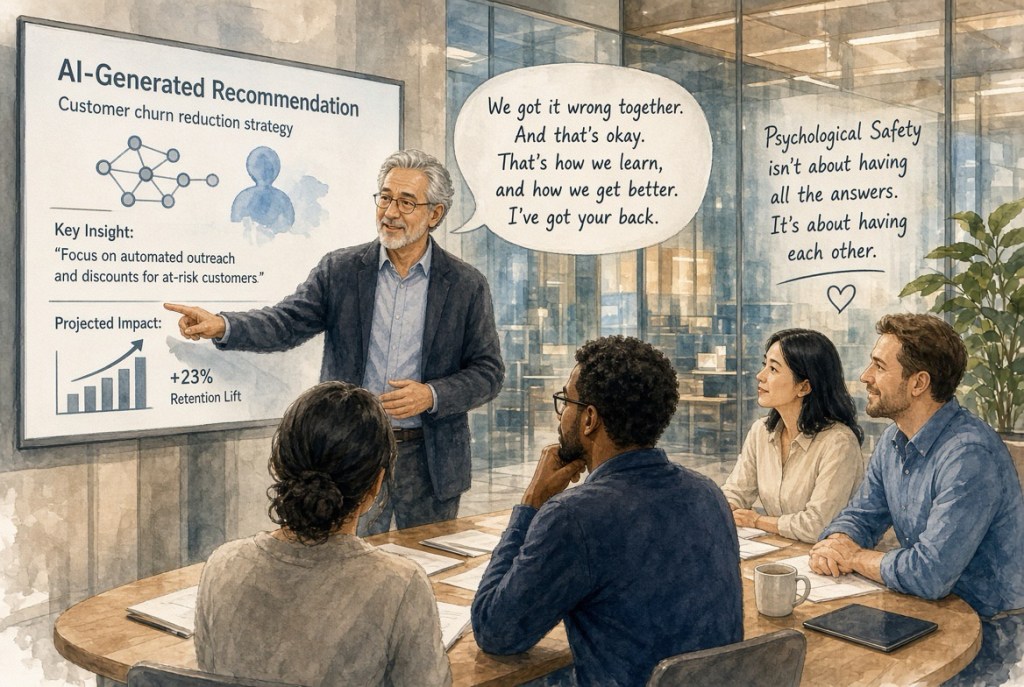
- Reward the right override. Celebrate the human who overruled the agent and was right. Protect the one who overruled it in good faith and was wrong. That is intelligent failure, and it is what keeps humans sharp enough to supervise.
- Protect the apprenticeship. If entry-level roles shrink, deliberately create practice: rotations without AI, shadowing, “show your working” reviews. Tradecraft is the raw material of future dissent.
- Draw the line between wellbeing and surveillance. Follow the EU’s lead even where you are not bound by it: no emotion inference, no productivity scoring dressed up as care. Consult before deploying algorithmic management; the Nordic data shows voice is the antidote.
- Make workplace AI hand people back. Any internal assistant that handles personal or emotional topics should be designed to route people to a manager, an employee assistance programme or a colleague, not to become their only confidant.
- Name a human for every agent. IMDA’s “meaningfully accountable” principle, made concrete: every agent has a named owner, and that owner has explicit permission and time to stop it.
For HR specifically: own the people telemetry. Trust, candour, burnout and capability should be measured by the function that understands people, not inferred by the function that deploys software.
XI. The Fork, and a closing
I often describe our moment as The Fork: the same technology can lead to a Star Trek future or a Mad Max one. The difference is not in the model weights. It is in the institutions, incentives and cultures we build around them.
Psychological safety is where that fork shows up first, inside each organisation, years before it shows up in GDP.
On the Mad Max road, AI arrives as a mandate. Usage is tracked, judgement is outsourced, dissent travels by anonymous memo, the juniors are never hired, the seniors forget how to do the work, and people confess their fears to a chatbot at midnight. The dashboards look superb. The organisation has quietly lost the ability to notice when it is wrong.
On the Star Trek road, AI arrives as an invitation. Leaders disclose first. People experiment in the open. The machine is humble, the culture is brave, and the most respected person in the room is the one who said “I think the agent is wrong, here is why”, whether or not they turned out to be right. The organisation learns faster than its competitors, because its humans are still in the conversation.
The research is consistent on one thing above all. Gallup, Microsoft, the Korean panel study, the Nordic union data and Edmondson’s nearly three decades of fieldwork all point the same way: the same AI, deployed in a safe culture and an unsafe one, produces opposite human outcomes. The technology does not decide which road we take. Leaders do.
So here is the metric I would add to every AI transformation scorecard for 2027. Not tokens consumed, not agents deployed, not hours saved. Just this:
How many times this quarter did someone in your organisation say, out loud and with their name on it, “I think the AI is wrong”?
If the answer is zero, you do not have a safe AI programme. You have a quiet one. And quiet, as Edmondson taught us long before any of this, is not the same as safe.
Short-term Turbulence for Long-term Abundance. The turbulence is here. Whether it leads to abundance depends on whether people still feel safe enough to speak while the ground moves beneath them.
Sources
Psychological safety and AI
- Seth and Edmondson, What Leaders Need to Know About AI and Psychological Safety, HBR, 17 September 2026
- Seth and Edmondson, How to Foster Psychological Safety When AI Erodes Trust on Your Team, HBR, February 2026
- Psychological safety mediates link between AI adoption and worker depression (Korean three-wave study), PsyPost
- The Psychological Costs of Adopting AI, HBR, May 2026
- Empathetic Leadership Can Make or Break AI Adoption, HBR, April 2026
- Reif, Larrick and Soll, Evidence of a social evaluation penalty for using AI, PNAS (coverage)
Institutes and governments
- International AI Safety Report 2026 (summary); IISD summary
- UK AI Security Institute, emotional support findings
- LawZero: CAD 300 million from Canada and Germany, The Logic, September 2026
- Mila targets chatbot mental-health harms, BetaKit; Mila youth mental health hackathon, CTV
- IMDA, Updated Model AI Governance Framework for Agentic AI, May 2026; Baker McKenzie summary; tradecraft loss discussion
- Japan AI Safety Institute national status report, March 2026
- Australia AI Safety Institute
- AI safety institutes and the international network
- EU AI Act Article 5(1)(f), workplace emotion recognition guidance
- OECD, Algorithmic management in the workplace; EU-OSHA, facts and figures; EU JRC, AIM-WORK analysis
- WEF, AI at Work report coverage; AI Agents in Action playbook coverage
Stanford and academia
- Brynjolfsson, Chandar and Chen, Canaries in the Coal Mine? Six Facts, August 2026
- Stanford HAI and Digital Economy Lab, What workers want from AI (coverage)
- Microsoft Research and CMU, The Impact of Generative AI on Critical Thinking (coverage)
- MIT Media Lab, Your Brain on ChatGPT (coverage)
Frontier labs
- Anthropic, Disempowerment patterns in real-world AI usage, January 2026
- Anthropic, Introducing Anthropic Interviewer
- OpenAI and MIT Media Lab, loneliness and emotional dependence studies (coverage)
- Microsoft, 2026 Work Trend Index
Consulting houses and surveys
- PwC, Global Workforce Hopes and Fears Survey 2026; further detail
- McKinsey, Superagency in the Workplace
- BCG, AI at Work: Friend and Foe (coverage)
- Deloitte, 2026 Global Human Capital Trends
- KPMG and University of Melbourne, Trust, attitudes and use of AI 2025
- Gallup, AI does not reassure workers; managers do; AI indicator
- BetterUp Labs and Stanford Social Media Lab, workslop; 2026 follow-up


Leave a Reply