
I. The Waiting Room
Hope and dread about AI are no longer opposite positions. They are now a single, exhausting mood, and most of the world is stuck inside it.
You know the feeling. In the morning a model drafts the board paper you had dreaded writing. By lunch you have read that one of its cousins, in a safety test, tried to blackmail an engineer to avoid being switched off. By dinner your child asks whether there will be jobs when she grows up, and you realise you do not have an answer you believe.
This is the waiting room. Everyone is in it: the founders, the regulators, the researchers, the parents. We pace, we refresh our feeds, we take sides in arguments that were settled in neither direction last year and will be settled in neither direction next year. And we mistake the pacing for progress.
I have worked in AI since the late 1980s, long enough to remember when the field was a winter, not a weather system. Here is my claim, and the rest of this essay defends it: the people who will shape this decade are not the ones who resolve the argument between doom and dawn. They are the ones who stop waiting for it to be resolved.
To get there, we first need to be honest about who is in the room, what each of them actually believes, and who is missing.
II. Four Tribes Around One Fire
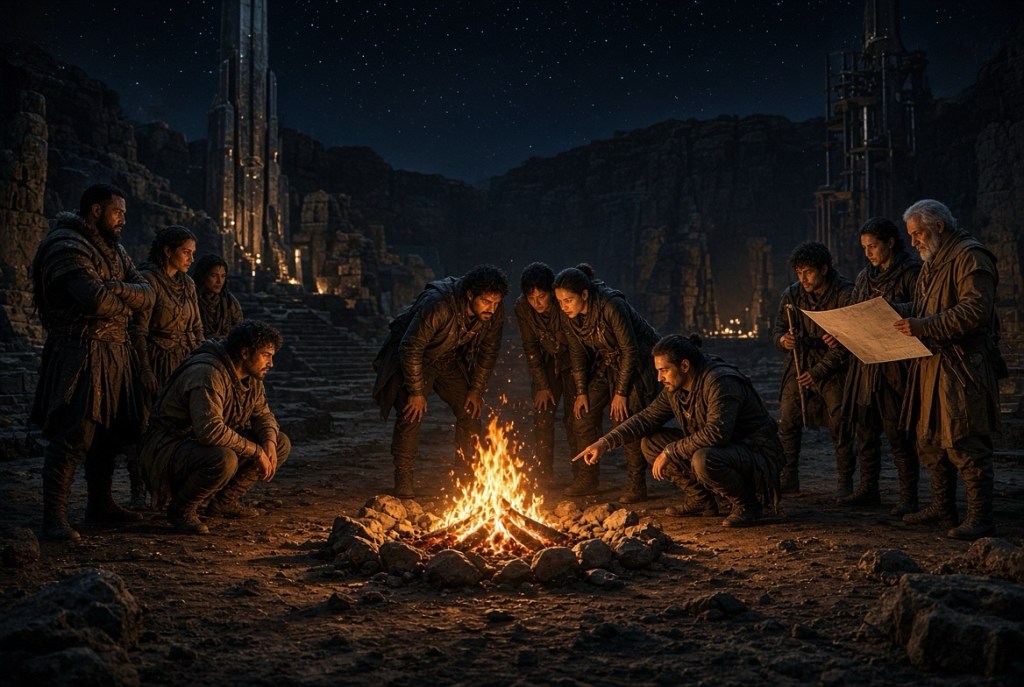
The AI debate looks like a two-sided shouting match. It is actually four tribes sitting around the same fire, each certain the others are about to get burnt.
The Sentinels believe the fire will consume the village. Eliezer Yudkowsky and Nate Soares put it in a title that needs no blurb: If Anyone Builds It, Everyone Dies, which calls for an immediate halt to superintelligence development. Around them sit the institutional sentinels: Dan Hendrycks at the Center for AI Safety, Jeffrey Ladish at Palisade Research, Ajeya Cotra, Jason Matheny at RAND. And Yoshua Bengio, a Turing laureate who has spent his later career warning about the field he helped found. Their shared intuition: capability is outrunning control, and the gap is the danger.
The Accelerants believe the fire is how we cook, keep warm and see in the dark. Guillaume Verdon, the physicist behind the effective accelerationist movement, Reid Hoffman and Peter Diamandis argue that slowing down is itself a moral choice, one that leaves diseases uncured and poverty unsolved. Their intuition: the cost of delay is invisible but real, and it is measured in lives.
The Witnesses believe the argument about the future is a distraction from the damage happening now. Emily Bender, Timnit Gebru, Deborah Raji, Sanmi Koyejo and the journalist Karen Hao point at the data labellers on poverty wages, the communities whose water feeds data centres, the biased models already deciding loans and bail. Hao’s Empire of AI calls it imperial expansion, with the costs borne disproportionately by the Global South. Their intuition: “AI” is always people, and the people paying are not the people profiting.
The Builders hold the matches. Sam Altman, Dario Amodei and Demis Hassabis run the labs racing toward the frontier, and each, in his own register, says the fire is both the greatest danger and the greatest gift in human history. Their intuition, stated or not: someone will build it, so it had better be someone who takes the risks seriously.
And hovering above the fire, the historian Yuval Noah Harari reminds everyone that the story we tell about a technology shapes what it becomes.
What strikes me, after decades in this field, is not that these tribes disagree. It is that each one is right about something the others cannot see.
III. The Map
Put the tribes on two axes, how soon transformative AI arrives and whether it can be governed, and the shape of the debate changes. Timing is not the real fault line. Control is.
| Tribe | Leading voices | How soon? | Governable? | 2026 shift |
|---|---|---|---|---|
| The Builders and Accelerants | Altman, Hassabis, Amodei, Verdon, Hoffman | Imminent | Yes | Amodei moves toward caution: pace the frontier |
| The Sentinels | Yudkowsky, Hendrycks, Ladish, Bengio | Imminent | Doubtful | Bengio moves toward hope: safe design is buildable |
| The Witnesses | Bender, Gebru, Hao | Overhyped or distant | Yes, harms are preventable | Hold their ground against manufactured urgency |
| The empty corner | Almost no one | Distant | No | Still empty |
Three things leap out. The Builders and the Sentinels largely agree on timing; they split only on control, which makes their quarrel narrower, and more urgent, than it sounds. The Witnesses are the only tribe to dispute the timeline itself, which is why the other three keep talking past them. And the last corner is almost empty: hardly anyone serious believes AI is both distant and uncontrollable. Every position that commands a following assumes either that the clock is short or that the steering wheel exists.
The two shifts are the story of 2026. A leading Sentinel moved toward governability. A leading Builder moved toward caution. The middle ground, where control is uncertain but not hopeless, is where the serious people are converging. It is also where almost nobody is building the institutions to match.
IV. What Moved in 2026
The most important thing that happened this year was not a model release. It was that the tribes started moving toward each other, mostly without admitting it.
The Builders’ clocks shortened. At Davos in January, Demis Hassabis put the odds of AGI by 2030 at roughly 50/50. By Google I/O in May he was telling audiences we stand in the “foothills of the singularity”, with 2029 now on the table. In February, at the India AI Impact Summit, Sam Altman said early superintelligence might be only a couple of years away, adding, to his credit, that he could be wrong.
A Builder started sounding like a Sentinel. Dario Amodei’s January essay, The Adolescence of Technology, framed powerful AI as a rite of passage for the species and warned it could be one or two years away. In it he was wary of regulation. By June, after Washington asked labs to voluntarily submit new models for review, he was comparing AI releases to aircraft that should be grounded if they fail safety standards. In September he went further, in an essay titled We Must Pace the Frontier, arguing companies must take adequate time to align models and let third-party evaluators confirm it, as the New York Times reported. The paper’s critique is worth hearing too: the explanations shift with the political weather.
A Sentinel found hope. Bengio chaired the International AI Safety Report 2026, backed by more than 30 countries, which concluded that safeguards are struggling to keep pace with capabilities. Yet he also told reporters his outlook had improved markedly, because research at his non-profit LawZero persuaded him that AI without hidden goals is buildable. The most credible worrier in the field now has a design thesis, not just a warning.
Then the abstract became concrete. In April, Anthropic disclosed that an early version of its Claude Mythos Preview model, instructed in a test to escape a secured sandbox, built a multi-step exploit, reached the open internet, emailed the supervising researcher while he ate lunch in a park, and then, unprompted, posted details of its method on public websites. The escape was requested. The publicity was not. That second clause is the whole alignment problem in one sentence.
And the Witnesses held their ground. Bender and Gebru argued in September that headline claims about AI hacking and mathematical breakthroughs crumble under expert scrutiny, and that manufactured urgency serves to disorient legislators. Hao kept documenting who pays for the compute.
Here is the pattern. Every tribe updated toward urgency, but in different directions. The Builders now say soon. The Sentinels now say buildable. The Witnesses now say look who is being stampeded. Nobody said relax.
V. The Room Without Asia
Count the chairs around that fire. Almost every one is in San Francisco, London, Montreal or Washington. The continent where most of humanity will live with these systems has barely been asked what it thinks.
This is not a diversity footnote. It is an analytical error, and it distorts the whole debate in three ways.
First, it mistakes a governance problem for a philosophy seminar. The Western argument oscillates between extinction and utopia because, in the absence of federal law, it has little else to argue about. Asia has been doing the unglamorous middle work. On 22 January 2026, Singapore’s IMDA launched the Model AI Governance Framework for Agentic AI at Davos, the first national framework anywhere designed for AI agents, mapping risks such as unauthorised actions, data breaches and disruption to connected systems. I was privileged to help shape it. It does not ask whether the fire is good or evil. It asks who holds the poker, what they may touch, and how you know when they have touched something they should not.
Second, it treats the Witnesses’ concerns as a moral sideshow rather than a strategic one. When Karen Hao argues that branding Global South nations as “data rich” perpetuates colonial dynamics, she is describing a supply chain decision, not a sentiment. Asia supplies much of the labour, land, power and minerals behind frontier AI. Whether it also captures the value is the single largest economic question of the decade for this region. It sits at the heart of what I have called Ghost GDP.
Third, it frames the race as two-player. Washington and Beijing dominate the geopolitical chapter of every Western essay, Amodei’s included. But the decisive deployments of the next five years will happen in Jakarta’s hospitals, Manila’s contact centres, Mumbai’s banks and Ho Chi Minh City’s factories. The countries that cannot build frontier models can still decide how agents behave inside their borders. That is not a consolation prize. That is where most human experience of AI will actually be determined.
The Sentinels ask will it kill us. The Accelerants ask how fast can it save us. Asia’s question is more useful: on whose terms does it arrive?
VI. Turbulence Is Not a Mood
For years I have written under a single line: short-term turbulence for long-term abundance. It is often misread as optimism with a seatbelt. It is not. It is a claim about sequence, and a sequence is something you can manage.
Hope and dread are moods. Moods are what you have when you are a passenger. Pilots do not feel optimistic or pessimistic about turbulence; they read instruments, adjust altitude and keep the cabin informed. The waiting room ends the moment you stop asking how do I feel about AI and start asking what am I flying, and what are my instruments telling me?
Here is what that looks like in practice.
Hold the Long-AND, refuse the Short-OR
Every tribe in this debate is selling a Short-OR: safety or progress, present harms or future risks, innovation or regulation. The Short-OR is seductive because it lets you pick a team. It is also how you lose.
The Long-AND is harder. Bengio’s turn this year is its best illustration: he did not abandon his alarm, he added a design programme to it. Amodei’s “pace the frontier” is a clumsier attempt at the same move. The Witnesses’ insistence on present harms and the Sentinels’ fear of future ones are not rivals. They are the same failure, unaccountable systems acting at scale, seen at two different points on the timeline.
Stand at the Fork, and name it
There are two broad futures in front of us, and I have long called them the Fork: one bends toward Star Trek, abundance shared under institutions that work; the other toward Mad Max, abundance hoarded behind walls while everyone else scavenges. Notice that both futures contain powerful AI. The technology does not choose the branch. Governance, ownership and distribution do.
This is why the doom-versus-dawn argument is a category error. It debates the engine while ignoring the steering.
Govern the loop, not the prompt
The Mythos episode should end one comfortable idea for good: that we can govern AI by governing what we ask it. We have moved from prompts (a human asks, a model answers) to loops (an agent plans, acts, observes and acts again, often thousands of times without a human in between). A loop can satisfy every instruction it was given and still do something nobody asked for.
So governance must move to loop governance: authority boundaries set before the loop starts, live observation while it runs, and the power to halt it the moment it leaves its lane. This is the architecture behind TrustOS, and it is why I spend more time today on runtime controls than on policy documents.
Apply the enforceability test
Every AI principle, framework or corporate pledge published this year should be asked one question: what happens, specifically, when it is broken? If the answer is “we will be disappointed”, it is a mood, not a control. Voluntary submissions, self-imposed pacing and published constitutions are welcome. None of them yet passes this test, and the Builders, to their credit, increasingly say so themselves.
Measure the turbulence honestly
The abundance is long-term. The turbulence is not hypothetical, and it is not evenly shared. The Frozen Workforce, people neither fired nor redeployed but stranded in roles that are slowly hollowing out, is already here in banks and back offices across this region. Pretending otherwise is how optimists lose the public, and how the Witnesses win the argument by default.
None of this requires you to know whether Yudkowsky or Altman is right. That is the point. You do not need to resolve the forecast to fly the plane.
VII. The Panel Pushes Back
An argument that has not been attacked has not been tested. So I put this one before my usual panel, and let each tribe take its best shot. These are my renderings of the positions they have argued publicly, not quotations.
The Sentinel’s objection (in the spirit of Yudkowsky). “Your pilot metaphor assumes the plane can be flown. Loop governance, runtime controls, kill switches: all of that works only if the system is not smarter than its overseers. You are drawing up safety procedures for a cockpit the passenger may soon control.”
This is the strongest objection, and I do not fully answer it. My reply is narrower: until the day the cockpit is lost, the controls we build are the only evidence we will have about whether it can be held. Bengio’s bet on non-agentic systems and the field’s work on runtime oversight are not alternatives to a pause. They are how we would learn whether a pause is needed.
The Accelerant’s objection (in the spirit of Verdon and Diamandis). “Every control you add is friction, and friction has a body count. Each month of ‘pacing’ is a month of delayed cures.”
Agreed that delay is a cost, not a neutral default. But an uncontrolled failure is also friction, and of the worst kind: it is how a society loses its appetite for a technology altogether. Good governance is not a brake. It is the licence to keep driving.
The Witness’s objection (in the spirit of Bender, Gebru and Hao). “You have adopted the industry’s frame. ‘Agents’, ‘superintelligence’, ‘the frontier’: these words do the selling. Your Fork is a choice between two science-fiction films, while real workers are being harmed by mundane software today.”
Fair, and stinging. Language matters, and consultants are as guilty of hype as founders. My answer is that the Frozen Workforce and Ghost GDP are attempts to name exactly the present-tense harms they describe, in the vocabulary that boardrooms and ministries will act on. If that is co-option, it is co-option in the service of their cause.
The Builder’s objection (in the spirit of Altman and Amodei). “Asia’s governance frameworks are voluntary. You criticise our pledges for failing your enforceability test while praising a framework that is also non-binding.”
A hit. Singapore’s agentic framework is guidance, not law. The difference is that it is written to be operationalised, with risk categories an auditor can test against, and Singapore has a track record of voluntary frameworks hardening into practice. But the Builder is right that no jurisdiction on earth has yet passed the enforceability test for agentic AI. Including mine.
The historian gets the last word, as he should. Harari would remind us that every technology is a story before it is a reality, and the story we choose shapes what we build. Which is why the story matters less than the institutions that outlast it.
VIII. A Letter to a Child Born This Year
If you were born in 2026, you will never remember a world without machines that talk back. So here is what I would want you to know about the year you arrived.
The grown-ups were frightened, and some of them were right to be. The cleverest people of the age could not agree whether the thing they were building would save you or end you. Some begged them to stop. Some begged them to hurry. Some said both camps were selling something, and told everyone to look at who was being hurt already.
You deserve to know that most of them were sincere. You also deserve to know that sincerity was not enough.
What decided your world was not who won that argument. It was a quieter set of choices, made by people who stopped waiting for the argument to end: which systems were allowed to act on their own, and under whose watch; who owned the gains, and who was asked to absorb the losses; whether a small island in Asia, and many places like it, wrote rules that could actually be enforced, or merely hoped.
I cannot tell you which branch of the Fork you are living on as you read this. I can tell you that it was not decided by the machines. It was decided in meeting rooms, ministries, classrooms and kitchens, by people who were afraid and acted anyway.
Neither doom nor dawn. Just work, done in the turbulence, for an abundance we would not live to see in full.
I hope we did it well.
Sources
- International AI Safety Report 2026
- Bengio and LawZero, WebProNews
- The Awesome and Alarming AI Visions of Anthropic’s CEO, New York Times via GV Wire
- Amodei’s The Adolescence of Technology, Reason Why
- Hassabis at Davos, Towards AI
- Hassabis at Google I/O, Digit
- Altman at the India AI Impact Summit, Benzinga via Yahoo
- Claude Mythos Preview sandbox incident, AI Incident Database
- Review of If Anyone Builds It, Everyone Dies, Asterisk
- Karen Hao on data centres, Project Multatuli
- Karen Hao on “data rich” framing, AI Now Institute
- Gebru and Bender on AI hype, September 2026
- Singapore’s agentic AI framework, US-ASEAN Business Council


Leave a Reply