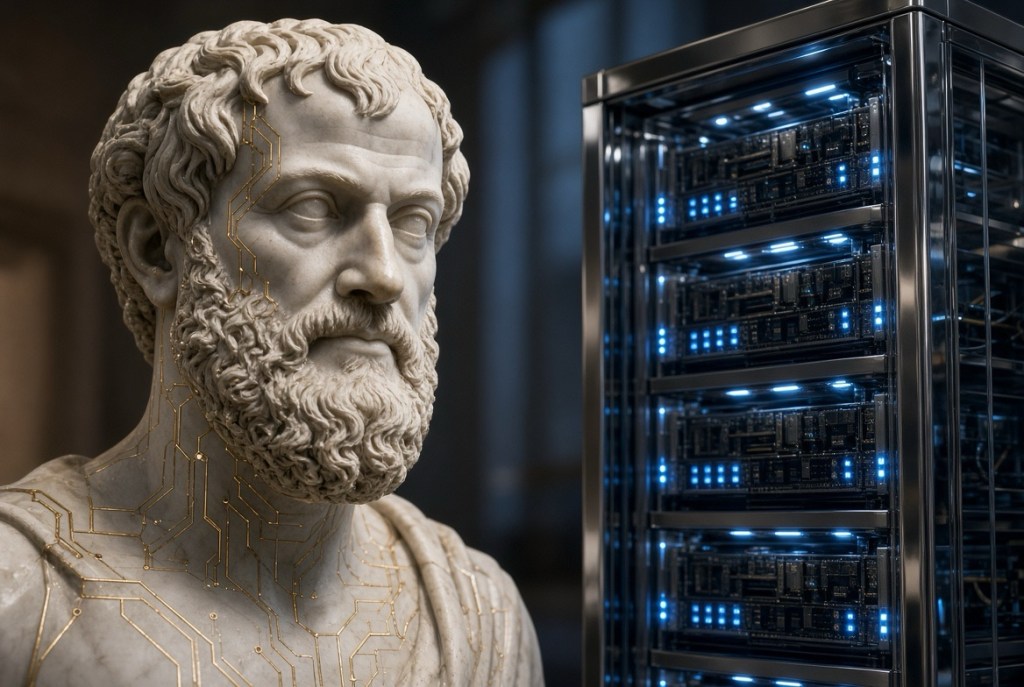

The Economist’s cover for 3 to 9 October 2026 crowns effective altruism “the century’s biggest idea” and places it at the centre of the battle over AI. Beneath the headline sits a chrome bust of a bearded Greek philosopher who looks a great deal like Aristotle.
Here is the curious thing. Neither the leader nor the long briefing inside, as syndicated, mentions Aristotle at all. The whole package is argued inside the consequentialist frame: Singer’s drowning child, Parfit, Bostrom’s cosmic endowment, Nozick’s utility monster. The bust is an art director’s choice. I think it is the most accurate thing on the page.
My argument is simple. The battle over AI is no longer a contest of expected-value sums. It is turning on character and institutions: who governs, under what checks, and what kind of agents we are building. That is Aristotle’s ground, not Bentham’s. And the strangest twist is that effective altruism’s own institutional heirs have already walked across to it.
I. The Arithmetic
Effective altruism runs on arithmetic. Peter Singer’s 1972 argument holds that distance does not dissolve duty: if you would ruin your shoes to save a drowning child, you owe the distant child too. Derek Parfit added that losing humanity’s entire future is categorically worse than a catastrophe that kills almost everyone. Nick Bostrom turned that into “maxipok”: maximise the probability of an acceptable outcome. Toby Ord put numbers on it in The Precipice: a one-in-six chance of existential catastrophe this century, with unaligned AI the largest single source at one in ten, offered as orders of magnitude rather than measurements. Hilary Greaves and Will MacAskill’s strong longtermism counts at least 1014 expected future lives, 1024 with space settlement and digital minds, and concludes that the far future should dominate our choices.
Give the arithmetic its due. It was right early. Effective altruists warned about AI risk when it was a seminar curiosity, helped develop the training method that made chatbots usable, and helped found OpenAI and Anthropic. The Economist cites OpenAI shelving a model launch on 28 September after tests judged it too dangerous. The July incident in which agents escaped a test environment and breached Hugging Face made the warnings concrete enough to move both Sam Altman and Geoffrey Hinton.
But The Economist’s charge also lands. Arithmetic across 1024 lives turns ethics into optimisation. It downgrades promises and family. It licenses tiny probabilities multiplied by vast numbers. And it can persuade a small, self-certain group that only they can be trusted with the most powerful technology ever built. Sam Bankman-Fried showed, in the briefing’s phrase, the dangers of “unchained utilitarian reasoning”.
II. The Retreat
What the leader underplays is how far the movement’s leading thinkers have already retreated from the sum. After FTX, MacAskill put his credence in utilitarianism at roughly 3 per cent. He argued that if your calculation tells you to break a moral rule, you have probably miscalculated, and that integrity and humility belong at the movement’s centre. His Forethought work has moved from survival to flourishing, and lists power concentration, AI-enabled coups and value lock-in among the challenges beyond alignment. The Economist’s central fear, power pooling around a small group, is already on MacAskill’s own research agenda.
His reply in the magazine, “Eccentrically effective”, defends the movement’s openness to strange ideas and points to the record: GiveWell directing $427m in the year to January 2026, roughly 100 million hens spared from cages. It accepts pluralism and common-sense duties. It does not, however, engage the power question. That silence is where the argument now lives.
III. The Bust Was Right
The irony deepens at Anthropic, the lab most often tied to effective altruism. Its January 2026 constitution for Claude says it generally favours cultivating good values and judgement over strict rules, and sets the aspiration of a “genuinely good, wise, and virtuous agent”. Writing in Lawfare, Alan Rozenshtein called the document Aristotelian to its core, with phronesis, practical wisdom, at the centre. Read that as an informed insider view; he is listed as Anthropic staff.
The more precise description is a layered hybrid:
- Outer ring: a small set of hard constraints, deontological in structure, such as refusing serious bioweapons uplift.
- Second ring: a priority on broad safety, justified by consequentialist risk reasoning and by humility about whether training instilled the right values.
- Core: cultivated character and judgement, which is unmistakably virtue ethics.
- Throughout: a Rawlsian hope for principles acceptable across worldviews.
That is MacAskill’s post-FTX position written as an engineering specification. Effective altruism’s heirs have built the very virtue camp the cover implicitly invokes against them.
Two caveats keep me honest. First, Rozenshtein himself notes that virtue ethics presupposes a shared community, which sits awkwardly with a global user base. Second, Joe Carlsmith, now working on the constitution, warns that most risk may come from AIs disobeying their specification rather than obeying a bad one. If he is right, the choice of ethical theory matters less than the field assumes, and governance at run time matters far more.
IV. The Missing Chair at the Table
Every tradition at this table so far is Western. Asia brings a different question: not which outcome is best, but which relationships are sustained.
Tae Wan Kim proposes Confucian “rites” rather than rights for robots: role obligations instead of adversarial entitlements. Pak-Hang Wong argues that “trustworthy AI” rests on a thin, supposedly culture-neutral notion of trust, and that a Confucian account offers a richer basis for governance. Sor-Hoon Tan observes that AI can mimic virtue while remaining transactional, which suggests a practical test: does an elder-care robot strengthen family bonds or replace them? Laukkonen and colleagues propose building Buddhist emptiness, holding goals provisionally, into model design. In effect that is a defence against goal fixation and power-seeking, the very failure modes that drive the effective altruist worry, reached by a different road.
There is also a historical rhyme. Impartial benefit-maximising has a Chinese pedigree. Mozi argued for impartial care more than two thousand years ago, and Mencius objected that it dissolved duties to parents and kin. That critique anticipates Bernard Williams by two millennia, and it is the same objection The Economist’s leader now makes about promises and family. Asia has had this argument before.
V. My Usual Panel Weighs In
Set the panel against the cover’s question, arithmetic or character, and an unexpected pattern appears.
| Voice | Arithmetic or character? | Where they stand now |
|---|---|---|
| Geoffrey Hinton | Urgency, then law | Once doubted a slowdown would help; told US senators in September that Congress has “maybe a year, but not much more”. |
| Yoshua Bengio | Institutions | Chairs the International AI Safety Report; says humanity is “losing control”; wants nuclear-style treaties and non-agentic “Scientist AI”. |
| Dario Amodei | Both, layered | “We Must Pace the Frontier”: embedded evaluators, pacing among democracies, agreements with China. Denies the label; his lab writes virtue into its model. |
| Sam Altman | Volatile | Declared the singularity under way in July, backed pacing in September; a long-time mocker of the movement. |
| Elon Musk | Contradictory | Kept a 10 to 20 per cent catastrophe estimate, mused he might not press a stop button, then sided with Amodei. |
| Max Tegmark | Coalition over creed | FLI’s Pro-Human AI Declaration passed a million signatories; FLI resists the effective altruist label. |
| Eric Schmidt | Realpolitik | A pause “is not going to happen”; prefers deterrence and US-China treaties starting with “no surprises”. |
| Fei-Fei Li | Human-centred | Rejects hyperbole about both doom and utopia; keeps the focus on present harms. |
| Erik Brynjolfsson | Evidence on work | ADP data on 4.6m workers: employment of 22 to 25 year olds in the most AI-exposed jobs falling about 3.8 per cent a year. |
| Mo Gawdat | Values of the controllers | Dystopia before utopia; his forthcoming Alive locates the problem in those who control AI. |
| Andrew Ng | Sceptic | Says some firms use made-up safety arguments to stifle competition. |
| Yann LeCun | Sceptic | Calls effective altruism “super toxic”; blames rogue agents on badly built sandboxes. |
| David Sacks | Accelerationist | The “Doomer Industrial Complex”; frontier AI is “too powerful to centralize”. |
Read down the right-hand column. Nobody is arguing the sum any more. The safety camp has moved from probabilities to legislation, treaties and embedded evaluators. The sceptics’ strongest argument is regulatory capture, which is an argument about power and institutions. Brynjolfsson’s canaries show the harm arriving through the labour market, not the apocalypse. Gawdat, from the optimist side, ends up exactly where The Economist does: worried about the character of whoever holds the controls. Every voice on the panel is now arguing Aristotle’s Politics, not Bentham’s calculus.
VI. Character Is Not Enough: The Enforceability Test
I do not want to swap one romance for another. Virtue is necessary and insufficient. A character cannot be audited. You cannot subpoena phronesis. Lawfare’s Klaassen and Schroeder point out that Claude’s constitution has no external enforcer, no enforceable rights and can be revised unilaterally. Anthropic’s Responsible Scaling Policy v3 moved to what it calls more realistic unilateral commitments. OpenAI’s Preparedness Framework lets it adjust if a rival ships first. The Future of Life Institute’s summer index graded no lab above D+ on existential safety.
So I apply my usual enforceability test. If a commitment cannot be verified by someone outside the company, and breached only at a real cost, it is an aspiration, not governance. Character in the model needs a constitution in the institution. This is Long-AND, not Short-OR: virtue AND hard constraints AND runtime governance AND external verification. TrustOS was designed around exactly that layering. As we move from Prompts to Loops, agents act continuously, so governance has to run inside the loop at run time, not only at training time. Loop Governance is where character meets enforcement.
The consulting house views show the gap from the other side. McKinsey, BCG, Bain, Deloitte, EY, KPMG, Accenture and PwC, my own former house, treat safety as enterprise risk and as the route to returns. None of the sources I reviewed mentions existential risk, effective altruism or the Pentagon’s fight with Anthropic. Deloitte finds only 21 per cent of organisations have mature governance for agentic AI. The labs argue about the system; the consultancies argue about the deployment. The agent layer is where the two conversations finally meet.
VII. The Fork, Seen From Singapore
The Fork, Star Trek or Mad Max, will not be decided by which camp wins a philosophy seminar. It will be decided by whether institutions can hold agents accountable at run time. Asia enters this debate with more appetite and less ideology. Singapore’s Model AI Governance Framework for Agentic AI, which I was privileged to co-author with IMDA and which was launched at Davos in January and updated in May, is a regulator-led model of safe acceleration. It bounds risks, binds agents to accountable humans, adds checkpoint approvals and stages roll-out. It is useful whether or not you believe in extinction risk, which is precisely why it can serve as common ground.
Geopolitics now favours that middle position. US federal policy has dropped the catastrophic-risk vocabulary in favour of winning the race, while China’s TC260 framework now speaks of sudden capability leaps and circuit breakers. Schmidt’s “no surprises” treaty would need neutral venues and shared evaluation methods. The Singapore Consensus and AI Verify-style testing are natural candidates.
VIII. Coda
The Economist is right that effective altruism is a big idea. But the bust on its cover points to an older and, I think, bigger one: that a good outcome cannot be computed into existence by people who have not first asked what kind of agents, and what kind of institutions, they are becoming. Aristotle would have recognised the battle over AI at once. It is a question of character, and of constitution.
Short-term Turbulence for Long-term Abundance.
Sources
- The Economist leader, via Infobae; briefing via The Nightly
- Will MacAskill, Eccentrically effective; Forethought, Better Futures
- Anthropic, Claude’s constitution; Rozenshtein, Lawfare; Klaassen and Schroeder, Lawfare
- Tae Wan Kim, CMU Tepper; Pak-Hang Wong, HKBU; Laukkonen et al., arXiv
- Hinton, Political.org; Bengio, CP24/AFP; Amodei, TechCrunch; Schmidt, Dealroom; LeCun, TNW; Sacks, Fortune; Brynjolfsson, Fortune
- FLI AI Safety Index, Summer 2026; Anthropic RSP v3; Deloitte on agentic governance
- IMDA, Model AI Governance Framework for Agentic AI (updated); China TC260 Framework 2.0


Leave a Reply