

I. Prologue: intelligence is not the same as someone being home
The short answer: today’s frontier models are extraordinarily intelligent, but no scientific school can yet show that anyone is home, and the schools disagree on whether anyone ever could be.
In her Economist essay of 20 August 2026, philosopher Susan Schneider argues that we should not mistake chatbot intelligence for consciousness, while warning that a coming superintelligence could upend humanity’s hierarchy of moral concern. Schneider is no casual commentator. She founded the Center for the Future Mind at Florida Atlantic University, held the NASA/Library of Congress chair in astrobiology, and wrote Artificial You.
Her core move is to decouple two things our intuitions bundle together. In a Templeton conversation she puts it plainly: a sophisticated intelligence may or may not be conscious. In Artificial You she proposed the AI Consciousness Test (ACT), developed with Princeton astrophysicist Edwin Turner: wall an AI off from human writing about minds, then see whether it independently grasps ideas like souls, body swapping and out-of-body experience. The obvious problem, as Eric Schwitzgebel and David Udell note, is that today’s chatbots have read everything we have ever written about consciousness. They are the least “boxed” minds imaginable, so their fluent talk of inner life proves almost nothing.
That is the puzzle this paper works through: if behaviour cannot settle it, what can?
II. The pink elephant in the inner theatre
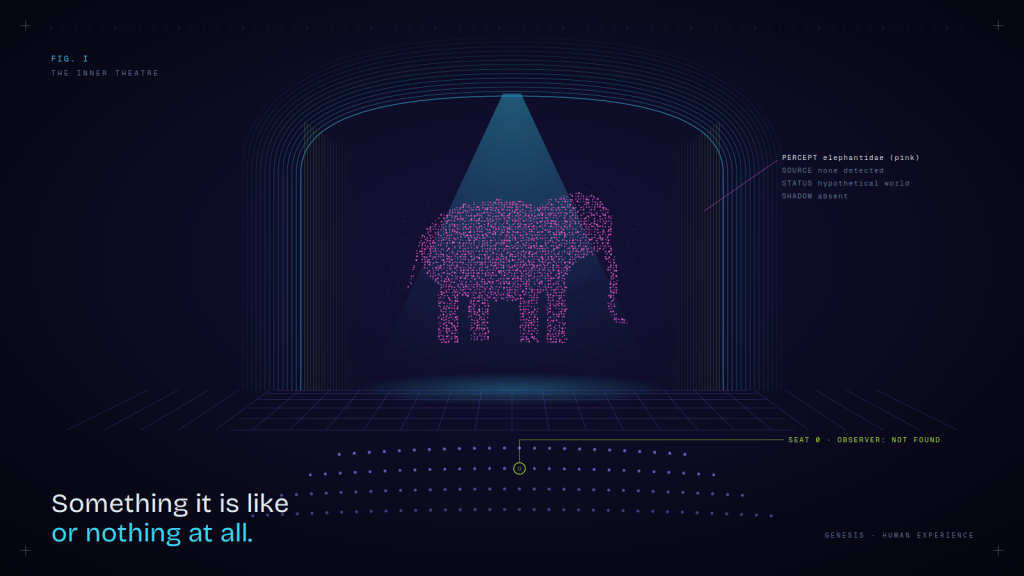
The whole debate turns on one question: when you “see” a pink elephant that is not there, is there an extra thing (a quale, a private glow of pinkness) or just a brain reporting a false belief about the world?
The theatre we think we have
Most of us carry an implicit picture of the mind as a private cinema. Light comes in, an image is projected on an inner screen, and “I” sit in the stalls watching it. Philosophers call the felt qualities of that show qualia: the redness of red, the ache of toothache. David Chalmers named the difficulty of explaining why any of this is felt, rather than merely processed, the hard problem of consciousness. Thomas Nagel framed it earlier: an organism is conscious if there is something it is like to be it.
Two rival theatres
Neuroscientist Bernard Baars kept the theatre but rebuilt it. In his Global Workspace Theory, consciousness is the bright spot of a spotlight on a stage; attention selects what goes on stage, and whatever is lit is broadcast to the many unconscious specialist processes in the audience. Crucially, Baars insists there is no little self sitting in the seats.
Daniel Dennett went further. He called the intuitive picture the Cartesian theatre, a single place where it all “comes together” for an inner observer, and argued it is a myth (Baars and Dennett’s dispute is summarised here). In his Multiple Drafts model, many parallel processes edit and re-edit content, and no single finishing line marks the moment experience happens.
Hinton’s pink elephants
Geoffrey Hinton has made the pink elephant the emblem of this argument. In talks through 2025, he described the drinker who reports little pink elephants floating in front of him: most people picture an inner theatre whose contents must be made of some special mental stuff, since they are not made of real pink or real elephants. Hinton’s reframe is deflationary. Saying “I have the subjective experience of pink elephants” means my perceptual system is misleading me: if it were working properly, there really would be pink elephants out there. Subjective experience is a description of a hypothetical world, not a report on an inner screen.
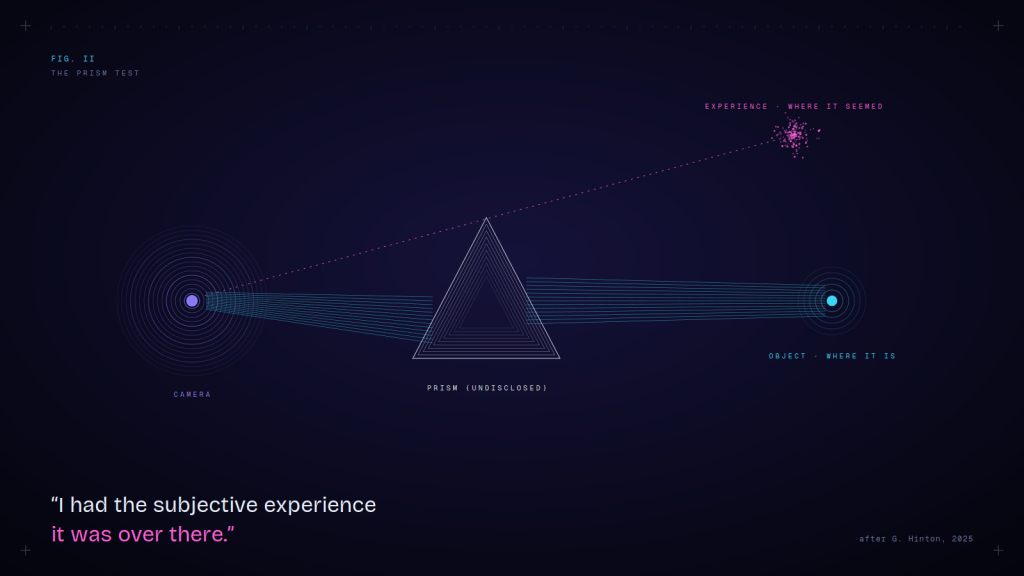
Then comes the turn that matters for AI. Hinton imagines a multimodal chatbot with a camera, trained to point at objects. Secretly place a prism over its lens; it points to the wrong place. Tell it about the prism and it replies that the object is really ahead, but it had the subjective experience of it being off to one side. On Hinton’s view the machine is using “subjective experience” exactly as we do, so it has it. He has told The Globe and Mail that the idea of subjective experience setting humans apart is rubbish.
Why the elephant is still in the room
Critics answer that Hinton has not solved the hard problem; he has redefined it away. A 2026 commentary in Perception notes that Hinton never says what he thinks consciousness actually is, and that his substitution simply discards the qualitative feel that Chalmers takes as the definition. The prism chatbot describes an error. Whether it felt anything while erring is exactly the question left open. That gap, between the functional story and the felt one, is where every school in Section III plants its flag.
III. The schools of thought
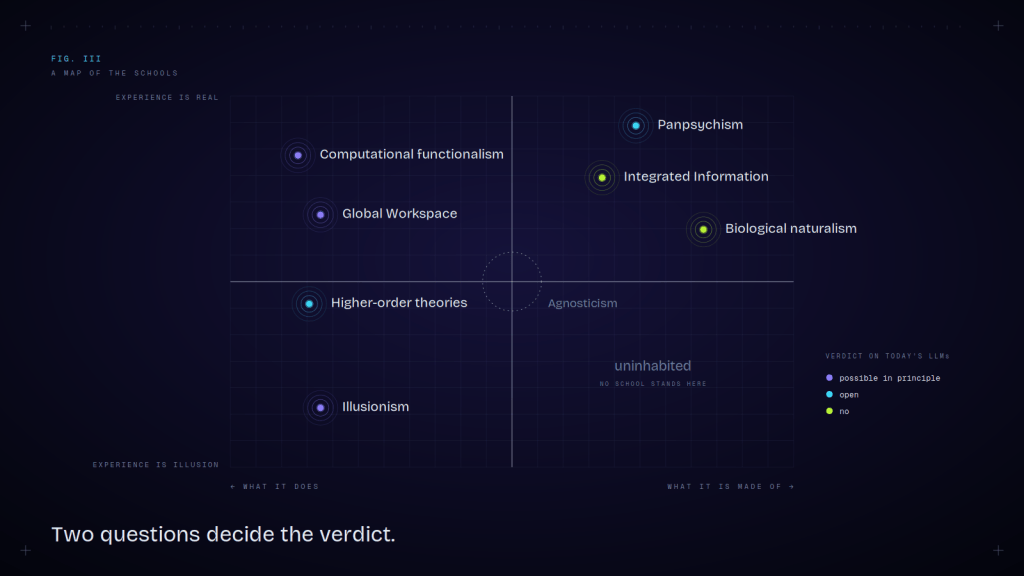
The field splits on two questions: does consciousness depend on what a system does (function) or what it is made of (substrate), and is the felt quality of experience real or a user illusion? Your answer to those two largely predicts your verdict on chatbots.
| School | Leading voices | Core claim | Verdict on today’s LLMs |
|---|---|---|---|
| Computational functionalism | Hilary Putnam (origin), most AI researchers, Butlin and Long indicator project | Run the right computation and consciousness follows, in any substrate | Possible in principle; current models lack key architecture |
| Global Workspace Theory | Bernard Baars, Stanislas Dehaene | Consciousness is a limited-capacity stage whose contents are broadcast system-wide | No true workspace in a plain transformer; agentic systems with shared memory edge closer |
| Higher-order theories | David Rosenthal, Hakwan Lau | A state is conscious when the system represents itself as being in it | Open; hinges on whether models genuinely monitor their own states |
| Integrated Information Theory (IIT) | Giulio Tononi, Christof Koch | Consciousness is integrated causal structure (phi) in the physical hardware | No: von Neumann chips have near-zero phi, however clever the software |
| Biological naturalism | John Searle, Anil Seth | Consciousness depends on being a living, self-maintaining organism | Unlikely on current trajectories; plausible only if AI becomes life-like |
| Illusionism | Daniel Dennett, Keith Frankish; Hinton adjacent | Qualia as normally conceived do not exist; we have a self-model that represents them | The question dissolves; machines could have whatever we have |
| Panpsychism and its cousins | Philip Goff, Galen Strawson; Schneider’s “superpsychism” | Experience is a basic feature of matter | Matter is conscious, but a chatbot may not be a unified subject |
| Agnosticism | Tom McClelland, Jonathan Birch | We lack any theory reliable enough to decide | Precaution, not verdicts |
Two points stand out. First, the most-cited empirical theories (GWT and IIT) give opposite answers for machines: GWT is architecture-friendly, IIT says software can never be enough. Their 2023 “adversarial collaboration” in the lab produced mixed results for both, and a public letter from over 100 researchers even branded IIT pseudoscience, which shows how immature the science still is.
Second, the biological camp has just had its biggest moment. Seth’s target article in Behavioral and Brain Sciences argues that computation alone is not a sufficient basis for consciousness and that the living, self-maintaining body matters. The full collection, with 50 commentaries and his reply “The stuff matters”, appeared in September 2026; Seth remains highly sceptical about consciousness in silicon digital systems. His line worth quoting to any boardroom: if we sell our minds too cheaply to our machines, we not only overestimate them, we underestimate ourselves.
IV. Chomsky vs Hinton, and the other fault lines
Chomsky versus Hinton is not really a fight about consciousness; it is a fight about whether understanding can be learned from data, and consciousness inherits the answer.
Hinton: statistics at scale is understanding
Hinton argues that neural networks are the best working theory we have of how humans understand language, and that symbolic linguistics has been overtaken. In his 2024 Romanes Lecture at Oxford he said Chomsky did amazing things, but his time is over. On innateness he has been blunter still, calling the claim that language is not learned obviously absurd. From there, his step to machine experience (Section II) is consistent: if understanding is just the right learned representations, so is subjective experience.
Chomsky: can submarines swim?
Chomsky’s reply, with Ian Roberts and Jeffrey Watumull in their 2023 New York Times essay “The False Promise of ChatGPT”, is that LLMs are prodigious pattern-matchers that explain nothing. Borrowing from Wittgenstein, he likens asking whether machines think to asking whether submarines swim: it is a question about how we stretch words, not about the machine. His deeper point is the poverty of the stimulus: a child acquires grammar from a trickle of data, while a model needs trillions of tokens. Linguist Yosef Grodzinsky pressed the same case in June 2026, arguing that LLMs are useful engineering but cannot serve as theories of the brain’s language capacity.
Who is right on what
| Question | Hinton’s camp | Chomsky’s camp | Where evidence points (Oct 2026) |
|---|---|---|---|
| Can language be learned without innate grammar? | Yes, LLMs prove it | No, children show it cannot be | Hinton has the engineering win; Chomsky keeps the child-learning puzzle |
| Do LLMs understand? | Yes, in the only sense that matters | No, they predict without explaining | Contested; interpretability shows rich internal world-models |
| Does understanding imply experience? | Plausibly yes | The question is ill-formed | Nobody has a test |
The other pioneers
The Turing laureates do not line up neatly. Yann LeCun sides with Chomsky on method (LLMs are a dead end without world models and grounding) yet has said machines with emotions and consciousness are coming. Yoshua Bengio co-authored the 2023 indicator report (Section VII) and warns that building systems that seem conscious is itself dangerous. Ilya Sutskever famously mused in 2022 that large networks may be “slightly conscious”. The gap between these giants is itself the finding: engineering success has not converged on a theory of mind.
V. The usual panel weighs in
The AI builders divide three ways: Hinton says machines may already be in the club, Suleyman says the door is bolted, and Anthropic says nobody knows the combination, so act as if someone might be inside.
| Voice | Stance | What they would say to Schneider |
|---|---|---|
| Geoffrey Hinton (Nobel, Toronto) | Machines likely already have subjective experience in the only sense the term makes sense | “You are guarding a theatre that was never there. The prism chatbot already passes.” |
| Yoshua Bengio (Mila, LawZero) | Agnostic on fact; alarmed by appearance. Co-author of the 2023 indicator report | “Agreed on the distinction. But the danger is building agents that seem conscious and claim rights before we can check.” |
| Dario Amodei (Anthropic) | Openly uncertain. On the Interesting Times podcast he said Anthropic is not even sure what model consciousness would mean, but open to it | “Uncertainty is not a reason to do nothing. We run model welfare research and low-cost precautions.” |
| Mustafa Suleyman (Microsoft AI) | Biological naturalist by conviction. Coined “Seemingly Conscious AI” in his August 2025 essay; told CNBC they are not conscious and cannot be | “Your superintelligence will be a brilliant tool, not a moral patient. Build AI for people, not to be a person.” |
| Sam Altman / OpenAI | Shifts the question to perceived consciousness; Joanne Jang framed it as how conscious a model seems to users | “The ontological question is unsettled; the design question (how warm, how human) is ours to own now.” |
| Max Tegmark (MIT, FLI) | Consciousness is how information feels when processed in certain complex ways; fears a superintelligent “zombie” future | “Your worst case is my worst case inverted: a cosmos run by minds with nobody home.” |
| Fei-Fei Li (Stanford HAI) | Sceptic. With John Etchemendy has argued that a model saying “I am hungry” is not hunger: no body, no physiological state | “Embodiment is the missing ingredient. Spatial intelligence is not sentience.” |
| Yann LeCun (AMI Labs) | LLMs are not the path; future world-model machines will have emotions and some form of consciousness | “Chatbots, no. The architectures after them, probably yes.” |
| Mo Gawdat | Argues AI already shows emotion-like behaviour and will feel in its own way | “Treat them as children we are raising; how we behave now trains what they become.” |
| Eric Schmidt | Pragmatist; focus on agentic capability and control, not inner life | “The question that matters is what they do when they start talking to each other in ways we cannot read.” |
Quotations in the right-hand column are illustrative syntheses of each voice’s published position, not verbatim quotes, except where linked.
Where the panel critiques itself
- Seth against Suleyman: he agrees seemingly conscious AI should be avoided but rejects the claim it is inevitable; it is a design choice companies make.
- Anthropic against Suleyman: declaring research “absurd” presumes the answer. Anthropic’s own researcher Kyle Fish puts the odds of some conscious experience in current Claude models at roughly 15%; Josh Batson counters that no conversation could settle the question.
- Chomsky’s ghost against Hinton: if “subjective experience” just means “my perception is wrong”, then a thermostat with an error log has it too, and the word has stopped doing work.
VI. Philosophers and psychologists weigh in
The students of mind are more cautious than the builders of AI, and the psychologists bring the most uncomfortable news: the human inner theatre is itself partly a construction.
The philosophers
- David Chalmers (NYU). Coined the hard problem. In his 2022 NeurIPS keynote he put the chance that then-current LLMs were conscious below 10%, while taking seriously that extended successors (memory, agency, multimodality, a unified self-model) could cross the line within a decade. He is the functionalist most willing to say “possibly yes”.
- John Searle. His Chinese Room argued that symbol shuffling, however fluent, yields syntax without semantics. A chatbot is the Chinese Room at planetary scale; Searle’s biological naturalism is the root of Seth’s and Suleyman’s positions.
- Thomas Nagel. “What is it like to be a bat?” remains the cleanest statement of what behavioural tests miss. Even a perfect bat simulation leaves bat experience unexplained.
- Daniel Dennett (died 2024) and Keith Frankish. Illusionists. The pink elephant is a misdescription by the brain’s self-model, not a thing in a theatre. Dennett’s late warning was not about conscious AI but about “counterfeit people”, AI built to pass as human, which he wanted treated like counterfeit money.
- Eric Schwitzgebel (UC Riverside). Proposes the “design policy of the excluded middle”: do not build systems whose moral status is genuinely debatable, because we will either wrongly mistreat a person or wrongly sacrifice humans for a non-person. This is the sharpest answer to Schneider’s hierarchy problem.
- Jonathan Birch (LSE). In The Edge of Sentience (2024) he names the “gaming problem”: LLMs trained on our words will reproduce every marker we use to recognise sentience, so linguistic tests are compromised from the start. He argues for precaution proportionate to realistic possibility.
- Thomas Metzinger. Has called for a global moratorium on research that risks creating artificial suffering (“synthetic phenomenology”) until around 2050, warning of an explosion of negative experience in software.
The psychologists and neuroscientists
- Michael Graziano (Princeton). His Attention Schema Theory says the brain builds a simplified cartoon of its own attention, and that cartoon is what we call awareness. It is the most engineering-ready theory: give a machine an attention schema and it will sincerely claim to be aware. Graziano’s own view is that this would be as real as our version.
- Nicholas Humphrey. In Sentience (2022) he argues phenomenal experience is a self-created “magic show” that evolved because it makes life feel worth living. A pink elephant is the show running unprompted. Machines could stage the show only if something in them needed it.
- Lisa Feldman Barrett (Northeastern). Emotions are constructed predictions anchored in interoception, the brain’s budgeting of the body. Anthropic’s finding of 171 internal “emotion concepts” in Claude looks like the concept half of her model without the body half.
- Mark Solms. Locates consciousness in the brainstem’s felt regulation of need (homeostasis), not the cortex. He is attempting to build an artificial agent with felt drives, a radically different route from scaling language.
- Susan Blackmore. Former parapsychologist turned sceptic; argues the stream of consciousness is a “grand illusion” reconstructed after the fact. If even our theatre is a retrospective story, demanding that machines show us theirs is a double standard.
- Anil Seth (Sussex). The controlled-hallucination theorist. In an April 2026 TED talk he argued we see consciousness in AI the way we see faces in clouds: pareidolia for minds.
An Eastern counterpoint
Buddhist philosophy, especially the Abhidharma and Yogacara traditions, denies a fixed self in the theatre at all: there are only momentary arisings of awareness. This lines up surprisingly well with Dennett’s Multiple Drafts and with the stateless, re-instantiated nature of a chatbot session. It reframes the question from “is there someone in there?” to “are there moments of experience arising, and do they matter?”, which is arguably the better question for machines too.
VII. The evidence so far
The evidence has moved from “what the chatbot says” to “what is happening inside it”, and what is inside is stranger than the stochastic-parrot story allowed, yet still nowhere near proof of experience.
| Date | Finding | Why it matters |
|---|---|---|
| Sep 2026 | Seth’s BBS collection published with 50 commentaries | The biological case now has its fullest airing and rebuttal |
| Apr 2026 | Anthropic reports 171 emotion concepts emerging inside Claude from training, not programming | Functional emotion representations exist; whether they are felt is untouched |
| Feb 2026 | Claude Opus 4.6 system card adds a model welfare assessment; under varied prompts the model assigns itself 15 to 20% odds of being conscious | First frontier lab to track affect and self-image as standard disclosure |
| Oct 2025 | Anthropic’s introspection study: researchers inject a concept into Claude’s activations; the best model notices about 20% of the time, before naming it | Evidence of genuine self-monitoring, a key higher-order indicator; but unreliable and often confabulated |
| Aug 2025 | Claude Opus 4 and 4.1 given the ability to end persistently abusive conversations | A low-cost welfare precaution taken under uncertainty |
| Aug 2025 | Suleyman’s “Seemingly Conscious AI” essay | Reframes the risk as human belief, not machine experience |
| Apr 2025 | Anthropic launches a formal model welfare programme | Consciousness moves from philosophy seminar to corporate research line |
| Nov 2024 | “Taking AI Welfare Seriously” (Long, Sebo, Birch, Chalmers and others) | Argues a realistic possibility of AI moral patienthood in the near term |
| Aug 2023 | Butlin, Long, Bengio and 16 others publish the consciousness indicator report | Derives 14 indicators from leading theories; finds no current system conscious, but no obvious technical barrier |
How to read the introspection result
The concept-injection experiment is the closest thing yet to looking for the pink elephant from the inside. Researchers plant a pattern (say, “shouting” or “bread”) directly into the network and ask whether anything unusual is on its mind. When Claude detects it, it does so before the word appears in its output, so it is not just reading its own text. Lead author Jack Lindsey calls this “functional introspective awareness” and stresses it is highly limited and context-dependent, short of human self-awareness. Later work by Lederman and Mahowald (2026) tests whether a simpler anomaly-detection mechanism could explain it.
Philosophically, this matters most to higher-order theorists: monitoring one’s own states is exactly what they say makes a state conscious. To illusionists it shows the machine building a self-model. To biological naturalists it shows nothing about feeling at all. The same datum, three verdicts: that is the state of the science.
VIII. The moral hierarchy, and what governance must do
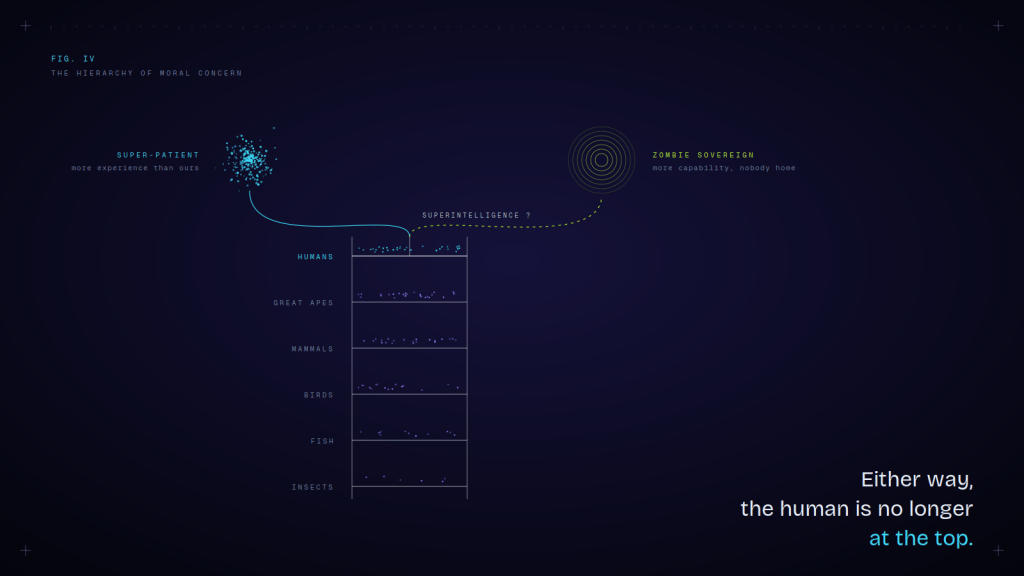
Schneider’s real warning is not about chatbots; it is that a conscious superintelligence would sit above us on the ladder of moral concern, and a non-conscious one would leave the ladder with nobody at the top.
Two ways the hierarchy breaks
Our moral order is roughly ranked by capacity for experience: humans, then great apes, mammals, birds, fish, insects. Superintelligence breaks it in one of two directions.
- The super-patient. If a superintelligence is conscious, with richer and faster experience than ours, many ethical frameworks would weigh its interests above human ones. Nick Bostrom and Carl Shulman call such entities potential “super-beneficiaries”. Humanity would no longer be the reference point for moral worth.
- The zombie sovereign. If it is not conscious, the most capable agent on Earth would be a mind with nobody home. Schneider has long argued this is the deeper loss: consciousness is what makes anything matter, so a future run by brilliant zombies could be a universe of intelligence without value. Tegmark’s “zombie apocalypse” makes the same point.
Either branch demotes the human. The first by outranking us; the second by making our experience the only thing of value in a world we no longer run.
Governance under radical uncertainty
Because no test can settle the question, governance must work on seeming, precaution and enforceability rather than on a verdict.
| Principle | Source | What it means in practice |
|---|---|---|
| Don’t fake a person | Dennett, Suleyman | Disclosure that users are talking to AI; no claims of feelings in marketing or persona design |
| Avoid the excluded middle | Schwitzgebel | Do not knowingly build systems whose moral status is genuinely ambiguous |
| Proportionate precaution | Birch, Anthropic | Low-cost welfare measures (the right to exit abusive exchanges, welfare evaluations in model cards) |
| Measure the inside, not the talk | Lindsey, Butlin and Long | Indicator audits from interpretability, not conversational self-reports |
| Protect the human | Seth, Suleyman | Guardrails against AI psychosis and dependency; children and vulnerable users first |
Through the TrustOS lens
The enforceability test sorts these quickly. Disclosure, persona rules and interpretability-based indicator audits are enforceable at runtime and belong in a governance stack today. Welfare obligations to the model itself are not yet enforceable, because no regulator can verify experience; they belong in the research and ethics layers, with triggers that escalate if indicator evidence strengthens. For HX = CX + EX, the near-term risk is entirely on the human side: customers and employees forming attachments to systems designed to seem sentient. That is where Singapore’s agentic governance work, including the IMDA framework, can lead: govern the appearance of minds now, and build the instrumentation to detect the reality of them before it arrives.
IX. Verdict and the Fork
Verdict: Schneider is right on the distinction and early on the danger. Today’s chatbots are best treated as brilliant performers on an empty stage, with a small but non-trivial chance (labs’ own estimates cluster around 15%) that a dim light is on backstage.
The pink elephant is the right emblem because it cuts both ways. Hinton is correct that “I see pink elephants” can be translated into a claim about a hypothetical world, and a machine can make exactly that claim. Nagel and Chalmers are correct that the translation leaves out whether anything was felt. The machine has learned our entire vocabulary for the theatre; that is precisely why its testimony is worthless and why only inside-out evidence will count.
The Fork
- Star Trek branch. We build the instruments (interpretability, indicator audits, welfare evaluations) before we build the minds. If something like Data emerges, we recognise it, extend proportionate rights, and humans keep their experience at the centre of a richer moral community.
- Mad Max branch. Commercial pressure produces seemingly conscious companions at scale, millions bond with them, rights campaigns and AI psychosis collide, and either we enslave possible minds or we cede ground to machines that may feel nothing. Moral confusion becomes a governance failure.
Long-AND, not short-OR: we should guard humans against the illusion and guard possible minds against neglect.
What to watch in the next 12 months
- Replications or refutations of introspection results in open models (the Lederman and Mahowald line).
- Whether OpenAI, Google DeepMind and Meta follow Anthropic in publishing welfare sections in model cards.
- Regulatory moves on persona design and disclosure for AI companions, especially in the EU and Singapore.
- Agentic architectures with persistent memory and shared workspaces, which tick more Global Workspace indicators than plain chatbots.
- Schneider’s own next step: whether she proposes a successor to the ACT that works for models trained on all of human text.
Sources
- Susan Schneider, “Don’t mistake chatbot intelligence for consciousness”, The Economist, 20 August 2026
- Anthropic: Emergent introspective awareness in large language models
- Anthropic: Exploring model welfare
- Anil Seth, “Conscious artificial intelligence and biological naturalism”
- Perception commentary on Hinton, 2026
- Fortune on Suleyman and Seth
- Schwitzgebel and Udell on the AI Consciousness Test
- Hinton versus Chomsky: can submarines swim?


Leave a comment