
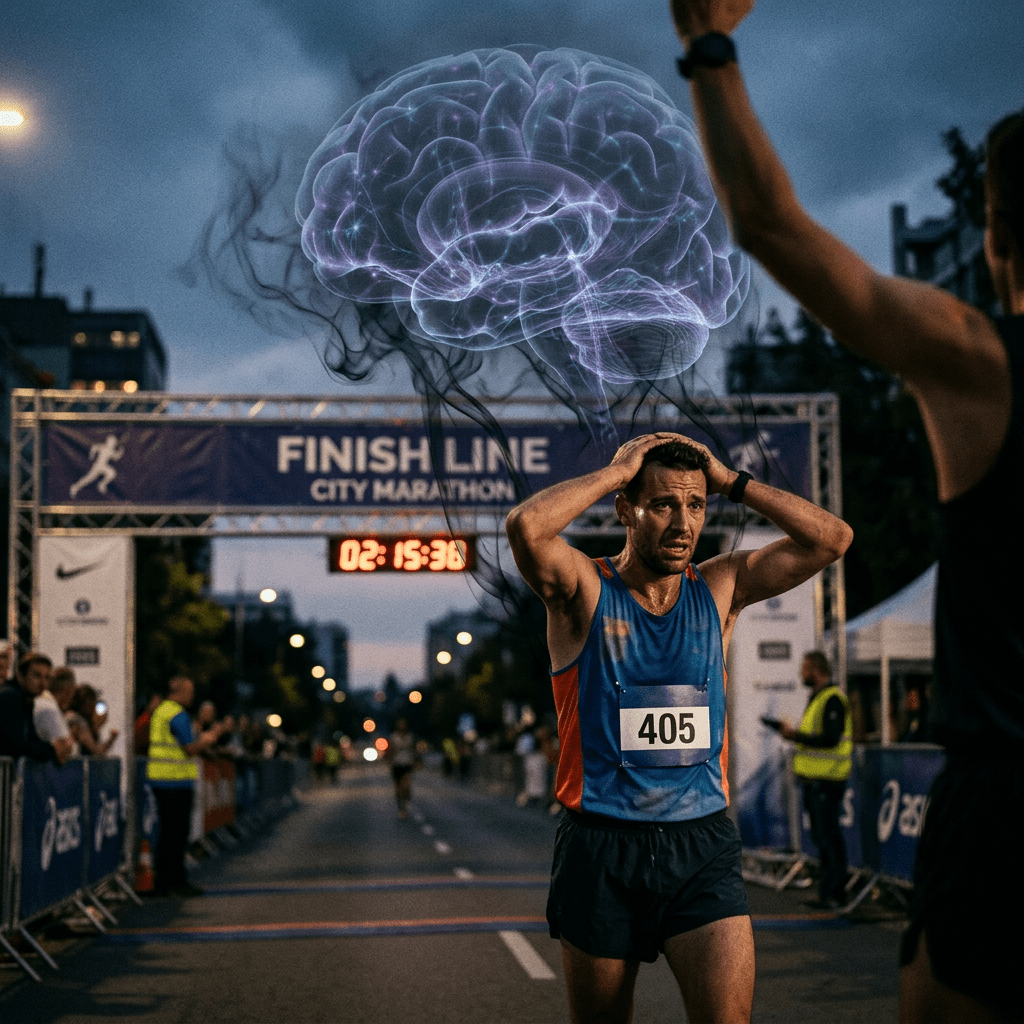

Here is a mildly insulting thought to start your day. Most of us are not living near our potential, and the reason is not laziness, bad luck, or a deficient morning routine. The reason is that we are working exactly as designed. Underperformance is not a bug in the human machine. It is a feature, installed by evolution, running quietly in the background while you tell yourself next Monday will be different.
The performance psychologist Dr. Gio Valiante calls the culprit the central governor. Strip away the biology and the idea is almost rude in its simplicity. Your brain was never optimized to make you great. It was optimized to keep you breathing long enough to pass on your genes. Survival is the factory setting. Greatness is a mod you have to install yourself.
The petri dish is you
You can watch the governor at work in the people who should have overridden it. Marathoners, ultramarathoners, triathletes: humans who have deliberately arranged their entire lives around finding the edge of the possible. How many of them actually run themselves to death? Almost none. Out of millions of finishers a year, a tragic handful die, and usually it is a car or a hidden heart condition, not the effort. They cross the line, they ache, and then they go eat pasta. Some inner official blows a whistle and shuts the body down long before the body is truly done.
That same official is on duty during your ordinary Tuesday. Valiante points to experiments with single-celled organisms in a petri dish. Heat one side and they drift toward comfort. Chill the other and they drift back. No brain, no ambition, no self-help podcasts, and still that unmistakable pull toward the pleasant middle. You are a more sophisticated version of the same instinct. Which is why “get comfortable being uncomfortable” is such an infuriating piece of advice. You are not correcting a flaw. You are arguing with three billion years of momentum.
Do you even have a vote?
This raises an old and slightly vertiginous question. If comfort is the default and the governor holds the wheel, do you actually decide anything at all? Philosophers have circled free will for centuries without landing it. William James, the great pragmatist, found a way out that is either a cheat or a stroke of genius, depending on your mood. “My first act of free will,” he said, “is to choose to believe in free will.”
Notice what he is doing there. He is not proving freedom. He is voting for it, and treating the vote as the freedom. That matters, because the honest research on human agency is humbling. Much of what we proudly call “thinking” turns out to be the quiet rearranging of prejudices we already held. We steer less than we imagine. But the thin slice of genuine agency we do own is the only slice that counts, and it is exercised in a single unglamorous move: deciding that you are going to be good at something. That decision wins you nothing yet. It is not the trophy. It is the entry fee.
Your beliefs are following your feet
Now the part almost everyone gets backwards. We assume transformation begins in the head. Find the motivation, install the mindset, and correct behavior will pour out behind it. The scoreboard disagrees. Roughly ninety-five percent of New Year’s resolutions are dead by the end of February, and the survivors mostly expire in March. The heroic decision, all by itself, changes essentially nothing.
Two thinkers explain the failure. The psychologist Albert Bandura noticed that behavior is a cause of behavior: every time you do a thing, you make the next repetition of that thing more likely, quietly stacking the odds. And John Dewey put the knife in cleanly. “We don’t think our way into a pattern of living,” he said. “We live our way into a pattern of thought.” Read it twice, because it flips the usual order of operations. You do not reason yourself into a new life and then move in. You start doing the thing, clumsily and without conviction, and the doing slowly renovates the mind that was supposed to come first.
So here is the deflating, liberating rule underneath all of it. It does not matter what you say, what you feel, or what you believe. It matters what you do. Belief is downstream. Motivation is a tourist. Action is the only resident.
What to do before you close this tab
Philosophy is comfortable, which should immediately make you suspicious of it. Here is the uncomfortable part, the part you can act on in the next ten minutes.
Name one governor. Not your whole flawed life, just the single comfortable habit doing the most damage. The phone that eats your mornings. The snack that is really a mood. The particular excuse you have polished until it shines. Pick one.
Make it a rep, not a resolution. Shrink it until it is almost embarrassingly small, small enough that you cannot talk yourself out of it on a bad day. Not “get fit,” but “shoes on, out the door.” Not “read more,” but “one page.” The size is the point, because you are trying to win the next repetition, not the whole war.
Do it today, before you believe in it. Waiting to feel ready is waiting for the mind to lead, and the mind is following your feet. Act first. Conviction shows up later, sweaty and a little behind schedule.
Then do it again tomorrow. This is the whole secret, and it is annoyingly plain. There is an everydayness to excellence. No lightning bolt of willpower, just one comfortable habit traded for a better one, repeated until it goes unconscious and the tail of the curve stops looking so far away.
The governor never resigns. But you get one vote, cast daily, in the only election that was ever rigged in your favor. Cast it before lunch.


Leave a Reply