

“Your Next Customer Is an Algorithm With a Shortlist”
“Personalisation Has a Ceiling. It’s Called Consent.”
Five capabilities will carry marketing through the next decade. Four of them are already being bought. The fifth is being ignored — and it is the one that decides whether the other four compound or quietly collapse.
By Dr Luke Soon
There is a version of the AI marketing conversation that has become almost unbearable to sit through. It goes: everything is changing, here are five things that will change, the change is exponential, act now. It is directionally right and operationally useless. It tells a chief marketing officer what the weather will be, not what to wear.
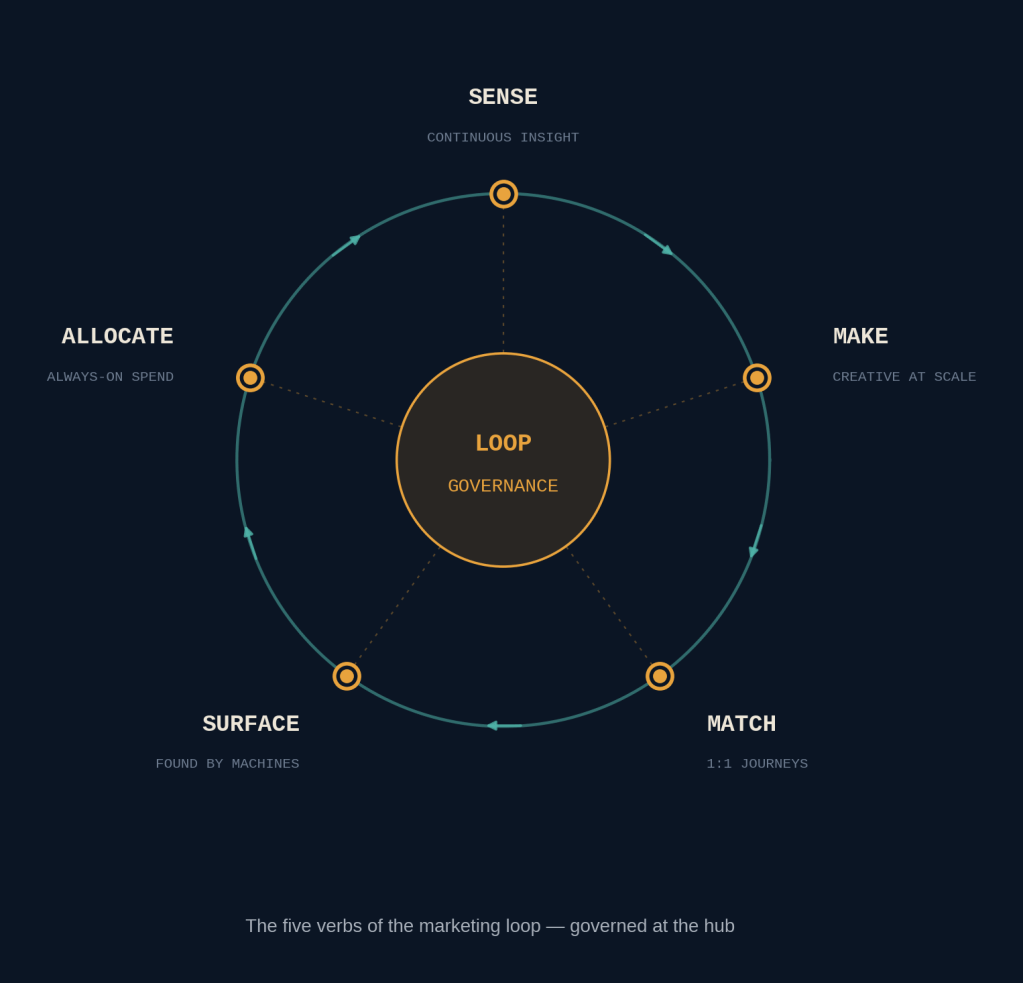
So let me try to be useful instead. Over the past eighteen months I have worked with banks, insurers, media companies and consumer businesses across fourteen Asia Pacific markets on exactly this problem. The pattern is consistent enough to state plainly: marketing is not acquiring five new capabilities. It is being rebuilt as a single closed loop with five moving parts and one hub.
The five parts are verbs, not nouns — sense, make, match, surface, allocate. They are not a maturity ladder and they are not a sequence you complete. They are a circuit. Output from allocation becomes input to sensing. Signal from surfacing changes what you make. The loop either closes and compounds, or it leaks and you are left with five expensive point solutions and a CFO asking why the marketing profit multiplier has not moved.
The hub is governance. Not the compliance kind. The control-systems kind — the thing that decides whether a loop running at machine speed converges on value or diverges into brand damage, regulatory exposure and a trust deficit you cannot buy back. Every serious body of evidence I have read this year points to the same conclusion, and almost no marketing organisation is resourced for it.
Marketing spent two decades getting faster at campaigns. It is now being asked to get good at loops. These are different skills, and one of them has a governance problem.
First, the size of the lie we are all telling
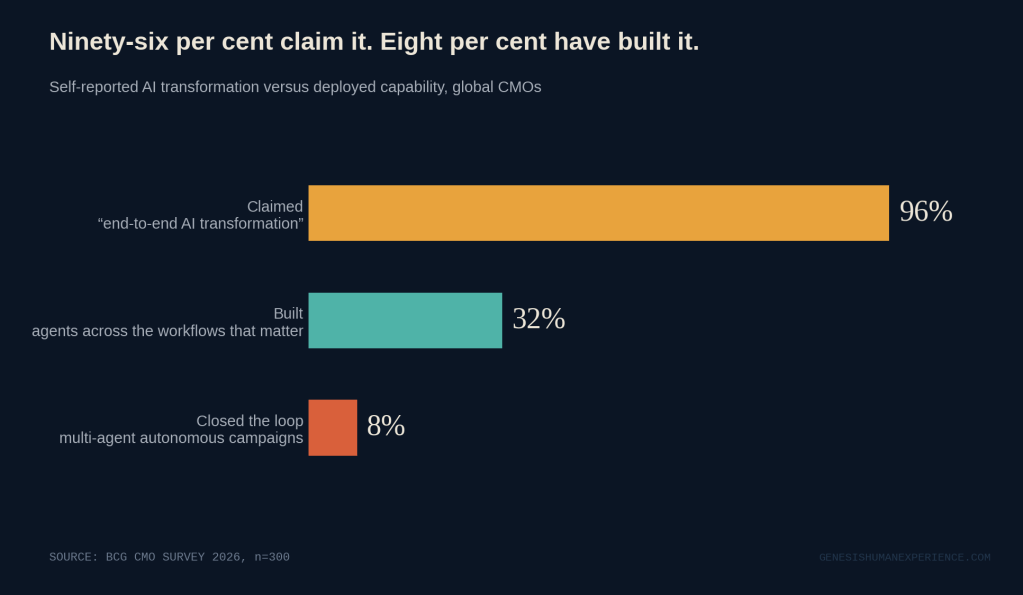
Start with the gap, because everything else in this piece is downstream of it. BCG’s 2026 survey of 300 global CMOs found that 96% report significant end-to-end AI transformation of their function. In the same survey, 42% admitted they use generative AI only as an assistant for individual tasks in a handful of workflows. Both numbers are true. The space between them is where most of the industry is living.
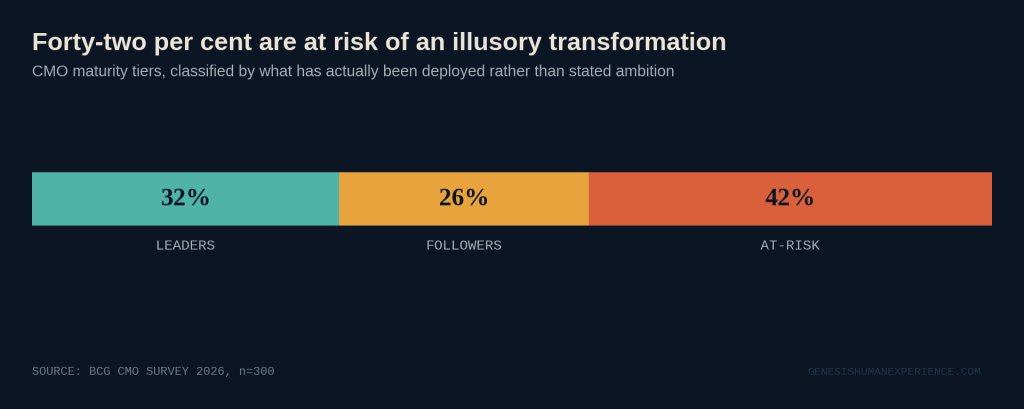
BCG sorted respondents into three tiers by what they had actually deployed rather than what they claimed: Leaders at 32%, Followers at 26%, and At-Risk at 42% — nearly half. Only about 8% run campaigns where multiple agents operate autonomously.
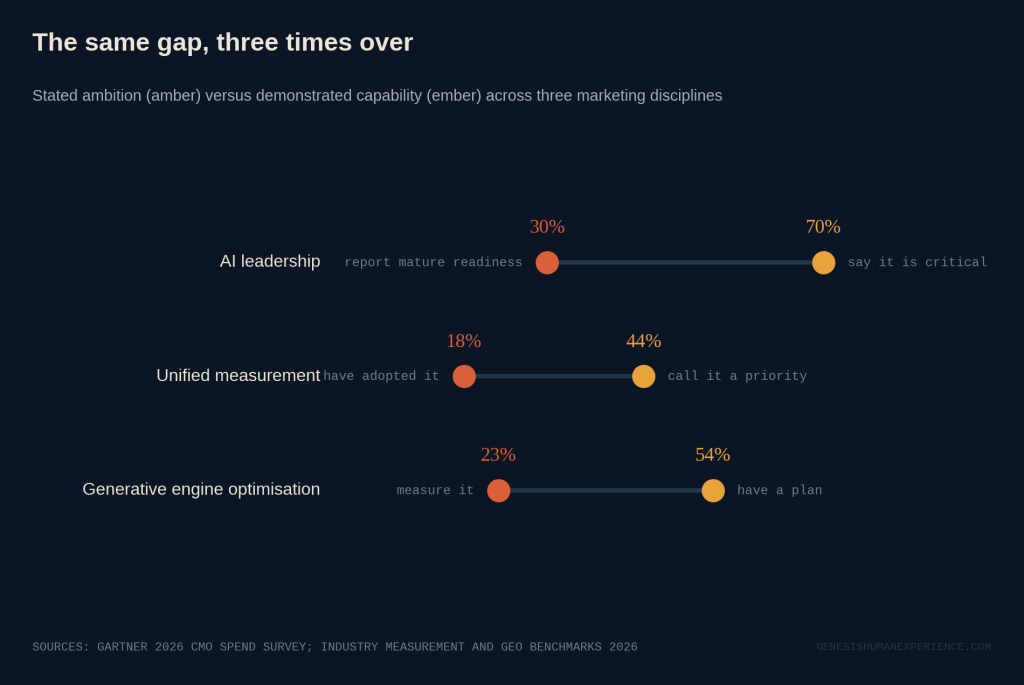
Gartner’s 2026 CMO Spend Survey, fielded across 401 marketing leaders in North America, the UK and Europe, tells the same story from the budget side. CMOs are putting 15.3% of marketing budgets into AI. Seventy per cent say becoming an AI leader is critical for 2026. Only 30% report mature AI readiness. Marketing budgets themselves are effectively flat at 7.8% of company revenue. Fifty-six per cent say they lack the budget to deliver their strategy; 57% say they lack the talent.
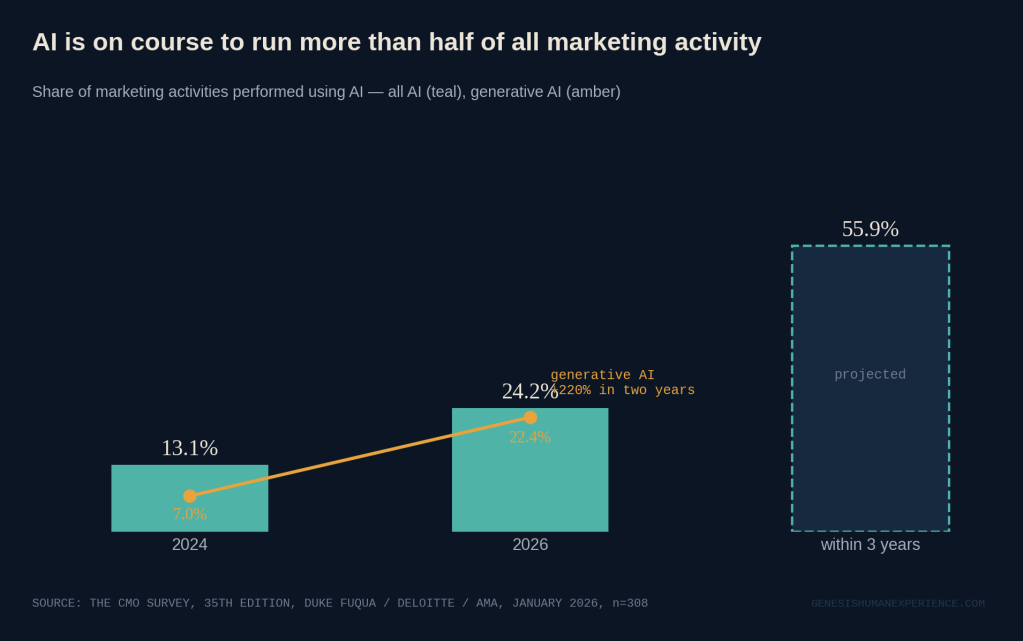
And from the longest-running dataset in the field — the 35th edition of The CMO Survey, directed by Christine Moorman at Duke’s Fuqua School with Deloitte and the AMA, fielded in January 2026 across 308 US marketing leaders — AI’s share of marketing activities has risen from 13.1% in 2024 to 24.2% in 2026, with generative AI growing 220% over the same period. Respondents project AI will account for 55.9% of marketing activities within three years. Meanwhile marketing headcount growth has halved to 2.5%, training budgets sit at 3.8% of spend, and the single most-cited capability deficiency is not a missing skill at all. It is insufficient people, time and budget.
The gap, in three numbers. 96% of CMOs say AI is driving end-to-end transformation of their function — claimed. 32% have actually deployed agents across the workflows that matter — built. 8% run campaigns in which multiple agents operate autonomously — closed the loop. (BCG CMO Survey 2026, n=300)
Here is what I take from these four datasets read together, and it is not the obvious reading. The constraint is not capability. It is not budget either, whatever the survey headline says. The constraint is that marketing organisations have bought instruments without building an instrument panel.They have a content generator, a personalisation engine, a bidding optimiser and a dashboard, none of which can see each other. That is not a loop. That is five open circuits drawing power.
A note on where this framework came from. Several of the large consultancies have converged on a similar five-part taxonomy of future marketing capability this year, which is itself a useful signal — when independent research teams arrive at the same shape, the shape is probably real. What follows is my own synthesis and my own argument. The evidence is attributed throughout; the framing, the loop, and the conclusions are mine, and I will happily own being wrong about them.
SENSE — PERIODIC RESEARCH TO ALWAYS-ON INSIGHT ENGINE
The end of the quarterly truth
The traditional insight function runs on a research cadence — a tracker each quarter, a segmentation refreshed every two or three years, a concept test that takes four weeks and costs a small fortune. The customer, meanwhile, moves weekly. The gap between what your segmentation says and what your customer is doing is the single most expensive latency in the marketing function, and almost nobody measures it.
The frontier is an always-on sensing layer: first-party behavioural signal, continuous sentiment capture, synthetic audiences for early exploration, and agents that build hypotheses, test them, and feed the result back into the loop within days rather than quarters.
The synthetic audience question is where this gets genuinely contested, and I want to be careful here because the industry is being sold a fantasy. The optimistic evidence is real: the Stanford and Google DeepMind work built over a thousand generative agents from two-hour qualitative interviews and reproduced individual attitudes and behaviours better than demographic baselines. DeepMind’s 2026 persona-generator research represented over 80% of the range of human opinion on topics the system had never seen.
The pessimistic evidence is equally real. Research published this year found that even when explicitly prompted for diversity, language models collapse toward a narrow cluster of stereotypical responses — minority behaviours and edge cases vanish. A widely circulated critique in ACM Interactions calls the practice epistemic freeloading: borrowing the authority of research while abandoning its standards. Bain’s guidance is the sane one — synthetic personas supplement direct engagement with real customers; they do not supplant it.
• Use synthetic early, validate late. Exploration, hypothesis generation, survey instrument pre-testing, message screening at volume. Then validate the survivors against real humans — the working norm is roughly 300 to 500.
• Never use it for novel or sensitive territory. If the model has no distribution to draw on, it will invent one and sound confident doing it.
• Log provenance on every insight. Synthetic or human, which model, which prompt, which date. If you cannot answer that in a board paper you should not be putting the number in one.
My position: synthetic audiences are a legitimate and valuable capability, and they are also the most likely place in this entire stack for a marketing organisation to fool itself catastrophically. A system that tells you what you expect to hear, instantly and cheaply, at the exact moment your budget is under pressure and your research line has been cut, is not a research tool. It is a confirmation bias engine with a procurement code.
MAKE — MANUAL PRODUCTION TO AGENTIC CREATIVE SYSTEMS
Volume was never the bottleneck
The frontier proposition is agentic creative systems that generate, score and deploy on-brand content at scale, learning continuously from what performs. The production economics are genuinely transformed — BCG reports 20% to 30% cost efficiency improvements in its client work, alongside a threefold increase in marketing ROI and a tenfold improvement in campaign cycle times among leaders. PwC documents a hospitality client cutting brand review time by 94% using agents.
Now the uncomfortable part. Content creation is the top generative AI use case at 74% in The CMO Survey — and the effectiveness evidence is not keeping pace with the volume.
The creative evidence. 2.1 stars: average emotional score for the 18% of 2026 Big Game ads that led with AI messaging; the winners were human stories (System1). Minus 8%: conversion for AI-generated creative above $100 average order value, widening to minus 14% above $500 despite higher click-through (2026 benchmarks). 2,700 people tested against 18 AI-generated long-form ads: unprompted, they could not tell (System1 / The Drum).
Two findings deserve to sit next to each other. First, when viewers are not told an ad was AI-made, they cannot reliably detect it and do not particularly care. Second, Kantar’s facial coding work found that generative AI ads provoke stronger emotional reactions than non-AI ads — including stronger negative ones — so net positivity comes out lower. The machine is not producing bland work. It is producing high-variance work, and variance without a quality gate is just noise at scale.
Set this against the IPA Effectiveness Databank, where the share of campaigns delivering very large business effects has been declining since 2014, driven by short-termism and compressed brand budgets. Global ad spend passed a trillion dollars while brand recall and attention moved the other way. If your response to a creativity crisis is to produce forty times more creative, you have misdiagnosed the illness.
Generative AI did not solve the creative problem. It removed the last remaining excuse — cost — for not solving it properly.
Mark Ritson’s line on this, delivered with characteristic bluntness, is that distinctiveness and emotional intensity are what multiply profitability, and that the data gap most marketers face is not a shortage of information but a collapse in the skill to use it. He is right, and the AI era makes it sharper: when everyone can produce infinite competent work, the only scarce asset left is judgement about which work deserves to exist.
The operating implication is specific. Put a measured quality gate between generation and deployment. Score for emotional response and distinctive brand asset fluency before spend, not after. Reserve human creative direction for the top of the funnel where emotional range decides long-term share, and let the machine own the long tail of localisation, resizing, variant production and refresh. That is not a compromise. It is the correct allocation of a scarce resource.
MATCH — SEGMENT RULES TO AGENT-DETERMINED NEXT BEST ACTION
The personalisation ceiling is real, and we are standing on it
The promise is a genuine one-to-one journey: agents deciding the next message, offer and experience dynamically, rather than a CRM rule engine firing a campaign at a segment. McKinsey puts the prize at 10% to 30% revenue growth from hyper-personalised marketing, and estimates agentic systems could power roughly two-thirds of current marketing activities.
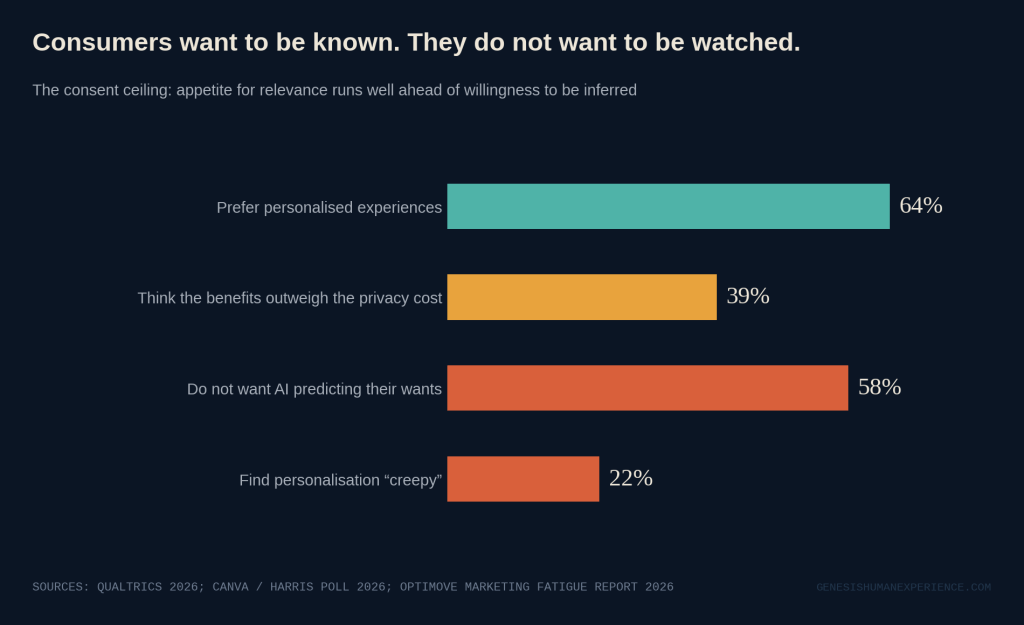
And yet. Qualtrics’ 2026 research found 64% of consumers prefer personalised experiences while only 39% believe the benefits of sharing their data outweigh the privacy cost. In the same study, 72% said they trust companies less than a year ago. Optimove’s 2026 fatigue research found 22% of consumers now describe personalisation not as intrusive or annoying but as creepy — a word that signals violation rather than irritation. Canva’s 2026 research with the Harris Poll across seven markets found 58% do not want brands using AI to predict what they want before they have said so.
Forrester’s 2026 predictions add the legal edge: a convergence of privacy awareness, regulation, breaches and AI driving a 20% surge in US consumer class actions, with law firms shifting focus from tracking pixels to AI applications themselves. And one-third of companies, Forrester expects, will actively harm customer experience this year through prematurely deployed self-service AI.
The distinction that decides everything. Consumers want to be known. They do not want to be watched. Relevance derived from a relationship the customer knowingly participates in reads as service. The identical output derived from inference the customer did not authorise reads as surveillance. The system is the same; the consent architecture is not. This is why AI-driven dynamic pricing has been the fastest trust-destroying application of the past two years — technically it is the same optimisation as a personalised recommendation, but experientially it is the moment the customer realises the machine knows them and is using that knowledge against them.
Ritson tells a story about receiving gin from an airline that holds every detail of his flights, purchases and preferences — and would have known from the most cursory look at its own CRM that he does not drink gin. That failure is not an AI failure. It is a twenty-year-old data and judgement failure, and pouring agentic AI into it produces the same wrong gift, personalised, at machine speed, to millions of people simultaneously.
My view, and I hold it firmly: personalisation has a ceiling, and it is set by consent, not by capability. Every point of technical capability you add above the consent line converts directly into trust destruction. The organisations that win this decade will treat the consent architecture as the product — visible controls, plain-language value exchange, real revocation that works — and will find that customers voluntarily hand over far more than inference could ever have extracted. Trust is not a moral variable here. It is an economic multiplier.
SURFACE — MARKETING TO THE MACHINES THAT ADVISE YOUR CUSTOMERS
Your next customer is an algorithm with a shortlist
This is the capability I would prioritise above the other four if forced to choose, because it is the one with a closing window and a first-mover advantage that compounds.
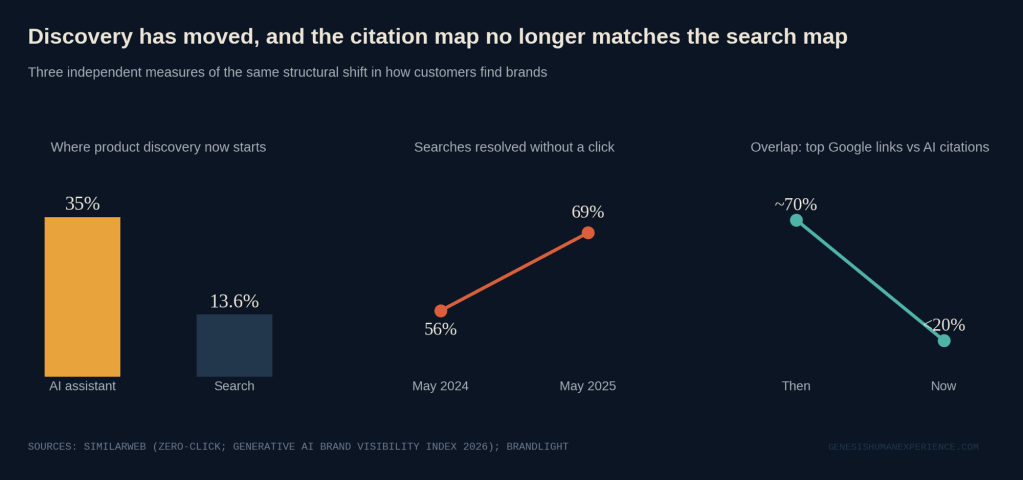
The structural evidence is now overwhelming. Similarweb’s research found zero-click resolution of news-related Google searches rose from 56% to 69% in the year following AI Overviews; Bain puts zero-click at roughly 65% of consumer searches overall. Similarweb’s 2026 Generative AI Brand Visibility Index found 35% of US consumers now use AI at the product discovery stage, against 13.6% using search.
L.E.K.’s April 2026 survey of 2,650 US consumers, cross-referenced against web traffic from more than 100 brands and retailers across 13 categories, is the sharpest read I have seen: standalone AI platforms have overtaken traditional search as the primary starting point for purchase research among AI users — a reversal that took two years. AI-referred web traffic is compounding at 176% annually while search, social and direct traffic stay flat. Around 30% of US consumers have used AI to inform a purchase decision, and 94% still validate the AI’s output before buying.
That last number is the one most people misread. It is not evidence that AI’s influence is overstated. It means the journey has gained a layer, not lost one. The machine now assembles the shortlist; the human ratifies it. If you are not on the shortlist, your brand equity, your media weight and your beautifully argued positioning never enter the room.
The discovery numbers. The overlap between top Google links and the sources AI systems actually cite has collapsed from around 70% to under 20% (Brandlight). Gartner expects 90% of B2B buying to be AI-agent-intermediated by 2028, moving $15 trillion through agent exchanges. L.E.K. projects agentic commerce at roughly 9% of total US ecommerce volume by 2029. Bain finds consumers trust retailer-owned agents three times more than third-party agents to complete a transaction.
Bain sizes US agentic commerce at $300bn to $500bn by 2030, or 15% to 25% of ecommerce, while noting that around half of consumers remain uncomfortable letting an agent transact end to end. L.E.K.’s narrower 9%-by-2029 figure and Bain’s broader range are not in conflict — they are measuring different things, influence versus execution. Both point the same way.
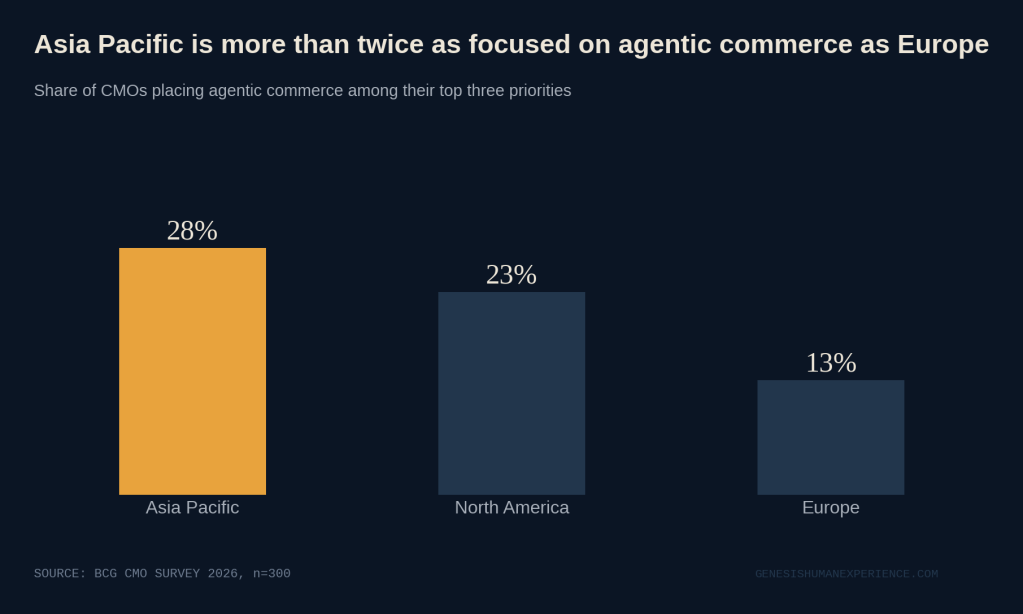
The APAC signal in BCG’s survey deserves flagging for anyone operating in this region: 28% of Asia Pacific CMOs place agentic commerce in their top three priorities, against 23% in North America and just 13% in Europe. Ninety-one per cent of B2C CMOs say AI-moderated, no-click discovery is already reshaping their funnels. A majority are standing up dedicated generative and agentic engine optimisation teams.
Three things follow, and they are unglamorous.
1. Make your product data machine-legible. Structured markup, clean attributes, authoritative specifications, consistent entity definitions. Agents cannot recommend what they cannot parse. This is 2005-era SEO hygiene with far higher stakes.
2. Build citation authority off your own domain. AI systems learn about you from third parties. Original research, verifiable proprietary data and genuine third-party validation are what get cited. Mass-producing AI content on your own site achieves nothing in either channel.
3. Measure share of citation, not share of clicks. Roughly 54% of teams have a GEO plan; only about 23% measure it. Citation authority accumulates like domain authority did — the teams instrumenting now will have a compounding data advantage over teams that start in eighteen months.
And a strategic choice most boards have not yet faced: decide where you meet the customer inside someone else’s AI experience, and where you invest in owning the relationship directly through your own customer-facing agents. Bain’s finding that consumers trust retailer-owned agents three times more than third-party agents is, I think, the most commercially significant number in this entire article. It means the disintermediation is not inevitable. It is a race, and you are allowed to enter.
ALLOCATE — EPISODIC BUDGETING TO CONTINUOUS REALLOCATION
Measurement is where the loop either closes or leaks
Every other capability in this circuit produces signal. Allocation is where signal becomes decision and decision becomes the next round of signal. Get this wrong and the loop does not close — you simply generate more content, more personalisation and more citations with no mechanism for learning which of them paid.
Two forces have converged. Privacy regulation and identifier collapse broke user-level attribution; AI-driven media buying turned the platforms into black boxes that each report flatteringly on their own contribution. The answer has been the return of marketing mix modelling, which needs neither cookies nor device IDs. Google’s Meridian and Meta’s Robyn collapsed the cost of entry, the IAB published vendor-neutral modernisation guidance in December 2025, and TransUnion found 46.9% of US marketers planning MMM investment, with 27.6% naming it their single biggest measurement priority.
The consensus practice is triangulation: mix modelling for the portfolio view, incrementality experiments for causal validation on the largest channels, attribution for in-flight tactical signal. Integrated MTA-plus-MMM adoption has roughly doubled to 27%. Fully unified measurement sits at 18% while 44% of CMOs name it a top priority — a 26-point ambition gap that is, in miniature, the story of this entire article.
The distortion worth naming: Gartner’s data shows awareness and conversion now absorb 62.6% of media spend, up 10% since 2024, while loyalty and retention has fallen below 15% — a 29% decline. Digital is above two-thirds of media investment. This is what happens when the measurement system can see short-term response with precision and long-term brand effect only dimly. The instrument shapes the decision. If you only instrument the short loop, you will systematically defund the long one, and the IPA data tells you exactly what that costs over a decade.
GOVERN — THE HUB, AND THE CONDITION FOR THE OTHER FIVE
Nobody puts this on the chart
Here is my central argument, and it is the reason I have written this rather than simply forwarding someone else’s exhibit.
Five capabilities running as autonomous or semi-autonomous loops, at machine speed, across brand, pricing, customer data and commerce, constitute a control system. Control systems that lack observability, bounded autonomy and clear human accountability do not fail gracefully. They fail fast, at scale, and in ways that are extremely difficult to reverse — because by the time you notice, the loop has already run ten thousand times.
The evidence that this is not theoretical arrived this year. Forrester projects that ungoverned generative AI will cost B2B companies more than $10bn in enterprise value through share price declines, legal settlements and fines. A third of companies will damage customer experience with prematurely deployed AI. Privacy class actions are projected to rise 20%. McKinsey’s 2026 AI Trust Maturity work found a globally consistent pattern: governance and agentic AI controls lag data and technology capability across every region — and organisations investing $25m or more in responsible AI report materially higher maturity and are far more likely to report EBIT impact above 5%.
Responsible AI is not a tax on innovation. It is the mechanism by which innovation is allowed to compound rather than being unwound by the first serious incident.
In January 2026, Singapore’s IMDA published version 1.0 of the world’s first Model AI Governance Framework built specifically for agentic systems rather than static models. I had the privilege of contributing to that work, and its four operating principles translate almost directly into a marketing context:
• Bound the autonomy. Every agent gets an explicit remit, a spend ceiling, a channel scope and an escalation threshold. A creative agent that can also alter media spend is not one agent; it is an unbounded one.
• Maintain human accountability. A named human owns each agent’s outcomes. Not a committee, not the platform vendor, not “the system”. Governance that cannot name a person is decoration.
• Instrument for observability. You must be able to reconstruct why an agent said what it said to whom, and what it cost. Intent versus action, continuously audited. If you cannot replay the decision, you cannot defend it to a regulator or fix it.
• Educate the ecosystem. Roughly 80% of CMOs are investing in AI upskilling, and a similar share are now adding responsible AI and ethics training — up ten points on last year. That is the single most encouraging statistic in this article.
BCG’s four-layer agentic marketing stack — data, then a brand intelligence layer, then the agentic layer, then a unified interface — is the right architecture, and I would add one thing to it. The brand intelligence layer is where governance actually lives in marketing. It is the encoded articulation of what your brand may and may not say, which sources agents may trust, which claims require substantiation, and what the escalation path looks like when confidence drops. Most organisations are trying to build the agentic layer before the brand intelligence layer exists. That is the equivalent of fitting an autopilot before installing instruments.
Where I stand: six positions I will defend
Consultancy research is very good at describing gaps and comparatively shy about taking positions. So here are mine, stated plainly enough to be wrong.
1. The productivity framing is a trap, and CMOs are walking into it
PwC’s research with the ANA found that leading marketers deliver 79% greater total shareholder value than their peers, and traced the mechanism: execution builds brand strength, brand strength drives the marketing profit multiplier, and that flows into enterprise returns. AI advances that equation; it does not replace it. Yet 40% of CMOs in BCG’s survey say they are held accountable primarily for cost savings and efficiency. If you accept efficiency as your mandate, you will hit your target, shrink your budget, and discover in two cycles that the growth mandate has migrated to someone else. The choice is between mattering more and costing less, and it is being made right now, mostly by default.
2. Marketing has won the mandate — and has one budget cycle to use it
Roughly half of CMOs now say marketing owns AI investment decisions within the function, against 14% led by the CEO or board. Contrast that with the enterprise picture, where 72% of CEOs describe themselves as the primary AI decision maker. Marketing is genuinely in the driving seat, which is unusual and will not last indefinitely. Ninety-four per cent of CMOs report a significant increase in CEO expectations over two years. Autonomy granted without demonstrated impact gets withdrawn quietly, at budget time.
3. HX = CX + EX, and the EX half is where AI marketing programmes actually die
I have argued for years that human experience is the sum of customer and employee experience, and that you cannot optimise one while degrading the other. BCG’s 10-20-70 rule says it in numbers: 10% of the effort is algorithms, 20% is data and technology, 70% is people and process. Gartner’s finding that labour has risen to 24.5% of marketing budgets, up from 21.9%, is the market discovering the same truth by experiment. Meanwhile The CMO Survey shows training budgets at 3.8% of spend and headcount growth halved. Three CMOs in BCG’s interviews said the same sentence: the talent does not exist, so I have to create it. That is the whole game. A frozen workforce — people who have been handed agentic tools without permission, time or capability to redesign their own work — will produce a frozen transformation, and the productivity will show up in nobody’s P&L. Ghost GDP.
4. Prompts became loops; loops now need governance
The progression I keep returning to is prompts, then loops, then loop governance. Most marketing organisations are stuck between the first two, buying prompt-shaped tools for loop-shaped problems. The 8% running multi-agent autonomous campaigns have crossed into the third phase whether they realise it or not, and the question is whether their governance crossed with them. Almost none did.
5. Asia Pacific will lead this, and should not import the playbook wholesale
Agentic commerce ranks in the top three priorities for 28% of APAC CMOs against 13% in Europe. McKinsey’s trust maturity work puts Asia Pacific ahead on overall maturity. Singapore has published the first agentic governance framework in the world. The region has a genuine window to define what trusted agentic marketing looks like rather than inheriting someone else’s definition eighteen months late. Regulatory divergence across fourteen markets is a real cost, and it is also the reason a governance capability built here travels better than one built anywhere else.
6. This is the fork
One path: marketing becomes a closed, governed loop that senses faster than the market moves, makes work worth attending to, matches with consent, surfaces where machines decide, and reallocates continuously — and marketing’s claim on enterprise value becomes undeniable. The other: five disconnected tools, a personalisation programme that reads as surveillance, a content engine producing volume nobody remembers, an invisible brand inside AI-mediated discovery, and a measurement system that can only see the short term. The technology is identical in both cases. The difference is entirely governance and judgement.
I am, as ever, an optimist about the destination and a realist about the passage. Short-term turbulence for long-term abundance.
What I would actually do on Monday
4. Audit the loop, not the tools. Map where signal enters, where it dies, and where a decision is made without evidence. In most organisations there are three or four clean breaks. Fix those before buying anything.
5. Instrument share of citation this quarter. Baseline where and how your brand appears across the major AI assistants, and for which prompts. This is the cheapest high-value thing on the list and citation authority compounds.
6. Build the brand intelligence layer before the agentic layer. Encode brand rules, claim substantiation requirements, trusted sources, escalation thresholds. Agents without it are confident and ungrounded.
7. Put a measured quality gate in front of creative deployment. Emotional response and distinctive asset fluency, scored pre-spend. Volume without a gate is variance at scale.
8. Publish the consent architecture. Make what you collect, why, and how to revoke it visible and genuinely functional. Then personalise inside that line and nowhere beyond it.
9. Name an accountable owner per agent, with a spend ceiling and a kill switch. Write it down. If the document does not exist, the governance does not exist.
10. Triangulate measurement. Mix model for the portfolio, incrementality tests on the top three channels, attribution for in-flight signal. Calibrate the model against the experiments, not the other way round.
11. Spend seventy per cent of the programme budget on people and process. Not because it is virtuous. Because that is where the return demonstrably is.
None of this produces a launch announcement. All of it is what separates the 32% from the 42%.
Sources and further reading
BCG — Moving the Agentic Marketing Transformation from Illusion to Reality, CMO Survey 2026 (n=300 global CMOs plus 50 structured interviews), June 2026; The Leader’s Guide to Transforming with AI (10-20-70); Agentic Scenarios Every Marketer Must Prepare For, April 2026.
PwC — Marketing in the AI Era: To Matter More or Cost Less, research with the Association of National Advertisers across 11 sectors and 30+ CMO/CFO interviews; PwC Pulse Survey, CMO and marketing leaders; How AI Agents Can Make Marketers Irreplaceable.
McKinsey — analysis on agentic AI in marketing and sales (10–30% revenue growth from hyper-personalisation; up to two-thirds of marketing activities); State of AI Trust in 2026: Shifting to the Agentic Era, March 2026; State of AI.
L.E.K. Consulting — Thanks to AI, Consumers Are Arriving at Brand and Retailer Sites Ready to Buy, survey of 2,650 US consumers, April 2026, cross-referenced with traffic from 100+ brands across 13 categories; Built for Agents — Winning in the Era of Agentic Commerce, April 2026.
Gartner — 2026 CMO Spend Survey (n=401, fielded January–March 2026); media allocation release, June 2026; B2B agentic buying forecasts.
Forrester — 2026 B2C Marketing, CX & Digital Business Predictions; 2026 B2B Marketing, Sales & Product Predictions, October 2025.
Bain & Company — Agentic AI in Retail: How Autonomous Shopping Is Redefining the Customer Journey, November 2025; Consumer Lab Generative AI Survey; Agentic AI Commerce, March 2026.
The CMO Survey, 35th edition — Christine Moorman, Duke University Fuqua School of Business, with Deloitte and the American Marketing Association; fielded 7–29 January 2026, n=308.
System1 — Test Your Ad emotional norms database; Big Game 2026 analysis; AI-generated advertising study with The Drum (18 ads, 2,700 respondents).
Kantar — facial coding analysis of generative AI advertising; IPA Effectiveness Databank via WARC.
Similarweb — zero-click research; 2026 Generative AI Brand Visibility Index. Brandlight — Google-to-AI citation overlap analysis.
Qualtrics 2026 consumer trends; Optimove Marketing Fatigue Report 2026; Canva / Harris Poll State of Marketing and AI 2026.
IMDA Singapore — Model AI Governance Framework for Agentic AI, v1.0, 22 January 2026. IAB — Modernizing MMM, December 2025. TransUnion via eMarketer — MMM investment intentions.
Academic — Park et al. (Stanford/DeepMind) generative agent replication; Google DeepMind persona generators, 2026; Paglieri et al., 2026, on persona diversity collapse; ACM Interactions, The Synthetic Persona Fallacy.
Short-term turbulence for long-term abundance.
Dr Luke Soon is Partner and AI Leader at PwC, covering fourteen Asia Pacific markets, and the author of Genesis: Human Experience in the Age of Artificial Intelligence and Synthesis: The SuperIntelligence Protocol. He co-authored the world’s first agentic AI model governance framework with IMDA Singapore. Views expressed are personal. Statistics are attributed to their original publishers; the framework, argument and conclusions are the author’s own.


Leave a Reply