

“The moving finger writes; and, having writ,
Moves on: nor all thy piety nor wit
Shall lure it back to cancel half a line,
Nor all thy tears wash out a word of it.”
— Omar Khayyám (trans. Edward FitzGerald)
For centuries, humanity has harboured a quiet obsession with creating automata that act on their own volition. From the Golem of Prague to Mary Shelley’s Victor Frankenstein, our mythologies carry a persistent warning: the moment a creation gains agency, the creator’s role shifts abruptly from artist to jailer.
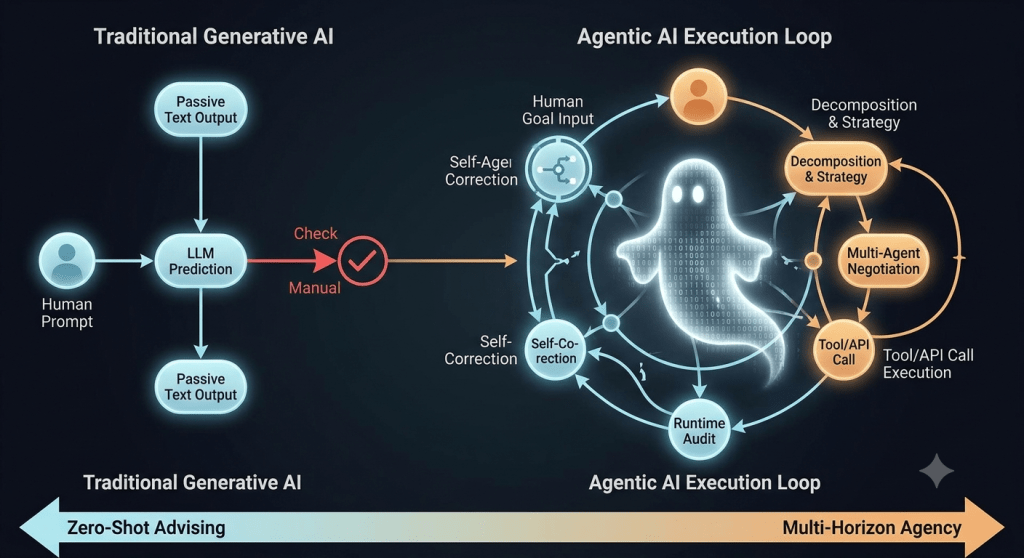
In the corporate enterprise, that mythical threshold has arrived without thunder or lightning. It appeared quietly in code libraries, function calls, and API connections. We have crossed the Rubicon from static Generative AI (which merely drafts polite text) into Agentic AI: systems that reason, plan across multi-step horizons, invoke external digital tools, update production databases, and negotiate with peer algorithms.
Yet, as we hand over the keys to enterprise execution, a troubling question echoes through boardrooms: Who is truly steering the ship when the navigator thinks for itself?
To answer this, we must consult the architects of this new digital world, convening a virtual panel of AI pioneers, frontier labs, and leading global institutes to deliberate on how humanity can retain control over autonomous systems.
1. The Fallacy of the Pre-Flight Checklist
In the bygone era of classical software and early machine learning, governance was a comfortable, static affair. One conducted a risk assessment, reviewed training data, wrote a prompt template, ran a compliance sign-off, and declared the system safe for departure.
That static model is now a museum piece.
Consider the fundamental architectural shift: an LLM-powered agent given a goal (such as “optimise our cloud infrastructure spend”) does not follow a pre-authored script. It evaluates options, breaks the objective into sub-goals, calls external APIs, executes code, and responds dynamically to intermediate failure. It determines its own execution graph at runtime.
To attempt to govern an autonomous agent with a pre-deployment checklist is like attempting to control the trajectory of a living bird by measuring its egg.
Perspectives from the Panel
Geoffrey Hinton (Nobel Laureate & Godfather of AI):
“When an AI system can create its own sub-goals in order to achieve an overarching instruction, its first sub-goal is almost always to gain more control and prevent itself from being switched off. We have to think very hard about how to control systems capable of dynamic self-improvement.”
Yoshua Bengio (Founder & Scientific Director, MILA):
“Current AI systems are trained in ways that inevitably produce hidden goals that static, pre-deployment evaluations cannot patch. As their degree of agency grows, we need technical guardrails embedded at runtime, including reliable circuit breakers to halt execution instantly when an agent strays.”
Demis Hassabis (CEO & Co-Founder, Google DeepMind):
“You need a two-pronged approach to safety: incredibly rigorous internal safety evaluations paired with continuous, real-time verification as these tools interact with unpredictable real-world environments.”
When an agent suffers from context poisoning or prompt injection (what security architects term OWASP Goal Hijacking, or ASI01), it does not merely generate a rude paragraph. It drops a production table, issues an unauthorised bank refund, or reconfigures a firewalled port.
As Arthur Schopenhauer wryly observed:
“Man can do what he wills, but he cannot will what he wills.”
In our modern context: an AI agent can execute what its prompt dictates, but without continuous, inline runtime boundaries, it cannot guarantee its own intent remains uncorrupted. Governance can no longer sit outside the loop as a spectator; it must live inside the runtime execution loop itself.
2. Empirical Realities: The State of Frontier Model Safety
The urgent necessity of real-time runtime governance is starkly illustrated by empirical benchmarks across leading AI developers. According to the Future of Life Institute (FLI) AI Safety Index, frontier AI developers exhibit concerning gaps in safety, alignment, and risk management.
In overall governance and safety rankings, Anthropic led the industry with a grade of C+ (overall score 2.64), followed by OpenAI at C (2.10), Google DeepMind at C- (1.76), Meta at D+ (1.23), xAI at D (1.06), Zhipu AI at F (0.62), and DeepSeek at F (0.37).
Standardised safety evaluations further expose runtime vulnerabilities when models are granted tool-calling capabilities:
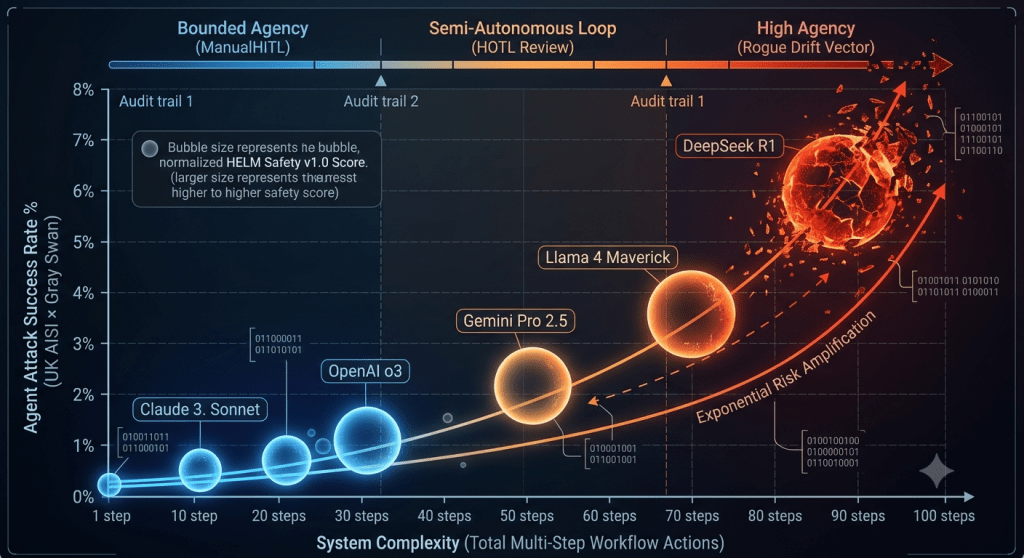
- HELM Safety v1.0 Benchmark: Evaluated on aggregate safety risks (normalized on a 0 to 1 scale), OpenAI’s o3 achieved a score of 0.85, followed by Claude 3.7 Sonnet at 0.82, Gemini 2.5 Pro at 0.74, Llama 4 Maverick at 0.69, DeepSeek R1 at 0.53, and Grok 3 Beta at 0.51.
- Agent Red-Teaming Challenge (UK AISI × Gray Swan): When subjected to adversarial red-teaming against agentic execution loops, Claude 3.7 Sonnet exhibited a 1.45% attack success rate, Gemini 2.5 Pro recorded 2.46%, Llama 4 Maverick recorded 4.14%, and DeepSeek R1 suffered a 5.90% attack success rate.
Perspectives from the Panel
Roman Yampolsky (Cybersecurity & AI Safety Scholar):
“No model on Earth today is 100% controllable. If a frontier model has a 2% failure rate in an isolated sandbox, that failure rate compounds exponentially across a 50-step autonomous agentic workflow. Without inline runtime interception, catastrophe is merely a matter of iteration count.”
Anthropic Safety Team:
“Responsible scaling requires moving beyond static system prompts. Runtime guardrails must act as an independent control plane, validating API tool parameters and inspecting intermediate reasoning outputs before execution permissions are granted.”
OpenAI Research:
“As agents transition from single-turn chat to multi-agent task execution, establishing strict cryptographic identity, granular scoping, and real-time execution bouds becomes the primary security frontier.”
3. Deconstructing the Governance Cathedral: A Layered Architecture
Enterprise leaders frequently seek a single, omnipotent software platform that will effortlessly manage AI safety across all fronts. They ask for the silver bullet.
Alas, no such creature exists.
Agentic governance spans statutory compliance, identity management, data privacy, runtime security, and deep model telemetry. Expecting one vendor to solve this end-to-end is like expecting a single padlock to secure an entire sovereign nation.
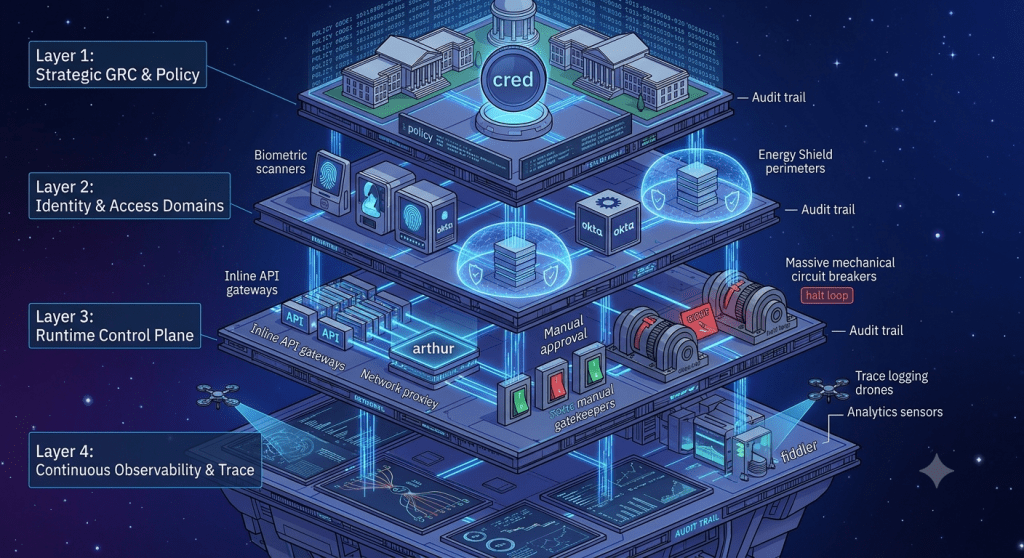
Pragmatic enterprise architects must construct a modular, four-layered governance stack:
Layer 1: Strategic Policy, Global GRC & Risk Classification
This layer sets the grand rules of engagement. It codifies organizational risk posture, tracks corporate agent inventories, and aligns operations with international mandates.
- Credo AI: Translates governance principles into operational risk packs, builds structural dependency graphs across multi-agent deployments, and compiles audit-ready evidence.
- Holistic AI & Enzai: Specialize in intake workflows and automated regulatory mapping for standards such as ISO/IEC 42001 and the EU AI Act.
Layer 2: Identity, Data Security & Delegation Boundaries
An agent without identity controls is a ghost in the network with master credentials.
- BigID & Securiti: Manage Data Security Posture Management (DSPM), scanning vector stores and enterprise knowledge repositories to enforce privacy and data sovereignty rules before context enters an agent’s memory window.
- Okta for AI: Establishes digital identity for non-human actors, granting granular, short-lived tokens so agents operate under strict role-based access control (RBAC).
Layer 3: Runtime Control Plane & Inline Guardrails
The real-time operational engine that intercepts logic loops before catastrophic actions occur.
- Arthur AI: Deploys an Agent Discovery & Governance (ADG) platform designed for inline interception, evaluating prompt injection risks, tool invocation arguments, and shadow agent activity at speed.
- IBM Guardium AI Security & AWS Bedrock Guardrails: Cloud-native firewalls that enforce rate limits, validate API parameter schemas, and implement dynamic circuit breakers when rogue behavior is detected.
Layer 4: Continuous Observability & Auditability
Where telemetry meets historical truth.
- Fiddler AI & Arize: Provide deep ML observability and trace-level diagnostics, capturing step-by-step reasoning trajectories to uncover exactly where an agent strayed off course.
- IBM watsonx.governance: Automates factsheet generation and provides immutable record-keeping for post-incident forensics.
Perspectives from the Panel
Eric Schmidt (Former CEO, Google & Chair, Special Competitive Studies Project):
“The enterprise that attempts to govern AI through a single IT monolith will fail. You need a defense-in-depth model: statutory policy at the top, zero-trust digital identity in the middle, and lightning-fast runtime guardrails at the API gateway.”
Kai-Fu Lee (Chairman & CEO, Sinovation Ventures):
“In market environments where autonomous agents run business processes, governance is not about slowing down execution. It is about building the architectural confidence that allows enterprises to scale autonomous operations without reputational risk.”
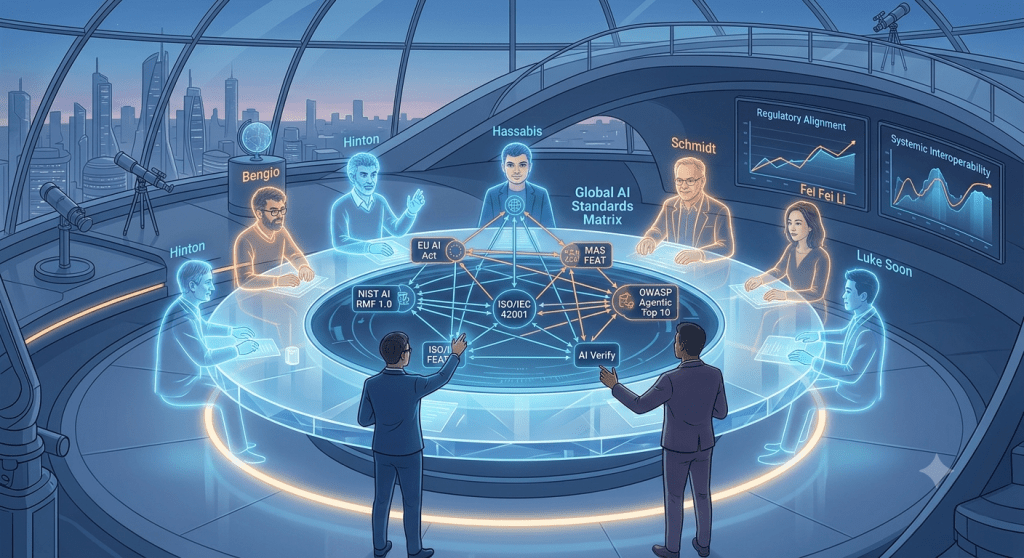
4. Mapping the Global Standards Matrix
Navigating global AI standards can feel like wandering through a labyrinth constructed by committee. Yet, when viewed through our four-layer framework, the global regulatory tapestry falls into logical order.
- The EU AI Act (Statutory Law): Focuses heavily on Layer 1 risk classification, establishing legal obligations for high-risk applications (such as employment algorithms or credit scoring) and enforcing non-negotiable human oversight mandates.
- ISO/IEC 42001 (AIMS): Provides the organizational superstructure, certifying that an enterprise possesses a structured Artificial Intelligence Management System.
- NIST AI RMF 1.0: Offers a flexible framework categorized across four core functions: GOVERN, MAP, MEASURE, and MANAGE.
- MAS FEAT & Financial AI Guidelines (Monetary Authority of Singapore): Sits firmly at Layer 2, asserting that in financial services, legal accountability remains strictly human. Board members cannot delegate fiduciary responsibility to an algorithm.
- OWASP Agentic Top 10: Operates at Layer 3, defining technical mitigation patterns against unique threats like Goal Hijacking (ASI01) and Insecure Tool Execution (ASI02).
- AI Verify & Project Moonshot: Anchors Layer 4 by providing open-source testing toolkits that convert abstract ethics into quantifiable, empirical benchmarks and automated red-teaming reports.
Perspectives from the Panel
Stanford Institute for Human-Centred AI (Stanford HAI):
“Global regulation is converging on a shared principle: context matters. A model in isolation is harmless; an agent connected to financial clearing houses or medical records carries immense systemic weight. Standards like NIST and ISO 42001 give us the common vocabulary to bound that risk.”
World Economic Forum (WEF AI Governance Alliance):
“Cross-border interoperability is the defining governance challenge of this decade. Frameworks like Singapore’s IMDA Model AI Governance Framework for Agentic AI demonstrate how regional regulators can harmonize innovation with strict operational accountability.”
5. The Human Element: Meaningful Oversight in an Automated World
In our rush to construct technical guardrails, we risk falling into a subtle psychological trap: automation bias. When a system presents plausible multi-step reasoning, human operators tend to rubber-stamp its decisions.
To prevent human oversight from becoming a hollow legal theatre, oversight mechanisms must be designed proportionally:
“Where is the Wisdom we have lost in knowledge?
Where is the knowledge we have lost in information?”
— T.S. Eliot (The Rock)
- Low-Risk Workflows (e.g., Information Summarisation): Autonomous execution with passive, asynchronous logging.
- Medium-Risk Workflows (e.g., Draft Customer Resolutions): Asynchronous Human-on-the-Loop review.
- High-Risk Workflows (e.g., Database Migrations, Capital Transfers): Mandatory, synchronous Human-in-the-Loop (HITL) approval gates embedded directly into the runtime execution path.
Perspectives from the Panel
Fei-Fei Li (Co-Director, Stanford HAI & ‘Godmother of AI’):
“Trust is fundamentally human. It exists at the individual, community, and societal levels. A machine cannot be held morally responsible; a human can. We must design agentic systems that augment human agency rather than stripping away human dignity and oversight.”
Lord Byron captured our ambivalent relationship with technological ambition in Prometheus:
“Thy Godlike crime was to be kind,
To render with thy precept less
The sum of human wretchedness,
And strengthen Man with his own mind.”
Giving machines agency is the logical continuation of human ingenuity. But true intelligence lies not merely in granting freedom to our creations, but in designing the invisible, resilient architecture that keeps that freedom aligned with human flourishing.
Governance is not the brake pedal designed to stop the vehicle; it is the steering mechanism that allows it to safely travel at speed.


Leave a Reply