
Half the economy is about to get more work, not less. Nobody has told you which half you are in.
By Dr Luke Soon
Genesis: Human Experience in the Age of Artificial Intelligence | Synthesis: The Superintelligence Protocol
July 2026
Erik Brynjolfsson said something in a recent interview that made every headline on the planet.
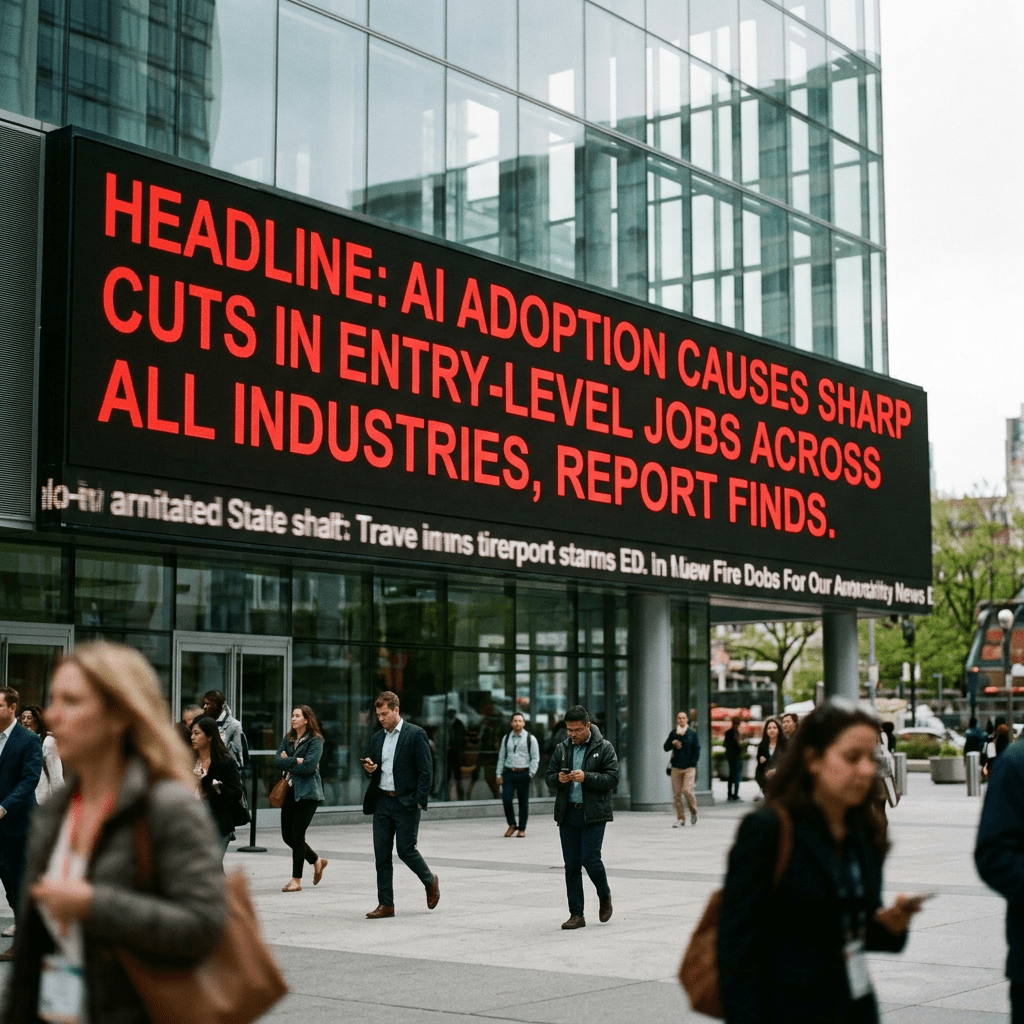
Sixteen per cent. Entry-level employment down sixteen per cent in the most AI-exposed occupations, for workers aged 22 to 25, while employment for experienced workers stayed flat. It was quoted everywhere. It was quoted by me.
Then, forty minutes later in the same conversation, he said something that made no headline at all.
He was asked whether call centres were employing fewer people. And instead of saying yes, he said this: not clear, actually. Because when AI can do a task, you need fewer people, but that is not always true. It depends on the demand curve. Roughly half the economy sits in categories where spending falls as the price falls. The other half is where lower prices lead to more spending.
Read that again, because it is the most consequential sentence spoken about work in the last two years, and it was delivered as an aside.
Your job is not being decided by what AI can do to your tasks. It is being decided by what the market does to your prices.
And almost nobody is measuring that.
THE NUMBER EVERYONE QUOTED, AND THE FOOTNOTE THEY DIDN’T
First, credit where it is due, and then the caveat, because I have written before that triangulation is now a governance skill and not an academic one.
The Stanford Digital Economy Lab study by Brynjolfsson, Chandar and Chen reads payroll records from ADP, covering firms employing over 25 million American workers, across more than 730 occupations, at monthly frequency. This is not a survey. These are paycheques. Early-career workers aged 22 to 25 in AI-exposed occupations showed 16% relative employment declines controlling for firm-level shocks. Adjustment came through employment, not compensation. And the declines concentrated in occupations where AI automates rather than augments.
For 22 to 25 year old software developers specifically, headcount is down roughly 20% since late 2022.
Now the footnote.
In February 2026, the same three authors published an update that most of the people quoting them never read. Two findings. Interest rates do not explain the pattern, and in fact AI-exposed jobs turn out to be less interest-rate sensitive than average, which kills the most popular alternative explanation. But when they apply the most stringent controls available, firm-time fixed effects, the decline in AI-exposed occupations only becomes statistically significant from 2024. The earlier declines were probably driven partly by something else.
Their own words: this measures a correlation between exposure and employment trend, not a causal link.
I want to be precise about what that means, because both camps are misreading it. It does not mean the canary is fine. Under those same stringent controls the effect has grown from 13% to about 16% by October 2025 and has not reversed. It means the bird started singing later than we said, and is now singing louder.
That is a more disturbing finding, not a less disturbing one.
THE SENTENCE NOBODY QUOTED
Here is why the elasticity aside matters more than the sixteen.
Every reskilling programme on earth, every corporate workforce plan, every national skills framework I have reviewed in the last eighteen months, is built on a single organising variable: exposure. How much of your job can a model do?
Exposure is the wrong variable.
Exposure tells you what the machine can do to your task. Elasticity tells you what the market will do to your job. They are not the same question, and only one of them is on your training plan.
Consider two workers. Identical exposure scores. Identical tasks absorbed by the model. One works in a market where the customer wanted a fixed quantity of the output and now buys it cheaper. The other works in a market where the customer was rationing demand because of price and now buys ten times more.
The first worker is a cost line. The second worker is a bottleneck.
Same technology. Opposite lives.
                        DEMAND ELASTICITY

                  INELASTIC              ELASTIC
              +--------------------+--------------------+
              |                    |                    |
   HIGH AI    |    THE CULL        |    THE BOOM        |
   EXPOSURE   |                    |                    |
              |  fixed budget,     |  price falls,      |
              |  fewer hands       |  volume detonates  |
              |                    |                    |
              |  junior coding     |  radiology         |
              |  tier-1 support    |  software (net)    |
              |  routine drafting  |  translation vol.  |
              +--------------------+--------------------+
              |                    |                    |
   LOW AI     |    THE PLATEAU     |    THE PULL        |
   EXPOSURE   |                    |                    |
              |  slow drift        |  care work         |
              |                    |  skilled trades    |
              |  stock clerks      |  home health aides |
              +--------------------+--------------------+
The canaries data fits this grid uncomfortably well. Home health aides, minimally exposed, elastic demand driven by demographics, show the strongest employment gains for the youngest workers. Stock clerks, low exposure, flat demand, show almost no relationship between age and outcome. Software developers and customer service representatives, high exposure, sit in the top-left box and are being culled at the bottom of the ladder.
Exposure sorted the deck. Elasticity is dealing the hand.
THE COYOTE AND THE CANARY
In 2016, Geoffrey Hinton said it was completely obvious that machines would outperform radiologists within five to ten years. He compared the profession to the coyote already over the edge of the cliff. Stop training radiologists, he said.
A decade later, the United States has a radiologist shortage severe enough that AuntMinnie named it the number one threat to the specialty for three consecutive years. There were more than 4,000 open radiologist posts as of early 2025. Diagnostic radiology residency filled at about 97% in the 2025 Match, interventional at effectively 100%. Mayo Clinic runs more than 250 AI models in its radiology department, employs a dedicated team of 40 AI scientists to build them, and has grown its radiologist headcount by roughly 55% since Hinton made the prediction.
The American College of Radiology projects the workforce grows 25.7% to 40.3% by 2055. Imaging demand grows faster.
Why was the smartest man in the room so wrong?
Two reasons, and Brynjolfsson names both.
Reason one: task decomposition. A radiologist does not read images. A radiologist performs roughly 26 distinct tasks, of which reading images is one. They conduct physical examinations, review laboratory data, coordinate care, perform interventional procedures, and manage clinical risk. Automate one task and you do not remove the worker. You remove the constraint on the other twenty-five.
Reason two: elasticity. Medical imaging demand was rationed by cost and radiologist time. Relieve the constraint and volume expands to fill it. Hinton solved for capability. The market solved for price.
Now hold that up against the junior software developer.
The junior developer’s bundle was thinner. And critically, the firm’s demand for internal engineering hours is set by a headcount budget, not by a market price. When the output gets cheaper, the buyer, in this case a CFO, does not order more. The buyer books the saving.
This is the whole thing. Radiology’s demand curve belonged to patients. Junior engineering’s demand curve belonged to a budget line. Elastic markets absorb productivity gains as growth. Budgeted markets absorb them as redundancy.
If you want to know your future, do not ask what a model can do. Ask who owns the demand curve for your output, and whether they can order more.
MECHANISM ONE: THE DISTILLATION TRAP
Now put two of Brynjolfsson’s own papers side by side, which almost nobody has done, and something genuinely unsettling appears.
Paper one, 2023. Brynjolfsson, Li and Raymond study 5,179 customer support agents given a generative AI assistant. Productivity rises 14% on average. But the distribution is the finding. Novice and low-skilled workers improve by 34%. The most experienced and highest-skilled workers improve by essentially nothing. Why? Because the model was trained on the firm’s own transcripts. It learned what separates the excellent agent from the average one, and it handed that tacit knowledge to the newcomer. It compressed the experience curve. An agent with two months of tenure started performing like one with six.
The paper was received, correctly, as good news. AI as a knowledge equaliser.
Paper two, 2025. The same lead author. The novices are the ones being cut.
Hold those two results in one hand.
The junior worker was not replaced by artificial intelligence. The junior worker was replaced by a compressed copy of their own future boss. The tacit knowledge of the senior cohort was harvested, distilled and installed as a system, and the person that system made redundant is the person it was designed to help.
I have called this pattern Shadow Work in this publication: the unpriced labour of the AI era. This is its sharpest form. The seniors’ judgement was extracted without a licence fee. The juniors’ apprenticeship was cancelled without a redundancy notice. Neither transaction appears on any balance sheet.
And now the part that should worry a chief executive rather than a philosopher.
The mine has no restocking programme.
The distillation worked because there existed a population of experienced humans whose tacit knowledge could be extracted. That population was produced by an apprenticeship pipeline. The pipeline is now being defunded by the very efficiency it created. Extract for a decade and you have a magnificent model of how the work was done in 2024, and nobody alive who learned it any other way.
We automated the apprenticeship and kept the exam.
Then we wondered why nobody could sit it.
The canaries data supports the mechanism directly. The Stanford team found no clean relationship between the augmentation share of AI usage and employment. But the automation ratio correlates clearly: occupations where a higher share of usage is full delegation see declines or muted growth.
Which is exactly what Brynjolfsson warned about in 2022, in a paper the industry has comprehensively ignored. He called it the Turing Trap. When AI is built to imitate humans, workers lose bargaining power and become dependent on whoever owns the machine. When AI is built to augment humans, humans retain the standing to insist on a share of the value created. Both are profitable. Only one is survivable. And he noted then that there are excess incentives for automation over augmentation among technologists, executives and policymakers.
Four years on, the payroll data has priced his warning.
Automation and augmentation are not two descriptions of the same technology. They are two different procurement decisions, made by named individuals, on Tuesdays, in your organisation.
MECHANISM TWO: THE EVALUATION BOTTLENECK
Brynjolfsson offers a decomposition in that interview which deserves to outlive the sixteen per cent. Almost every project divides into three parts: defining the question, executing it, and evaluating the result. Agents are becoming very good at the middle one.
Everyone who heard that concluded the value moves to defining. Ask better questions. Manage a fleet of agents.
I think that is half right, and the wrong half.
Definition is teachable. It is a taught skill, it responds to frameworks, it can be scaffolded, and frankly a good model will help you do it. Go and ask a frontier model to interrogate your problem statement. It is excellent at it.
Evaluation is the bottleneck. And evaluation cannot be taught, because it is not knowledge. It is calibrated pattern recognition, and it is only ever produced by having executed the thing yourself, badly, several hundred times.
The junior lawyer who read a thousand contracts did not learn contract law. She learned the feeling that something in the thousand-and-first was wrong before she could say why. The junior analyst who rebuilt the model by hand did not learn Excel. She learned to flinch at a number. None of that was the point of the work. All of it was the point of the work.
You cannot evaluate what you have never executed.
So when we automate execution and tell the next generation to focus on judgement, we are asking them to arrive at the destination without the journey that constitutes it. This is not a training gap. It is a category error.
MY FRAME · WHY THIS IS A CONTROL PROBLEM, NOT A CAREERS PROBLEM
Regular readers will see where this lands. In TrustOS, layer seven does one thing: it compares declared intent against executed action, continuously, and raises its hand when they diverge. That is evaluation, industrialised.
Every regulated enterprise deploying agents is now discovering that it can generate output far faster than it can generate warranted confidence in that output. The constraint is not compute. It is the supply of humans who can look at a plausible artefact and say, correctly, no.
Which means the apprenticeship crisis and the AI governance crisis are the same crisis wearing two badges. The organisations reporting they are catastrophically understaffed for AI governance and the organisations quietly closing their graduate intake are, with striking frequency, the same organisations.
No governance and you stay stuck in pilots. Operationalised governance and you get autonomy at scale. You cannot operationalise what nobody in the building can evaluate.
THE STEELMAN
If I gave you only the bear case I would be doing what I criticise. So here is the strongest argument that everything above is overwrought, made by people who know this terrain better than the commentariat.
One. The aggregate data says nothing is happening. The Budget Lab at Yale has run this repeatedly and found that the broader labour market has not experienced discernible disruption. Their preferred specification puts the employment impact of AI on the average exposed occupation close to zero and statistically indistinguishable from it. Same for real hourly wages. Occupational churn, the rate at which workers report changing occupations, shows no unusual rise, and that measure does not depend on contested exposure metrics at all. Their conclusion in May 2026 was blunt: AI is probably not yet the reason for labour market weakening.
Two. The macro numbers do not support a productivity revolution. Acemoglu’s task-based estimate puts total factor productivity gains from AI at no more than 0.66% over ten years, and argues it is probably below 0.53% once you account for the fact that early wins came from easy-to-learn tasks. Yes, US output per hour has run around 2.5% a year since late 2022, about a percentage point above pre-pandemic pace. But recent growth accounting attributes much of that to higher utilisation, working existing labour and capital harder, rather than to efficiency. Firm surveys are more encouraging, with AI-attributed labour productivity around 0.6% in 2025 rising towards 1.8% in 2026, but those are self-reports, and they consistently exceed what the revenue and employment data imply.
Three. Jevons may not save you. The most careful empirical work on the market for intelligence itself, by Fradkin and colleagues using OpenRouter and Azure data, estimates short-run price elasticity of demand for LLM inference just above one. Just above one is not a detonation. It is barely enough. And elasticity is not a general property of the economy. It is a property of specific markets. Software is elastic because software is a general-purpose tool. Legal document review is not infinitely elastic. Tax preparation is not. Freelance video editing is not. In bounded markets, productivity gains convert to headcount reductions with brutal directness.
Four. The canaries sample is not the economy. ADP’s client base is not a representative cross-section of American firms. The 22 to 25 cohort is 7% of the sample. The authors themselves have restated that they measure correlation, not causation, and that they do not believe AI is always and everywhere the determinant of employment.
Every one of these objections is correct.
And not one of them touches the argument.
Because the argument is not that a measurable macro catastrophe is underway. It is that the composition of who gets hired is changing while the aggregate stays still, and aggregates are precisely the instrument least capable of seeing that. A stable unemployment rate is exactly what displacement-without-dismissal looks like. Nobody is fired. Nobody is hired. The rate barely twitches. And a cohort quietly fails to appear.
I have called this Ghost GDP: output climbs, the wage bill does not, and the growth never reaches a household because the household was never hired.
You will not find it in the unemployment rate. You will find it in a job-finding rate, in a payroll file, and in the arithmetic of an economy compounding its output while decompounding its own succession plan.
THE ASIA LENS: WE BUILT A MAGNIFICENT SECOND CHANCE
Now the part that concerns those of us in this region, and I will be direct, because I think Singapore has built the best workforce transition machinery in the world and has aimed almost all of it at the wrong end of the ladder.
Look at the instruments. The SkillsFuture Level-Up Programme catalogue expanding to around 200 full WSQ qualifications from the fourth quarter of 2026. The Mid-Career Training Allowance of up to $3,000 a month for up to 24 months. The $4,000 mid-career credit top-up, used by over 36,000 citizens in its first year. Career Transition Programme enrolments up roughly six-fold. A self-diagnostic AI readiness tool arriving on MySkillsFuture.
This is world-class. It is also, read as a portfolio, overwhelmingly a mid-career portfolio.
Every one of those instruments assumes a worker who already has a career to transition from. They are built for the 42 year old whose role was reconfigured. They are magnificent for that worker.
But the canary is not 42. The canary is 23. And the 23 year old does not need a second chance. The 23 year old needs a first one.
We have, correctly, insured against displacement. We have not yet insured against non-admission. And non-admission is the mechanism the payroll data is actually showing us. Singapore does have real first-rung assets, the AI Singapore Apprenticeship Programme chief among them, and they are good. They are also small relative to the size of the gap that four independent instruments now say is opening.
There is a warning from the last time an advanced economy told itself that adjustment support would handle a structural shock.
Autor, Dorn and Hanson estimate as many as two million American jobs were lost to the China trade shock. Trade Adjustment Assistance, the designated remedy, covered an average of about 130,000 workers a year from 2004 to 2006, and fewer than 50,000 a year actually entered training.
A programme that works beautifully for the people it reaches, and reaches one in forty of the people it was built for, is not a policy. It is a ritual.
Brynjolfsson makes the same point in the interview and he is right to make it emphatically. The lesson of globalisation is not that the economics were wrong. The economics were right. The politics were catastrophic, because the losers were real, identifiable, geographically concentrated, and were handed a brochure.
We are about to do it again, to a cohort instead of a region.
THE FORK: WHAT YOU ACTUALLY DO ON MONDAY
If you run an enterprise.
Stop planning your workforce by exposure. Build an elasticity map instead. For every function, answer one question: if the unit cost of this output fell by 80%, would our customers buy more, or would our budget simply shrink? Those are opposite answers and they require opposite plans. Functions in the elastic column should be expanding headcount right now while your competitors cut. Functions in the inelastic column need honest, early, well-funded transition, not a webinar in eighteen months.
Second, put the apprenticeship in the budget. It used to be a free by-product of drudgery. The drudgery has gone. The by-product went with it. It is now a capital expenditure, and it needs a line, an owner and a number. Every organisation that cuts its graduate intake this year is making a decision about 2032 that nobody in the room will be accountable for.
Third, treat the automation-versus-augmentation choice as a governed decision, not a default. Somebody in your organisation is making that call, project by project, with no framework and no review. The payroll data says that call is the single strongest predictor of employment outcome. If it is not on a risk register, you are not managing it. You are discovering it.
If you set policy.
Insure the first rung, not only the second. Wage support for verified apprenticeships in AI-exposed occupations. A tax treatment that stops making a human junior more expensive than an agent seat for work whose entire purpose is learning. And measure the right thing: not the unemployment rate, which is structurally blind to this, but the graduate job-finding rate by exposure quintile, published monthly. What you do not measure, you will be surprised by in 2031.
If you are 23.
I am not going to tell you to step up faster. That is a demand, not a mechanism, and I have heard senior people say it from stages this year, including me, and it was not good enough.
Here is the mechanism. Go where the demand curve is elastic and the machine is welcome. Pick work where cheaper output means more of it, not the same amount of it for less. And build the one asset that compounds and cannot be distilled from a transcript: the documented record of having been right when the machine was confidently wrong.Keep it. That file is your career.
THE CLOSE
Brynjolfsson ends where I have ended for three years, which is why I take him seriously.
The next decade will be the best in human history by a distance, or one of the worst ten years ever, and the difference is decided by what we do right now. He has a bet running with Bob Gordon that productivity by the end of this decade will run far ahead of official projections. I would take his side of it.
But the growth was never the argument. Growth arrives either way. The Fork is not about how much we produce. It is about whether the people who produce it are permitted to remain in the building. Star Trek on one branch. Mad Max on the other. Roughly 2030 on the signpost. Short-term turbulence for long-term abundance, but only if somebody funds the crossing.
The canary is not a metaphor for the mine collapsing. The canary is a metaphor for having enough warning to act, and choosing not to.
They did not fire the young.
They simply stopped opening the door,
and called the silence efficiency.
Half the economy is about to need more people than it has ever needed.
The only question that matters is whether we let anyone learn how to be one of them.
DATA NOTES
- Canaries. Brynjolfsson, Chandar and Chen, Canaries in the Coal Mine? Six Facts about the Recent Employment Effects of Artificial Intelligence, Stanford Digital Economy Lab, revised 13 November 2025. ADP administrative payroll data, firms employing over 25 million US workers, 730+ occupations. 16% relative employment decline for ages 22 to 25 in AI-exposed occupations controlling for firm-level shocks; experienced-worker employment stable; adjustment via employment not compensation; effects concentrated where AI automates rather than augments; robust to excluding technology firms and remotable occupations.
- Canaries author update. Same authors, 9 February 2026. Interest-rate exposure is negatively correlated with AI exposure, so rates do not explain the pattern. Under firm-time fixed effects the decline becomes significant only from 2024; earlier declines likely partly non-AI. Effect reaches about 16% by October 2025 versus 13% with data through July, with no reversal. Authors state the series measures correlation, not causation.
- Canaries dashboard. Stanford Digital Economy Lab and ADP Research, updated monthly, last updated 1 July 2026. Employment growth slowest in the two most-exposed occupation groups. Divergence concentrated among early-career workers, with muted evidence up to age 34. Home health aides show the strongest gains for the youngest cohort. Automation ratio correlates with employment declines; augmentation ratio shows no clear relationship. 22 to 25 cohort is 7% of the sample at baseline.
- Novice gains. Brynjolfsson, Li and Raymond, Generative AI at Work, NBER Working Paper 31161. 5,179 customer support agents. 14% average productivity gain, 34% for novice and low-skilled workers, minimal for experienced and highly skilled. Model disseminates tacit knowledge of top performers and compresses the experience curve.
- Turing Trap. Brynjolfsson, The Turing Trap: The Promise and Peril of Human-Like Artificial Intelligence, Daedalus 151(2), 2022. Excess incentives for automation over augmentation among technologists, executives and policymakers.
- Radiology. Hinton, 2016. American College of Radiology and Neiman Health Policy Institute workforce studies, February 2025: 37,482 radiologists enrolled in Medicare in 2023, projected growth of 25.7% to 40.3% by 2055 depending on residency expansion; imaging demand projected to grow up to 27%. Over 4,000 open radiologist posts as of early 2025. 2025 Match: diagnostic radiology approximately 97% fill, interventional approximately 100%. Mayo Clinic: 400+ radiologists, roughly 55% growth since 2016, 250+ AI models in production, 40-person AI team.
- Aggregate nulls. The Budget Lab at Yale, Evaluating the Impact of AI on the Labor Market: Current State of Affairs, 1 October 2025, and AI Is Probably Not (Yet) the Reason for Labor Market Weakening, May 2026. No discernible economy-wide disruption 33 months post-ChatGPT; preferred specification puts employment and real wage effects close to and statistically indistinguishable from zero; no unusual rise in occupational churn.
- Macro estimates. Acemoglu, The Simple Macroeconomics of AI, NBER 32487 / Economic Policy 40(121). TFP gains no more than 0.66% over ten years, likely below 0.53%. US output per hour approximately 2.5% a year from end-2022 to Q1 2026, about 1pp above pre-pandemic; growth accounting attributes much of this to higher utilisation rather than efficiency. Atlanta Fed corporate executive survey: AI-attributed labour productivity approximately 0.6% in 2025, expected approximately 1.8% in 2026, with a persistent wedge between reported and implied gains.
- Elasticity of intelligence. Fradkin and colleagues, The Emerging Market for Intelligence, December 2025, using OpenRouter and Azure data. Short-run price elasticities just above one, suggesting limited scope for short-run Jevons effects at market level.
- Singapore instruments. SkillsFuture Singapore Budget and Committee of Supply 2026: AI readiness self-diagnostic tool on MySkillsFuture by Q2 2026; Level-Up Programme catalogue expanded by approximately 200 WSQ full qualifications from Q4 2026; Mid-Career Training Allowance up to $3,000 monthly for up to 24 months; $4,000 mid-career SkillsFuture Credit top-up used by over 36,000 citizens in its first year; Career Transition Programme enrolments up roughly six-fold.
- Adjustment precedent. Autor, Dorn and Hanson, The China Shock, NBER 21906 and Annual Review of Economics 8. Up to two million jobs lost. Trade Adjustment Assistance covered an average of approximately 130,000 workers a year from 2004 to 2006, with fewer than 50,000 a year entering training.
- Interview. Brynjolfsson, podcast interview, 2026, on entry-level effects, task decomposition, demand elasticity, the define/execute/evaluate decomposition, the electricity comparison, and the wager with Robert Gordon.
Where an author has published a caveat to their own headline, both are shown. Where the evidence is contested, the contest is shown. Nothing here is interpolated.
###AI ###FutureOfWork ###Elasticity
RED TEAM PANEL: FOUR PASSES
What each persona killed, and what survived.
Pass 1. The empiricist (Chandar / Chen). Rejected the first draft outright: it quoted 16% as fact and ignored the February 2026 update. Changed: the caveat now sits in section two, before the argument is built, and the reframe (the effect started later and is growing) does more work than the original claim did.
Pass 2. The sceptic (Acemoglu / Gimbel). Objected that the piece was an anecdote wearing a regression. Also flagged that I was invoking Jevons loosely, which is the single laziest move in AI commentary right now. Changed: the Steelman section was doubled, the Fradkin elasticity estimate of just above one was added specifically because it undercuts my own framing, and the utilisation-not-efficiency finding was included even though it weakens the productivity story.
Pass 3. The CHRO and the Singapore policymaker. Both said the same thing from opposite chairs: this diagnoses beautifully and instructs nobody. The policymaker also objected, fairly, that the piece implied Singapore has no first-rung provision. Changed: the elasticity map became a concrete Monday instrument, AI Singapore’s apprenticeship programme is credited by name, and the criticism was narrowed from absent to undersized relative to the gap, which is defensible and more useful.
Pass 4. The 23 year old, and the editor. The graduate rejected the advice section as another variation of “step up faster.” The editor cut roughly 900 words of throat-clearing and killed a section on GDP measurement that duplicated the Ghost GDP piece. Changed: the advice to juniors is now a mechanism (go where demand is elastic, and keep the file of times you were right and the machine was not) rather than an exhortation. The measurement material was cut and pointed to the earlier piece.
What survived all four passes: the elasticity thesis, the Distillation Trap, and the evaluation bottleneck. Those three are the additive contribution. Everything else in the piece is scaffolding around them.
Two structural options if you want to split this: the Distillation Trap is strong enough to stand alone as a shorter LinkedIn piece, and the Singapore section could become a separate policy note aimed at a different audience. Say the word and I will cut either.


Leave a Reply