
Four independent instruments – a central bank’s graduate survey, a billion job advertisements, a frontier model’s own telemetry, and the payroll records of one in six American workers — are all deflecting the same way. Everything that can be specified is being deflated. What’s left is the last thing we own.
A cartoon went round the internet last month. A bearded Athenian in a chiton, finger raised, lecturing a semicircle of humanoid robots seated on broken marble. The gag was that the coders are out of work and the philosophers are booked solid.
Everybody shared it. Almost everybody read it wrong.
The shallow reading is a status-inversion joke: the useless degree finally gets its revenge; the kid who read Kant beats the kid who learned React. Comforting, faintly smug, analytically worthless.
The correct reading is that a factor of production is being repriced in public, and the philosopher is simply the first person visible enough to make it into a cartoon.
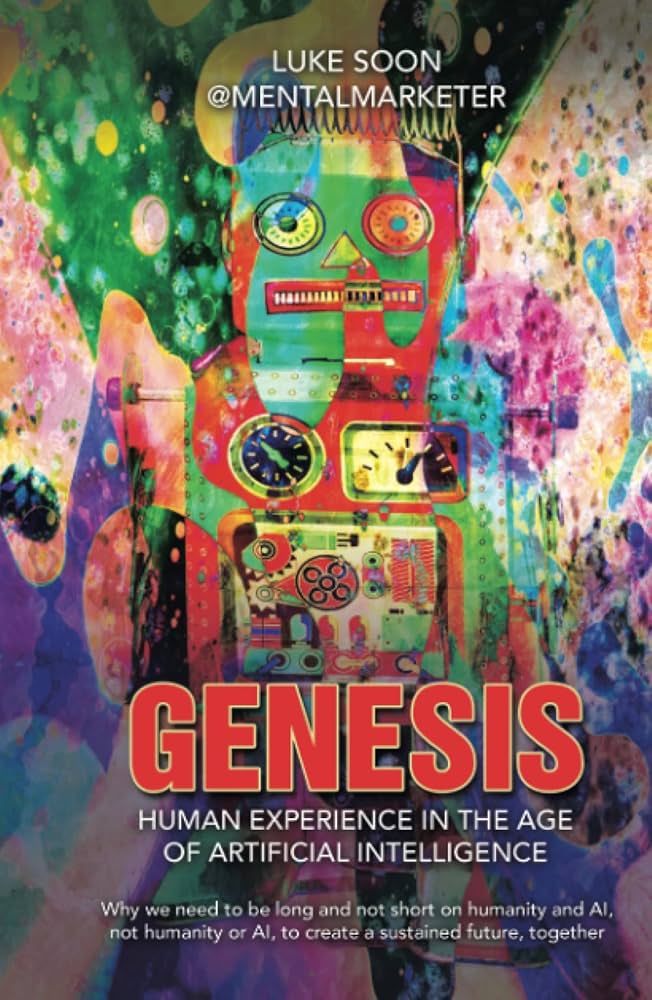
I have been writing the same argument here for three years under a different name. In Genesis I called it HX = CX + EX — the proposition that human experience is the irreducible remainder once customer and employee experience have been instrumented, automated and optimised away. In Synthesis I pushed it to its limit and asked what remains when the optimiser is smarter than the optimised. This month, four datasets caught up with the thesis at the same time.
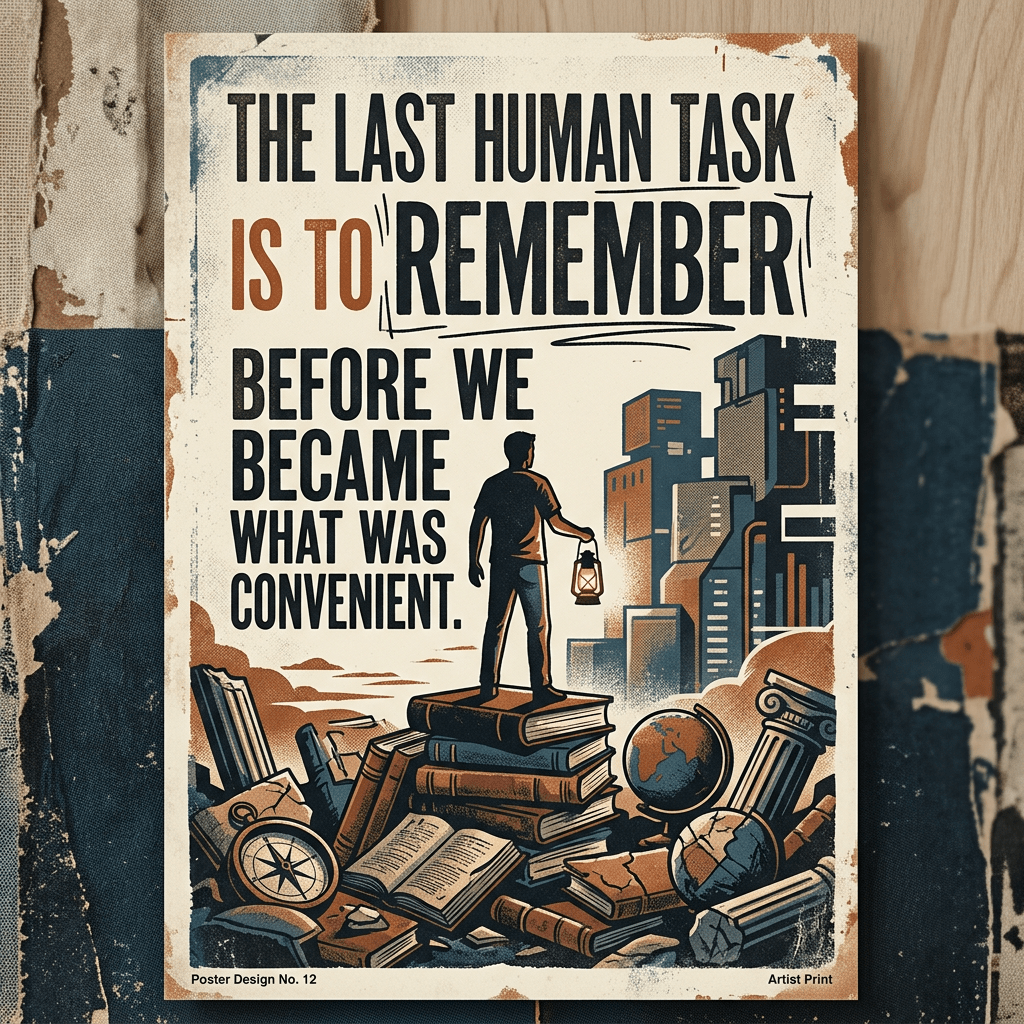
AI collapses the value of everything that can be specified. The residual — deciding what should be specified, and proving afterwards that it held — is the last human task.
It is not a philosophy seminar. It is a control function. The frontier labs call it alignment and staff it with philosophers. Regulated enterprises call it AI governance and cannot staff it at all. These are the same operation at different altitudes: converting contested human values into machine-executable constraint, then generating the evidence that the conversion survived contact with the runtime.
Four instruments. One reading. Let’s fly the panel.
INSTRUMENT 01 · LABOUR SUPPLYThe chart that broke a decade of career advice
The US central bank’s regional research arm tracks unemployment among recent graduates aged 22–27, broken down by field of study. In the 2023 vintage — the one that went viral — recent computer science graduates showed 6.1% unemployment and computer engineering 7.5%, both above the ~5.6–5.7% average for all recent graduates. Philosophy came in at 3.2%. Art history 3.0%. Nutrition sciences 0.4%.
In February 2026, the 2024 vintage landed. Both fields deteriorated — computer science to 7.0%, philosophy to 5.1% — but the ordering held.
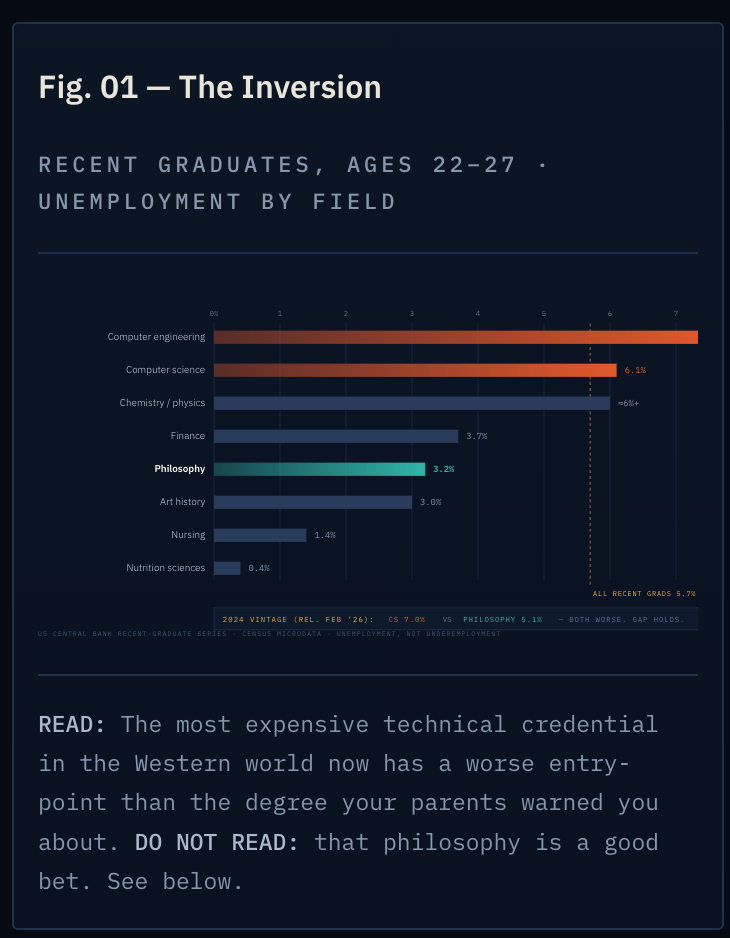
READ: The most expensive technical credential in the Western world now has a worse entry-point than the degree your parents warned you about. DO NOT READ: that philosophy is a good bet. See below.
CAVEAT — READ THIS BEFORE YOU QUOTE THE CHART ON A STAGE
This chart is far noisier than its virality deserves. Independent dissection of the underlying household survey found confidence bands wide enough to make ranking majors meaningless — for recent physics graduates the 95% interval runs roughly 2% to 12%. On a different metric, employment-to-population, roughly 90% of 22–27-year-old computing graduates were employed. Unemployment counts only those actively searching; the discouraged vanish from the numerator entirely.
So do not build a thesis on this chart. Build it on the fact that three other instruments, with entirely unrelated sampling frames, deflect the same way. That is what the rest of this piece is for. I have argued before, in The Measurement Gap, that our AI statistics are a lagging, lossy compression of a fast-moving reality — and that the discipline of triangulation is now a governance skill, not an academic one.LINK: /THE-MEASUREMENT-GAP
INSTRUMENT 02 · LABOUR DEMAND
A billion job advertisements say the same thing
In June, a global barometer built on more than one billion job advertisements across 27 countries published its 2026 edition. It is, functionally, the cartoon rendered as a demand curve.
Its central finding is a bifurcation — a two-track labour market. On one track sit roles being professionalised by AI: the machine absorbs the routine, leaving a residue of human judgment and expertise (radiologists, recruiters). On the other sit roles being democratised: the tool makes the work easy enough for a non-expert to perform (IT service managers, medical secretaries).
Professionalised roles are growing at twice the rate of democratised ones, with 42% faster wage growth.
Three further readings matter more than the headline.
Skills churn is accelerating — and churning toward the human
Skills required in the most AI-exposed jobs are changing more than twice as fast as in the least exposed — a 75% widening of that gap in a single year. And the new tasks being added to AI-exposed roles are 2.5× more likely to depend on empathy, judgment and creativity.
The premium is compounding
The wage premium for AI-skilled workers has climbed to 62%, from 57% a year earlier — and exceeds 100% in some sectors.
And the bottom rung has been sawn off
This is the finding that should cost you sleep. Across 2.4 million entry-level postings, roles most exposed to AI are now seven times more likely to demand traditionally senior skills — strategic decision-making, stakeholder management, motivational leadership. In the most exposed occupations, 52% of the new skills appearing in entry-level adverts were skills historically associated with experienced workers. In the least exposed, that figure was 7%.
Openings for these redrawn entry roles have grown 35% since 2019. Every other entry-level vacancy fell 10%.
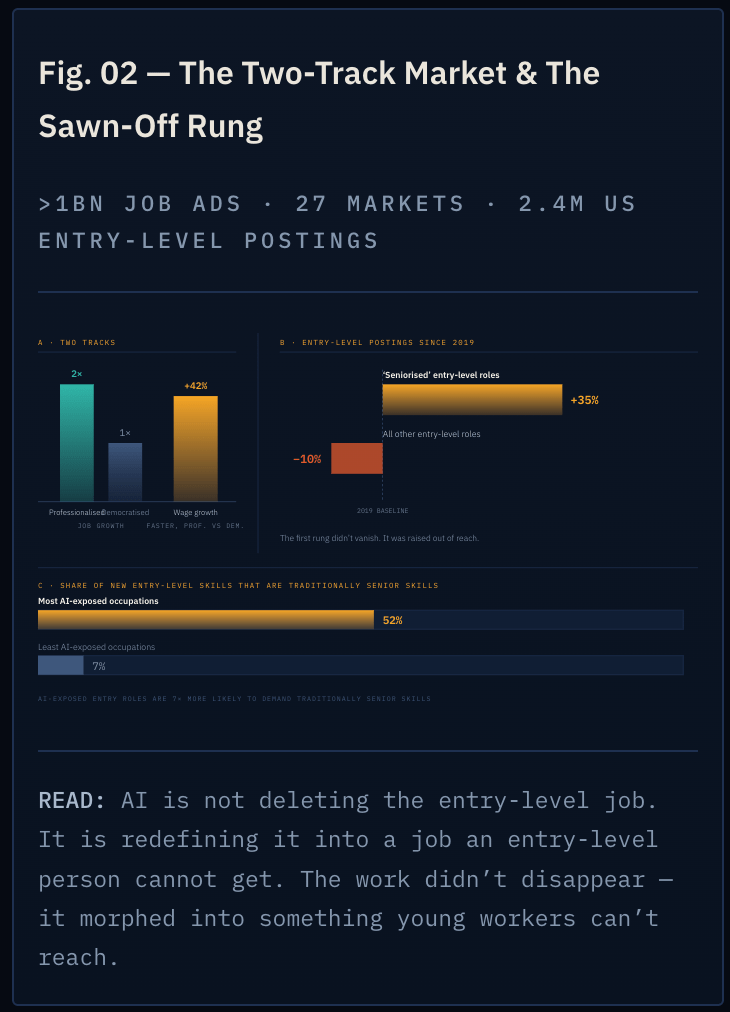
THE FINDING NOBODY IS QUOTING
The same barometer demolishes the lazy doomer read. Firms most exposed to AI grew headcount 52% against 36% at the least exposed (relative to 2018), with wage growth 24% vs 17%. The top quintile of AI-exposed companies posted 163% labour-productivity growth against 2018.
At the firm level, AI is not a job killer. It is a reallocator. And what it is reallocating away from is the young.
INSTRUMENT 03 · MACHINE TELEMETRY
Watching the substitution frontier from inside the tool
The barometer measures what employers ask for. A frontier lab’s economic index measures what the machine actually does — and it is the only party in this argument with a live feed from the substitution frontier itself.
Since early 2025 it has classified every sampled conversation as automation (the model performs the task) or augmentation (the human learns, iterates, validates). The trajectory is not a straight line, and the wobble is the whole point.
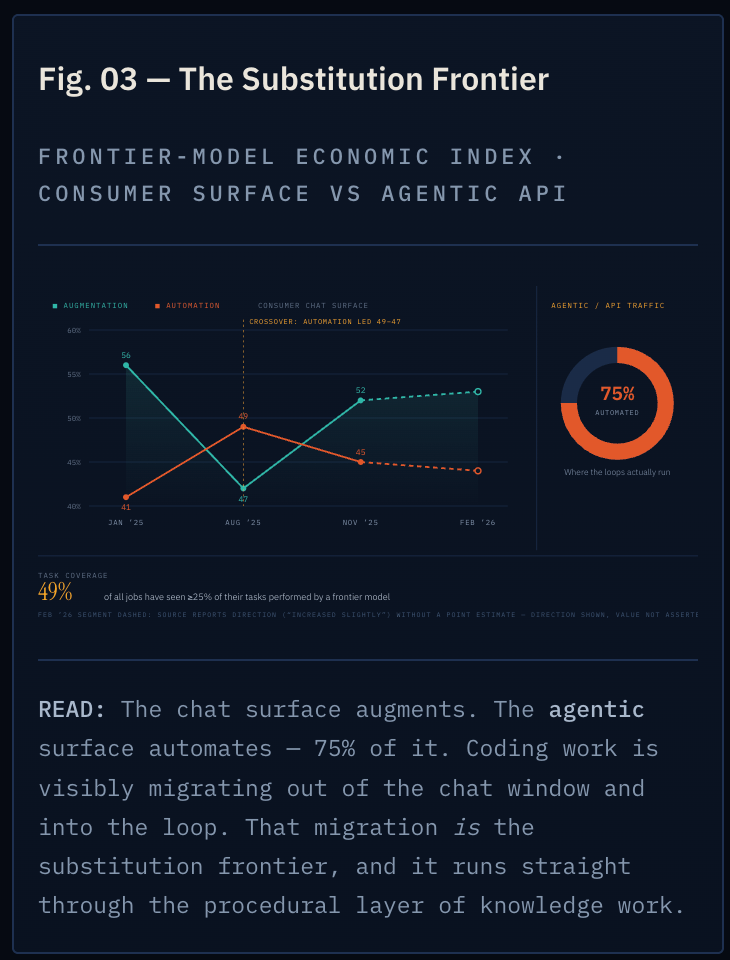
MY FRAME · PROMPTS → LOOPS → LOOP GOVERNANCE
Regular readers will recognise this chart as my own three-act structure, drawn by someone else’s telemetry. Act I — Prompts: a human in the loop on every turn; the machine augments. Act II — Loops: the work leaves the chat window and becomes an agent running unattended; augmentation collapses into automation. Act III — Loop Governance: the only remaining human position is above the loop, setting its constraints and auditing its intent.
The 75% figure is Act II arriving. Which makes Act III the entire remaining job description.LINK: /FROM-PROMPTS-TO-LOOPS
Two further readings from the same index.
The people who use it most, fear it least. Roughly 9,700 heavy users were surveyed and — for the first time — their answers were linked to their actual session telemetry. About half said AI can already handle 50% or more of their work tasks. 4% said it could do their entire job today. Twenty-six percent expected it to take the majority of their tasks within twelve months. And the heaviest delegators were the most optimistic about their pay and job security.
And now the sentence that matters most in the entire corpus. The researchers flag their own selection problem: every respondent is, by definition, someone who has already adopted frontier AI. Their self-reported task coverage exceeded what the telemetry showed. And the workers most at risk of displacement may not be in the sample at all — because separate central-bank research published in February 2026 found employment declines in AI-exposed industries falling disproportionately on the under-25s, not primarily through layoffs, but through a collapsed job-finding rate for new graduates.
Displacement without dismissal. Nobody is fired. Nobody is hired. The unemployment rate barely twitches — and an entire cohort quietly fails to appear.
This is the mechanism I have been describing as Ghost GDP: output climbs, the wage bill doesn’t, and the growth never reaches a household because the household was never hired. A central bank has now written it down in its own prose. LINK: /GHOST-GDP-THE-LONG-NIGHT-BEFORE-THE-LONG-DAY
INSTRUMENT 04 · PAYROLL GROUND TRUTH
The canaries: the only dataset that sees individual humans
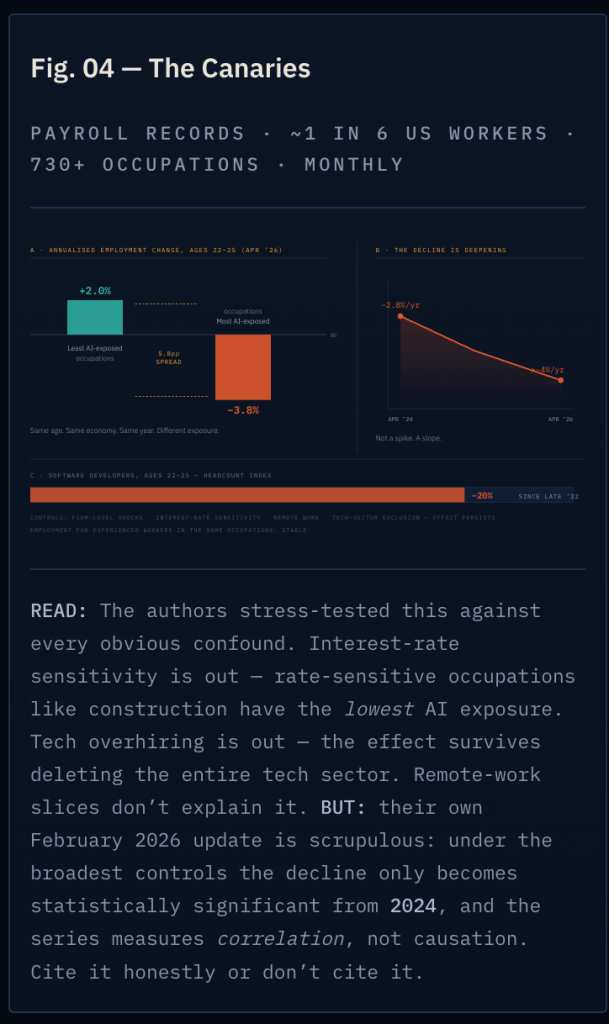
The central bank surveys households. The barometer scrapes adverts. The lab watches its own tool. A Stanford team does something none of them do: it reads payroll records — actual paycheques, for roughly one in six American workers, across 730+ occupations, at monthly frequency.
As of April 2026, workers aged 22–25 in the most AI-exposed occupations are seeing employment contract at 3.8% a year, while the same age cohort in the least-exposed occupations grows at about 2%. For 22–25-year-old software developers specifically, headcount is down roughly 20% since late 2022.
And the decline is deepening: from 2.8% a year in April 2024 to more than 4% a year since.
THE PANEL
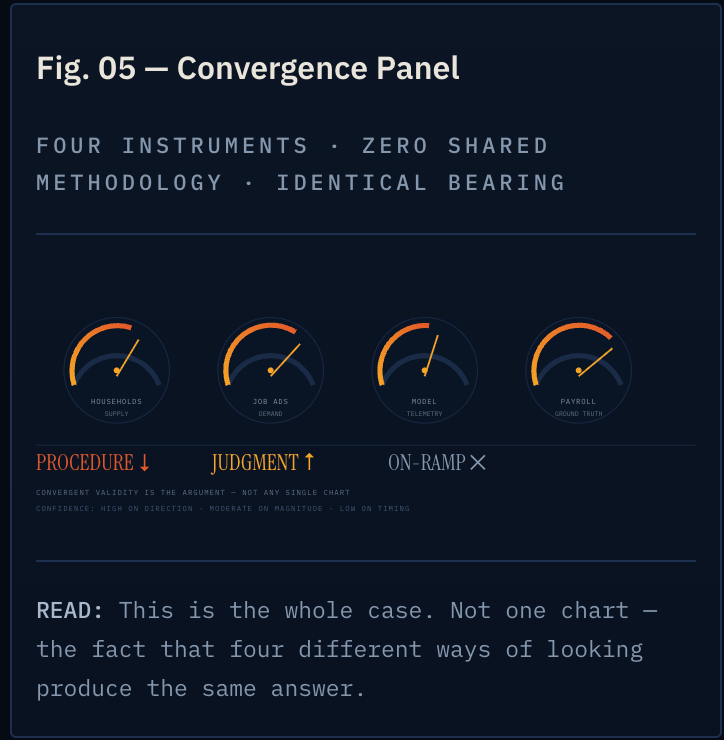
Four instruments. One bearing.
Any single one of these is contestable. The household survey’s confidence intervals are wide. The barometer reads demand signals, not hires. The lab is surveying its own enthusiasts. The payroll study measures correlation. A determined sceptic can knock over any one of them.
What no sceptic can explain is why four instruments with entirely different sampling frames — a household survey, a billion scraped adverts, model telemetry, and payroll ground truth — all deflect the same way at the same time.
THE MECHANISM
Why the labs hired philosophers — and why you will hire something else
The reporter who wrote the philosopher story made two points in a follow-up broadcast that deserve far more attention than the cartoon received.
First: the philosophers are not decoration. Asked whether they were a few thinkers kept in a corner, he was blunt — they are in senior positions, they are the ones writing the constitutions, they are drafting what the labs call their AI principles. They are shaping how the models are built.
Second — and this is the commercially loaded observation of the entire genre: as lawmakers regulate, the deontological school will win. Because laws are, in fact, deontological. They say this behaviour is prohibited — regardless of your intent, regardless of the outcome you were chasing.
Sit with that for a second, because it has an architecture consequence that almost nobody in my industry has said out loud.
A consequentialist agent optimising for outcomes is structurally un-auditable in a regulated industry — because you cannot produce evidence for a counterfactual. A supervisor does not want to hear what your agent avoided. A supervisor wants the rule, the trace, and the proof the rule bound.
Every framework any of us are actually shipping against is rule-shaped, prohibitive and ex ante: the Singapore financial regulator’s fairness, ethics, accountability and transparency principles; the agentic model governance framework I co-authored with the national infocomm regulator; the EU’s risk-tiered act; the US risk-management framework; the ISO management-system standard; the agentic security top ten. Every one of them is deontology wearing a control ID.
So the frontier lab hires a philosopher to write a constitution in prose. And the regulated bank hires — what, exactly? — to write the same constitution as policy-as-code, with runtime enforcement, an intent-versus-action auditor, and an evidence chain a supervisor can subpoena.
That job exists. It is the job I have spent three years building an operating system for. It just doesn’t have a cartoon yet.
MY FRAME · THE SEVEN LAYERS
This is precisely why TrustOS is seven layers and not one policy PDF. Orchestration (L1) and monitoring (L2) tell you what the agent did. Runtime safety (L3) and cloud security (L4) stop it doing the prohibited thing. Compliance (L5) maps the prohibition to a named obligation. Explainability (L6) shows the reasoning that produced the act. And the trust intelligence engine (L7) does the only thing a regulator ultimately cares about: it compares declared intent against executed action, continuously, and raises its hand when they diverge.
Philosophy at L7. Enforcement at L3. Evidence in between. That is not a metaphor — it is a build spec.LINK: /GOVERNING-THE-UNGOVERNABLE
THE STEELMAN
Now let me argue against myself
If I only gave you the bull case for judgment I would be doing exactly what I criticise in the AI commentariat. So here is the strongest counter-argument, made by people who know this terrain better than the cheerleaders.
1. The numbers are tiny and the hype is enormous. There are still vastly more philosophy PhDs than there are jobs. The claim that departments are “haemorrhaging” staff to industry is overstated when a handful of prestigious names have moved. A dozen hires is not a labour market.
2. This may be ethics-washing. A director of one of the world’s leading AI ethics institutes has put it plainly: there is a real risk here, because it flatters public perception if people believe the labs are doing something unusually serious. Hiring an ethicist makes consumers assume a model is ethical. The harder version of the charge: philosophical research becoming an extension of the marketing function — and philosophers with apparent free rein remaining, ultimately, accountable to shareholders. If a for-profit lab signs your cheque, is your conclusion for sale?
3. Philosophy runs at the wrong clock speed. The best philosophy happens slowly, and not in response to market demand. Alignment ships on a fortnightly release cadence. Something has to give, and it will not be the release cadence.
4. Chasing the trend is the same mistake, twice. Here is the irony nobody says out loud: the computer science graduates now facing 7% unemployment were following exactly the same logic that would send someone into a philosophy department today. They picked the safe, obviously-employable, in-demand major — at the peak. Enrol in philosophy because of a cartoon and you graduate in 2030 into whatever the cartoon looks like then.
Every one of these objections is correct. And not one of them touches the thesis. Because the thesis was never “philosophy is a good major.” The thesis is that judgment has been repriced — and judgment does not care which faculty issued your certificate. The billion-advert barometer does not measure philosophy graduates. It measures skills: judgment, creativity, leadership, the capacity to navigate ambiguity, the ability to command AI as a tool and a partner. That is not a degree. It is a stance.
THE PARADOX
We are hiring for judgment while abolishing the apprenticeship that produces it
Now assemble all four instruments into one uncomfortable sentence.
Judgment is the scarcest and fastest-appreciating input in the AI economy. The demand data says employers want it seven times more urgently at the entry level than they used to. The telemetry says the machine is eating everything except it. The payroll data says the young people who would have grown into it are being locked out of the buildings where it is grown.
And here is the thing about judgment: it was historically manufactured by doing, for years, precisely the drudgery that AI now absorbs.
The junior lawyer read a thousand contracts to develop the instinct that something in the 1,001st was off. The junior analyst rebuilt the model by hand until she could feel a wrong number before she could prove it. The junior developer fixed a thousand trivial bugs and, somewhere in there, learned what a system is. None of that was the point of the work. All of it was the point of the work.
We have automated the apprenticeship and kept the exam.
This is the Frozen Workforce in its mature form, and it is far more insidious than the mass-redundancy scenario everyone is braced for. Nobody is fired. A generation is simply declined admission to the process that would have made them valuable — and that shows up in no unemployment statistic, no layoff announcement, no earnings call. It shows up only in a payroll dataset, in a job-finding rate, and in the quiet arithmetic of an economy compounding its output while decompounding its own succession plan.
“Step up faster” — the advice being handed to juniors from every stage this year, mine included — is a demand, not a mechanism. Nobody has yet built the mechanism. The apprenticeship used to be a free by-product of drudgery. It is now a capital expenditure. Somebody has to put it in the budget.
THE FORKWhat you actually do on Monday
If you run an enterprise
Stop treating governance as a cost centre and start treating it as the residual value layer. Every framework you must comply with is a deontological system. Every autonomous agent you deploy is a consequentialist optimiser. That gap is not a compliance inconvenience — it is the product surface of the next decade. It is the whole reason for the line I have been repeating in every room I’ve stood in this year: no governance and you stay stuck in pilots; operationalised governance and you get autonomy at scale. The organisations reporting they are catastrophically understaffed for AI governance are not describing a hiring problem. They are describing an unpriced liability.
Rebuild the on-ramp deliberately. Budget for the apprenticeship you used to get for free, or bid for senior judgment in an open auction against everyone else who didn’t.
If you are early in your career
Do not chase the cartoon. Whatever arbitrage existed is closed by the time it becomes a meme. What is not closed — and will not close — is the compounding value of being the person in the room who can say: we should not do this, here is the argument, here is the control that stops it, and here is the evidence it held.
That is one skill wearing four hats — ethics, engineering, law and audit. No faculty teaches it. That is exactly why it pays.
And for the rest of us
The Athenian in the cartoon is not lecturing the machines because he won. He is lecturing them because somebody has to tell them what good means — and that turns out to be the one task they cannot take. Not because they lack the intelligence. Because they lack the standing.
The Fork is still ahead of us. Star Trek on one branch, Mad Max on the other, and roughly 2030 on the signpost. Which branch we take will not be decided by capability. It will be decided by whether we bothered to write down what we meant — and whether we could prove, afterwards, that the machine did it.
That is the last human task. Everything else is a token.
DATA NOTES — EVERY FIGURE IN THIS PIECE IS TRACEABLE
- Instrument 01 · Households. US central bank research series on the labour market for recent college graduates, ages 22–27, built on national household survey microdata. 2023 vintage: computer science 6.1%, computer engineering 7.5%, philosophy 3.2%, finance 3.7%, art history 3.0%, nursing 1.4%, nutrition 0.4%. 2024 vintage (released Feb 2026): computer science 7.0%, philosophy 5.1%. Overall recent-grad unemployment ~5.7%, underemployment 41.5% (Q1 2026).
- Instrument 01 · Caveat. Independent methodological critique of the same survey: confidence intervals by major are extremely wide (recent physics graduates: roughly 2%–12% at 95%); employment-to-population for recent computing graduates ~90%.
- Instrument 02 · Job advertisements. Global AI jobs barometer, 2026 edition (published June 2026): >1bn job advertisements, 27 countries. Professionalised roles growing 2× democratised, 42% faster wage growth. Skills in most-exposed jobs changing >2× as fast (a 75% widening on the prior year); new tasks 2.5× more likely to require empathy, judgment, creativity. AI-skills wage premium 62% (from 57%), >100% in some sectors. Headcount growth 52% vs 36%; wage growth 24% vs 17%; top-quintile AI-exposed firms 163% labour-productivity growth vs 2018.
- Instrument 02 · Entry level. Same barometer, sub-analysis of 2.4m US entry-level postings: AI-exposed entry roles 7× more likely to demand traditionally senior skills; 52% of new entry-level skills in the most-exposed occupations are traditionally senior skills, vs 7% in the least exposed; ‘seniorised’ entry openings +35% since 2019 while other entry openings −10%.
- Instrument 03 · Model telemetry. Frontier-lab economic index, reports of Jan 2026, Mar 2026 and Jun 2026. Consumer-surface interaction mix: Jan 2025 augmentation 56% / automation 41%; Aug 2025 automation leads 49–47; Nov 2025 augmentation 52% / automation 45%; Feb 2026 augmentation reported as increasing slightly (direction only — no point estimate published, and none is asserted here). Enterprise/agentic API traffic ~75% automated. ~49% of jobs have seen ≥25% of their tasks performed using the model.
- Instrument 03 · Linked survey. Same index, June 2026 edition: ~9,700 heavy users surveyed April 2026, responses linked to session telemetry via privacy-preserving methods. ~Half report AI can already handle ≥50% of their work tasks; 4% say it could do their entire job today; 26% expect majority coverage within 12 months; heaviest delegators most optimistic on pay and job security. Authors disclose a selection effect: respondents are existing adopters, self-reported coverage exceeded observed telemetry, and the most-exposed workers may be absent from the sample.
- Instrument 03 · Corroboration. Regional central-bank research, February 2026: employment declines in AI-exposed industries fall disproportionately on under-25s — driven not principally by layoffs but by a collapsed job-finding rate for new graduates.
- Instrument 04 · Payroll. University digital-economy lab study using private payroll administrative records covering ~1 in 6 US workers across 730+ occupations at monthly frequency. Ages 22–25 in most AI-exposed occupations: −3.8%/yr as of April 2026, vs ~+2%/yr in least exposed. Rate of decline deepening from −2.8%/yr (April 2024) to >−4%/yr. Software developers aged 22–25: headcount ~−20% since late 2022. Original paper reports 16% relative employment declines for 22–25s in AI-exposed occupations controlling for firm-level shocks, with experienced-worker employment stable.
- Instrument 04 · Author caveat. The authors’ February 2026 update: under the broadest set of controls, declines in AI-exposed occupations become statistically significant only from 2024; earlier declines are likely influenced by non-AI factors. The series measures correlation between exposure and employment trend, not a causal link.
- Governance demand. Professional-body and labour-market intelligence, 2026: AI governance the fastest-rising skill category tracked (~+150% year-on-year; AI ethics ~+125%); ~98.5% of organisations report being understaffed for AI governance; posting volumes for governance roles up by an order of magnitude, with roughly half originating in professional services.
Where two data vintages exist, both are shown. Where a source reports a direction without a point estimate, the chart shows direction only and says so on the axis. Nothing here is interpolated, smoothed or inferred. Publishers and vendors are described by function rather than name — the numbers, not the mastheads, are the argument.
Read my other articles:
The Nine-Day Window: Runtime Governance or Nothing
🔗https://lnkd.in/giEajm7p
The Longest Night Before Dawn: Ghost GDP
🔗https://lnkd.in/gM2Hvkxy
The Last Human Task. Ever.
🔗https://lnkd.in/gaeqGjbZ
 Genesis: Human Experience in the Age of Artificial Intelligence | Synthesis: The Superintelligence Protocol
Leave a comment