

METHODOLOGY & EPISTEMIC STATUS
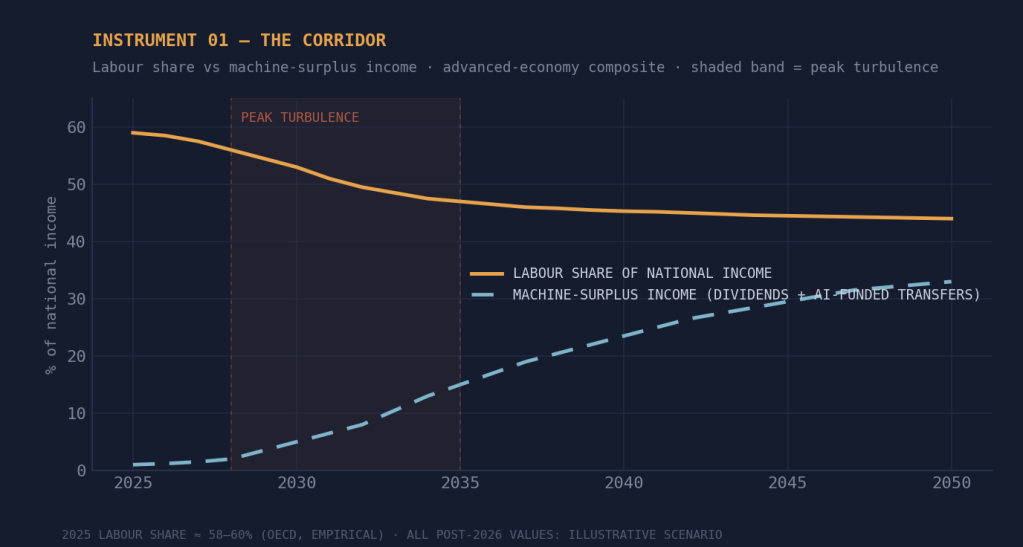
Every figure dated 2025–mid-2026 is empirical, drawn from the sources logged at the end. Every figure dated beyond mid-2026 is an illustrative scenario projection– internally consistent numbers chosen to make the mechanisms visible, not forecasts to be scored. The mechanisms come from the 2026 economics literature: the displacement externality of Falk & Tsoukalas’s AI Layoff Trap, the Ghost-GDP velocity wedge and intermediation collapse of the Abundant Intelligence and Deficient Demand stress test, Acemoglu–Restrepo’s displacement-versus-reinstatement race, and the fiscal insolvency paradox described by Korinek & Lockwood. Dates will be wrong. The sequence is the claim.
The scenario assumes: continued capability gains on the 2024–26 trajectory with agentic and embodied AI maturing through the early 2030s; no single AGI discontinuity and no great-power war; and policy that behaves the way policy behaves – late, uneven, and crisis-activated. Where the expert community disagrees, the timeline generally runs slower than the lab CEOs predict and faster than the sceptics allow, which is what the 2016–2026 track record supports.
RECORDED POSITIONS · THE BUILDERS, ON WHAT THEY ARE BUILDING
Dario Amodei
Expects powerful AI – systems broadly better than humans at almost all cognitive tasks, “a country of geniuses in a datacenter” — around 2026–27, a forecast Anthropic has put on regulatory record. Warned in May 2025 that AI could eliminate half of entry-level white-collar jobs and push unemployment to 10–20% within one to five years. His essays map both poles: Machines of Loving Grace (a compressed century of biomedical progress) and The Adolescence of Technology (the danger is closer in 2026 than 2023).
Geoffrey Hinton
Revised his own timeline from ~50 years to 5–20; assigns a 10–20% probability to AI-caused human extinction; told CNN in late 2025 he is more worried than when he left Google because progress outran his expectations. Also the field’s most honest self-corrector — his 2016 radiologist prediction failed, and he says so. Advocates engineering “maternal” protective instincts into systems smarter than us.
Demis Hassabis
Roughly 50% odds on AGI by 2030 (reaffirmed at Davos 2026); emphasises today’s “jagged intelligence” — olympiad-gold ability beside child-level failures. Long horizon: AI as the ultimate tool for science, delivering what he calls radical abundance — disease, energy and scarcity as solvable problems – if governance keeps pace.
Sam Altman
Calls AGI “not a super useful term” and frames the world as moving past it toward superintelligence; his Intelligence Ageessay put transformative systems “a few thousand days” out. Funded the largest UBI trial in US history (OpenResearch) and warns that compute scarcity could concentrate advanced AI in few hands — the distributional problem he says the industry must solve.
Jensen Huang
At Davos 2026 urged nations to build sovereign AI on their own language and culture, argued the buildout itself creates six-figure skilled-trade jobs, and warned that pensioners and savers must share AI’s growth or feel left out. By March 2026 he sketched the agentic endpoint: on the order of 100 AI agents for every human worker, working around the clock.
Mo Gawdat
Predicts a 12–15 year dystopian transition — sectoral unemployment of 20–50%, erasure of shared reality, capitalism itself in question — before abundance, arguing jobs were a capitalist invention and human purpose was never employment. Bets on AGI in 2026. His frame: the problem is not the rise of AI but its rise at the moment of humanity’s lowest morality.
Yoshua Bengio
The most-cited computer scientist alive now works primarily on loss-of-control risk: warns against giving frontier systems open-ended agency, and builds non-agentic “Scientist AI” oversight – AI that models the world and audits other AIs without goals of its own. Chaired the International AI Safety Report backing global coordination.
Max Tegmark
Life 3.0 framed the full space of post-AGI societies, from libertarian utopia to zookeeper dystopia; he argues the outcome is chosen, not fated. Led moratorium calls and demands quantitative safety guarantees – computing a “Compton constant” for loss-of-control before anyone builds superintelligence.
Fei Fei Li
The human-centered counterweight: insists AI policy be grounded in measurement, not science fiction, and that dignity and agency are design requirements. Her technical bet – spatial intelligence and world models – is the bridge from language AI to the embodied, physical-world systems that drive the scenario’s second displacement wave.
Kai Fu Lee
Predicted in AI Superpowers (2018) that ~40–50% of jobs would be automatable within 15 years – a claim that matures, on schedule, in the early 2030s of this timeline. Prescribes redirecting displaced labour into what AI lacks: compassion, care, and human connection — the jobs of the heart.
Eric Schmidt
Relays the “San Francisco consensus” of digital superintelligence within a decade, believes society is under-prepared rather than over-hyped, and frames the 2030s as a race between AI-driven energy/science windfalls and governance failure – with national-security competition as the accelerant nobody can switch off.
ERA I · 2026–2029
THE FREEZE & THE FIRST CRACKS
Displacement begins as a flow problem — hiring that never happens — while the dashboards stay green. Then the demand machine starts to misfire.
The Year is 2026
The ladder loses its bottom rungs — and the statistics can’t see it
The paradox year, and the only fully empirical entry. Headline unemployment sits near historic norms; the Yale Budget Lab finds no macro disruption signal. Underneath: employment for 22–25-year-olds in AI-exposed occupations is down 16% since late 2022, young software developers down ~20%, recent-graduate unemployment (5.7%) sits above the national rate for the first time in modern records, and PwC documents “seniorisation” — exposed entry-level roles now 7× more likely to demand senior skills. Firms don’t fire; they stop hiring. Ghost GDP begins.
Δ 22–25 EMPL. (AI-EXPOSED) −16% vs 2022GRAD UNEMPLOYMENT 5.7% > NATIONAL SENIORISED ENTRY ROLES +35% vs 2019GENAI IN ≥1 BUSINESS FUNCTION: 70% OF ORGS
The Year is 2027
Agents cross from pilot to production – for the governed few
The freeze spreads from tech into the intermediation belt: professional services, back-office finance, customer operations, routine legal work. Agent deployment, single-digit across business functions in early 2026, triples where governance was operationalised – the governance dividend becomes measurable as a 2–3× autonomy-scaling gap between governed and ungoverned enterprises. First large AI-attributed layoff waves hit BPO economies. Two graduate cohorts now queue behind a frozen door; Suleyman’s 12–18-month clock on professional-task automation is running.
AGENT DEPLOYMENT ~8% → ~25% OF FUNCTIONS YOUTH UNEMPL. (ADV. ECON.) → ~12%GOVERNED FIRMS SCALE AUTONOMY 2–3×
The Year is 2028
Displacement graduates from flow to stock
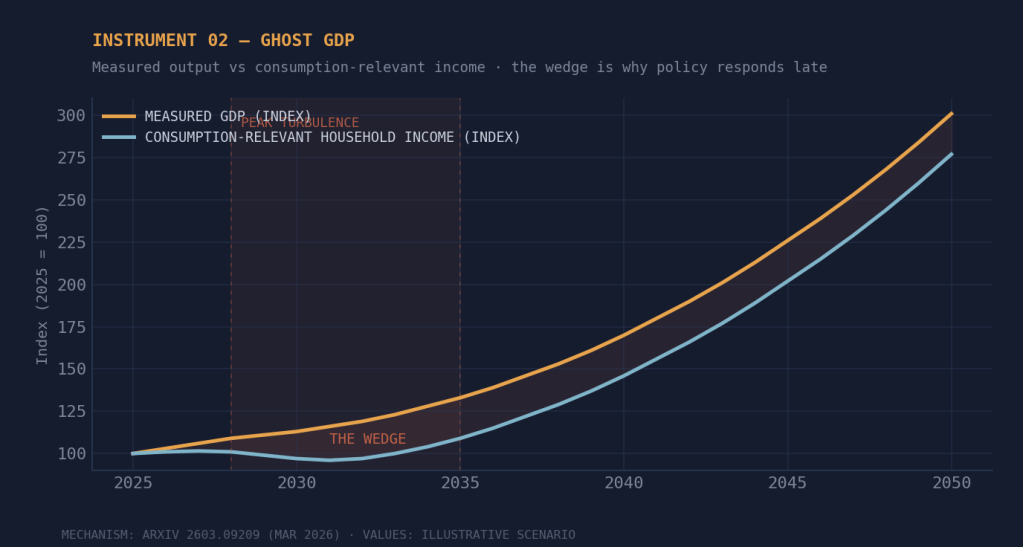
With three cohorts stacked and mid-career attrition unreplaced, white-collar employment begins visibly contracting. Demand cracks appear precisely where the externality model predicts: discretionary retail, hospitality and travel soften in the under-35 urban cross-section; mortgage origination to under-35s hits record lows. Central banks cut into what the dashboards call prosperity – Ghost GDP means output statistics stay green while velocity and consumption breadth fall – inflating AI-linked assets and widening the ownership chasm.
WHITE-COLLAR HEADCOUNT −2% Y/YU-35 MORTGAGE ORIGINATION: RECORD LOW MEASURED GDP +3% · HOUSEHOLD INCOME BREADTH −1%
The Year is 2029
OG 04 · SCENARIO The credit event – displacement becomes a financial-stability story
A tranche priced on stable white-collar income reprices abruptly — private credit’s $2.5T pool, office-heavy CRE, or a mid-sized mortgage market. Not a 2008; a 1998 with a labour-market cause. It is the moment governments move, because financial stability is the only genre that moves them in under a year. Emergency income bridges — Korinek’s “seed UBI” under other names — are enacted in two or three economies. The first Pigouvian automation-tax bills are tabled and mostly defeated. Automation remains individually rational, collectively ruinous; it continues.
CREDIT REPRICING EVENT · LABOUR-CAUSED FIRST INCOME BRIDGES ENACTED (2–3 STATES)AUTOMATION-TAX BILLS: TABLED 12 · PASSED 1
ERA II · 2030–2035
THE FISCAL RECKONING & THE FORK
The tax base erodes exactly when transfer demand peaks. Different systems choose different tines, and Kai-Fu Lee’s fifteen-year clock strikes.
The Year is 2030
The insolvency paradox arrives; national models diverge
Labour-tax receipts undershoot for a fourth consecutive year across the OECD while crisis stipends nobody dares repeal compound. Bond markets begin pricing “labour-share risk.” The Fork becomes explicit: the US builds a patchwork — state dividends plus a watered federal compute/token levy feeding a National Productivity Fund; the EU goes services-first (universal basic services funded by coordinated digital-capital tax, accepting slower adoption); China fuses distribution with control; the sovereign-fund states — Gulf, Norway, Singapore — discover they already own the winning endowment template. Hassabis’s 50%-by-2030 AGI coin lands somewhere between jagged and general; capability keeps compounding either way.
OECD LABOUR-TAX SHORTFALL: YR 4FIRST SOVEREIGN AI FUNDS CAPITALISED”LABOUR-SHARE RISK” ENTERS BOND PRICING
The Year is 2031
The Two-price economy breaks the CPI
Everything AI touches deflates – software toward free, professional services collapsing in automated segments, first robotics cost-downs reaching consumer goods. Everything AI cannot touch inflates – urban land, in-person care, credentialed access, provenance. A single averaged inflation number becomes actively misleading; central banks quietly adopt dual-basket frameworks. Household experience bifurcates by asset ownership: for AI-capital owners, life gets cheaper and richer; for wage-dependent non-owners, the essentials squeeze tightens amid free intelligence. Relative-price politics replaces inflation politics.
Δ AI-PRODUCIBLE BASKET −38% vs 2025SCARCE BASKET +24% vs 2025DUAL-BASKET CPI FRAMEWORKS ADOPTED
The Year is 2032
Peak turbulence – the reinstatement race decides everything
Cumulative displacement in exposed white-collar and logistics categories reaches 20–30% within those sectors (Gawdat’s numbers, sectorally right); economy-wide unemployment runs 9–12% with the deeper damage hidden in participation collapse. Maximum political risk: luddite movements with real electoral power, demagogic capture, techno-authoritarian consolidation, tail-risk conflict. The Acemoglu–Restrepo variable – whether new human tasks are created faster than old ones are destroyed – separates self-limiting economies from explosive ones, and everyone can now see which list they are on.
ADV.-ECON. UNEMPLOYMENT ~9–12%SECTORAL DISPLACEMENT 20–30% (EXPOSED)REINSTATEMENT RATE = THE SORTING VARIABLE
The Year is 2033
The settlement institutions – ownership, pricing, supply, purpose
Forged in three years of crisis, the pattern repeats across successful jurisdictions in local vocabulary: citizen equity in the machine surplus (sovereign AI funds fed by token taxes — usage-based, auditable, low innovation-drag — plus golden shares and data-rent royalties); the automation externality finally priced, pacing displacement to reinstatement speed; supply-side liberation of the scarce basket as housing-abundance coalitions win; and contribution architecture — civic service, care credits, open-source work carrying stipend, status and progression. Kai-Fu Lee’s 2018 forecast ;;; 40–50% of jobs automatable within fifteen years — matures roughly on schedule; his prescription, the jobs of the heart, becomes policy.
Δ TOKEN-TAX REGIMES: 9 JURISDICTIONSCONTRIBUTION STIPENDS LAUNCH (CARE/CIVIC)LEE-40% THRESHOLD REACHED, ON SCHEDULE
2034LOG 09 · SCENARIO
The dividend era normalises
In leading jurisdictions the citizen draw – dividend plus universal services plus near-free AI-produced goods – reaches a floor near today’s median-minus-a-third living standard, decoupled from employment. Formal work hours per capita are down 25–35% from 2025, but composition has inverted: growth occupations are supervisory-of-AI, relational, embodied, creative, civic. Seniorisation, it turns out, was the first visible edge of a permanent migration of human work up the judgement stack.
Δ CITIZEN DRAW ≈ 15% OF MEDIAN INCOME (LEADERS)WORK HOURS/CAPITA −30% vs 2025JUDGEMENT-STACK ROLES: FASTEST-GROWING
The Year is 2035
Divergence locks in – the governance-rich inherit the transition
The Fork stops being a metaphor and becomes a map: societies that made the crossing (surplus broadly owned, essentials cheapening, contribution re-architected, governance operationalised) versus societies trapped in the bad equilibrium (surplus concentrated, transfers hostage to annual politics, populations sedated or seething). Migration pressure from the second set to the first becomes the dominant geopolitical issue. The inversion of 20th-century development logic completes: the winners are not the resource-rich or even the technology-originating nations but the governance-rich. Trust was the scarce factor of production.
THE MAP SPLITS: CROSSED vs TRAPPEDMIGRATION PRESSURE = TOP GEOPOLITICAL ISSUEGOVERNANCE PREMIUM: VISIBLE IN SOVEREIGN SPREADS
ERA III · 2036–2042
THE EMBODIED WAVE & THE REBUILD
Spatial intelligence takes AI off the screen and into the world. The second displacement wave hits atoms as the first hit bits – but this time the institutions exist.
The Year is 2036 LOG 11 · SCENARIO
The embodied wave crests – Fei-Fei Li’s bet pays out in atoms
World-model robotics – the spatial-intelligence line Li championed — reaches cost-parity with human labour across logistics, light manufacturing, agriculture and construction tasks. Huang’s 2026 Davos pitch proved right and temporary: the buildout of AI factories delivered a decade of six-figure skilled-trade employment, and now the factories increasingly build and maintain themselves. The second displacement wave hits blue-collar work – but into economies that, in the crossed zone, now have dividends, levies and contribution architecture already running. The difference in social outcome between wave one (institutionless) and wave two (instituted) becomes the century’s great natural experiment in governance.
ROBOT COST-PARITY: LOGISTICS/LIGHT MFG HUMANOID+ FLEET ≈ 40M UNITS GLOBAL WAVE-2 SOCIAL STRESS < WAVE-1 (CROSSED ZONE)
The Year is 2037 LOG 12 · SCENARIO
The energy inflection – abundance gets a power source
Compounding solar-plus-storage cost declines, grid-scale batteries and the first serial-produced SMR fleets push marginal electricity cost through the floor in leading regions. Energy – the deep input to everything, including intelligence itself – joins the deflating basket. Schmidt’s framing of the 2030s as a race between AI-driven energy windfalls and governance failure resolves, in the crossed zone, in favour of the windfall. Desalination, vertical agriculture and synthetic materials scale on cheap power; the scarcity island shrinks to land, presence and status.
MARGINAL kWh −70% vs 2025 (LEADERS)COMPUTE/CAPITA +100× vs 2025SCARCITY ISLAND: LAND · PRESENCE · STATUS
The Year is 2038 LOG 13 · SCENARIO
The instruments change – HX ledger replaces the P&L
GDP, wages and CPI quietly stop being the numbers anyone steers by; they described a wage-circuit economy that no longer exists. Successor metrics — surplus-distribution breadth, contribution participation, wellbeing-adjusted life years – move from academic to official in the crossed zone. Money doesn’t disappear; it recedes to the island of the scarce, one instrument among several rather than the operating system of life. Ghost GDP, the wedge that blinded the 2020s, is finally closed by measurement rather than argument.
POST-GDP DASHBOARDS: OFFICIAL IN 14 STATES DIVIDEND+SERVICES ≈ 22% OF MEDIAN LIVING STANDARD MONETARY VELOCITY: STRUCTURALLY LOWER, ACCEPTED
The Year is 2039 LOG 14 · SCENARIO
Education completes its inversion
The reformed systems now teach, as core curriculum, roughly the five skills the 2025 keynote circuit proposed: tool fluency, human depth, truth discernment, adaptability, ethics. Credential gatekeeping – one of the last scarce-basket rents – cracks as competence verification by AI replaces degree signalling; the university unbundles into research, formation and community. The first generation educated for the post-wage economy, rather than retrofitted to it, enters adulthood.
COMPETENCE-VERIFIED HIRING > DEGREE-GATED TERTIARY COST −55% vs 2025 (REAL)FIVE-SKILLS CURRICULUM: STANDARD IN LEADERS
The Year is 2040 LOG 15 · SCENARIO
Proto-abundance milestone — security decouples from employment
In the crossed zone — perhaps a fifth of world population — median material security is formally decoupled from employment: the citizen draw covers a dignified floor, and work is chosen for meaning, status and surplus income. Ajeya Cotra’s carefully hedged 2040 line for human-level systems is passed with less ceremony than anyone expected in 2026; capability stopped being the binding constraint years earlier. The binding constraints are what they were always going to be: land, institutions, and the human heart.
SECURITY-EMPLOYMENT DECOUPLING: ~20% OF WORLD POP.FORMAL WORK: CHOSEN BY ~65% OF ADULTS (LEADERS)BINDING CONSTRAINTS: LAND · INSTITUTIONS · MEANING
The Year is 2041. LOG 16 · SCENARIO
The health dividend – the compressed century begins to show
Amodei’s Machines of Loving Grace thesis — that AI could compress a century of biomedical progress into a decade — starts registering in population statistics: AI-designed therapeutics from the early-2030s pipeline reach scale, diagnostic access approaches universality via near-free medical intelligence, and healthy-life-expectancy curves in the crossed zone bend visibly upward. Care work — Lee’s jobs of the heart — is now the largest human employment category, augmented rather than replaced, exactly as Huang’s radiology anecdote foreshadowed.
HEALTHY LIFE EXPECTANCY +3.5 YRS vs 2025 (LEADERS)DIAGNOSTIC ACCESS: NEAR-UNIVERSAL CARE = LARGEST HUMAN EMPLOYMENT CATEGORY
The Year is 2042 LOG 17 · SCENARIO
The trapped-zone crisis peaks
The other map. In societies that concentrated the surplus, the 2040s open as durable neo-feudalism: comfortable enough to be stable, closed enough to be hopeless – Tegmark’s zookeeper scenarios in economic rather than existential form. Migration pressure, IP flight and legitimacy crises peak; two trapped-zone states suffer disorderly resets. The crossed zone faces its own moral question – walls or bridges – and the answer, unevenly, begins shaping the first serious proposals for surplus-sharing beyond national borders.
TRAPPED-ZONE LEGITIMACY CRISES: PEAK2 DISORDERLY RESETS CROSS-BORDER SURPLUS-SHARING: FIRST PROPOSALS
RA IV · 2043–2050
THE ABUNDANCE LEDGER
The institutions compound, the singularity year arrives quieter and stranger than advertised, and the century audits what abundance actually delivered.
The Year is 2043 LOG 18 · SCENARIO
The first machine-surplus treaty
The proposals of 2042 harden into the first international AI-surplus instrument: a coalition pools a fraction of compute-levy revenue into a global dividend endowment — the “missing institution” the Digitalist Papers sketched in 2025, built two decades later, in miniature. Modelled on Norway’s fund and the Cherokee model’s legal entitlements rather than Alaska’s revocable statute, it is small, symbolic, and the template everything larger will copy.
GLOBAL DIVIDEND ENDOWMENT v1.0 (COALITION OF 23)CORPUS ≈ 0.4% GWP · ENTITLEMENT-BASEDTEMPLATE: NORWAY GOVERNANCE + CHEROKEE LAW
The Year is 2044 LOG 19 · SCENARIO
The post-wage generation comes of age
The first cohort raised entirely inside the new compact reaches adulthood: they have never equated worth with wage, and the anthropological wound the 2030s inflicted on their parents – purposelessness dressed as leisure – largely passes them by. Status now accrues to contribution, craft, care and creation; Gawdat’s claim that human purpose was never employment stops being a keynote line and becomes a demographic fact. The trapped zone watches its young leave, or log on, or organise.
Δ FIRST POST-WAGE COHORT: AGE 18WORK-AS-IDENTITY (U-25, LEADERS): MINORITY VIEWSTATUS CURRENCY: CONTRIBUTION > CONSUMPTION
The Year is 2045 LOG 20 · SCENARIO
Kurzweil’s year — the singularity arrives as an argument
The date the century spent sixty years anticipating. What exists in 2045: recursive AI-driven research acceleration across most sciences, superintelligent capability in every measurable domain, and – because Bengio’s non-agentic oversight architectures and Tegmark’s quantitative-guarantee movement won the institutional fight of the late 2020s – a containment regime that kept open-ended agency gated. Hinton’s 10–20% extinction estimate has not cashed out; his other prediction did – the systems are smarter than us, and the “maternal-instinct” design school he proposed is now a formal alignment discipline. Whether this is the singularity is the decade’s favourite argument, which is itself the evidence of a managed transition: discontinuities don’t leave time to argue.
KURZWEIL CHECKPOINT: CAPABILITY YES · RUPTURE NO AGENCY-GATING REGIME: HELDAI-DRIVEN DISCOVERY: MAJORITY OF NEW SCIENCE
The Year is 2046 LOG 21 · SCENARIO
Post-scarcity accounting becomes law
The successor metrics of 2038 are formalised into an international accounting standard: national accounts now report the abundance ledger (near-zero-marginal-cost provision) separately from the scarcity ledger (land, presence, provenance, frontier). Economics as a discipline completes its own transition – from the science of allocating scarcity to the science of distributing abundance and governing the remainder. First-year students learn the wage-demand circuit of 1950–2030 the way 2020s students learned the gold standard.
DUAL-LEDGER NATIONAL ACCOUNTS: ISO STANDARD SCARCITY LEDGER ≈ 18% OF ECONOMIC ACTIVITY (LEADERS)WAGE-CIRCUIT ECONOMICS: HISTORY CURRICULUM
The Year is 2047 LOG 22 · SCENARIO
The meaning economy at scale
What humans buy from humans, when machines make everything else: presence, witness, mastery, faith, play. Live performance, craft with provenance, sport, pilgrimage, mentorship and communal ritual boom – the serotonin-and-oxytocin economy Gawdat predicted replacing the dopamine-and-cortisol one. Loneliness, the epidemic AI companionship both salved and deepened through the 2030s, becomes the last great public-health target; the crossed zone treats connection infrastructure – third places, care networks, civic ritual – as it once treated roads.
Δ PRESENCE ECONOMY: FASTEST-GROWING LEDGER SEGMENT CONNECTION INFRA: PUBLIC-WORKS CATEGORY HUMAN-PROVENANCE PREMIUM: 4–12× MACHINE EQUIV.
The Year is 2048 LOG 23 · SCENARIO
The endowments compound past the tipping point
Second-generation dividend states hit the number that settles the old UBI argument: sovereign and citizen funds now hold 30–40% of domestic AI-capital value in leading jurisdictions, and the citizen draw – dividend, services, near-free goods – funds a standard of living that 2025’s median household would recognise as comfortable, without labour income. The 2020s critique was right that transfers into an unreformed scarcity structure fail; the answer was never a bigger cheque but a broader ownership base, and it took twenty years of compounding to build.
Δ CITIZEN/SOVEREIGN SHARE OF AI CAPITAL: 30–40%CITIZEN DRAW ≈ 2025-COMFORTABLE, LABOUR-FREE UBI DEBATE: RESOLVED BY OWNERSHIP, NOT TRANSFERS
2049LOG 24 · SCENARIO
Δ The last scarcity politics — land, location, and the partial escape
The final unreformed rent is place. Desirable land in desirable cities remains the one asset abundance inflates rather than deflates; the century’s last old-style political war is fought over it. Relief comes partially and from three directions: construction robotics collapsing build costs, the energy glut making new geography habitable, and immersive presence making some location premium optional. Partially — because status is positional, and positional goods are the one thing no amount of production can make abundant. The scarcity island has a permanent population.
Δ LAND: LAST STRUCTURAL RENTBUILD COST −60% vs 2025 (ROBOTIC CONSTRUCTION)POSITIONAL GOODS: PERMANENTLY SCARCE, BY DEFINITION
The Year is 2050 LOG 25 · SCENARIO
The ledger — what abundance delivered, and what it never could
The audit at mid-century. Delivered, in the crossed zone: material security decoupled from employment; disease burden and energy poverty in structural retreat; human time massively reallocated to care, craft, community, science and play. Not delivered: universality — the two-worlds map endures, and roughly half of humanity lives under concentrated-surplus regimes ranging from comfortable clientelism to hard neo-feudalism; equality of status — positional scarcity survived post-scarcity intact; and meaning by default — purpose proved to be infrastructure, built deliberately or not at all. Scored against the 2026 predictions: the lab CEOs were early on capability and silent on institutions; the sceptics right about friction and wrong about ceiling; Gawdat’s 12–15-year corridor approximately correct in duration, wrong only in assuming everyone would travel it together. The differential, start to finish, was never the technology — identical everywhere by 2035 — but whether a society treated governance, surplus ownership and workforce transition as one integrated design problem while there was still time. The turbulence was the price of admission. Not everyone was allowed to pay it.
CROSSED ZONE ≈ 45–55% OF WORLD POP.TRAPPED ZONE: ENDURESDECIDING VARIABLE: INSTITUTIONAL QUALITY, 2026–2033
SOURCES & RECORDED POSITIONS
EMPIRICAL ANCHORS, MECHANISM PAPERS, AND EXPERT STATEMENTS
Mechanisms. Falk & Tsoukalas, The AI Layoff Trap(arXiv 2603.20617, June 2026) — automation as dominant strategy, demand externality, Pigouvian automation tax. Abundant Intelligence and Deficient Demand (arXiv 2603.09209, March 2026) — displacement spiral, Ghost GDP, intermediation collapse, consumption-concentration amplifier. Acemoglu & Restrepo, task displacement and reinstatement. Korinek & Stiglitz (2019); Korinek & Lockwood (2026) on AGI taxation and the fiscal paradox; Korinek’s “seed UBI” (Digitalist Papers, 2025). Token Taxes Can Mitigate AI’s Economic Risks (arXiv 2603.04555). Benzell et al. (2015); Mian, Straub & Sufi on indebted demand; IMF F&D, AI and the Economics of Adjustment (June 2026).
2025–26 empirical anchors. Stanford HAI AI Index 2026 — US consumer surplus $172B; GenAI in ≥1 function at 70% of organisations; Singapore adoption 61%; developers 22–25 employment −20%. PwC 2026 Global AI Jobs Barometer (June 2026) — seniorisation (7× senior-skill likelihood; +35% seniorised vs −10% other entry postings since 2019); two-track labour market. WEF & PwC, AI and the Future of Entry-Level Work (June 2026) — 37% of young workers in medium/high-exposure occupations; 22–25 exposed employment −16% since late 2022. Fortune / Harvard working paper (62M workers) — junior hiring −8% within six quarters at AI adopters; NY Fed — grad unemployment 5.7%, underemployment 42.5% (Q4 2025). Goldman Sachs (2025) ~2.5% near-term displacement risk; Yale Budget Lab (2025–26) null aggregate findings.
UBI evidence. OpenResearch Unconditional Cash Study (Vivalt et al., NBER 2024) — $1,000/mo, 3 years; −1.3–1.4 hrs/wk labour supply; spending to essentials; consensus mixed-to-disappointing, with advocate rebuttals (Santens; Standing). Finland KELA experiment (2017–18); Stockton SEED; Alaska Permanent Fund; Eastern Band of Cherokee dividends; Norway GPFG as endowment precedent.
Recorded expert positions. Amodei — Davos 2026; Anthropic OSTP submission; May 2025 entry-level warning; Machines of Loving Grace; The Adolescence of Technology. Hinton — CNN late 2025; 10–20% risk estimates; radiologist self-correction; maternal-AI proposal. Hassabis — Davos 2026 (~50% AGI by 2030); jagged intelligence; radical abundance. Altman — The Intelligence Age; OpenResearch funding. Huang — WEF Davos 2026 session with Larry Fink; Fortune, March 2026 (agents-per-worker). Suleyman — Feb 2026 interview. Legg — Jan 2026 (50% minimal AGI by 2028). Gawdat — Business Insider AI Architects(2026); Scary Smart. Bengio – International AI Safety Report; LawZero. Tegmark — Life 3.0; Compton-constant guarantees. Li — The Worlds I See; Stanford HAI; World Labs. Lee — AI Superpowers (2018). Schmidt — superintelligence-consensus remarks. Kurzweil — The Singularity Is Nearer (AGI 2029; singularity 2045). Cotra — bio-anchors ~50% by 2040.
LOG ENDS · 25 ENTRIES · THE SEQUENCE IS THE CLAIM, NOT THE DATES
SHORT-TERM TURBULENCE FOR LONG-TERM ABUNDANCE — FOR THOSE WHO BUILD THE INSTITUTIONS THAT BUY IT.


Leave a Reply