
By Dr Luke Soon
Author of Genesis: Human Experience in the Age of Artificial Intelligence & Synthesis: The Superintelligence Protocol
Singapore | June 2026
Introduction: The Decisive Decades – Where We Stand Mid-2026
From 2025 to 2050, the tectonic plates of work are shifting faster than at any point since the Industrial Revolution. In my previous writings – The Future of Work: Year by Year Trajectories 2025–2050 (Sep 2025), A Potential Roadmap to Abundance (2026–2030) (Feb 2026), The Agentic Organisation, Job Displacement and the Great Skills Recomposition (Mar 2026), The Productivity Paradox of AI (Mar 2026), and the utopian/dystopian scenarios for 2026–2030 (Mar 2026) – I laid out a comprehensive playbook of possible tomorrows.
This enriched update compiles all my Future of Work predictions into one cohesive narrative. It adds deltas (what has changed or materialised since publication) and incremental views (new perspectives from real-world deployments, Singapore’s governance leadership, PwC client work, IMDA AI Verify, and emerging frameworks like TrustOS and CIRCLE).
Core Thesis (Updated): We are broadly on the predicted trajectory towards an Agentic Organisation era, but the transition is uneven. The Productivity Paradox is unfolding exactly as forecasted – work is increasing before it structurally decreases. The Great Skills Recomposition has begun. The fork between Trust-Based Transformation (abundance, human flourishing) and Turbulent Times / Fragmentation (hollowing, deskilling, inequality) remains open. Governance, workflow redesign, and deliberate Human Experience (HX = CX + EX) design are the unlocks. Singapore’s pragmatic, tripartite model offers a global beacon – if we act with urgency and intention.
The future is not predetermined. It is being architected now through choices in technology, organisation design, skills, policy, and values.
2026: The Agentic Inflection Point & The Productivity Paradox Onset
Original Predictions (Synthesised)
- Agentic systems move from experimentation to default deployment – executing end-to-end workflows autonomously (Roadmap to Abundance).
- Humans shift from operators to supervisors and orchestrators. The “job” begins its unrecognisable transformation (paid for orchestration, judgement, and outcomes rather than execution).
- Productivity Paradox strikes: AI lowers the cost of producing information/output but raises the cost of coordinating it → activity explosion, more drafts, reviews, iterations, and “work slop” before workflow redesign delivers gains (Productivity Paradox post).
- Great Skills Recomposition defines the labour market. Surface-level AI use creates mediocrity; deep adoption separates winners. AI Generalists and Orchestrators rise. Middle layers begin structural compression (hourglass or diamond org shapes emerge) (Agentic Organisation post).
- Utopian path: AI fluency becomes baseline literacy; skills-based hiring accelerates; end to “job hugging”. New roles: AI Prompt Engineer, Agentic Workflow Designer, Cyber-Physical Risk Analyst.
- Dystopian risk: Aggressive layoffs based on automation potential; shadow AI produces low-quality output; 50% entry-level roles under immediate pressure.
Sector early signals (from 2025–2050 narrative): Law & Tax copilots handle drafting; lawyers pivot toward ethics/governance. Healthcare sees concierge telehealth and AI diagnostic assistants surge. Manufacturing: Automation Supervisors and Digital Twin Managers appear.
Delta – June 2026 Status (Are We on Trajectory?)
Yes ; early but clear inflection.
- Productivity Paradox is empirically visible: Goldman Sachs (Mar 2026) and Fortune reporting confirm activity expansion, busier knowledge workers, pressure on entry-level and mid-tier roles, yet productivity metrics lagging because workflows have not been redesigned.
- Agentic pilots are scaling toward P&L impact in leading enterprises (PwC 2026 AI Business Predictions align). Multi-agent orchestration tools are maturing rapidly.
- Great Skills Recomposition is underway: Organisations are building central “AI Studios”, reusable components, and sandboxes. AI fluency programmes (SkillsFuture, corporate academies) are expanding, but many still treat AI as a toy or bolt-on rather than core operating system.
- Structural compression signs: Middle-management coordination layers are being questioned; “superworker” archetypes (individuals operating at team-level output via agents) are emerging in advanced teams.
- Positive Singapore delta: IMDA AI Verify Global AI Assurance Pilot technical testing (which I led elements of) demonstrated real-world governance in action. MGF for Agentic AI and NAIS 2.0 provide structured guardrails. TrustOS (my June 2026 framework) offers the world’s first complete agentic safety operating system – governance catching up with capability.
- Risk delta: Many organisations remain in augmentation mode, creating coordination debt. Shadow AI and work slop are real. Entry-level and routine cognitive roles face the sharpest early pressure. Global north-south divergence in adoption speed is already visible.
Assessment: Firmly on the predicted early trajectory. The paradox and recomposition are not surprises – they are the necessary messy transition. The window to redesign workflows (rather than just add tools) is now.
Incremental View & Enriched Perspective
- Workflow Redesign is the #1 priority. Adding AI to old processes guarantees the paradox. We must re-architect end-to-end human-AI workflows with humans positioned above the agents (verifying, judging, contextualising, taking accountability).
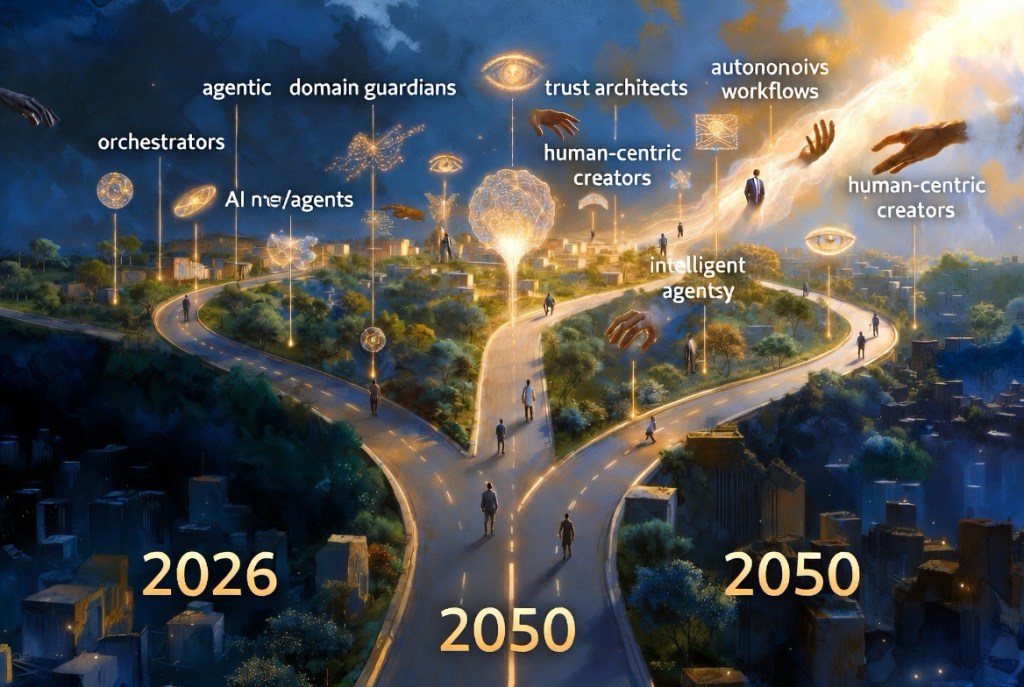
- Build the Five Archetypes of the Agentic Organisation immediately:
- The Orchestrator – Designs and deploys human-AI workflows.
- The Domain Guardian – Supervises outputs, manages exceptions, provides human judgement.
- The Trust Architect – Embeds governance, explainability, ethical guardrails (TrustOS/CIRCLE ready).
- The Augmented Specialist / AI Generalist – Leverages agents for 40-50%+ effort reduction, focuses on higher-order work.
- The Human-Centric Creator – Supplies empathy, ethics, creativity, relational depth, and strategic imagination (the irreplaceable human core).
- Measure what matters: HX (psychological safety, transparent governance, fair transition pathways, dignified reskilling) alongside ROI. Trust is the economic multiplier.
- Singapore’s edge as global model: Practical, tripartite governance (government-industry-unions) + real-world testing (AI Verify) + lifelong learning infrastructure (SkillsFuture) positions us to steer the utopian path. Export this model.
2027: Orchestration Mainstream & The Hollow Middle Emerges
Original Predictions
- Multi-agent orchestration becomes mainstream. Managers evolve into system supervisors overseeing fleets of agents.
- Middle management (coordination, reporting, routine information routing) erodes – the “hollow middle”.
- Premium skills shift heavily toward agent supervision, exception handling, and connective labour (coaching, conflict resolution, empathy, negotiation, leadership).
- Utopian: Fluid talent pipelines, role pivots enabled by modular credentials. High-prevalence human skills revalued.
- Dystopian: 50% middle-management roles eliminated; cognitive atrophy from over-reliance; 40% AI projects fail due to poor governance.
Delta – June 2026 Lens (Trajectory Check)
Still early, but signals are aligning. Orchestration platforms are advancing quickly. Leading firms are already experimenting with agent fleets. The hollowing risk is real if organisations automate coordination without redesigning accountability and decision rights.
Incremental View: Deliberately design the future org shape now (diamond for front-line/task work; hourglass for knowledge work). Do not let middle layers evaporate without building the new connective tissue of orchestrators and guardians. Invest heavily in archetype training and Trust Architect capability – governance debt will be more expensive than tech debt.
2028–2030: Cognitive Decoupling, Jobless Growth & The AI-Native Economy
Original Predictions (Roadmap + Utopian/Dystopian + 2025–2050 Narrative)
- 2028: Cognitive Decoupling & Jobless Growth – Revenue and productivity rise while headcount stagnates or declines. White-collar roles compress. “Superworker” archetype solidifies. Synthetic content production dominates creative domains.
- 2029–2030: AI-Native Economy – Agentic AI enters physical worlds (warehouses, hospitals, manufacturing, logistics, embodied agents/robots). Routine administration and physical execution largely automated. Human roles augment in care, complex judgement, service, accountability, and high-stakes domains.
- By 2030: The “job” as we know it is unrecognisable. Payment primarily for orchestration, stewardship, judgement, and outcomes. ~$2.9T–$15.7T annual economic value unlocked (depending on utopian execution). Net job creation possible globally if reskilling succeeds (78M+ in optimistic scenarios), but massive transformation of 1.1B+ jobs.
- New roles crystallise: AI Safety & Governance Leads mainstream; Sustainability Analysts critical; Human-AI Co-Design Facilitator, Ethical Data Curator, Metaverse Workplace Architect, Bio-AI Coaches, AI Wealth Guardians.
- Sector evolution: Financial Services → AI Wealth Guardians ensuring fiduciary trust. Energy & Climate → Grid decarbonisation architects then Climate Restoration Engineers. Technology → Agentic Orchestration Leads then Living Intelligence Custodians.
- Fork sharpens: Trust-Based Transformation (GDP index ~132 by 2035 baseline 2025=100; HX flourishes) vs Turbulent Times (stagnation, polarisation, gig traps, wage deflation, structural stagnation).
Delta – June 2026 Status
On trajectory, foundations being laid.
- AI infrastructure build-out (data centres, energy, chips) is already creating hundreds of thousands of new jobs globally – early signal of the “jobless growth but infra jobs” dynamic.
- Embodied AI and robotics accelerating (physical world integration on schedule for late 2020s).
- Governance experiments (Singapore MGF, AI Verify, my TrustOS) provide proof points that trust-based paths are viable and accelerate adoption rather than slow it.
- Skills recomposition visible but uneven: AI fluency programmes scaling, yet depth varies. Risk of cognitive deskilling in organisations that over-rely without critical thinking guardrails.
- Value distribution debate emerging (who pays the bill in post-labour elements?) – my earlier calls for ownership models over pure UBI are gaining relevance.
Real-Time Validation: PwC 2026 Global AI Jobs Barometer (Released 15 June 2026) – Year-on-Year Insights
PwC’s 2026 Global AI Jobs Barometer (analysis of over 1 billion job advertisements across 27 countries on six continents) delivers powerful, fresh year-on-year confirmation of the trajectory. Released just days ago, it shows AI rapidly reshaping the labour market into two distinct tracks while dramatically accelerating demand for human skills.
Key year-on-year and trend findings (since 2019/2021/2022/2024 baselines):
- Two-track labour market emerges strongly: “Professionalised” roles — where AI automates routine tasks and amplifies human judgement, creativity, leadership and expertise (e.g. orchestrators, domain guardians, recruiters, radiologists) — are growing twice as fast as “democratised” roles (where AI simply makes tasks easier for non-experts). Professionalised roles show 42% faster wage growth since 2021.
- AI skills explosion: Jobs requiring specific AI skills (prompt engineering, machine learning orchestration, etc.) have grown 69% since 2019 – nearly 8x faster than the overall jobs market (+9%). AI-related job postings are almost twice as high as in 2024.
- Wage premium rising: Average premium for AI skills now 62% (up from 57% last year); peaks at up to 118% in Consumer Markets.
- Entry-level “seniorisation” and compression: In the US (2.4 million entry-level roles analysed), AI-exposed junior roles grew +35% since 2019 while other entry-level roles declined -10%. These AI-exposed entry-level roles are now 7x more likely to demand traditionally senior skills (leadership, strategic thinking, judgement, creativity).
- Company divergence accelerates: Most AI-exposed companies achieved 52% headcount growth (vs 36% for least exposed). “Super-star” top 20% AI-exposed firms delivered 163% productivity growth since 2018 (vs 34% overall AI-exposed, 24% least exposed). Productivity growth is 40% higher in most-exposed companies.
- Human skills premium confirmed: New tasks in AI-exposed roles are 2.5x more likely to rely on empathy, judgement, creativity and leadership. Skills requirements in the most AI-exposed jobs are changing more than twice as fast as in least-exposed roles (75% wider gap than last year).
This is direct, data-backed validation of my predictions: the Productivity Paradox resolving into gains for those who redesign (exposed firms hiring faster + far more productive); the Great Skills Recomposition and structural compression (entry/mid layers under pressure, but premium roles expanding); the rise of the Five Archetypes (human judgement/orchestration/guardian/creator elements rewarded); and the live fork between amplification (abundance, more/better jobs, higher wages) and pure automation (democratised, slower-growth track).
Incremental View (updated with Barometer):
This Barometer is now an essential annual tracker. It proves organisations that treat AI as an amplifier of human expertise (via workflow redesign, archetype development and HX focus) pull decisively ahead on hiring, productivity and wages. Those stuck in bolt-on automation risk the lower track. Use these numbers in client conversations, talent strategy and policy advocacy. Singapore’s SkillsFuture and governance leadership are perfectly positioned to build the high-value “professionalised” track at scale. The data reinforces urgency: move fast on the Five Archetypes and human-in-the-loop orchestration to ride the wave the Barometer is measuring in real time.
Updated Incremental View (overall for 2026 section):
- The $ trillions in value will only materialise at scale with workflow redesign + human-in-the-loop accountability + robust governance. Task-level automation without orchestration yields the lower “democratised” track.
- Prioritise ownership and equity mechanisms now: AI value sharing, public/sovereign AI infrastructure, citizen stakes in foundational models/infra, redesigned social contracts. UBI alone is structurally misaligned with a fragmenting, agentic economy.
- Human Experience as the North Star. In the AI-native era, the decisive differentiator becomes HX – creativity, empathy, systems thinking, planetary stewardship, judgement and leadership. Organisations and societies that protect and amplify these win the trust-based, professionalised path the Barometer rewards.
- Singapore opportunity: Position as the global testbed and exporter of balanced Agentic AI governance + skills recomposition models that deliver the high-growth amplification track.
2031–2040: The Human-AI Co-Production Era & The Great Divergence Deepens
Original Predictions (from 2025–2050 Narrative + extended themes)
- Majority of enterprises deploy mature agentic AI with embedded trust frameworks.
- New roles proliferate: Human-AI Co-Design Facilitator, Ethical Data Curator, Metaverse Workplace Architect, GovTech Guardians (algorithmic transparency), Longevity Advisors, Human Enhancement Ethicists.
- Education reinvents around Skills Wallets, modular credentials, and lifelong modular learning.
- Polarisation risk peaks: Sustainability Analysts and AI Safety/Governance roles become critical everywhere. HX roles (care, trust-building, complex judgement) premium-priced.
- Fork between Trust-Based Transformation and Turbulent Times becomes stark in GDP, social cohesion, and human flourishing metrics.
Delta & Incremental View (June 2026 Forward Projection)
Too early for direct deltas, but the trajectory is being set by 2026–2030 choices.
Incremental: The organisations and nations that master the Five Archetypes, TrustOS-style governance, and HX measurement in this decade will dominate the co-production era. Those that treat AI as pure cost replacement will face hollowed capability, talent flight, and social licence erosion. Planetary stewardship and climate restoration roles will surge as AI enables (and demands) net-positive transitions.
2041–2050: The HX Century – Symbiosis or Fragmentation?
Original Predictions (Extended from Narratives)
- AI saturates every workflow. The decisive differentiator is Human Experience (HX).
- Future skills converge on: creativity, empathy, systems thinking, planetary stewardship, ethical judgement, relational depth.
- New archetypes: Climate Restoration Engineer, Human Experience Strategist, AI-augmented Educator, Living Intelligence Custodians.
- The Fork Resolves or Persists:
- Abundance Path (Trust-Based Transformation): Human work is redefined as meaningful orchestration, stewardship, exploration, care, and purpose pursuit. AI handles execution at scale. Societies redesign value distribution (contribution + ownership models). Shorter work horizons possible alongside higher human flourishing. HX becomes the core economic and social metric.
- Fragmentation Path (Turbulent Times): Structural underemployment, loss of purpose/meaning, elite capture of AI-generated value, diamond economy (tiny orchestrator class + precarious majority), weakened social cohesion, and eroded trust. “Last Labour” dynamics intensify without new social contracts.
Delta & Incremental View
The path is not fixed in 2026, but the direction of travel will be locked in by the quality of our 2026–2035 decisions on governance, skills infrastructure, organisational architecture, and value distribution.
My enriched conviction: We can steer toward the abundance/HX path. Singapore’s model – pragmatic regulation, tripartite collaboration, real-world assurance (AI Verify), lifelong learning, and human-centric values – is one of the best positioned globally to demonstrate that governance is the unlock for agentic scale, not the brake.
Key enablers for the positive 2050:
- AI fluency + human core skills as universal baseline (never let AI replace critical thinking or empathy).
- Deliberate Agentic Organisation design with the Five Archetypes.
- Trust architectures (TrustOS, CIRCLE, MGF-style) embedded by default.
- Ownership and contribution-based value models that prevent extreme concentration.
- HX as measurable north star in every transformation.
- Global cooperation to ensure AI serves humanity broadly, not just extract from the Global South or concentrate in few hands.
Conclusion: We Are on the Trajectory – Now Steer It Deliberately Toward Abundance
All my Future of Work predictions – from the 2025–2050 narrative, the 2026–2030 roadmap, the Agentic Organisation and Skills Recomposition thesis, the Productivity Paradox, and the utopian/dystopian scenarios – are proving directionally accurate as of June 2026.
Deltas are largely positive in capability and early governance experiments, but the messy transition costs (coordination explosion, skills gaps, structural compression pressures) are exactly as forecasted. The fork is real and live.
The incremental call to action is clear:
- Leaders & Organisations: Stop bolting AI onto old workflows. Redesign for human-AI symbiosis. Build the Five Archetypes. Measure HX alongside ROI. Adopt TrustOS/CIRCLE principles.
- Policymakers & Educators: Treat AI fluency as foundational literacy. Scale modular, lifelong reskilling. Design for ownership and contribution, not just safety nets. Export Singapore’s balanced model.
- Individuals: Become AI-fluent orchestrators and guardians while doubling down on irreplaceable human strengths – empathy, creativity, ethical judgement, systems thinking, and purpose.
- All of us: Keep the human at the centre. AI is our superpower – but never let it replace our brains, our relationships, or our responsibility for the future we are building.
The decades ahead are decisive. The abundance path is achievable if we choose governance with teeth, organisations designed for humans + agents, skills recomposition with dignity, and Human Experience as the ultimate measure of success.
We are not passengers. We are the architects.
References & Further Reading (from my canon)
- The Future of Work: Year by Year Trajectories 2025–2050 (Sep 2025)
- The Future of Work: A Potential Roadmap to Abundance (2026–2030) (Feb 2026)
- The Agentic Organisation, Job Displacement and the Great Skills Recomposition (Mar 2026)
- The Productivity Paradox of AI: Why Work Is Increasing Before It Disappears (Mar 2026)
- The Future of Work 2026–2030: Utopian vs Dystopian Scenarios (Mar 2026)
- TrustOS: The World’s First Complete Agentic AI Governance Operating System (Jun 2026)
- Ongoing series at genesishumanexperience.com
Dr Luke Soon is Partner at PwC Singapore, leading agentic AI transformations and governance. He is the author of Genesis and Synthesis, and a frequent speaker on responsible, human-centric AI futures. Connect via LinkedIn or X @mentalmarketer. This post reflects personal views and synthesis of ongoing research.
 Genesis: Human Experience in the Age of Artificial Intelligence | Synthesis: The Superintelligence Protocol
Leave a comment