
“No governance means stuck in pilots. Operationalised AI governance means autonomy at scale.” – Luke Soon
I’ve been building TrustOS quietly for two years. Referencing it in talks. Embedding its logic into every client engagement. Mapping it mentally to every new regulation that drops.
Today, I’m naming it explicitly – because the frameworks have caught up, and enterprises need more than principles. They need architecture.
Why “Operating System” – and Why It Matters
The metaphor is deliberate.
An operating system doesn’t do your work. It creates the conditions under which your work can be done – safely, reliably, at scale. It manages resources, enforces rules, isolates failures, and provides a consistent interface between capability and application.
That is exactly what AI governance needs to be.
Not a policy document. Not a compliance checklist. Not a framework bolted on after deployment. An operating system – live, runtime, embedded in the architecture of how your AI agents are designed, deployed, monitored, and retired.
Most organisations today don’t have this. They have point solutions: a fairness tool here, an audit log there, an AI ethics policy that nobody reads. These are plugins without a kernel. You cannot govern at scale without the kernel.
TrustOS is the kernel.
The Seven Layers of TrustOS
TrustOS is a 7-layer architecture. Each layer addresses a distinct governance domain. Together, they form a complete, interlocking system – one that maps to every major regulatory framework in operation today.
Layer 1 – Risk Intelligence
What it governs: Identifying, classifying, and continuously monitoring AI risk before and during deployment.
This is where governance begins. Before an agent touches a production system, TrustOS requires a structured risk assessment across five dimensions: harm potential, autonomy level, data sensitivity, regulatory exposure, and reversibility of actions.
The IMDA MGF v1.5 calls this “assessing and bounding risks upfront.” NIST AI RMF calls it the MAP function. ISO 42001 calls it Clause 8 operational planning. The language differs; the requirement is the same.
TrustOS makes this continuous, not one-time. Risk profiles update as agents evolve, as threat landscapes shift, as regulatory requirements change. Static risk assessments are governance theatre. Dynamic risk intelligence is governance in practice.
The key question this layer answers: Is this agent appropriate to deploy, in this context, with these capabilities, at this autonomy level — and does that assessment hold as conditions change?
Layer 2 – Identity & Trust Architecture
What it governs: Who — or what — is acting, and under what authority.
This is the most underestimated layer in enterprise AI governance today. When a human employee acts, there is an identity, an employment contract, a chain of authority, and accountability. When an AI agent acts, most organisations have none of these things in place.
TrustOS establishes agent identity as a first-class governance primitive. Every agent in a TrustOS-governed environment has:
• A persistent, auditable identity
• A defined scope of authority (what it can do, where, on whose behalf)
• A supervising human principal who is accountable for its actions
• Expiry and review conditions on that authority
NIST’s February 2026 autonomous agent initiative focuses on exactly this: agent identity and authentication as the foundational requirement for agent governance. OWASP’s Agentic Top 10 lists identity and privilege abuse (ASI03) as a top-tier risk. Zero Trust principles — never trust, always verify – apply here with full force.
The key question this layer answers: For every action this agent takes, can I identify the agent, its authority, its human principal, and the chain of accountability?
Layer 3 – Human Oversight Architecture
What it governs: Where, when, and how humans remain meaningfully in the loop.
The EU AI Act’s Article 14 mandates “effective human oversight” for high-risk AI systems. The IMDA MGF calls for “meaningful accountability through defined checkpoints.” These requirements are easy to state and notoriously difficult to implement.
The failure mode is checkbox oversight: a human nominally approves an agent’s output but has no meaningful ability to understand, challenge, or reverse it. This is governance theatre. It satisfies the letter of the regulation while violating its spirit — and it will not survive regulatory scrutiny.
TrustOS defines a human oversight architecture across three tiers:
Tier 1 – Supervised Automation: Agent acts; human reviews before any consequential output is released. Appropriate for high-risk, low-frequency decisions.
Tier 2 – Monitored Autonomy: Agent acts and outputs; human monitors with defined intervention triggers. Appropriate for medium-risk, high-frequency workflows.
Tier 3 – Audited Agency: Agent acts fully autonomously; comprehensive audit trail enables post-hoc review. Appropriate only for low-risk, well-bounded, reversible actions with proven track records.
The assignment of agents to tiers is not static. It is earned through demonstrated performance and governance maturity — and revoked when performance degrades.
The key question this layer answers: At what tier does each agent operate, and does the oversight architecture match the risk profile and regulatory requirements of that tier?
Layer 4 – Technical Controls & Safety Rails
What it governs: The runtime enforcement of governance policy.
This is where governance becomes code. TrustOS’s technical controls layer translates the policy decisions made in Layers 1–3 into deterministic, automated enforcement.
OWASP’s Agentic Top 10 identifies ten specific attack surfaces for autonomous agents – from goal hijacking and memory poisoning to cascading failures and rogue agents. Microsoft’s April 2026 Agent Governance Toolkit implements sub-millisecond deterministic policy enforcement against all ten. TrustOS maps directly to this toolkit and equivalent implementations.
Core technical controls in this layer:
• Scope isolation: Agents operate within defined action boundaries; access to tools, APIs, and data is whitelisted, not defaulted-open
• Memory integrity: Agent memory is validated, sandboxed, and audited to prevent poisoning or manipulation
• Circuit breakers: Automated halt conditions when agent behaviour deviates from defined parameters
• Prompt injection defence: Input validation across all agent interfaces — not just user-facing
• Inter-agent authentication: When agents communicate with other agents, identity is verified; orchestration chains are authenticated end-to-end
The key question this layer answers: Can I demonstrate, in code, that my governance policies are enforced at runtime — not just stated in documentation?
Layer 5 — Audit, Observability & Incident Response
What it governs: The complete and immutable record of what agents did, and the capability to investigate, respond, and learn.
Three frameworks converge on this layer: EU AI Act Article 12 (logging requirements for high-risk systems), ISO 42001 Clause 9 (monitoring and measurement), and NIST AI RMF’s MANAGE function (incident management). All require the same thing: you must be able to reconstruct what happened, why, and by whom — after the fact, at regulatory request, in court if necessary.
Most enterprise AI deployments today generate no structured audit trail. Agents act, produce outputs, trigger downstream workflows — and the only record is the final output. This is not sufficient for governance, and it will not be sufficient for regulators.
TrustOS requires:
• Immutable action logs at the agent level (not just system level)
• Decision provenance: for every consequential output, the chain of reasoning and inputs that produced it
• Incident classification and response playbooks
• Regular review cycles: governance is not a deployment event; it is a continuous operating discipline
The key question this layer answers: If an agent takes a harmful action today, can I reconstruct exactly what happened, respond effectively, and demonstrate to a regulator that governance was in place?
Layer 6 – Regulatory & Standards Mapping
What it governs: The explicit alignment of all governance controls to applicable regulatory requirements and standards.
This is TrustOS’s most commercially distinctive layer – because it is the one that converts governance investment into compliance evidence.
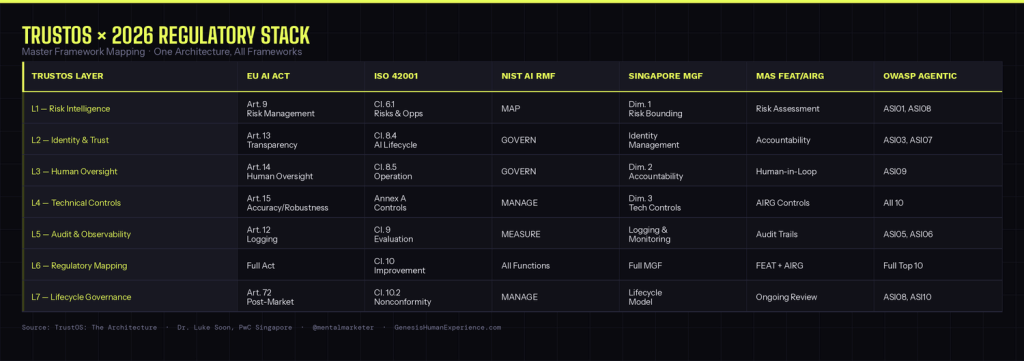
The regulatory landscape in 2026 is not one framework. It is a stack: EU AI Act (mandatory), ISO 42001 (certifiable), NIST AI RMF (US baseline), Singapore MGF (Asia-Pacific best practice), MAS FEAT/AIRG (Singapore financial sector), OWASP Agentic Top 10 (security standard), GDPR (data privacy), and jurisdiction-specific legislation.
Most organisations treat these as separate compliance programs. This is expensive, duplicative, and produces inconsistent governance. TrustOS treats them as a single, integrated requirement set — mapping each control once, satisfying multiple frameworks simultaneously.
The convergence is real: EU AI Act, ISO 42001, and NIST AI RMF share over 60% of their substantive requirements. The EU AI Act defines what is legally required; ISO 42001 provides the management system to demonstrate it; NIST AI RMF provides the methodology to implement it. Singapore’s MGF extends this to agentic-specific requirements that these global frameworks have not yet caught up to.
TrustOS is, to my knowledge, the only governance architecture explicitly designed to satisfy all of these simultaneously – with Singapore’s agentic-specific requirements as the leading edge.
The key question this layer answers: For every regulatory obligation and standard applicable to my AI deployments, can I point to a specific TrustOS control that satisfies it?
Layer 7 – Lifecycle Governance
What it governs: The governance of AI agents across their entire existence — design, development, deployment, operation, evolution, and retirement.
The most common governance failure is what I call the “deployment cliff”: organisations invest in pre-deployment risk assessment, build some controls, deploy the agent – and then governance stops. The agent operates in production, evolves through fine-tuning or prompt changes, is connected to new systems, operates in changing regulatory environments – and the governance doesn’t update.
IMDA MGF v1.5 addresses this explicitly through its lifecycle model. ISO 42001 requires ongoing conformance monitoring. NIST AI RMF’s Manage function covers post-deployment operation.
TrustOS’s lifecycle governance layer establishes:
• Mandatory re-assessment triggers (capability changes, new data access, new use cases, regulatory changes, incident events)
• Version governance: every change to an agent’s system prompt, tools, or memory architecture is a governance event
• Sunset criteria: conditions under which an agent should be retired rather than evolved
• Continuous conformance monitoring: real-time dashboards tracking governance status, not point-in-time snapshots
The key question this layer answers: Does my governance keep pace with how my agents change – and with how my regulatory environment changes?
TrustOS × the 2026 Regulatory Stack – The Master Mapping
The Business Case: Governance as Competitive Moat
Here is the number every board should know.
PwC’s 2026 AI Performance Study surveyed 1,217 senior executives across 25 sectors and found that 74% of AI’s economic value is being captured by just 20% of organisations – and those leaders are 1.7 times more likely to have a Responsible AI framework in place, and 1.5 times more likely to have a cross-functional AI governance board. Their employees are twice as likely to trust AI outputs.
These companies are 2.8 times more likely to have increased the number of decisions made without human intervention – enabled by a focus on “trust at scale.”
Read that again: the companies most willing to remove humans from the loop are the ones with the strongest governance. This is not a paradox. This is the commercial logic of TrustOS.
You cannot safely automate at scale without governance. You cannot govern effectively without architecture. You cannot build the architecture without knowing what it needs to do.
TrustOS is what it needs to do.
The organisations that operationalise TrustOS – or an equivalent architecture – in 2026 will be able to deploy agentic AI faster, at greater autonomy, with lower risk, and with defensible evidence for every regulatory and board question. The organisations that don’t will stay stuck in pilots, adding governance point solutions that don’t cohere, and missing the 80% of AI value that the leaders are capturing.
What TrustOS Is Not
I want to be precise about scope.
TrustOS is not a product you can buy off the shelf. It is an architecture and a methodology – one that PwC implements with clients through our LEAH AgentOS and broader AI governance practice.
TrustOS is not a replacement for any specific framework. It is the architecture that implements them all – simultaneously, coherently, with measurable evidence.
TrustOS is not a one-time deployment. It is an operating system. It runs continuously, updates with the environment, and governs every agent in its scope – from inception to retirement.
TrustOS is not only for large enterprises. The principles scale down. A 100-person FinTech deploying three agents needs Layers 1, 2, 3, and 5 at a minimum. The complexity of implementation scales with the complexity of deployment. The architecture itself is universal.
Starting Points
If you are reading this and thinking “I need this but don’t know where to begin” – here is the entry sequence.
Week 1: Build your AI agent inventory. You cannot govern what you cannot see. List every agent in production or development: its purpose, its tools, its data access, its autonomy level, the humans accountable for it.
Month 1: Apply Layer 1 (Risk Intelligence) to your inventory. Classify each agent by risk tier using IMDA MGF Dimension 1 criteria. Identify which agents are in the wrong tier for their current oversight level.
Quarter 1: Implement Layer 2 (Identity) and Layer 5 (Audit) for all Tier 1 and Tier 2 agents. These are your highest-risk deployments. Identity and audit trails are non-negotiable for EU AI Act compliance and MAS expectations.
Year 1: Full TrustOS implementation, with Layer 6 (Regulatory Mapping) documented for board and regulator presentation.
The governance window is open. The competitive advantage is available. The architecture exists.
Build it.


Leave a Reply