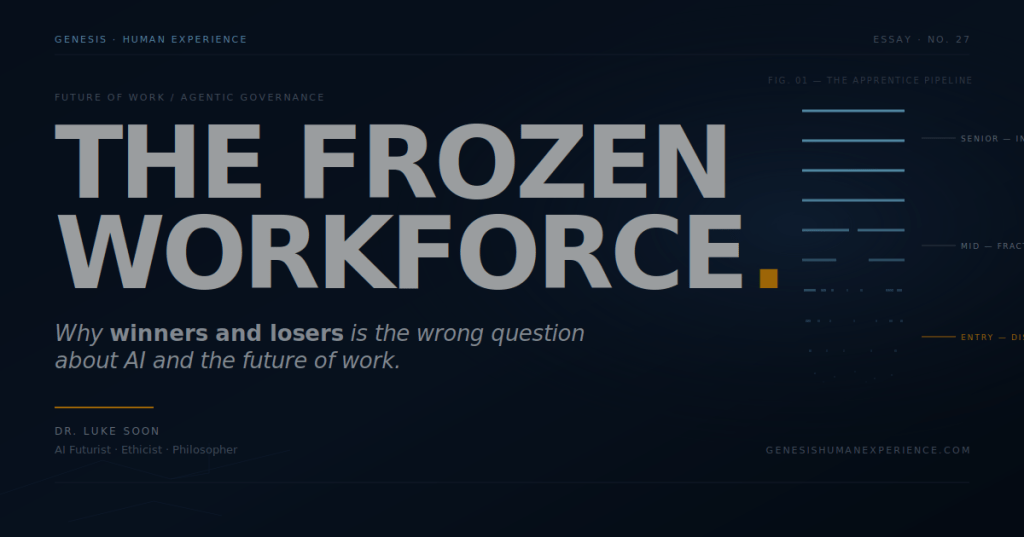

The question we keep asking is the question we should stop asking
The current debate at every leadership forum, every economist briefing, every Davos panel circles around the same framing: in the age of AI, who wins and who loses?
It is a comfortable question. It assumes a stable game with players on either side of a ledger. It assumes the productivity dividend is real, the only debate is its distribution, and the policy task is to redirect some surplus from winners to losers via taxes, dividends, or universal basic income.
That framing is wrong. Not because the distribution doesn’t matter – it matters enormously – but because it smuggles in three assumptions that the data is now actively dismantling:
1. That aggregate AI productivity gains are arriving on the timeline being priced into capex.
2. That displacement and reinstatement happen on the same clock, the way they did in previous technological waves.
3. That the labor market remains a market – that is, a place where prices clear, workers move, and employers compete.
Each of those assumptions is breaking. And the new shape of the labor market is not what most governance frameworks, my own earlier work included, were calibrated for.
The frozen workforce: displacement without firing
The most counterintuitive finding from real-time payroll data – the kind that comes from the platforms actually running tens of millions of paychecks every month, not from forecasts -is this: there are no mass layoffs. There is no Great Displacement event. The labor market in the most AI-exposed economies looks, on a layoff chart, almost serene.
What is actually happening is far more sinister. Hiring has slowed sharply. Quits have collapsed to a multi-year low. New-hire pay has been flat for more than a year. Workers are not being fired; they are being clung to. Employers are not hiring; they are waiting. Some economists have started calling this “job hugging.” I would call it the frozen workforce.
This is what AI-driven labor displacement actually looks like in 2026. Not pink slips. Not protests. Just a slow, quiet, almost invisible attrition – fewer roles posted, fewer ladders climbed, fewer people moving anywhere. The market freezes, and over time it sublimates.
Why does this matter for governance?
Because every regulatory and corporate governance framework I have written about, including the layered TrustOS architecture, was implicitly designed for a world where displacement is an event. Events have timestamps. Events have decision-makers. Events trigger audit trails. Frozen attrition has none of these. There is no moment when a CHRO decides to “replace the team with AI.” There is only a series of quiet decisions not to backfill, not to post, not to expand. By the time the workforce has hollowed out, there is no one to hold accountable, and no specific decision to govern.
This is the first incremental argument I would add to my prior writing on agentic governance: the next generation of AI governance must audit hiring decisions, not just operational AI outputs. The “Intent vs Action Auditor” layer in TrustOS needs a sibling – an Intent vs Inaction Auditor. Because in a frozen labor market, the governance failure is the absence of an action, not the presence of one.
Eating the apprentice: the structural crisis hiding inside the early-career data
If the frozen workforce is the macro story, the micro story is more brutal still. The tasks AI does best – drafting, summarizing, pattern-matching, basic coding, document review, first-pass analysis, customer triage – are precisely the tasks that traditionally sat at the bottom rung of every white-collar career ladder. They are the apprentice tasks. They are how a 22-year-old becomes a 32-year-old senior.
The data is now unambiguous: AI exposure creates a specific, concentrated vulnerability at the early-career stage. Entry-level finance, IT, professional services, junior law, junior consulting, junior engineering – these are the roles being absorbed first, fastest, and most completely.
We are eating the apprentice pipeline that produces the 2035 senior workforce. And we are doing it without a replacement mechanism.
This is not a “winners and losers” problem. It is a generational sabotage problem. The senior workers AI is augmenting today were trained in an apprenticeship model that AI is now dissolving. The compounding effect is what economists are missing: in ten years, when today’s seniors retire, there is no cohort behind them with the tacit knowledge, the pattern recognition, the relationship capital that only comes from having spent five years doing the boring, repetitive, AI-replaceable work.
This is the second incremental argument: HX (Human Experience) = CX + EX collapses in 2035 if we don’t govern the apprentice pipeline today. You cannot have an Employee Experience strategy in a decade if there are no employees with mid-career maturity. The CX side will be fine — agents will handle it. The EX side has no pipeline. And without EX, there is no organizational learning, no institutional memory, no human judgment in the loop where it matters most.
The governance implication is sharp and uncomfortable: every enterprise deploying AI agents at scale has a fiduciary obligation, not just an ESG one, to actively reconstruct the apprentice tier. Synthetic apprenticeship environments. Mandatory human-in-the-loop on tasks AI could do solo. Funded shadowing programs. Counter-economic in the short term. Existentially necessary in the long term. This is what “Trust by Design” actually means when extended from systems to careers.
The lag is not a transition. It is the steady state of ungoverned AI.
The most cited data point in current productivity debates is the gap between AI’s reported innovation impact and its reported earnings impact. Roughly two-thirds of organizations report AI is enabling meaningful innovation. Roughly four in ten report tangible EBIT impact at the enterprise level.
The conventional reading is that this gap is a transition lag. Adoption is ahead of integration; integration is ahead of measurement; measurement is ahead of attribution; eventually they converge.
I no longer believe this. After watching the same gap persist across multiple quarterly cycles in 2025 and 2026, with no convergence, I think we are looking not at a lag but at a structural feature of ungoverned AI deployment. The firms that pilot indefinitely are not in transition. They are stuck. They will remain stuck. The pilot trap is the stable state for organizations without operationalised governance.
This is a position I have been building toward in earlier writing – that “no governance means stuck in pilots; operationalized governance means autonomy at scale” — but the new data lets me sharpen it. The 64/39 gap is not a transition statistic. It is the bifurcation between governed and ungoverned deployments. The 39% who are realizing EBIT impact are disproportionately the firms with operating models, audit trails, intent-tracking, goal decomposition, and chain-of-thought visibility for their agentic systems. The other 61% are running pilots they cannot retire and agents they cannot trust enough to scale.
Governance is not the productivity tax. Governance is the productivity enabler. And the panel format that pits “automation accelerationists” against “labor protection skeptics” misses this entirely, because it treats governance as friction rather than as the load-bearing infrastructure that lets autonomy actually compound.
The 20-year tell
Here is something the discourse undersells, and it is worth dwelling on. The most aggressive automation-maximalist voices – the founders building companies whose explicit thesis is the full automation of the global wage bill – quietly publish timelines of 20 to 30 years for full automation of white-collar work. Some say 10 to 20. Few say less.
This matters. When the people whose entire commercial proposition depends on rapid full automation tell you, in their more sober moments, that the timeline is two to three decades, that is a tell. It cuts hard against the AGI-by-2027 narrative being used to justify both the capex bubble and the most extreme labor-replacement rhetoric.
For those of us building governance frameworks, this 20-year horizon is good news and bad news. Good news: we have time. The agentic AI systems being deployed now are not god-tier autonomous workers; they are narrow, fragile, task-decomposable systems that benefit enormously from the kind of layered oversight TrustOS describes. Bad news: most enterprises are making capex and workforce decisions on a 3-year horizon while the technology curves on a 20-year one. The mismatch in tempo is itself a governance problem. Boards are being asked to approve workforce reductions today against productivity claims that will not be testable for a decade.
This is the third incremental argument: enterprise governance must explicitly de-couple capex tempo from workforce tempo. The two run on different clocks. AI infrastructure investment is a 3-year decision. AI-driven workforce restructuring is a 15-year commitment. Treating them as the same decision, as most organizations currently do, locks in displacement on a tempo the technology cannot yet justify.
Why the redistribution argument is intellectually lazy
The standard response from the automation-maximalist camp to displacement concerns is some version of: even if wages decline, displaced workers can derive income from rents, dividends, and government transfers. Eventually we will live in radical abundance. UBI smooths the transition. The pie grows. Everyone is fine.
This is not an economic argument. It is a faith claim wearing economic clothing.
The political economy of “rents and dividends” assumes the displaced workers own assets that generate rents and dividends. They do not. Asset ownership in advanced economies is more concentrated than at any point in modern history. A frozen labor market that compresses wages while AI capital appreciates does not generate a redistribution opportunity; it generates a redistribution prerequisite that does not currently exist.
The political economy of UBI assumes a state with the fiscal capacity, political legitimacy, and administrative competence to tax AI-generated surplus and transfer it efficiently to displaced workers. The same governments currently struggling to enforce existing AI regulations, currently failing to coordinate on cross-border data flows, currently captured by the firms they are meant to regulate, are not the governments that will execute a flawless UBI transition.
I am not opposed to redistribution. I am opposed to using “we’ll figure out redistribution later” as a license to skip the governance work today. The honest version of the automation-maximalist argument is: “we are confident the political economy will sort itself out.” It will not sort itself out. It has never sorted itself out. The Industrial Revolution generated abundance and a century of immiseration before the political economy adjusted. The AI transition does not have a century to spare.
This is the fourth incremental argument, and the most provocative: redistribution is downstream of governance.
A society that cannot govern AI deployment cannot redistribute AI surplus. The current rush to debate UBI as a substitute for governance is the exact wrong order of operations. Govern the systems first. Audit the agents. Operationalize the trust layer. Then, and only then, does the redistribution debate become coherent.
What’s missing from the conversation
Three lanes are open, and the dominant Future of Work debate is not running in any of them.
First, the agentic-specific failure modes. Most economic analysis treats AI as a tool. Agents are not tools. Agents are workers – bounded, fragile, often misaligned, but workers. A productivity framework calibrated to “AI as software” misses the entire intent-action gap that agents introduce. We need new economic models for agentic deployment, and we need them now.
Second, the global-South distribution. The displacement-reinstatement debate is implicitly Northern. The BPO industries of Manila, Bengaluru, Nairobi, and Cebu are early-career economies for entire countries. When we talk about eating the apprentice pipeline, we are talking about hollowing out the development models of half the world. This barely registers in the leadership-forum discourse.
Third, the governance-as-competitive-advantage frame. The firms that operationalize AI governance first will compound. The firms that pilot indefinitely will stagnate. This is no longer a compliance argument. It is a strategy argument. And the boards that understand this in 2026 will own 2030.
What this means for the governance work
The conventional Future of Work conversation, even at its most thoughtful, is still asking who wins and who loses in a contest whose rules it has not specified. The sharper question is whether we have the governance infrastructure to make the contest fair, the timelines to make the transition humane, and the institutional capacity to keep humans meaningfully in the loop while agents do more of the work.
My prior position has been that operationalized AI governance turns pilots into autonomy at scale. I now want to extend it: operationalized AI governance is also the only credible mechanism for distributing the productivity dividend. Not because governance produces the dividend, but because ungoverned AI deployment produces a frozen workforce, a hollowed apprentice pipeline, and a structural EBIT lag – none of which generate a dividend to distribute.
The frozen workforce is not a temporary state. It is the equilibrium of ungoverned agentic deployment. Thawing it requires governance that audits inaction as well as action, protects the apprentice tier as well as the senior workforce, decouples capex tempo from workforce tempo, and treats the trust layer as productivity infrastructure rather than compliance overhead.
The winners-and-losers framing assumes the game is being played. In the frozen workforce, the game has stopped. Governance is what restarts it.
That is the work. The next decade will be defined not by the firms that automated fastest, but by the firms that governed best – and by the societies that built the infrastructure to make the transition something other than a slow, quiet erasure of the careers that were supposed to come next.
 Genesis: Human Experience in the Age of Artificial Intelligence | Synthesis: The Superintelligence Protocol
Leave a comment