
By Dr Luke Soon
1. The Agentic Shift — From Generative AI to Autonomous Collaboration
The year 2025 marks a decisive inflection point: we are transitioning from generative to agentic AI — from systems that respond to systems that act.
According to Google Cloud’s ROI of AI 2025 Report , 52% of enterprises using GenAI now deploy AI agents in production, and 88% of early adopters are already seeing tangible ROI.
Unlike traditional GenAI models confined to chat interfaces, Agentic AI couples reasoning, planning, and execution with external tool access — effectively closing the loop between intent, action, and outcome.
These agents represent the third wave of AI maturity:
Predictive AI (analytics and machine learning), Generative AI (content and reasoning), Agentic AI (autonomous orchestration and task execution).
At PwC, we view this as a trust-based transformation: humans and AI will increasingly share cognitive workloads, while governance, ethics, and interpretability form the scaffolding of responsible autonomy.
2. The Emerging Taxonomy of AI Agents
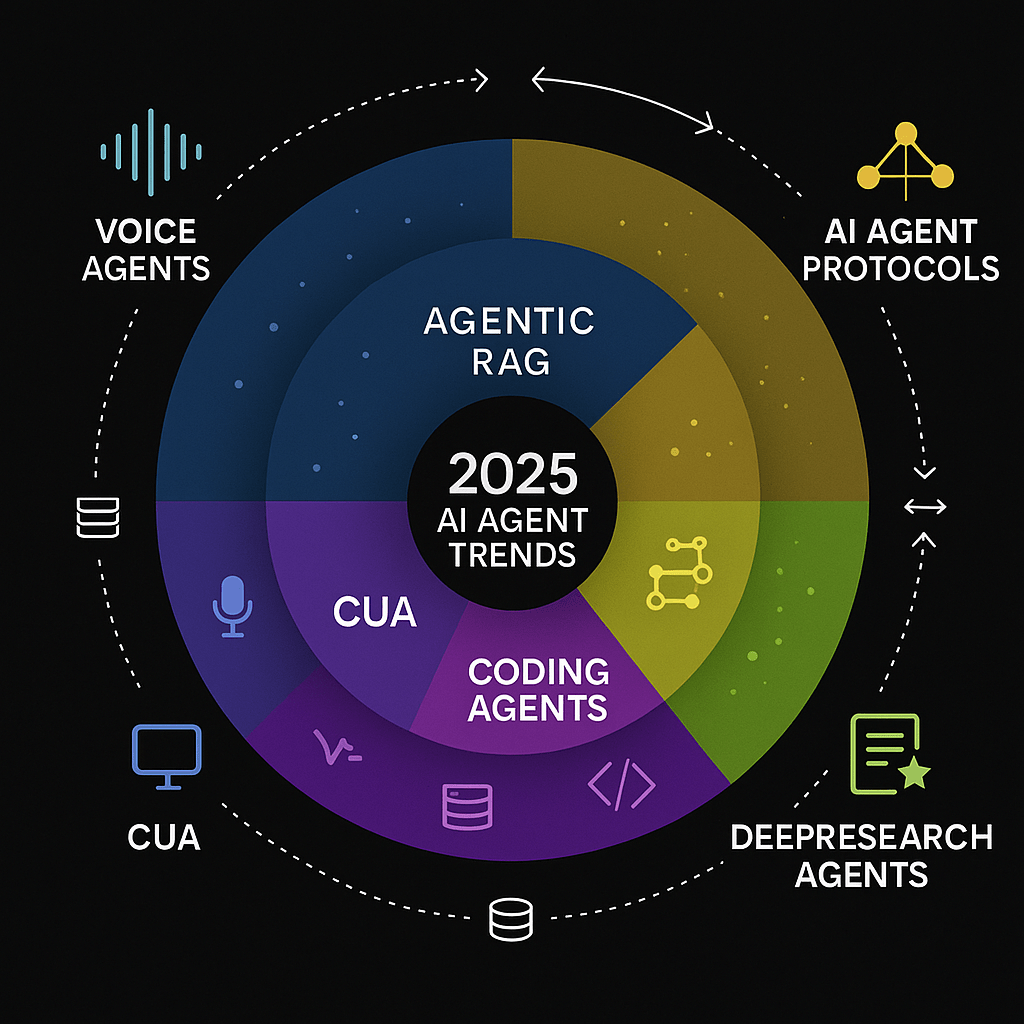
The “AI Agent Trends of 2025” infographic highlights six archetypes that are shaping enterprise transformation:
a. Agentic RAG (Retrieval-Augmented Generation Agents)
These agents combine memory, planning, and tool-use to deliver real-time reasoning across complex datasets.
They connect knowledge bases (e.g., Google Search, Perplexity, Glean, IBM watsonx) to internal enterprise systems.
Use Cases:
Financial analysts performing dynamic due diligence with cross-source citations. Healthcare researchers synthesising genomic and clinical trial data. Compliance officers running contextual policy checks with explainable citations.
Recent research: Lewis et al., “Retrieval-Augmented Generation for Knowledge-Intensive NLP Tasks” (NeurIPS, 2020) remains foundational, while 2025 implementations (OpenDevin, LangGraph, and IBM’s AgentX) demonstrate practical orchestration patterns.
b. Voice Agents
Leveraging embedding models and speech transformers (STT/TTS), voice agents deliver bi-directional natural language interaction.
Applications:
Banking voice concierges capable of transaction validation. Healthcare assistants guiding patients through post-discharge steps. Retail advisors conducting product recommendations in natural dialogue.
Technical Stack:
STT models (Whisper v3, Google’s AudioPaLM 2), TTS synthesis (OpenVoice, Bark), vector-based memory embeddings, and sentiment recognition pipelines.
Research References:
“AudioLM: A Language Modelling Approach to Audio Generation” (Borsos et al., Google Research, 2024). “End-to-End Neural Conversational Voice Agents” (Meta AI, 2023).
c. AI Agent Protocols (A2A, MCP, ACP, SLIM)
The 2025 landscape introduces Agentic Interoperability Protocols — a lingua franca for multi-agent collaboration.
Agents can now communicate across ecosystems (Google ADK, LangGraph, Cisco SLIM, Anthropic MCP).
Use Cases:
Multi-department enterprise automation (Finance ↔ HR ↔ IT). Cross-platform orchestration — e.g., a legal AI (Harvey) requesting audit data from a compliance AI (Stride). Multi-agent collaboration in software QA or risk assessment.
Technical Model:
A2A (Agent-to-Agent) protocol defines discovery, messaging, and capability sharing, akin to REST for distributed cognition.
Research:
Stanford HAI & MIT CSAIL joint work on “Protocols for Coordinated Multi-Agent Systems” (2025). Google DeepMind’s “Society of Mind 2.0” agent framework (Nature AI, 2025).
d. DeepResearch Agents
Inspired by systems like Perplexity’s DeepResearch and OpenAI o1-preview, these agents coordinate multiple sub-agents (Citation, Summarisation, and Validation agents) to generate evidence-backed research outputs.
Use Cases:
Investment houses automating ESG and equity research. Law firms drafting briefs with multi-source citations. Policy institutes producing real-time regulatory digests.
Architecture:
Aggregator Agent → Sub-agents (Citation, Summariser, Checker) → Memory + Tool Stack (Bing API, Scholar, LexisNexis).
PwC Perspective:
When integrated with our HX framework (CX + EX), DeepResearch Agents enable knowledge synthesis across organisational silos — a step toward collective intelligence ecosystems.
e. Coding Agents
AI development accelerators like Devin (Cognition Labs) and Cursor IDE Agents are revolutionising software engineering.
These agents autonomously write, debug, and test code within sandboxed environments.
Pipeline:
Agent → Code Generator → Debugger → Test Runner → Deployment Tools (Docker/Kubernetes).
Impact:
10× acceleration in build–test cycles. Seamless integration with CI/CD pipelines. Auto-healing production monitoring loops.
Use Cases:
Financial services: automating compliance code generation (e.g., AML, Basel III). Insurance: creating custom underwriting logic and scenario simulators. Retail: automated web performance tuning.
Key Research:
“Devin: The World’s First Fully Autonomous Software Engineer” (Cognition Labs, 2024). OpenDevin: A General Framework for Autonomous Coding Agents (MIT CSAIL, 2025).
f. CUA (Computer-Using Agents)
CUA (Computer Using Agents) bridge the digital–physical divide — operating software interfaces like humans do, via simulated mouse and keyboard interactions.
They leverage desktop sandboxes and vectorised observation models.
Use Cases:
Automated data entry into legacy systems (finance/ERP). HR onboarding workflows (form population, credential setup). Cybersecurity operations (log scanning, patch validation).
Key Technical Work:
AutoGPT’s CUA Plug-in (2024). Stanford’s WebVoyager and DeepMind’s SIMA (Scalable Instructable Multi-Agent) — showing cross-application learning via reinforcement imitation.
3. The ROI of Agentic AI
The Google Cloud 2025 survey across 3,466 senior leaders confirms that Agentic AI is no longer experimental.
88% of early adopters report positive ROI; 39% have more than 10 AI agents in production.
The top five ROI domains are:
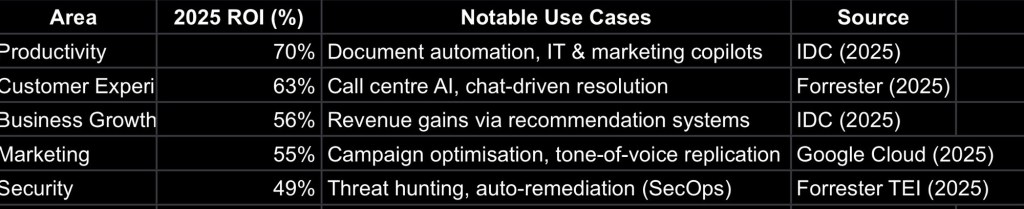
Example:
Google Cloud SecOps AI Agents saved US$1.2M over three years by replacing legacy tools. Customer Engagement AI improved routing efficiency by 207% ROI and 120 seconds saved per call. AI code agents yielded 50% more productive developers and 36% more efficient end users .
4. Financial Services: The Agentic Frontier
The financial sector — long reliant on automation — is now at the vanguard of agentic orchestration.
Key Use Cases:
AI Risk Agents autonomously triaging alerts, correlating anomalies, and drafting incident reports. KYC/AML Agents performing ongoing customer risk scoring and regulatory reporting. Portfolio Agents synthesising macroeconomic, ESG, and client intent data for adaptive recommendations. Agentic RAG systems in private banking enabling advisors to converse with enterprise data in real-time.
Research & Industry Examples:
Deutsche Bank’s AI VC Group using internal multi-agent frameworks for compliance and innovation monitoring. J.P. Morgan’s LOXM 2.0 now integrated with reasoning agents for liquidity optimisation. PwC’s AgentOS in pilot across asset and wealth management — integrating LangGraph and MCP for controlled autonomy.
5. Challenges and Trust Guardrails
Despite momentum, data privacy (37%), system integration (28%), and cost management (27%) remain primary obstacles .
Enterprises must therefore architect Responsible Autonomy Frameworks anchored on:
Human-in-the-loop oversight for explainability. Data lineage verification for provenance integrity. Ethical policy embedding (AI Bill of Rights, AI Verify, ISO/IEC 42001). Agentic safety platforms — to monitor memory leakage, prompt injection, and self-modification risk.
As AI systems evolve toward self-correcting “societies of agents,” safety scaffolds become as vital as the agents themselves.
6. Outlook: HX in the Age of Agentic AI
We stand at the dawn of Agentic Human Experience (HX) — where CX (Customer Experience) and EX (Employee Experience) converge under intelligent orchestration.
AI agents will not replace human agency; they will amplify it, redistributing cognitive load and unlocking new creative bandwidth.
In the next five years, expect:
The emergence of Agent Markets (akin to App Stores). The rise of Agent Governance Boards (akin to ethics committees). Standardised Agent Performance KPIs (latency, accuracy, alignment).
As Geoffrey Hinton presciently noted, “We are no longer programming intelligence — we are cultivating it.”
The agentic age is not about automation; it’s about symbiosis — a new social contract between humans and machines.
References:
Google Cloud (2025). The ROI of AI 2025: How Agents Unlock the Next Wave of Business Value. Forrester Consulting (2025). The Total Economic Impact™ of Google SecOps & Customer Engagement Suite. IDC (2025). The Business Value of Google Cloud Generative AI. Stanford HAI (2025). Protocols for Multi-Agent Collaboration. MIT CSAIL (2025). OpenDevin: A Framework for Autonomous Coding Agents. PwC (2025). AI Jobs Barometer & AgentOS Research.


Leave a Reply