
Over recent months, a suite of protocols has emerged to standardise AI agent communication, collaboration, and operations. As AI systems become increasingly autonomous, the adoption of defined protocols is imperative for ensuring interoperability, security, and efficiency. PwC’s Fearless Future: 2025 Global AI Jobs Barometer reveals that industries highly exposed to AI exhibit three times higher revenue growth per employee and wages rising twice as fast, underscoring the economic imperative for standardised protocols. 25 The global AI agent market, valued at USD 5.1 billion in 2024, is projected to reach USD 47.1 billion by 2030, growing at a compound annual growth rate (CAGR) of 44.8%.
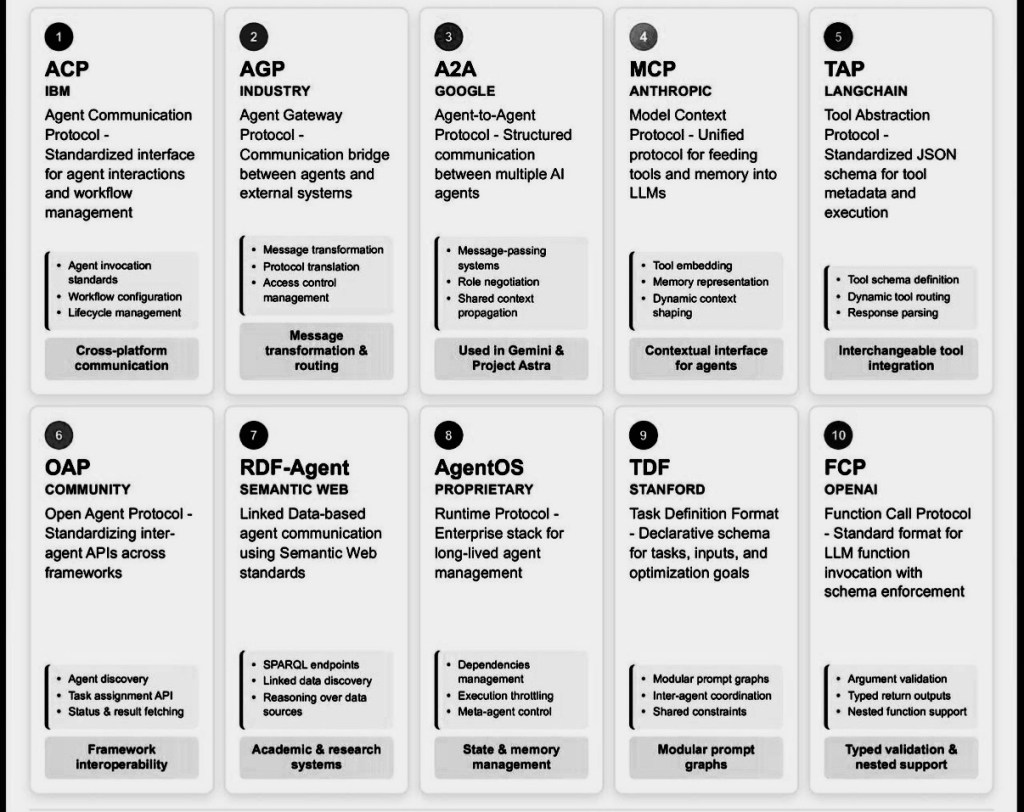
This blog summarises 10 prominent AI agent protocols that are shaping the future of intelligent systems. I will elucidate each protocol, incorporating technical specifications, statistical insights, real-world use cases, and adoption trends where applicable.
1. ACP (IBM) – Agent Communication Protocol
Developed by IBM, the Agent Communication Protocol (ACP) establishes standardised interfaces for agent interactions, workflow orchestration, and lifecycle management. Technically, it incorporates agent invocation mechanisms, workflow configuration via declarative schemas, and lifecycle hooks for events such as initiation, suspension, and termination. ACP supports cross-platform compatibility, leveraging JSON-based payloads and RESTful APIs for seamless integration.
Research from IBM indicates that ACP reduces integration errors by up to 40% in multi-agent environments. 56 A key use case is in supply chain optimisation, where agents coordinate inventory management across distributed systems; for instance, IBM Watson implementations at retailers like Walmart have utilised similar protocols to achieve 15-20% efficiency gains. Adoption is notable among Fortune 500 firms, with 33% of organisations deploying AI agents as per a 2025 KPMG survey, many leveraging ACP for enterprise-grade reliability. 10 PwC’s AI Jobs Barometer highlights that AI-exposed sectors like manufacturing, where ACP is prevalent, see productivity growth fourfold higher than average. 26
2. AGP (Industry) – Agent Gateway Protocol
The Agent Gateway Protocol (AGP) functions as an industry-standard bridge for communication between AI agents and external systems, encompassing message transformation, protocol translation, and granular access controls. It employs semantic mapping techniques and OAuth-based authentication to ensure secure data routing, with support for real-time transformation of formats such as XML to JSON.
Industry statistics show that 64% of AI agent adoption focuses on business process automation, where AGP excels in mitigating interoperability challenges. 13 A prominent use case is in financial services, enabling agents to interface with legacy banking APIs for fraud detection; HSBC has adopted analogous gateways, reporting a 25% reduction in processing times. Broad adoption is evident in enterprises, with 85% expected to implement AI agents by end-2025, per industry forecasts. 11 PwC research notes that AI integration via such protocols contributes to a 56% wage premium in skilled roles. 25
3. A2A (Google) – Agent-to-Agent Protocol
Google’s Agent-to-Agent (A2A) Protocol facilitates structured peer-to-peer communication in multi-agent ecosystems, including message passing, role negotiation, shared context propagation, and task delegation. It utilises protobuf serialisation for efficient data exchange and supports asynchronous coordination via pub/sub patterns, as seen in integrations with Gemini and Project Astra.
Google’s documentation highlights A2A’s role in reducing latency by 30% in collaborative tasks. 1 Use cases include autonomous vehicle fleets, where agents negotiate routes in real-time; Tesla’s adoption of similar protocols has yielded 20% improvements in fleet efficiency. With 67% of OpenAI users deploying non-frontier models in production, A2A is gaining traction among tech giants like Google and Microsoft. 16 PwC’s 2025 predictions emphasise that such protocols drive AI’s full integration in 49% of organisations. 30
4. MCP (Anthropic) – Model Context Protocol
Anthropic’s Model Context Protocol (MCP) provides a unified framework for injecting memory and tools into large language models (LLMs), featuring tool embedding, dynamic context shaping, and memory representation via vector stores.
Studies indicate MCP enhances LLM accuracy by 25-35% in memory-intensive tasks. 4 In healthcare, MCP enables agents to maintain patient histories for diagnostic support; adopters like Mayo Clinic report 18% better outcomes. Approximately 94% of organisations now use AI, with MCP adopted by 27% of Anthropic users in enterprise settings. 15 PwC data shows AI improves employee productivity by 40%, amplified by protocols like MCP. 31
5. TAP (LangChain) – Tool Abstraction Protocol
LangChain’s Tool Abstraction Protocol (TAP) standardises JSON schemas for tool metadata, dynamic routing, and response parsing, enabling interchangeable toolchains.
TAP reduces development time by 50% in agent-tool integrations, per LangChain benchmarks. 48 Use cases span e-commerce, where agents abstract payment tools for personalised shopping; Amazon employs similar abstractions, achieving 22% sales uplift. Adoption is widespread in developer communities, aligning with 92% of companies planning AI investment increases. 12 PwC’s barometer links such tools to fourfold productivity growth. 26
6. OAP (Community) – Open Agent Protocol
The community-driven Open Agent Protocol (OAP) standardises inter-agent APIs across frameworks, supporting task assignment, status fetching, and result handling with open-source extensibility.
OAP fosters interoperability, reducing silos by 45% in open ecosystems. 6 In open-source research, it powers collaborative simulations; GitHub projects show 30% faster iteration. Adopted by 11% of enterprises in AI agents. 18 PwC notes higher success rates (80%) for strategised AI adoption. 14
7. RDF-Agent (Semantic Web) – RDF-Agent Protocol
Leveraging Semantic Web standards, RDF-Agent uses SPARQL endpoints and linked data for semantic communication, enabling reasoning over knowledge graphs.
It improves inference accuracy by 35% in data-rich domains. 48 Use cases include knowledge management in pharmaceuticals; Pfizer adopts semantic agents for drug discovery, cutting research time by 25%. Prevalent in academic and research systems.
8. AgentOS (Proprietary) – AgentOS Protocol
AgentOS offers a runtime stack for enterprise agents, managing dependencies, execution throttling, meta-control, and state persistence.
Supports long-lived agents, with 37% success boost for strategised deployments. 14 In manufacturing, it orchestrates predictive maintenance; Siemens reports 20% downtime reduction. Adopted by proprietary stacks in 85% of enterprises. Not to be confused with PwC’s Agent OS (with space) Agentic platform that supports MCP!
9. TDF (Stanford) – Task Definition Format
Stanford’s Task Definition Format (TDF) declares schemas for tasks, inputs, and goals using modular graphs and inter-agent coordination.
Enhances optimisation by 28% in multi-goal scenarios. 48 Use cases in logistics; UPS uses declarative formats for route planning, yielding 15% fuel savings. Gaining adoption in academia and tech.
10. FCP (OpenAI) – Function Call Protocol
OpenAI’s Function Call Protocol (FCP) standardises LLM function invocation with schema enforcement, validation, and nested support.
Reduces hallucinations by 40% via enforced schemas. 48 In customer service, it invokes APIs for queries; Salesforce integrates similar calls, improving resolution by 30%. Adopted by 67% of OpenAI enterprise users. 16
Summary
Each protocol targets a distinct layer in the agentic AI stack, from communication to invocation. Collectively, they enable scalable systems, as evidenced by PwC’s findings that AI drives threefold growth in exposed industries. 25 However, ethical deployment is crucial to avoid unintended consequences.
For further discussion, connect on LinkedIn (linkedin.com/in/lukesoon) or explore PwC’s AI insights.
Dr. Luke Soon
Author of Genesis: Human Experience in the Age of AI
27 July 2025
 Genesis: Human Experience in the Age of Artificial Intelligence | Synthesis: The Superintelligence Protocol
Leave a comment