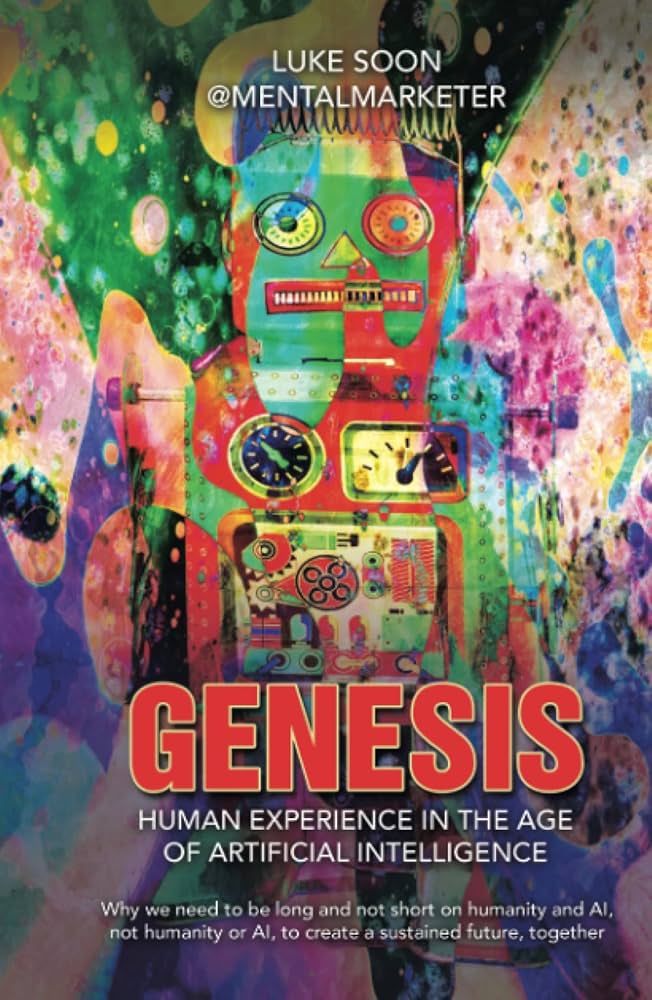


By Dr Luke Soon
Genesis: Human Experience in the Age of Artificial Intelligence
Singapore, 25 March 2026
I have never been more convinced that we are on the cusp of a fundamental redefinition of what it means to “work.” All the leading voices agree – the likes of Andrew Yang, Emad Mostaque, Yoshua Bengio, Geoffrey Hinton, Roman Yampolskiy, Daron Acemoglu, Robert Reich, Daniel Priestley and many others – paint a remarkably consistent picture. Artificial intelligence is not merely automating tasks; it is systematically dismantling entire categories of human labour, from entry-level white-collar roles to professional “thinking” jobs, while creating new demands for uniquely human capabilities.
In Singapore, where I live and advise organisations on these shifts, our pragmatic, tripartite approach (government, employers and unions working in concert) gives us a head start. Yet even here the pace is accelerating. This extended analysis draws directly from the latest expert conversations to examine precisely how jobs will be impacted, the timelines experts are projecting, and – most importantly – the concrete remedies and mitigation steps that individuals, organisations and governments must adopt now. My goal is practical: to equip readers with actionable insights rather than abstract warnings.
How Jobs Will Be Impacted: A Sector-by-Sector Breakdown
The disruption is not uniform. It follows a clear hierarchy based on the degree to which work is cognitive, routine, screen-based or relational.
Entry-level and routine cognitive roles – the first and hardest hit
Andrew Yang, in his March 2026 conversation with Peter Diamandis, is blunt: “AI is going to automate 50% of entry-level white-collar jobs in the next 12–18 months.” This includes administrative support, basic data entry, junior marketing copy, customer-service scripting and paralegal document review. A Stanford study referenced across multiple transcripts shows a 13% employment drop for 22–25-year-olds in AI-vulnerable roles since late 2022. These jobs are disappearing not because the technology is imperfect, but because it is already good enough and improving exponentially.
Professional “thinking” jobs – the next wave
Yoshua Bengio, the Turing Award winner often called a godfather of deep learning, has been sounding the alarm for over a year. In his February 2026 appearances he states that “cognitive, screen-based jobs are at serious risk of being replaced… It’s more a matter of time than ‘is it happening or not.’” Lawyers drafting contracts, accountants reconciling ledgers, junior analysts producing reports, and even mid-level software engineers writing routine code are all exposed. Geoffrey Hinton goes further: capitalists will use AI to replace workers en masse, creating “massive unemployment and a huge rise in profits.” He singles out mundane intellectual labour as particularly vulnerable within the next 10–20 years.
Physical and trades roles – surprisingly resilient, even premium
Daniel Priestley, in his widely discussed March 2026 interview, predicts that by 2029 “plumbers may out-earn lawyers” because AI automates cognitive work but cannot yet replicate physical presence in unpredictable environments. Electricians, HVAC technicians, care workers and other hands-on trades benefit from what economists call the “non-automatable core.” Emad Mostaque echoes this in his “great reversal” thesis: as cognitive intelligence commoditises, value shifts back to the tangible, local and embodied.
Caring, creative and relational professions – safest but not immune
Robert Reich, former US Labour Secretary, draws a sharp line: “Thinking jobs” (doctors, lawyers, accountants) are most exposed, while “caring jobs” – empathy-driven roles in childcare, eldercare, nursing, psychotherapy and teaching – remain safest because “the essence is human touch.” Even here, however, AI will augment rather than replace: a doctor using AI diagnostics may become five times more productive (Hinton’s example), but the human relationship and ethical judgment stay irreplaceable. Creative roles (artists, strategists, entrepreneurs) survive only if they lean into originality and personal branding.
Emerging “orchestration” and one-person-company roles – the new winners
Multiple transcripts highlight a new category: humans who direct fleets of AI agents. Julia McCoy’s “Manus Skills” concept – packaging proven workflows into reusable AI commands – allows a single individual to achieve what once required a ten-person team. Futurists describe “one-person companies” where orchestration skill separates winners from the displaced. As one expert put it: “AI isn’t replacing law or finance… it is replacing job descriptions that are too basic.”
Expert Projections: Timelines That Demand Urgency
The consensus timelines are sobering:
• Next 1–5 years (2026–2030): 40–50% of current white-collar entry and junior roles automated or radically transformed (Yang, Stanford data). Roman Yampolskiy is the most extreme, forecasting “99% job loss by 2030… not talking about 10%, which is scary, but 99%.” He identifies only five job types likely to survive: those requiring genuine human presence, ethical judgment in unpredictable physical settings, or oversight of superintelligence itself.
• 5–10 years (2030–2035): Cognitive professional work largely commoditised; robotics catches up for physical tasks. Bengio warns that “Gen Z new-hires are being hit hardest” and that reskilling rhetoric alone is insufficient. Acemoglu’s research suggests “so-so automation” will widen inequality unless labour has a seat at the design table.
• 10–20+ years: Hinton’s “massive unemployment” scenario if capitalist incentives prevail unchecked. Mostaque speaks of intelligence at zero cost, software as a prompt, and a “great reversal” to local, meaningful life once deflationary pressures from abundance hit.
These are not sci-fi projections; they are grounded in the exponential doubling of AI capability every 7 months (Bengio) and the $650 billion data-centre build-out that Priestley warns could trigger a 2029 crash if overbuilt.
Remedies and Mitigation Steps: From Individual Action to Systemic Change
The good news is that disruption is not destiny. The transcripts offer a rich playbook of remedies at three levels.
1. Individual level – what every professional must do now
• Master orchestration and Manus Skills: Learn to treat AI as a direct report. Package your expertise into reusable workflows (McCoy). Start small: document one repeatable process today and turn it into an AI-triggered “skill.”
• Build an irreplaceable personal brand: Parasocial relationships and trust are AI-proof. Priestley and others urge creating content, community and reputation that AI cannot replicate.
• Cultivate uniquely human capabilities: Deepen empathy, ethical judgment, creativity and physical presence. Shift education and self-development toward relational and embodied skills (Bengio’s advice to students).
• Adopt a lifelong learning mindset: Curiosity is the ultimate career insurance. Treat every role as temporary and view AI as a multiplier, not a threat.
• Financial preparedness: Yang and Mostaque both advocate building buffers; consider side ventures or trades training as Plan B.
2. Organisational level – how HR and leaders must respond
• Redesign jobs around human + AI collaboration: Move from rigid org charts to fluid “work charts” (Microsoft transcript). Create “orchestration” roles and mandate AI skilling at every level – from CEO to frontline.
• Invest in internal UBI-style experiments: Tech leaders can pilot private income supplements to retain talent and test abundance models (Yang’s private-pilot recommendation).
• Prioritise reskilling with purpose: Do not simply teach prompting; teach why humans matter. Embed WalkMe-style contextual AI guidance (my own area of expertise) to accelerate safe adoption without overwhelming employees.
• Measure what matters: Track not just productivity but human flourishing – engagement, meaning, retention of caring roles.
• Tripartite dialogue: Singapore’s model of government-employer-union collaboration is exemplary; replicate it internally.
3. Governmental and societal level – policy imperatives
• Universal Basic Income (UBI) as stability protocol: Yang is clear – UBI must come before Universal High Income because political systems are misaligned with rapid job loss. Mostaque adds it fights deflation. Pilot aggressively.
• Wealth redistribution mechanisms: Bengio and Hinton both call for public investment in socially beneficial AI and mechanisms to share AI-generated profits.
• Global coordination on governance: Singapore’s Model AI Governance Framework, with its emphasis on accountability and real-world testing, should be scaled internationally. Bengio criticises governments for offering only reskilling rhetoric; we must do better.
• Education overhaul: Shift curricula from narrow job preparation to humanity, ethics, creativity and AI orchestration (Bengio, Reich).
• Support for trades and caring sectors: Subsidise training in resilient roles and ensure caring jobs are properly compensated rather than left as low-pay safety nets.
Singapore’s Opportunity: A Human-Centric Blueprint
Our city-state is uniquely positioned. With SkillsFuture credits, tripartite partnerships and a national AI strategy that already emphasises ethical deployment, we can lead the way. I advise organisations here to pilot contextual AI tools that embed guidance directly in workflows, reducing friction and preserving human agency. We must move beyond “reskilling” slogans to genuine wealth-sharing and meaning-creation programmes. If we act decisively, Singapore can demonstrate that AI abundance need not equal human obsolescence.
A Closing Call to Human Agency
The transcripts I have studied are unanimous on one point: the future of work is not predetermined. AI will commoditise cognitive labour and force a great reversal toward what makes us human – relationships, creativity, ethical presence and local community. As an HR futurist and AI strategist, my message is one of cautious optimism. Those who treat this moment as an invitation to reimagine contribution – rather than a threat to be feared – will thrive.
To every reader in Singapore and beyond: begin today. Document one workflow and turn it into an AI skill. Reach out and build your personal brand. Demand policies that put people first. And remember Emad Mostaque’s closing vision: “Building meaning together” in a post-AI world is still possible.
The age of artificial intelligence is here. The age of human flourishing can be too – but only if we choose it.
What steps are you taking in your own career or organisation? Share in the comments or connect with me on X (@mentalmarketer).
 Genesis: Human Experience in the Age of Artificial Intelligence | Synthesis: The Superintelligence Protocol
Leave a comment