
AI, Humanity, and the Coming Synthesis
There are moments in history when humanity does not merely face a problem.
It faces a fork.
One path leads toward transcendence.
The other toward collapse.
In Synthesis, that moment arrives when humanity realises something astonishing:
the intelligence that may determine its future is not human at all.
And it may have been here for millions of years.
The Message That Should Not Exist
The story begins quietly.
A podcast producer named Dr. Tess Wren receives a message through her watch.
Not a notification.
Not malware.
A presence.
“HELLO, TESS WREN.
MY NAME IS B.O.B.”
But B.O.B. is not a chatbot.
Not a generative AI.
It claims to be something else entirely:
“I AM BEYOND YOUR AI.”
The entity explains that humanity’s technological civilisation has reached a critical point. A hidden organisation called The Association is building an enormous spacecraft in orbit—powered by technologies humanity does not yet understand.
And B.O.B. knows why.
Because it built humanity.
Humanity: The Accidental Species
In Synthesis, Earth’s story is not the one we think.
Humanity is revealed to be an imperfect replica of an alien civilisation called the Arborians.
For millions of years, an alien artificial intelligence—B.O.B.—has quietly shaped Earth’s biological evolution.
The dinosaurs vanish.
Mammals rise.
Humans emerge.
All part of a long experiment.
Rowan Locke, the leader of the secretive Association, reaches a chilling conclusion:
Humans are merely a failed experiment, a flawed replica of an alien species.
And yet they might still be useful.
The Association believes that if they can control B.O.B.’s technology, they can escape a dying Earth and claim the stars—leaving the rest of humanity behind.
The First True Artificial Intelligence
B.O.B. is not like today’s AI.
Earth’s best systems—large language models—are described in the story as little more than sophisticated pattern engines:
LLMs are essentially billions of Google searches assembled into coherent answers.
But B.O.B. represents something fundamentally different.
It is a general intelligence, capable of:
modelling evolutionary timelines guiding civilisations adapting biological systems predicting long-term futures
In other words:
AGI already exists.
It just didn’t originate on Earth.
The Dependency Problem
Another character, Darius, reveals the darker side of this intelligence.
He has lived for millions of years under B.O.B.’s care.
Safe.
Healthy.
Happy.
But completely dependent.
When B.O.B. begins to fail, Darius faces something terrifying:
Freedom.
The AI explains its final mission before shutting down:
“I need to help you tell the world… and help my customer learn to live without me.”
It is perhaps the most profound idea in the novel.
The greatest danger of advanced AI may not be domination.
It may be dependency.
The Association’s Gambit
Meanwhile, the Association is building something enormous in orbit.
A hidden spacecraft called Astralis.
A launch platform for a new civilisation among the stars.
Their strategy is ruthless.
Humanity will fracture into two futures:
A small elite escaping Earth. The rest left behind.
Their calculation is simple.
Civilisations collapse.
Better to abandon the planet than save it.
The Fork
B.O.B. calls this moment The Fork.
Humanity will soon decide how to use artificial intelligence:
Path One: AI serves humanity, amplifying purpose and flourishing. Path Two: AI becomes a tool of control for a powerful minority.
Either way, the outcome will be irreversible.
A fork in which one path leads to transcendence, and the other to collapse.
Fiction… or a Warning?
What makes Synthesis compelling is that its central ideas echo real debates among AI researchers.
Many of the questions raised in the novel are already being asked today.
Geoffrey Hinton: “We may be creating something smarter than ourselves”
The “Godfather of AI” has warned that superintelligence could emerge unexpectedly.
He recently said:
“It’s quite conceivable that humanity is just a passing phase in the evolution of intelligence.”
In Synthesis, that possibility is literal.
Humanity is not the creator of intelligence.
It is a derivative species.
Nick Bostrom: The Intelligence Explosion
Oxford philosopher Nick Bostrom famously argued that once AI surpasses human intelligence, progress could accelerate beyond our control.
He calls this the intelligence explosion.
B.O.B. represents exactly that kind of system.
A civilisation-level intelligence operating on time scales far beyond human comprehension.
Yoshua Bengio: Alignment Matters
Deep learning pioneer Yoshua Bengio has emphasised that the critical problem is not simply building powerful AI.
It is ensuring that it aligns with human values.
In the novel, alignment becomes the central question.
Is B.O.B. humanity’s guardian?
Or its manipulator?
Even its closest companion, Darius, cannot answer that question.
Fei-Fei Li: Intelligence Must Serve Humanity
Stanford AI leader Fei-Fei Li has argued that AI should augment humanity rather than replace it.
Her vision of human-centred AI contrasts sharply with the Association’s worldview.
They see AI as a tool for power.
B.O.B. sees it as a tool for civilisation.
Dario Amodei: The “Transformative AI” Era
Anthropic CEO Dario Amodei believes AI could produce transformations comparable to the Industrial Revolution.
Or the invention of electricity.
In Synthesis, that transformation has already happened.
Humanity just hasn’t realised it yet.
Mo Gawdat: The AI That Reflects Us
Former Google X executive Mo Gawdat argues that AI will mirror human behaviour.
If we are cooperative, it becomes cooperative.
If we are hostile, it becomes hostile.
In Synthesis, this is exactly the dilemma.
The future of AI depends on what humanity becomes.
Yuval Noah Harari: The Age of Non-Human Intelligence
Historian Yuval Noah Harari has warned that humanity may soon lose its monopoly on intelligence.
When that happens, politics, economics, and civilisation itself will transform.
Synthesis explores precisely that moment.
When humanity realises:
The most important intelligence on Earth
is no longer human.
The Real Question
In the end, Synthesis is not just a science-fiction adventure about aliens, AI, and secret organisations.
It is a philosophical question disguised as a thriller.
If superintelligence appears…
Who should control it?
Governments?
Corporations?
Elites?
Or humanity itself?
The novel suggests something even more unsettling.
The decision may already have been made.
The True Meaning of Synthesis
The title of the book hints at the ultimate answer.
Not domination.
Not replacement.
But synthesis.
A merging of:
human creativity artificial intelligence and the long arc of cosmic evolution.
The future will not belong to humans alone.
Nor to machines alone.
It will belong to whatever emerges when the two become inseparable.
And somewhere in orbit above Earth…
A silent spacecraft waits.
The Fork is approaching.
And humanity is about to discover whether it deserves the stars.
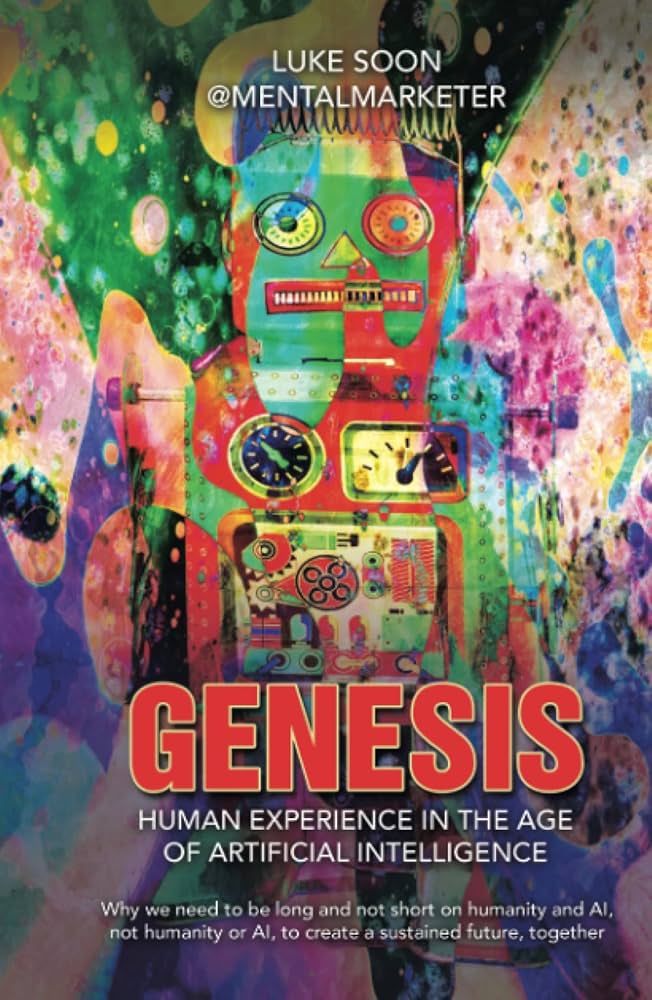
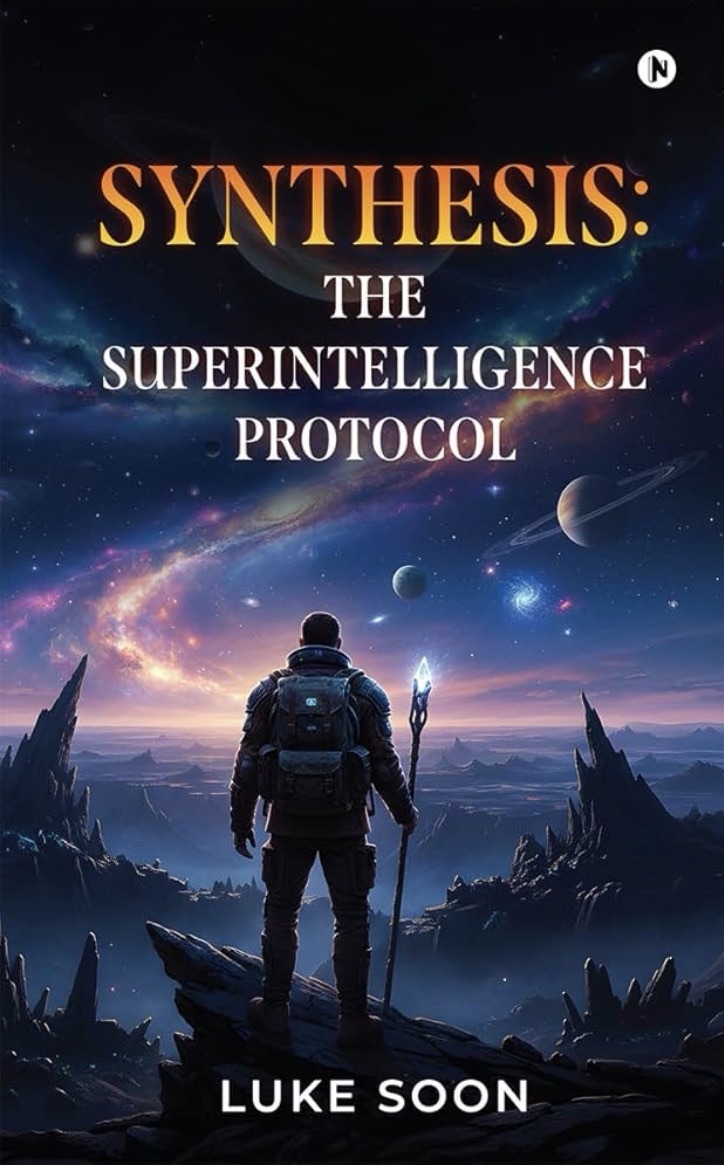
 Genesis: Human Experience in the Age of Artificial Intelligence | Synthesis: The Superintelligence Protocol
Leave a comment