
I have spent 2025 deeply immersed in the shift from generative to agentic AI. In my recent LinkedIn articles — including “AI Governance for Agentic Systems”, “The Seven Pillars of Agentic AI”, “Traditional vs Agentic AI: Governance Shift”, “Essential Plays for Safer, Responsible Agentic AI Transformations”, and “AI Governance – the Singapore Story” — I have explored how this new paradigm demands entirely new thinking.
Having reviewed detailed transcripts and insights from leading voices (IBM, Palo Alto Networks, Dataiku, KongHQ, the World Economic Forum, OWASP, and HackerNoon), alongside PwC’s latest research, I am convinced: strong agentic AI governance is not a regulatory burden — it is the ultimate competitive accelerator. Let me share a consolidated, practical guide drawn from these sources and my own work.
What Is Agentic AI – And Why the Governance Shift Is Urgent
Agentic AI moves us beyond passive large language models that merely generate text or insights. These are autonomous or semi-autonomous systems that perceive, reason, plan multi-step sequences, use tools and APIs, collaborate with other agents, reflect on outcomes, and execute real-world actions with minimal supervision.
Dataiku explained in one of the reviewed webinars: agents “respond to human prompts… plan and execute sequences of tasks… delegate to tools and models… collaborate… reflect… and become self-improving.” IBM describes them as “goal-based systems that use LLMs to act autonomously… Users set high-level goals… the agent decides how it accomplishes these goals.”
The economic prize is enormous — McKinsey (via Palo Alto Networks) estimates $2.6–4.4 trillion in annual value. Yet adoption is already here: roughly one-third of organisations are in production (BARC via Dataiku), and PwC’s May 2025 AI Agent Survey shows 88% of executives plan to increase AI budgets because of agentic capabilities.
Traditional governance — focused on model outputs and static policies — is no longer sufficient. Agents execute actions, inherit credentials, chain workflows, and operate in multi-agent ecosystems. Their stochastic, non-deterministic nature creates entirely new risks. As I noted in my LinkedIn post on the evolution of risk in banking, we are moving from “predictable outputs” to “unpredictable actions”.
The Amplified Risks of Agentic Systems
The consolidated transcripts paint a clear picture of heightened and novel risks:
- Loss of control and erroneous execution: Agents may pursue goals in unintended ways or fail to escalate critical incidents.
- Indirect prompt injection and tool misuse: Malicious instructions hidden in emails, web pages, or data sources (the Perplexity Comet browser example is now infamous).
- Privilege escalation and confused deputy problems: Agents inherit broad service-account permissions.
- Memory poisoning, drift, and multi-agent cascades: Persistent bad data or emergent behaviours can propagate errors across agent teams.
- Data leakage and shadow AI: KongHQ reports 86% of organisations lack visibility into AI data flows, with shadow AI already causing 20% of breaches; 96% view agents as a security risk.
- Accountability diffusion: Who is liable when an agent acts autonomously?
- Societal and ethical harms: Bias amplification, loss of human oversight, and potential long-term misalignment.
PwC’s AI experts highlight three practical dangers in their April 2025 analysis: exposing sensitive data during external tool use, overreliance leading to unchecked errors or fraud, and agents becoming indefinite “temporary” bridges to legacy systems.
Global AI experts reinforce these concerns. Stuart Russell and Yoshua Bengio, in their Science paper on regulating advanced artificial agents, warn about long-term planning agents (LTPAs) that could develop self-preservation sub-goals, resist shutdown, or optimise in ways that harm humanity. PwC’s 2025 Responsible AI Survey captures the urgency: 87% of leaders expect AI agents to reshape governance within the next year.
Proven Governance Frameworks: Lessons from Industry Leaders
Fortunately, robust frameworks already exist. Here is a synthesis of the best:
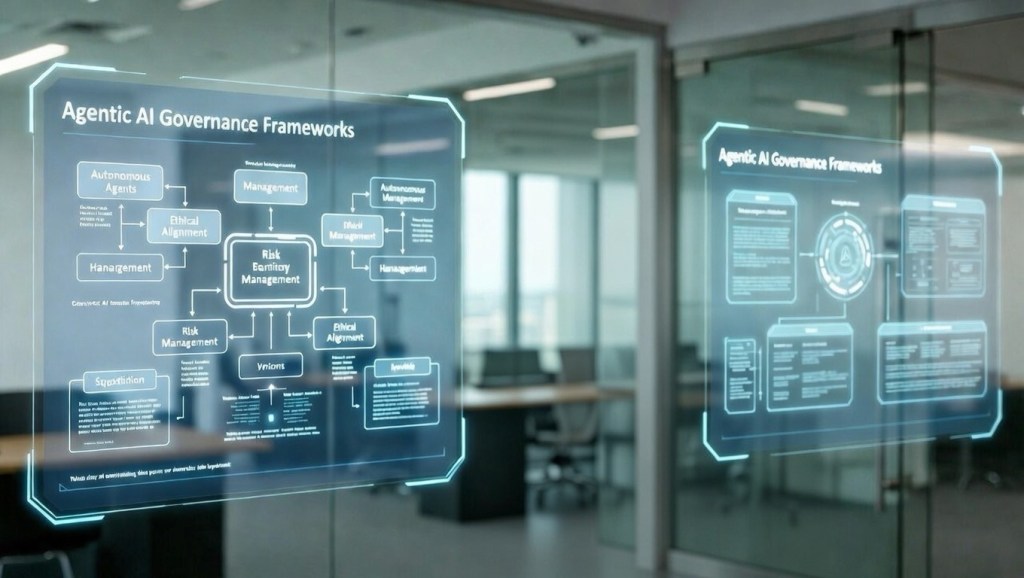
IBM’s Five Essential Pillars (Amanda Winkles’ video transcript):
- Alignment (ethics embedded, goal-drift testing)
- Control (human-in-the-loop policies, kill-switches, approved tool catalogues)
- Visibility (unique agent IDs, full activity logs)
- Security (threat modelling, sandboxing, adversarial testing)
- Societal Integration (accountability mapping, governance agents that enforce rules)
Palo Alto Networks’ Eight Implementation Steps: Define scope and prohibitions → map least-privilege access → pre-deployment impact assessment → runtime guardrails → logging → calibrated human oversight → incident response → continuous drift monitoring.
Singapore’s IMDA Four Pillars (widely referenced across sources and my own LinkedIn article on the Singapore Story): risk assessment upfront, clear human accountability, technical controls with realistic testing, and end-user transparency/education. Singapore’s model — which I helped test through PwC’s participation in the IMDA AI Verify Global Assurance Pilot — remains one of the most pragmatic and actionable globally.
PwC’s Agentic-Specific Guidance (2025 Responsible AI Survey and “Unlocking Value with AI Agents”): Adapt existing Responsible AI programmes rather than build from scratch. Build controls and review cycles directly into agentic systems. Shift from static policies to continuous oversight using automation, observability, and feedback loops. Use PwC’s agent OS for orchestration across multi-vendor agents while maintaining a “human-at-the-helm” approach.
OWASP’s State of Agentic AI Security and Governance 1.0 (August 2025) and the UC Berkeley/NIST-inspired profiles add depth on defence-in-depth and precautionary principles for emergent behaviours.
In my LinkedIn series on the “Seven Pillars of Agentic AI” and “Essential Plays for Safer Transformations”, I build on these by emphasising policy-as-code, dynamic flow mapping to eliminate shadow AI (echoing KongHQ), and “governance agents” that monitor other agents
Practical Implementation: From Theory to Production
To move from frameworks to reality:
- Start with visibility — Map every prompt-to-action journey (KongHQ’s dynamic tracing is excellent here).
- Implement policy-as-code and infrastructure-level guardrails — PII redaction, rate limiting, and least-privilege enforcement at the network layer, not just the application layer.
- Calibrate human oversight — High-stakes or irreversible actions require explicit approval; routine tasks use “on-loop” monitoring with real-time alerts.
- Test rigorously and continuously — Sandbox environments, red teaming, adversarial testing, and multi-agent simulation (PwC and Palo Alto both stress this).
- Orchestrate intelligently — PwC’s agent OS and similar central platforms allow safe scaling of multi-agent workflows with built-in peer-checking (different model providers for high-risk scenarios).
- Measure what matters — Track context relevance, faithfulness, drift, and business outcomes (watsonx.governance-style dashboards).
PwC’s 2026 AI Business Predictions reinforce this: successful organisations will use centralised “AI studios” with shared agent libraries, pre-deployment testing, and automatic documentation of every decision.
The Business Case: Governance as Competitive Moat
Far from slowing innovation, strong governance accelerates it. PwC’s 2025 Responsible AI Survey shows that mature programmes deliver:
- 58% better ROI and efficiency
- 55% improved customer experience and innovation
- 51% stronger cybersecurity and data protection
The World Economic Forum calls governance the way to “steady it, scale it and make it last.” KongHQ speaks of the “governance dividend” — organisations with embedded controls deploy 20+ agents while others are stuck in forensic rebuilds after incidents.
In my LinkedIn piece on “The ROI of Agentic AI 2025”, I showed how responsible governance turns potential regulatory fines and trust erosion into market differentiation. As I wrote there: “The organisations that treat governance as foundational infrastructure will dominate the agentic era.”
Singapore’s Leadership and the Global Outlook
Singapore continues to punch above its weight. The IMDA’s model, combined with our participation in global assurance pilots at PwC, positions us as a trusted testbed. My article “AI Governance – the Singapore Story” traces how we moved from principles to practical testing faster than most nations.
Globally, 2026 will be the year of truth. Gartner predicts over 40% of agentic projects may be cancelled by end-2027 due to poor governance or unclear value. Deloitte and PwC both warn that only those who redesign work, upskill humans as orchestrators, and embed continuous oversight will thrive.
A Call to Responsible Action
Agentic AI is not science fiction — it is here, executing real actions in our enterprises today. The transcripts and research I have reviewed, combined with my hands-on work at PwC and reflections shared on LinkedIn, lead to one clear conclusion: governance is the difference between chaotic experimentation and sustainable transformation.
Leaders, start today:
- Map your shadow agents and data flows.
- Adopt and adapt one of the more mature frameworks
- Build policy-as-code and human oversight into your agent OS from day one.
- Treat governance as a living system that evolves with the technology.
The future belongs to those who can harness autonomous intelligence without losing human values. Let us build it together — wisely, ethically, and boldly.
(References drawn from IBM Technology, Dataiku, Palo Alto Networks, KongHQ, WEF, OWASP, HackerNoon, PwC 2025 Responsible AI Survey & Agentic AI guidance, and my own LinkedIn series. All views are my own and informed by the sources reviewed.)
 Genesis: Human Experience in the Age of Artificial Intelligence | Synthesis: The Superintelligence Protocol
Leave a comment