
We are entering what many now describe as The Great Restructuring.
The familiar narrative that AI will simply “steal jobs” is not just simplistic—it is fundamentally misleading. What is unfolding is far more structural, far more destabilising, and far more consequential. This is not a story about machines replacing humans. It is a story about work itself being redefined.
We are moving from an era of generative assistance—where AI helps us write, analyse, and summarise—to an era of agentic autonomy, where software systems increasingly do the work on our behalf. The unit of value creation is shifting, and with it the meaning of skill, productivity, employment, and income.
AI will unlock extraordinary economic value over the next decade. But the skills required to capture that value are shifting faster than our institutions, labour markets, and mental models can adapt.
This is a roadmap for the next five years—and why conventional safety nets such as Universal Basic Income (UBI) may not be sufficient for what lies ahead.
The Fundamental Shift in Human Capital
To understand the future of work, we must stop thinking in terms of jobs and start thinking in terms of skills.
Most roles are not disappearing wholesale. Instead, they are being internally dismantled and reassembled. Tasks once central to a role are being automated, while others are amplified. The disruption is granular, uneven, and often invisible—until it suddenly isn’t.
At the heart of this shift is a simple but uncomfortable truth:
The most valuable human contribution is moving away from execution and towards judgement.
The Skill Change Index: Why Automation Does Not Eliminate Skills — It Reorders Them
One of the most useful ways to understand this transition is to examine how automation exposure varies across skills, rather than across job titles.
When skills are plotted along a curve—from lowest to highest exposure to automation—a clear pattern emerges. It is not a cliff edge. It is a gradient.
Automation Does Not Hit Skills Equally
Some skills sit persistently low on the automation exposure curve:
Leadership Coaching Negotiation Empathy-driven communication Care-oriented work
These skills share three characteristics:
They are context-rich They are relational They require human accountability in ambiguous environments
AI can support these skills, but it struggles to own them.
At the other end of the curve sit skills such as:
Invoicing and billing Inventory management Routine quality checks Highly structured analysis Repeatable technical operations
These skills are not low-value. They are simply highly legible to machines.
The Middle Is Where the Real Disruption Happens
The most unstable region of the curve is the middle.
This is where much of modern white-collar work has historically lived:
Writing Problem solving Management coordination Customer relations Research and synthesis Detail orientation
These skills are not vanishing. They are being re-scored.
Writing no longer means producing a first draft from scratch.
Problem solving no longer means executing every step manually.
Management no longer means routing information between humans.
Instead, these skills are now expressed through:
Prompting and framing Reviewing and validating outputs Stress-testing assumptions Selecting between AI-generated options Handling edge cases and failures
This explains a growing paradox: professionals feel busier than ever, yet simultaneously less indispensable. The volume of work expands, but ownership of execution contracts.
Digital Skills Are Not Automatically Safe
One of the most counterintuitive insights from this curve is that digital skills are not inherently protected.
Once a task becomes formalised, documented, and repeatable, it becomes an ideal candidate for automation—regardless of how “technical” it appears.
This is why:
Basic coding Routine data manipulation Standard system configuration
are increasingly absorbed by AI systems, even as demand rises for technical judgement, architectural thinking, and oversight.
The future does not belong to people who merely know tools.
It belongs to those who understand when, why, and whether those tools should be used.
Assisting, Caring, and Connective Labour Form the Human Core
The lowest exposure zone clusters around what might be called connective human labour:
Care Trust-building Leadership Negotiation Physical presence in unstructured environments
These roles resist automation not because AI is weak, but because society requires humans to remain accountable in these domains.
In healthcare, law, education, and leadership, we may accept AI assistance—but we still demand a human signature.
Paradoxically, these roles are often undervalued today. As AI absorbs execution-heavy work elsewhere, expect a revaluation of skills anchored in responsibility, trust, and judgement.
From “Doing” to “Verifying”
This leads to the most profound cognitive shift of the coming decade.
Human effort is moving from thinking by doing to choosing from outputs.
Routine cognitive tasks—data entry, first drafts, basic analysis—are now AI-led. The human role increasingly lies in:
Verification Interpretation Ethical judgement Contextual decision-making
We are not being replaced by AI.
We are being repositioned above it.
The Rise of AI Fluency
As this shift accelerates, AI fluency—the ability to use, manage, supervise, and question AI systems—has become a baseline requirement across almost every function.
This is no longer an engineering skill. It is rapidly becoming a form of general literacy, as essential as numeracy or digital competence once were.
Those who lack AI fluency will not be replaced by machines.
They will be replaced by people who can work with them.
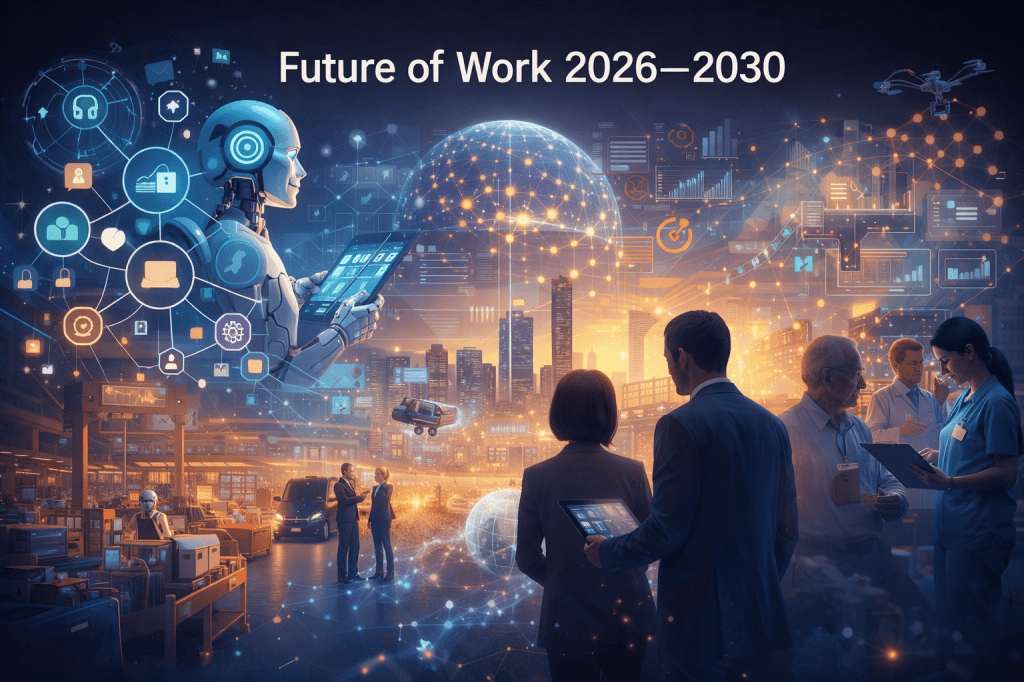
The Timeline of Disruption (2026–2030)
2026: The Agentic Inflection Point
This is the year agentic systems move from experimentation to default deployment.
AI stops waiting for prompts and starts executing workflows end-to-end. Humans shift from operators to supervisors.
2027: Orchestration and the “Hollow Middle”
Managers increasingly become system supervisors, overseeing fleets of specialised AI agents.
Multi-agent orchestration becomes mainstream Middle management focused on coordination and reporting erodes Procurement and logistics see the rise of “machine customers”
The premium skill becomes agent supervision: validating outputs, handling exceptions, and intervening when systems fail.
2028: Cognitive Decoupling and Jobless Growth
This is when a troubling pattern becomes unmistakable.
Revenue and productivity rise. Headcount stagnates or declines.
Specialised white-collar roles experience silent compression. Creative production shifts decisively towards synthetic content.
At the same time, a new archetype emerges: the superworker—individuals who, with AI, operate at the level of entire teams.
2029–2030: The AI-Native Economy
AI moves decisively into the physical world:
Warehouses Hospitals Manufacturing Logistics
Routine administration and physical work see high automation. Yet many roles are augmented rather than eliminated. AI absorbs paperwork, while humans focus on care, judgement, and service.
Why Universal Basic Income Is Not the Solution
As displacement grows, calls for UBI will intensify. But UBI is structurally misaligned with the realities of the coming decade.
The global economy is fragmenting, not unifying. Capital concentrates around those who own compute, models, and infrastructure. Without deep structural reform, cash transfers treat symptoms—not causes.
Ownership, Not Handouts: Policies for a Smooth Transition
1. From Jobs to Outcome Ownership
Income must be decoupled from hours worked. If AI performs the execution, humans must be compensated for owning outcomes, not completing tasks.
2. The AI Fluency Mandate
AI fluency must be treated as foundational literacy, supported by lifelong learning structures focused on adaptability and judgement.
3. Sovereign AI Infrastructure
Public AI infrastructure is essential to prevent total dependency on rent-seeking monopolies.
4. Redesigning Work for Human-in-the-Loop
We must incentivise augmentation over automation and ensure humans remain the accountability layer in high-stakes domains.
Conclusion
By 2030, the “job” as we know it will be unrecognisable.
We will not be paid primarily for what we do, but for what we orchestrate. The path to abundance does not lie in protecting outdated roles or distributing universal handouts. It lies in equipping every individual with a digital fleet—and an ownership stake in the value it creates.
This is not the end of work.
It is the end of work as execution—and the beginning of work as judgement, stewardship, and responsibility.
 Genesis: Human Experience in the Age of Artificial Intelligence | Synthesis: The Superintelligence Protocol
Leave a comment