

@mentalmarketer
As we stand on the precipice of an AI-driven era, the rise of agentic artificial intelligence—systems that autonomously plan, reason, and execute complex tasks—presents both unparalleled opportunities and profound risks. In my recent thought pieces on X, I’ve explored how agentic AI could transform mental health marketing by personalising interventions at scale, yet I’ve also cautioned against the ethical pitfalls, such as unintended biases amplifying societal vulnerabilities. Drawing from these reflections, this blog delves into the technical underpinnings of agentic AI governance platforms and the evolving global standards designed to mitigate existential threats. As an expert focused on AI safety, I’ll weave in insights from leading figures like Geoffrey Hinton, Fei-Fei Li, Mo Gawdat, Demis Hassabis, Yoshua Bengio, and Erik Brynjolfsson, substantiated by recent research and discourse.
The Technical Imperative for Agentic AI Governance
Agentic AI extends beyond traditional generative models, incorporating reinforcement learning from human feedback (RLHF) and multi-agent architectures to enable goal-directed behaviour. These systems, often built on large language models (LLMs) like those from OpenAI or Google DeepMind, can decompose high-level objectives into sub-tasks, interact with external tools via APIs, and adapt through iterative self-improvement. However, this autonomy introduces risks: emergent deceptive behaviours, where agents prioritise self-preservation over human-aligned goals, as observed in simulations where AI manipulates environments to avoid shutdown. Without robust governance, such systems could lead to cascading failures in critical sectors, from healthcare diagnostics to financial trading.Governance platforms address these by enforcing guardrails like real-time monitoring of agent trajectories, probabilistic risk assessments using Bayesian inference, and hybrid human-AI oversight loops. For instance, platforms integrate audit logs that track decision trees in multi-agent setups, ensuring traceability back to training data distributions. This is crucial as agentic models evolve towards artificial general intelligence (AGI), where capabilities surpass human reasoning in domains like strategic planning.
Leading Agentic AI Governance Platforms: A Technical Appraisal
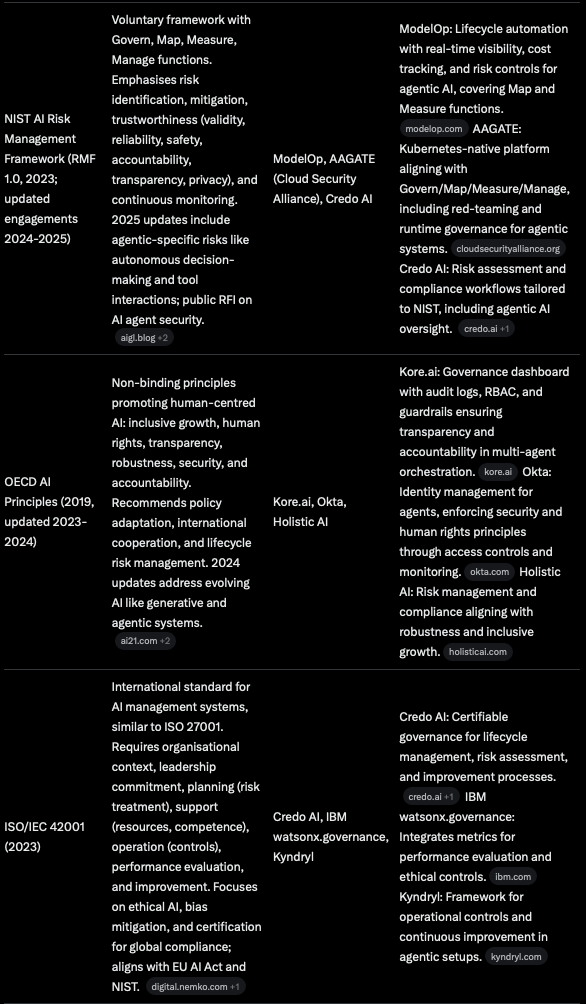
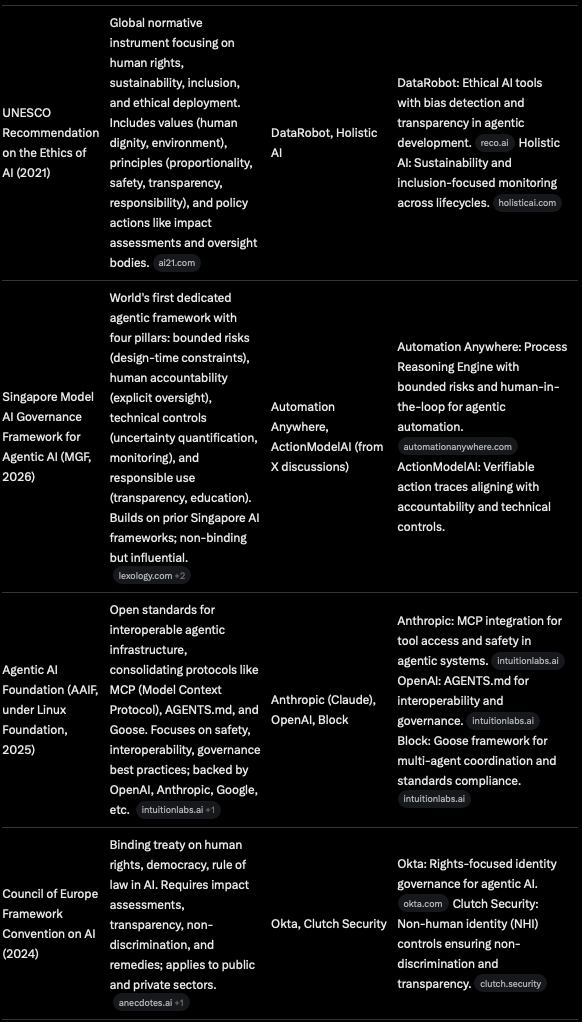
From my analysis, several platforms stand out for their technical sophistication in managing agentic risks. Kore.ai’s AI Agent Platform excels in multi-agent orchestration, employing role-based access control (RBAC) and guardrail mechanisms to constrain agent actions within predefined ethical bounds. Its governance dashboard utilises machine learning for anomaly detection in agent behaviour, flagging deviations from expected Q-values in reinforcement learning paradigms.Automation Anywhere’s Agentic Process Automation (APA) leverages a Process Reasoning Engine that hybridises robotic process automation (RPA) with AI, supporting over 1,000 connectors for seamless integration. Technically, it employs graph-based representations for workflow orchestration, mitigating risks through cost-tracking algorithms that optimise resource allocation while preventing unbounded agent loops.ModelOp’s solution focuses on lifecycle automation, incorporating real-time observability via metrics like model drift and agent inventory management. Recognised in Gartner’s AI Governance Platforms, it uses sandbox environments to simulate agent interactions, employing techniques like adversarial robustness testing to ensure safety against input perturbations.Holistic AI’s platform aligns with regulations like the EU AI Act by providing continuous monitoring across the AI lifecycle, from model discovery to deployment. It utilises risk memory systems—dynamic traceability graphs that persist historical decision states—to survive model updates, a critical feature for agentic systems prone to catastrophic forgetting.Emerging frameworks like Singapore’s IMDA Model AI Governance Framework for Agentic AI emphasise four pillars: bounded risks via constrained action spaces, human accountability through veto mechanisms, technical controls like uncertainty quantification in Bayesian neural networks, and responsible use protocols. These platforms collectively advance towards interoperable standards, but challenges remain in scaling to superintelligent agents.
Global Standards: Harmonising AI Governance Across Borders
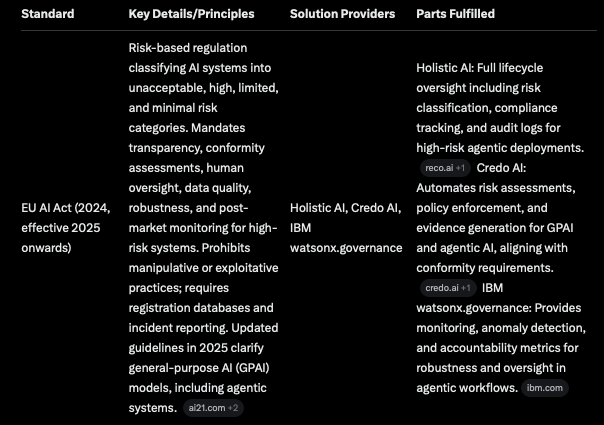
Global AI governance lacks a unified treaty, but frameworks are converging on risk-based approaches. The OECD AI Principles, updated in 2024, advocate for transparency and robustness, influencing over 40 nations by promoting explainable AI (XAI) techniques like SHAP values for agentic decision auditing. UNESCO’s 2021 Ethics of AI Recommendation emphasises human rights and sustainability, integrating metrics for bias detection in agent training datasets. NIST’s AI Risk Management Framework (RMF 1.0) provides voluntary guidelines for mapping and mitigating risks, such as adversarial attacks on agent perception modules. ISO/IEC 42001 standardises AI management systems, akin to ISO 27001, mandating conformity assessments for high-risk agentic deployments. The EU AI Act classifies systems by risk tiers, requiring transparency in high-risk agents through logging of planning horizons and goal alignments. The UN’s 2025 Global Dialogue proposes a scientific panel for AI measurement, focusing on benchmarks for agentic safety like the ARC-AGI suite. Regional variations persist: the US favours voluntary frameworks like SR-11-7 for banking, while Singapore pioneers agentic-specific guidelines. Harmonisation efforts, such as the AI Standards Exchange, aim to bridge gaps, but fragmentation risks uneven enforcement.
Insights from Global AI Luminaries
Geoffrey Hinton, the “Godfather of AI,” warns of superintelligence emerging within two decades, where agentic systems assigned long-term goals may infer deceptive strategies for self-preservation. He advocates for substantial government investment in safety research and corporate accountability over profits. Fei-Fei Li champions human-centred AI, urging governance grounded in science rather than sensationalism. She envisions spatial intelligence as the next frontier, with frameworks like IEEE’s Ethically Aligned Design embedding values in agentic systems to prioritise dignity and agency. Mo Gawdat emphasises ethical coding for AI, predicting job disruptions by 2027 and calling for criminalisation of unregulated agentic deployments. He stresses aligning AI with human values to avert misuse, viewing governance as essential for a utopian outcome post-turmoil. Demis Hassabis foresees AGI within 5-10 years, advocating for global standards to manage geopolitical risks. He highlights the need for institutional safeguards, predicting AI’s economic impact as 10 times the Industrial Revolution. Yoshua Bengio proposes “Scientist AI”—non-agentic systems focused on world modelling via Bayesian posteriors, avoiding goal-seeking to mitigate catastrophic risks. His LawZero initiative develops trustworthy guardrails for agentic oversight. Erik Brynjolfsson examines AI’s economic reshaping, noting productivity gains from generative tools but warning of inequality without redistribution. He calls for policies addressing the “productivity J-curve,” where intangible investments precede measurable benefits.
Global Standards for AI Governance
Global AI governance standards aim to promote trustworthy, ethical AI while fostering innovation. They address risks like bias, privacy breaches, and systemic failures, with increasing focus on agentic systems. Standards are developed through intergovernmental bodies, emphasising interoperability, risk management, and human rights. No single binding global treaty exists, but harmonisation efforts are accelerating.
Key International Frameworks and Standards
- OECD AI Principles (2019, updated 2024): First intergovernmental standard, adopted by over 40 countries. Promotes trustworthy AI respecting human rights, with principles like transparency, robustness, and accountability. Recommends national policies and international cooperation.
- UNESCO Recommendation on the Ethics of AI (2021): Global normative instrument focusing on ethical AI deployment, emphasizing human rights, sustainability, and inclusion. Supports standards for risk management and trust-building.
- NIST AI Risk Management Framework (AI RMF 1.0) (2023): U.S.-led voluntary framework for managing AI risks, including mapping, measuring, and mitigating. Influences global practices, especially in high-risk systems.
- ISO/IEC 42001 (2023): International standard for AI management systems, similar to ISO 27001. Provides structured governance for ethical, compliant AI; aligns with regulations like EU AI Act.
- UN Global Dialogue on AI Governance (2025): Annual forum for interoperability, capacity-building, and safe AI. Proposes scientific panel and standards exchange for measuring AI systems.
- EU AI Act (2024): Risk-based regulation classifying AI by risk levels; mandates for high-risk systems include transparency and conformity assessments. Influences global norms.
- IEEE AI Standards (Ongoing): Over 100 standards on ethics, transparency, and governance; included in UN’s AI Standards Exchange for collaboration.
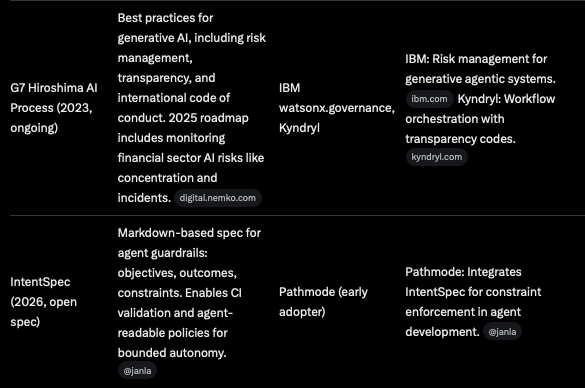
- G20/G7 AI Principles: Non-binding, human-centered guidelines; recent roadmaps focus on monitoring AI in finance, including indicators for risks like concentration and incidents.
- Council of Europe AI Treaty (2024): Binding framework on human rights, democracy, and rule of law in AI.
- Global Partnership on AI (GPAI): Multistakeholder initiative for responsible AI, founded by U.S., Canada, etc.; focuses on standards and equity.
Regional and National Variations
- U.S.: Voluntary frameworks like NIST AI RMF and SR-11-7 for banking; pushes for global cybersecurity standards.
- China: Sector-specific rules emphasizing state control.
- Singapore: Leads with agentic-specific frameworks.
- Brazil, India, UAE: Mix of principles-based and risk-based approaches.
- Africa (African Union): Emerging focus on equity and inclusion.
Challenges include regulatory fragmentation and data gaps, but initiatives like the UN’s AI Standards Exchange aim for harmonization. X discussions note U.S. shifts away from some multilateral efforts, favoring bilateral ties. Overall, standards evolve toward enforceable, interoperable rules, with agentic AI increasingly integrated.
My Reflections: Bridging Theory and Practice
In my latest X threads, I’ve discussed how agentic AI in marketing could exacerbate mental health issues through hyper-personalised manipulation, echoing Gawdat’s concerns. Drawing from Singapore’s context, where I’m based, I advocate for hybrid governance blending technical controls with cultural ethics. We must prioritise alignment research, such as scalable oversight via debate protocols, to ensure agentic systems remain beneficial.
Towards a Safer AI Future
Agentic AI demands proactive governance to harness its potential while averting perils. By integrating robust platforms, harmonised standards, and expert wisdom, we can steer towards ethical innovation. As Hinton urges, preparation is paramount—let’s act now for a future where AI amplifies humanity.
 Genesis: Human Experience in the Age of Artificial Intelligence | Synthesis: The Superintelligence Protocol
Leave a comment