
In an era where artificial intelligence (AI) is no longer a futuristic concept but a tangible force reshaping industries, the question of how it will affect the world of work looms large. Recent research from organisations such as the World Economic Forum (WEF) and PwC suggests that AI could create as many opportunities as it disrupts, with projections indicating a net gain of 78 million jobs globally by 2030. Yet, this transformation is far from uniform. Rather than a blanket disruption, AI is bifurcating the economy—intensifying competition in digital realms while providing a tailwind for physical, localised sectors. This post explores a three-layer framework for understanding business activities, drawing on insights from experts and recent studies to predict which jobs AI might replace—and which it likely will not. We’ll integrate viewpoints from thought leaders like Josh Bersin, who emphasises AI as a “job-leveller” rather than a killer, and economists from the International Monetary Fund (IMF), who highlight regional disparities in AI’s labour market effects.
Understanding the 3-Layer Framework
At the heart of analysing AI’s influence on employment is a structured approach to dissecting business work into three distinct layers. This framework helps clarify why some roles are vulnerable to automation while others remain resilient, aligning with findings from Microsoft’s 2025 New Future of Work Report, which stresses AI’s role in enhancing collective productivity rather than outright replacement.
1. Tokenisable Cognition (Layer 1: Production)
This layer encompasses cognitive tasks that can be articulated through language or code, such as drafting reports, summarising data, conducting research, or generating code variations. AI excels here, driving costs towards zero and enabling exponential output increases. As noted in the Jevons Paradox—observed in 19th-century economics where efficiency boosts consumption rather than reducing it—cheaper cognitive work leads to more of it, not less. A junior analyst’s two-hour draft might now take mere minutes with AI tools.
Experts like Erik Brynjolfsson from Stanford argue that this layer’s commoditisation will accelerate productivity but shift human roles upwards. PwC’s 2025 Global AI Jobs Barometer supports this, revealing that AI-exposed industries have seen revenue growth accelerate since 2022, with workers commanding wage premiums up to 56% higher if they possess AI skills. However, the IMF warns that employment in AI-vulnerable occupations drops by 3.6% over five years in high-AI-demand regions, particularly affecting entry-level positions.
2. Judgement and Accountability (Layer 2: Decision-Making)
Here, humans evaluate AI-generated options, assume responsibility for outcomes, and apply nuanced judgement or “taste.” AI can produce alternatives but cannot own accountability or navigate ethical complexities. This layer becomes a bottleneck in digital workflows, as the flood of Layer 1 output demands human oversight.
Josh Bersin echoes this in his analysis, noting that AI amplifies individual capabilities but requires human-centric “power skills” like emotional intelligence and resilience to thrive. The WEF’s Future of Jobs Report 2025 predicts that nearly two-fifths of skills will evolve over the next five years, with demand for AI oversight surging. Contrasting views come from Sadiq Khan, Mayor of London, who cautions that AI could usher in mass unemployment without intervention, emphasising the need for policies to protect judgement-based roles.
3. Physical Execution (Layer 3: Real-World Action)
This involves hands-on tasks tied to the physical world, such as repairs, installations, or caregiving. AI aids indirectly—through scheduling or diagnostics—but cannot replicate presence. Baumol’s Cost Disease explains why these roles may become more valuable: as AI boosts productivity elsewhere, wages rise economy-wide, making non-automatable physical work relatively pricier and more profitable.
Ken Goldberg from UC Berkeley highlights the data gap hindering robotic advancements, suggesting physical jobs remain safe for now. The International Labour Organization (ILO) adds that AI’s impact extends to wages and conditions in these sectors, potentially improving job quality if managed well. Yet, Goldman Sachs warns of a potential “job apocalypse” if AI automates 25% of US work hours, including some physical tasks via robotics.
This framework reveals that AI floods Layer 1 with abundance, making Layers 2 and 3 the new constraints. As Microsoft’s report notes, the focus shifts to human-AI collaboration for team-level gains.
The Bifurcated Economy: Digital Contestation vs Physical Resilience
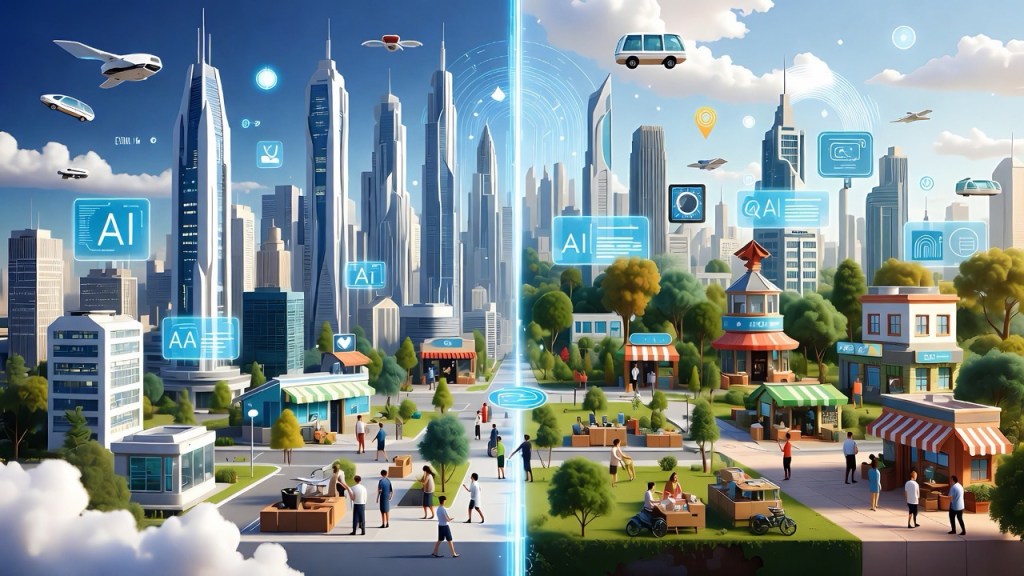
AI is not disrupting uniformly; it’s creating a “barbell” economy. In digital, contestable markets—where outputs are easily compared and switching providers is simple—competition intensifies. Mid-tier firms, like a 50-person software consultancy, face squeezes from lean AI-native teams below and giants with distribution moats above. J.P. Morgan’s research indicates early displacement in routine tasks, such as data entry.
Conversely, physical, localised markets—think plumbing or dentistry—benefit from AI’s overhead reductions without heightened contestability. KPMG’s Future of Work report predicts employees working alongside AI, enhancing efficiency in these areas. The OECD emphasises AI’s potential for higher productivity and better occupational safety in such sectors. However, experts like those in a Reddit discussion warn that full automation, including robotics, could disrupt even physical jobs within 5-10 years.
Gloat’s 2026 trends forecast accelerated job transformation, with 22% of jobs disrupted by 2030, but net gains through new roles. CNBC’s survey of HR leaders shows 89% expect AI to reshape jobs in 2026, underscoring the bifurcation.
Sector-Specific Implications and Expert Perspectives
In digital services, mid-tier players risk obsolescence unless they adapt. Gartner predicts AI’s transformational impact, urging CIOs to prepare. For physical businesses, AI is a boon, as per Barclays’ report on humanoid robots’ growth, though limited to factories initially.
Experts diverge: Patrick Vallance, UK Science Minister, sees AI enhancing skills by removing repetitive tasks, while Elon Musk predicts AI replacing half of white-collar jobs imminently. McKinsey’s “Superagency” research finds employees more ready for AI than leaders realise, with 92% of firms planning increased investments. In manufacturing, Nexford estimates two million jobs lost by 2026, but PwC counters that AI boosts value in automatable roles.
Strategic Advice for Navigating the Change
For mid-tier digital firms, radical leanness or upstacking to Layer 2 is essential—avoid marginal efficiencies, as Bersin warns it’s “dying slower.” Physical businesses should prioritise back-office AI, per KPMG. Startups must build moats in accountability, as WEF advises running towards compliance. Giants face internal talent risks, requiring operational shifts.
Workers: Upskilling is key. The GSD Council notes 90% of organisations face skills shortages by 2026. As one X post from a user reflects, AI agents save hours, freeing time for human pursuits.
Conclusion: A Balanced Future Requires Proactive Policy
AI’s bifurcation demands nuanced responses. While Goldman Sachs fears widespread loss, optimists like those at Investopedia argue meaningful automation is years away. The ILO calls for rethinking AI’s effects on wages and equity. Policymakers must foster upskilling, as the IMF urges, to ensure gains are shared. Ultimately, AI augments humanity—if we steer it wisely. What are your thoughts on this framework? Share in the comments below.
 Genesis: Human Experience in the Age of Artificial Intelligence | Synthesis: The Superintelligence Protocol
Leave a comment