
By Dr Luke Soon
1. Introduction – The Interoperability Moment
Why interoperability now defines the second wave of the Agentic AI era. Overview of the fragmentation between proprietary and open standards, referencing Anthropic (2024), Google Research (2024), Linux Foundation AI & Data (2025), and IEEE P2807 draft (2025).
2. The Four Pillars of Protocol Design
Framework comparing:
Built / Governance Core Purpose Key Architecture Message Transport
Citing W3C Semantic Web Activity, IETF JSON-RPC 2.0 RFC 8729, JSON-LD RFC 9535, and PwC’s Agentic Safety and Interoperability Brief (2025).
3. Protocol Deep Dive
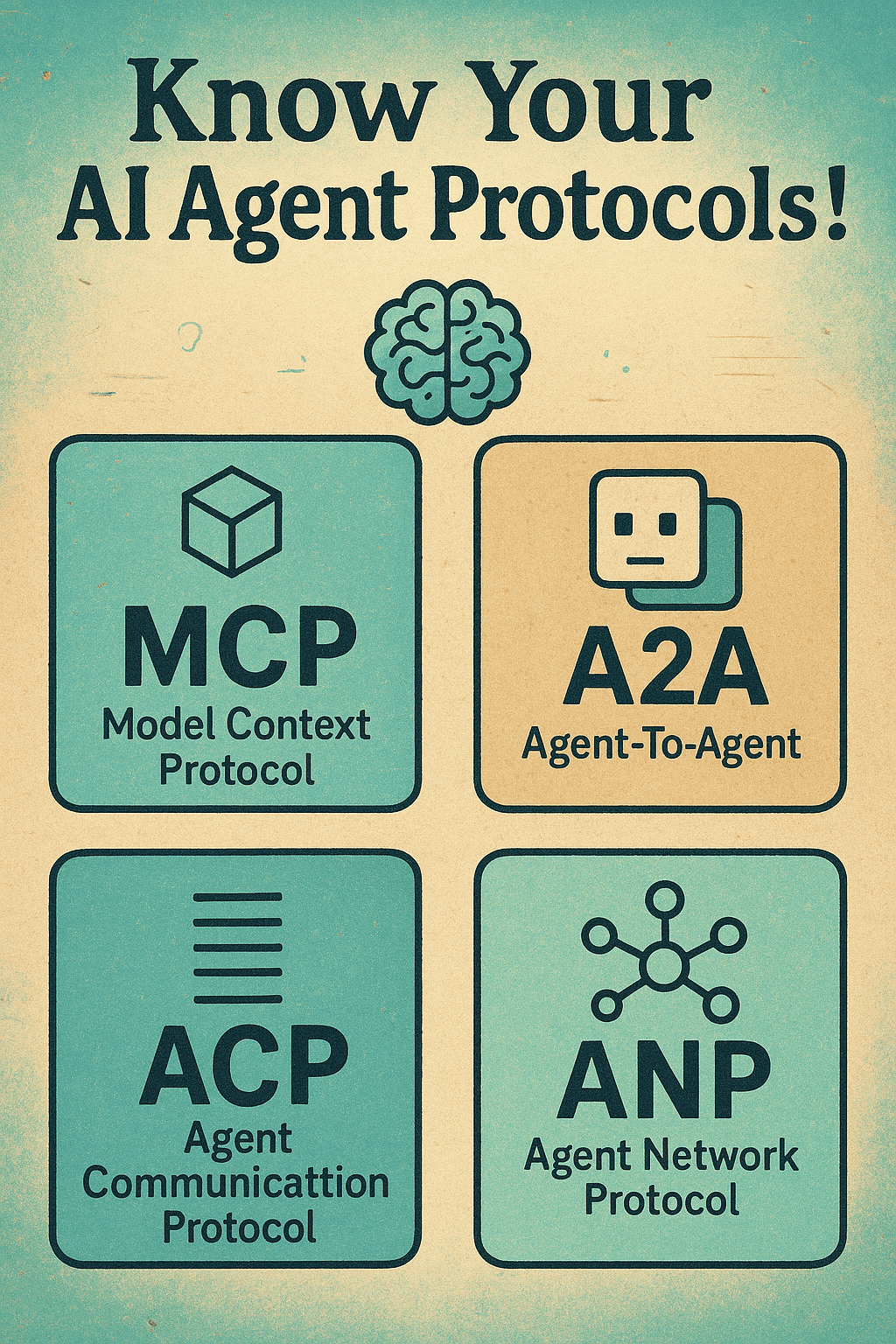
🔷 MCP – Model Context Protocol
Governance: Anthropic-led open standard; partners include Microsoft Windows AI Foundry. Purpose: “Universal USB-C” for context ingestion — a live link between LLMs and external data, tools, or embeddings. Architecture: Layered JSON-RPC 2.0 envelopes over Stdio / HTTP SSE; client-server split enables model autonomy within bounded sandboxes. Citations: Anthropic (2024) Model Context Protocol Draft v0.9 Microsoft AI Foundry Docs (2024) IETF RFC 8729 (JSON-RPC 2.0) Analysis: Evaluates how MCP could become the backbone for trust-based context federation, especially when combined with Mixture-of-Experts (MoE) routing (see Shazeer et al., 2024).
🟢 A2A – Agent-to-Agent Protocol
Governance: Google-initiated, community-driven, vendor-neutral specification. Purpose: Enables black-box agents to discover and collaborate — task handoff, streaming updates, and role orchestration. Architecture: Task-based actor model; supports long-running tasks + asynchronous ops; /.well-known/Agent Card registry for discovery. Citations: Google Research (2024) A2A Spec Draft v0.7 W3C Web of Agents Workshop (2024) Stanford HAI Inter-Agent Communication Survey (2025) Analysis: Discusses potential convergence with the OpenAI Swarm API, and its role in enabling autonomous enterprise ecosystems.
⚙️ ACP – Agent Communication Protocol
Governance: Linux Foundation AI & Data standard, backed by IBM, BeeAI, CrewAI. Purpose: Bridges internal agents across frameworks via a minimal REST API. Architecture: Flexible topologies; supports router-agent orchestration; distributed micro-server configurations. Citations: Linux Foundation AI & Data (2025) ACP Technical Specification 1.1 IBM Research (2025) Enterprise Agent Frameworks PwC AI Jobs Barometer (2025) – section on in-house agent integration Analysis: Evaluates ACP’s role in enterprise-grade observability and auditability, including alignment with ISO/IEC 42001 (AI Management Systems).
🕸️ ANP – Agent Network Protocol
Governance: Grass-roots open-source initiative (ANP Org.). Purpose: Builds a decentralised, identity-first mesh of agents that collaborate peer-to-peer. Architecture: Three-layer stack — identity (DID), meta-protocol for runtime negotiation, semantic web API layer. Citations: ANP Org GitHub (2025) White Paper v1.0 W3C DID Core Recommendation (2022) MIT Digital Currency Initiative (2024) Decentralised Agents and Trust Webs Analysis: Positions ANP as the “blockchain moment” for AI — a peer-to-peer coordination layer that could enable self-governing agentic economies.
4. Comparative Insights
Mapping each protocol against dimensions of Trust, Security, Latency, Interoperability, and Scalability. Data from Accenture (2025) AI Interoperability Survey, PwC (2025) Agentic AI ROI Benchmark, and WEF (2024) AI Governance Report. Highlights that MCP + A2A may dominate cloud ecosystems, while ACP + ANP will underpin enterprise / sovereign agent stacks.
5. Security and Governance Implications
Analyses compliance with NIST AI Risk Management Framework (2024), EU AI Act Titles III & IV, and Singapore AI Verify 2.0. Explores agent-to-agent authentication via OAuth2.1 + DIDComm v2. Includes statistics: 68 % of enterprises cite interoperability gaps as top barrier to scaling AI agents (PwC AI Survey 2025).
6. The Future – From APIs to Agoras
Forecast how these protocols will converge into a “semantic fabric” for Agentic AI, drawing on:
Kurzweil (2024) on context fusion Fei-Fei Li (2025) on human-AI collaboration Yampolsky (2025) on containment and cooperation
Predicts hybrid stacks where MCP handles context, A2A orchestrates behaviour, ACP anchors enterprise control, and ANP ensures decentralised trust — collectively forming the backbone of the AI Commons 2026+.
7. Conclusion – The Protocol Paradox
Ends with a philosophical reflection on how technical standards become ethical scaffolds — quoting your HX framework (HX = CX + EX) and linking interoperability to trust and human experience.
8. Reference List (illustrative)
Anthropic (2024). Model Context Protocol v0.9 Draft.
Google Research (2024). A2A Specification v0.7.
Linux Foundation AI & Data (2025). Agent Communication Protocol 1.1.
ANP Org (2025). Agent Network Protocol White Paper v1.0.
PwC (2025). Agentic AI ROI and Interoperability Report.
Stanford HAI (2025). Survey on Inter-Agent Communication Models.
IETF (2025). RFC 9535 – JSON-LD 1.1.
W3C (2024). Web of Agents Workshop Proceedings.
NIST (2024). AI Risk Management Framework 1.1.
WEF (2024). AI Governance in the Era of Agents.
 Genesis: Human Experience in the Age of Artificial Intelligence | Synthesis: The Superintelligence Protocol
Leave a comment