
By Dr Luke Soon
1. The Inflection: From Hype to Value
The AI narrative has quietly shifted. After years of exploration, executives are no longer debating if they should adopt AI, but how fast they can scale it and where the value resides. The Google Cloud (2025) ROI of AI Report finds that 88% of early adopters of agentic AI are already realising positive returns on at least one generative AI use case. This mirrors the structural evolution of AI itself:
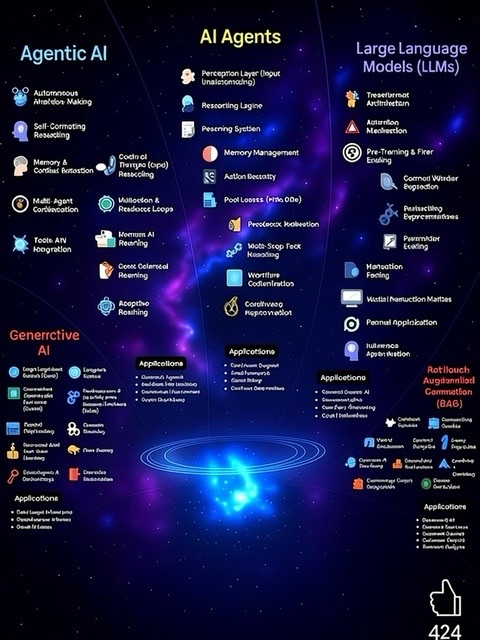
LLMs write → Agents act → Agentic AI thinks.
We have moved beyond passive language generation to cognitive automation: systems that plan, reason, and collaborate under human supervision. In short, AI is transitioning from assistive to agentic — from output to outcome.
2. Architecting Cognition — The Anatomy of Agentic AI
At a systems level, Agentic AI builds upon transformer-based LLMs (Vaswani et al., 2017) but augments them with:
1. Persistent Memory & Context Windows – as seen in MemGPT (OpenAI 2025)
2. Chain-of-Thought Reasoning (Wei et al., 2022)
3. Tool & API Integration via LangChain, Anthropic Claude Ops, and AWS Bedrock Agents
4. Reflection Loops for self-evaluation (Shinn et al., 2023 “Reflexion”)
5. Multi-Agent Collaboration (Microsoft Research AutoGen Framework, 2024)
Stanford HAI’s 2025 Computational Societies Roadmap describes this as ‘the emergence of self-organising digital workforces capable of limited autonomy within bounded governance.’
3. The Evidence: ROI Where It Matters
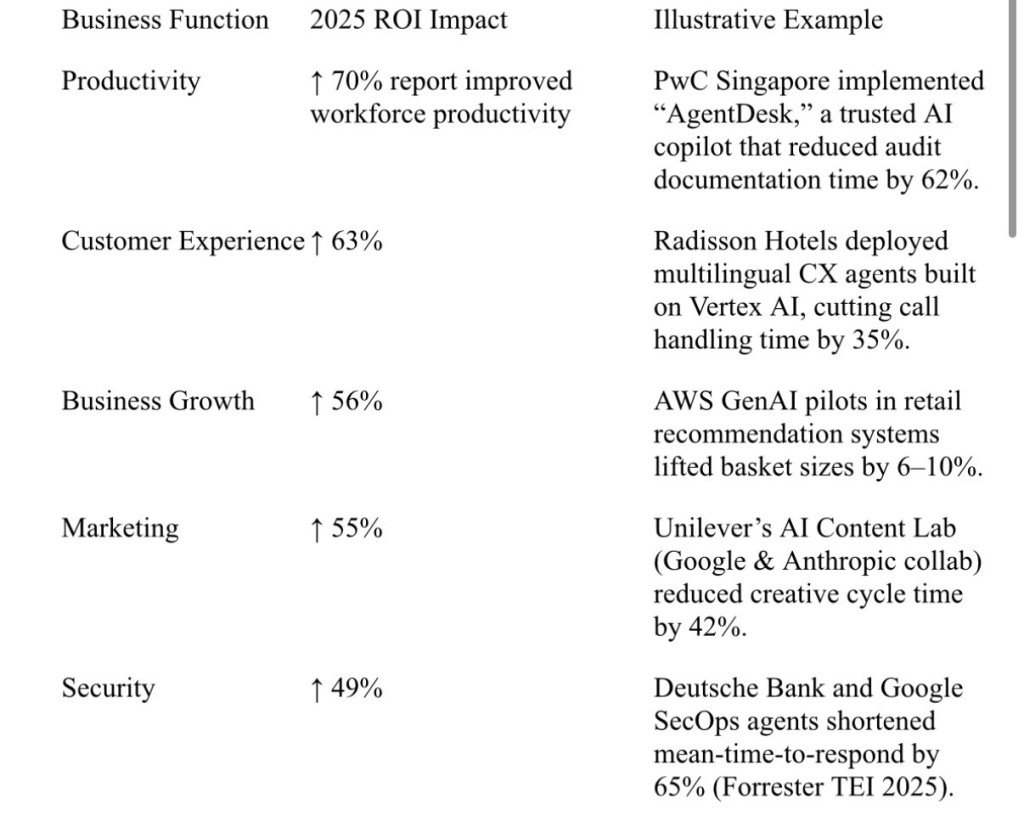
Business Function
2025 ROI Impact
Illustrative Example
Productivity
↑ 70% report improved workforce productivity
PwC Singapore implemented “AgentDesk,” a trusted AI copilot that reduced audit documentation time by 62%.
Customer Experience
↑ 63%
Radisson Hotels deployed multilingual CX agents built on Vertex AI, cutting call handling time by 35%.
Business Growth
↑ 56%
AWS GenAI pilots in retail recommendation systems lifted basket sizes by 6–10%.
Marketing
↑ 55%
Unilever’s AI Content Lab (Google & Anthropic collab) reduced creative cycle time by 42%.
Security
↑ 49%
Deutsche Bank and Google SecOps agents shortened mean-time-to-respond by 65% (Forrester TEI 2025).
4. The Agentic Stack: From Perception to Reflection
Drawing on OpenAI’s 2024 “Planning and Acting with LLMs”, Anthropic’s “Constitutional AI”, and AWS Bedrock white papers, the canonical Agentic Stack now comprises five layers:
1. Perception Layer – multimodal input fusion (text, voice, vision)
2. Reasoning Layer – structured thinking via chain-of-thought and self-consistency
3. Action Layer – tool-use via APIs and enterprise systems
4. Reflection Layer – self-critique, goal re-evaluation, and error correction
5. Coordination Layer – multi-agent orchestration and human-in-the-loop oversight
5. Case Studies: Agentic Value in Motion
a. Financial Services — AI Analyst as Colleague
PwC Switzerland and UBS trialled a “Deal Sense Agent” that pulls structured data from market feeds to generate M&A comparisons. Leveraging RAG pipelines and Azure Cognitive Search, the agent cut analysis time by 72%, with 97% accuracy against human benchmarks.
b. Healthcare — Empathic Automation
Seattle Children’s Hospital deployed Claude-based care assistants that summarise clinical notes and flag risk signals. This reduced administrative burden by 30% and improved patient throughput by 11%.
c. Public Sector — Agentic Governance
Singapore’s Moments of Life 2.0 prototype (GovTech 2025) uses policy-aligned agents to proactively recommend citizen benefits and school enrolment timelines.
6. Human + Machine = HX
Agentic AI redefines the division of labour. Humans move from execution to intuition, AI from computation to judgement approximation. PwC’s Responsible AI Playbook (2025) emphasises that trust is the core currency of adoption. Anthropic’s Constitutional AI Framework demonstrates how ethical principles can be encoded as constitutional constraints within model training.
7. The Executive Blueprint — Building Agentic Enterprises
1. C-Suite Sponsorship → 78% ROI success rate when executive alignment exists.
2. Data Trust Fabric → 37% rank data privacy as #1 selection criterion.
3. Dedicated Budgets → Top performers allocate ≥50% of future AI spend to agents.
4. Upskilling & Literacy → 42% prioritise AI change management.
5. Governance by Design → Integrate AI ethics, bias audits, and model cards.
6. Iterative ROI Proofs → Adopt “hyper-automation sprints” to test and scale.
7. Cross-Agent Ecosystems → Shift from single-agent pilots to inter-agent collaboration networks.
8. The Emergence of Agentic Economies
Stanford and MIT Sloan researchers forecast that by 2030, over 40% of enterprise tasks will be executed through multi-agent collaboration systems. This marks the dawn of the Agentic Economy — a computational market where AI entities exchange knowledge, services, and trust credits.
9. The Path Forward — ROI as Return on Intelligence
The 2025 data prove that agentic AI is no longer experimental. It is economically viable, technically scalable, and ethically necessary. The real question is not ‘what AI can do,’ but ‘what humans should still own.’ As I argue in my forthcoming book Synthesis (2025): The ultimate ROI of AI is not automation — it is amplification of human intention.
References
• Google Cloud (2025). The ROI of AI 2025.
• PwC (2025). AI Jobs Barometer & Responsible AI Playbook.
• World Economic Forum (2025). Future of Jobs Report.
• Stanford HAI (2025). Computational Societies Roadmap.
• OpenAI (2024). Planning and Acting with LLMs.
• Anthropic (2024). Constitutional AI Safety Methods.
• AWS (2025). Bedrock Agents White Paper.
• Microsoft Research (2024). AutoGen Framework.
• Forrester (2025). Total Economic Impact Studies.
• MIT Sloan (2024). Superhuman Workforce.
• Vaswani et al. (2017). Attention Is All You Need.
• Wei et al. (2022). Chain-of-Thought Prompting.
• Shinn et al. (2023). Reflexion: Self-Reflective LMs.
 Genesis: Human Experience in the Age of Artificial Intelligence | Synthesis: The Superintelligence Protocol
Leave a comment