
By Dr Luke Soon
As we stand on the threshold of Agentic AI, the lexicon of artificial intelligence has evolved from niche research jargon to mainstream strategic vocabulary. “Prompt engineering”, “model context protocols”, and “retrieval-augmented generation” are no longer technical curiosities — they are the operational grammar of our new digital economy.
In 2025, organisations that understand and operationalise these terms will shape the next phase of AI transformation: one defined by trust, autonomy, and human experience (HX).
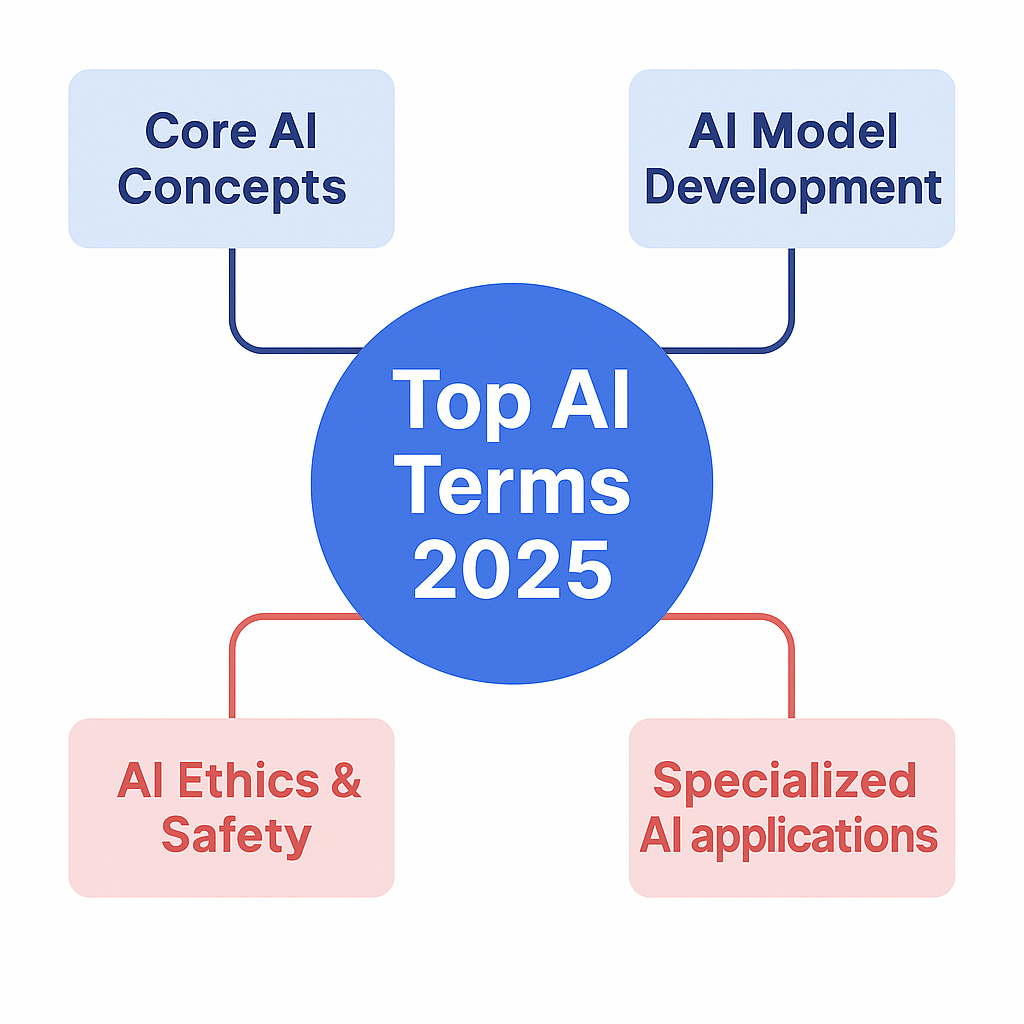
1. Core AI Concepts: Foundations of Machine Intelligence
At the heart of AI lie fundamental learning paradigms:
Machine Learning (ML) enables systems to learn from data through statistical inference rather than hard-coded logic. Deep Learning (DL), a subfield of ML using multilayered neural networks, underpins modern breakthroughs from computer vision to natural language processing. Supervised vs. Unsupervised Learning delineate how models interpret data — one through labelled examples, the other by discovering latent structures. Reinforcement Learning (RL), popularised through AlphaGo, introduces feedback-driven adaptation — essential for Agentic AI systems capable of self-improvement.
As PwC notes in its AI Jobs Barometer 2025, nearly 40% of job tasks in high-skill occupations now intersect with some form of ML-driven augmentation — signalling that literacy in these core terms is not optional, but foundational for digital fluency.
2. AI Model Development: From Parameters to Prompts
Modern AI development has moved from code-centric engineering to parameter stewardship.
Fine-tuning adapts a pre-trained foundation model for specific industries (e.g., finance or healthcare), significantly lowering compute costs. Prompt Engineering, a term barely known in 2022, has matured into a discipline — blending linguistics, psychology, and semiotics to elicit consistent reasoning from large models. Tokenization and Embedding define how human language becomes machine-interpretable vectors, the lingua franca of modern NLP systems. Quantization reduces model weights for efficiency, critical in edge deployments (e.g., LLMs running on mobile).
Stanford’s HAI 2025 Index reports that model efficiency research now rivals performance research in publication volume — reflecting an industry pivot from scale to sustainability and safety.
3. AI Processes & Functions: From Reasoning to Retrieval
2025 marks the mainstream adoption of reasoning architectures:
Chain-of-Thought (CoT) reasoning, first explored by Google Brain in 2022, allows models to “show their work”, improving transparency. Retrieval-Augmented Generation (RAG) couples LLMs with external knowledge sources — ensuring grounded, context-aware responses. PwC’s internal Knowledge Graph pilots show a 35% reduction in hallucinations when RAG pipelines are deployed. Context Windows (e.g., 200K tokens in GPT-5 scale models) expand memory, enabling multi-document comprehension. Inference cost, measured as cost per token, is emerging as a new AI KPI — shaping total cost of ownership in enterprise deployments.
The World Economic Forum (WEF), in its AI Governance 2025 Brief, highlights that context-sensitive reasoning will define the next generation of trustworthy AI systems, where explainability and reliability are not afterthoughts but design pillars.
4. AI Tools & Infrastructure: The Invisible Backbone
While front-end interfaces capture attention, the true revolution lies beneath — in the AI infrastructure layer:
GPUs (graphics processing units) remain central to model training, while TPUs (tensor processing units) and emerging AI ASICs from NVIDIA, Cerebras, and Graphcore redefine compute economics. Transformers, the neural architecture introduced by Vaswani et al. (2017), continue to underpin multimodal reasoning. Model Context Protocol (MCP), proposed by OpenAI and Anthropic in 2025, is fast becoming a universal standard for AI data access and interoperability — akin to what HTTP did for the web. APIs and agent frameworks (e.g., LangChain, AgentOS) now form modular ecosystems where AI components communicate autonomously.
As PwC’s Tech Effect 2025 report emphasises, cloud-native AI infrastructure will enable adaptive enterprises — where every business process is instrumented, monitored, and dynamically optimised by intelligent agents.
5. AI Ethics & Safety: Aligning with Human Intent
AI’s exponential capability demands proportional ethical stewardship.
AI Alignment — ensuring models act in accordance with human values — is the cornerstone of the AI Safety trinity: alignment, interpretability, and control. Bias and Privacy remain dual imperatives: according to Stanford HAI, 65% of public trust concerns stem from opaque decisioning and data misuse. Regulation, from the EU AI Act to Singapore’s AI Verify framework (co-developed with PwC and IMDA), is converging toward risk-based governance.
PwC’s Responsible AI Framework advocates for “ethics-by-design” — embedding safety checks from model conception to deployment, including automated bias audits and transparent model cards.
6. Specialised AI Applications: The Expanding Frontier
Computer Vision now powers autonomous inspection in manufacturing and predictive maintenance in aviation. Natural Language Processing (NLP) extends to multilingual agents capable of reasoning across law, finance, and health domains. Generative AI continues to redefine creative industries — PwC’s Global Entertainment Outlook 2025 projects a 30% productivity uplift from AI-augmented content pipelines. Vibe Coding, a term gaining traction in 2025, integrates emotion-driven design cues into AI-assisted programming — enabling tools that “feel” developer intent. AI Agents represent the frontier of autonomy: systems that plan, act, and learn across contexts — precursors to the Agentic AI ecosystems that will dominate by 2030.
At Stanford HAI, current research explores multi-agent deliberation models — where AI systems negotiate goals collaboratively, mirroring human collective intelligence.
7. The Path Forward: From Terminology to Trust
Language precedes transformation. Understanding these terms isn’t just technical literacy — it’s strategic foresight.
As AI systems evolve from assistive to autonomous, leaders must speak the language of alignment, interpretability, and purpose. This shared vocabulary is how we ensure that intelligence — artificial or otherwise — amplifies the best of our humanity.
References & Further Reading
PwC (2025). AI Jobs Barometer 2025: Measuring the Human-Machine Transition. PwC & IMDA (2024). AI Verify: Responsible AI Governance in Practice. World Economic Forum (2025). AI Governance & Alignment Framework. Stanford HAI (2025). AI Index Report 2025. Vaswani et al. (2017). Attention Is All You Need. OpenAI (2025). Model Context Protocol (MCP) Technical Whitepaper. PwC (2025). The Tech Effect: AI Infrastructure in the Adaptive Enterprise. MIT Sloan (2024). Chain-of-Thought Reasoning in Large Language Models. Anthropic (2025). Constitutional AI and Alignment Research.
 Genesis: Human Experience in the Age of Artificial Intelligence | Synthesis: The Superintelligence Protocol
Leave a comment