
A lot of big companies pay big money to professional services firms. But the game is changing.
The traditional consulting model — built on human-labour intensity, billable hours, and knowledge asymmetry — is being unbundled. In its place, we’re witnessing the rise of modular, intelligent, AI-augmented offerings powered by AI agents.
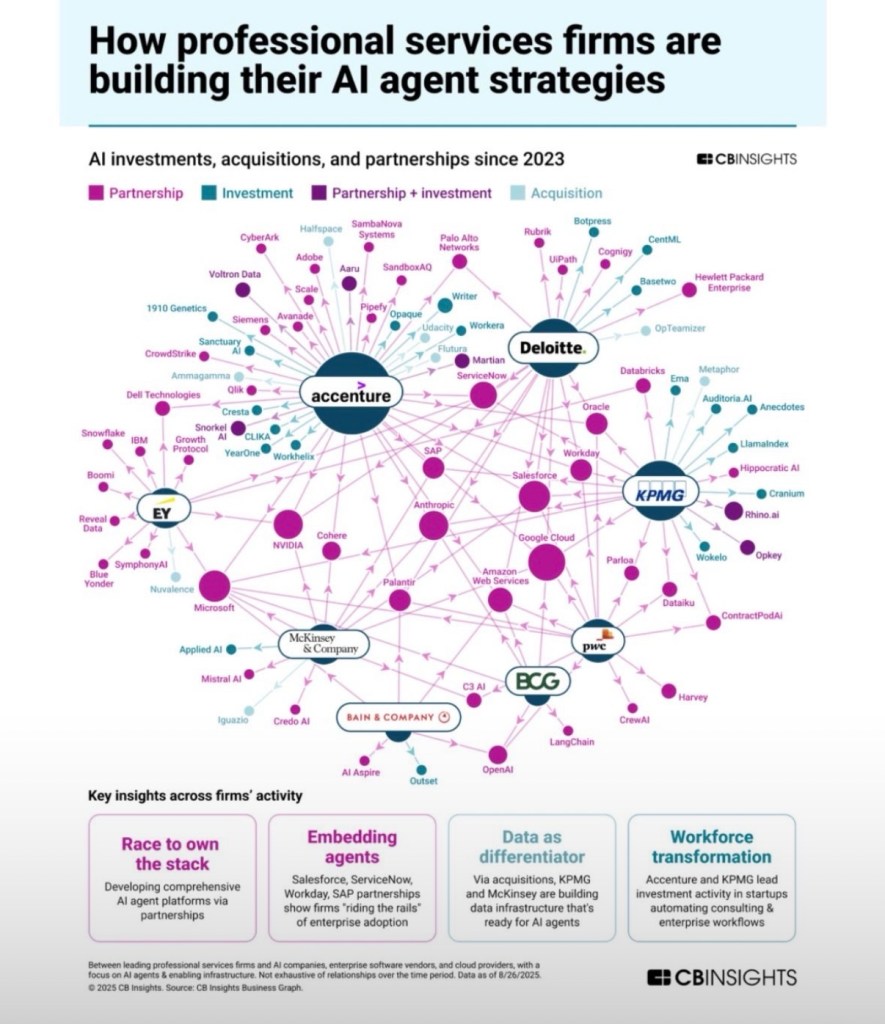
CB Insights’ latest network map shows how firms like Accenture, Deloitte, PwC, EY, KPMG, McKinsey, Bain, and BCG are racing to build their AI agent strategies — through a mix of partnerships, acquisitions, and investments across startups like Anthropic, Databricks, Hugging Face, and ServiceNow.
But the implications of this agentic shift go far beyond corporate R&D. They point to a redefinition of value itself in the consulting economy.
Three Hard Truths
1️⃣ To cut costs, firms will increasingly use AI to produce deliverables assembled by humans.
These firms will argue their AI frameworks, governance layers, or proprietary datasets make their outputs “special.” But behind the scenes, most slide decks, data summaries, and reports will be AI-generated — templated, parameterised, and QA-checked by consultants.
2️⃣ Clients will cut out the middleman.
Many large enterprises are building internal AI CoEs, deploying their own private agents. Instead of paying consulting firms to “analyse themselves,” they’ll DIY strategic analysis through secure, in-house agents and a small cadre of specialists who understand their unique workflows.
3️⃣ Most outputs will become “vanilla.”
We’ll see a convergence toward a common AI-generated recommendation schema — advising clients to flatten hierarchies, automate reporting, and deploy digital assistants. It’s the new cognitive offloading problem: efficiency without insight.
Key Themes & Implications
1. Rise of AI Agents & Modularised Services
The Google Cloud 2025 ROI of AI report confirms what many of us already see in the field — the agentic era has arrived.
Over 52% of global enterprises using GenAI have already deployed AI agents in production, automating workflows in marketing, finance, HR, and cybersecurity.
Professional services firms are adapting fast:
AI agents are being embedded into delivery systems — from Salesforce and ServiceNow integrations to Workday, SAP, and Anthropic partnerships. Services are being modularised: data ingestion, anomaly detection, research summarisation, and workflow orchestration are now automated Lego blocks that can be recombined. Embedded intelligence is now part of the client offering — not an add-on.
Implication: Consulting is shifting from “sell time” to “sell capability.”
2. Shifting Value Pools & Monetisation Models
Value is migrating from human labour to platforms, data, and proprietary models.
The Google study shows that AI early adopters allocate 39% of their IT budget to AI, with over half of that earmarked for agentic deployments.
The payoff: 88% of these organisations already report positive ROI, mainly in productivity, customer experience, marketing, and security.
As professional services firms chase this value:
Pricing models will evolve from hourly rates to usage-based, outcome-based, or subscription-based models. Engagements will “shift left,” with firms embedding earlier in clients’ design and decision loops — before strategy becomes execution.
Implication: The next consulting gold rush isn’t in “selling hours” — it’s in “owning flow.” Whoever owns the data and orchestration layer of a client’s operating model wins.
3. Changing Client Expectations & Relationships
Clients today want speed, transparency, and actionability.
They’re no longer satisfied with post-hoc insights; they expect continuous intelligence — AI agents that don’t just advise but act.
The boundaries between consulting, tech, and product firms are blurring:
Deloitte and Accenture resemble platform integrators more than traditional consultancies. McKinsey and BCG are launching data infrastructure plays, while PwC and KPMG are investing heavily in agentic workflow automation startups.
But with this integration comes responsibility. The Google Cloud survey found that data privacy and security remain the top considerations for enterprises adopting large language models.
Implication: Trust, validation, and explainability are no longer “compliance checkboxes.” They are the product.
4. Organisational & Capability Shifts
Professional services firms are re-architecting their DNA.
The emerging archetype blends AI engineering, product management, and design thinking with traditional advisory skills.
Cross-functional, agile pods are replacing linear project teams. AI engineers now work alongside strategists, data scientists, and behavioural economists.
Implication: The next generation of consultants won’t just “advise” — they’ll build and govern AI agents that deliver outcomes.
The Human Equation
Even as AI agents scale, the human layer remains irreplaceable — but its role is changing.
We move from doing to defining, from analysing to interpreting.
The greatest value now lies in:
framing the right questions, validating AI-generated insights, and guiding ethical and explainable use.
As I’ve often said, “HX (Human Experience) = CX + EX.”
The true differentiator in the agentic era isn’t automation — it’s empathy, judgment, and the ability to curate human-AI collaboration.
Strategic Recommendations
✅ Experiment early.
Pilot AI agents in low-risk, repetitive domains to establish proof of value.
✅ Own your data & models.
Proprietary datasets and governance frameworks are your new intellectual property.
✅ Hybrid delivery.
Combine the scale of AI with human oversight — what I call “symbiotic agency.”
✅ Repackage services.
Shift toward modular, subscription-style offerings — continuous delivery, not episodic projects.
✅ Build trust and guardrails.
Invest in explainability, validation, and bias controls from day one.
In Closing
The consulting industry is entering its Agentic Inflection Point.
Just as ERP systems redefined enterprise software in the 1990s, AI agents will redefine professional services in the 2020s.
But amidst the automation wave, one truth remains: human trust is the ultimate currency.
Those who design for it — not just with AI, but with intent — will own the next era of advisory value.
References:
CB Insights (2025). How Professional Services Firms Are Building Their AI Agent Strategies Google Cloud (2025). The ROI of AI 2025: How Agents Are Unlocking the Next Wave of AI-Driven Business Value PwC (2025). AI Jobs Barometer MIT Sloan (2024). Superhuman Workforce Stanford HAI (2025). AI Agents and the Future of Work
 Genesis: Human Experience in the Age of Artificial Intelligence | Synthesis: The Superintelligence Protocol
Leave a comment