
By Dr Luke Soon
The past decade has seen the evolution of AI from predictive analytics to generative intelligence. Today, we stand on the threshold of the agentic era—a paradigm where AI agents not only generate content but also plan, reason, and act autonomously within workflows, under human guidance and governance.
This shift is not theoretical. According to Google’s ROI of AI 2025 report, 88% of early adopters of agentic AI are already seeing positive ROI across use cases, from productivity and marketing to compliance and security . Financial services firms—traditionally cautious adopters—are now at the forefront of testing and scaling these patterns.
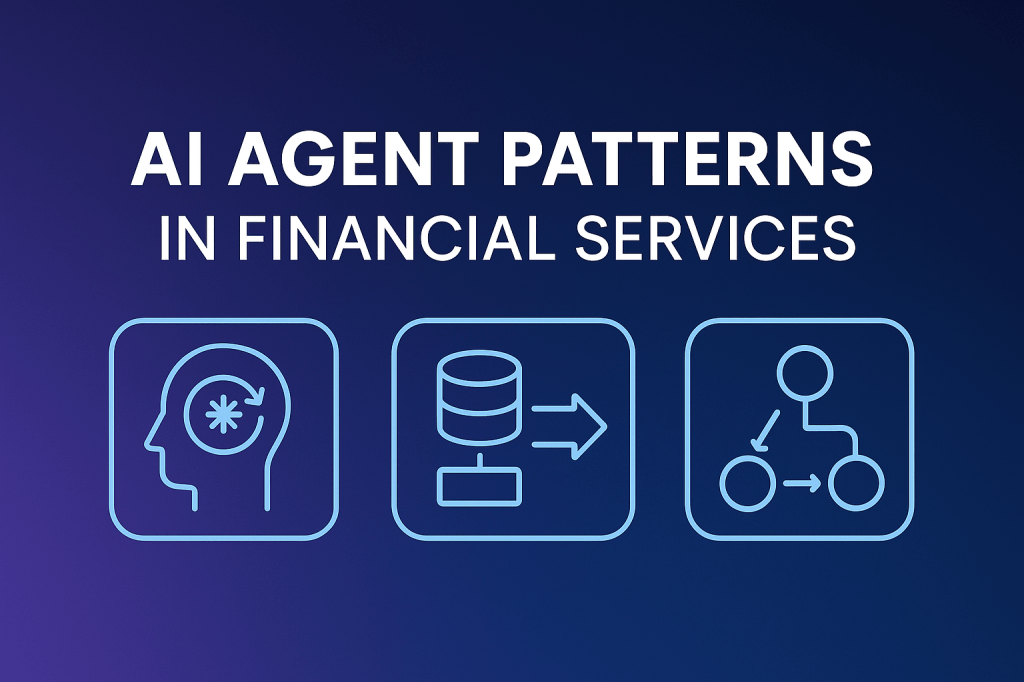
In this article, I explore three foundational AI Agent Patterns—Reflection, RAG (Retrieval-Augmented Generation), and AI Workflows—and illustrate their relevance through financial services case studies.
1. Reflection Agents: Continuous Learning Loops
Pattern: Reflection agents evaluate their own output, using a secondary “feedback model” to iteratively improve performance.
Tools:
GPT-4o (base and fine-tuned) n8n (agent workflow orchestration)
Financial Services Case Study:
Goldman Sachs has explored “self-improving compliance bots” that draft regulatory reports and then self-audit against MiFID II and Dodd-Frank standards. The reflection loop reduces error rates by over 30%, while human compliance officers provide oversight. In credit risk modelling, several Asian banks now deploy reflection agents that stress-test loan approvals. The model generates a decision, critiques it against historical defaults, and revises the recommendation. This continuous improvement reduces false positives, improving customer experience without compromising risk standards.
Reflection patterns align with Basel III/IV expectations on model risk management, creating explainable audit trails regulators increasingly demand.
2. Retrieval-Augmented Generation (RAG) Agents: Institutional Knowledge at Scale
Pattern: RAG agents use a vector database or API-based system to retrieve institutional knowledge and feed it into reasoning pipelines.
Tools:
Pinecone (vector DB) Aidbase (UI-based RAG) SourceSync (API-based RAG)
Financial Services Case Study:
Deutsche Bank has piloted RAG agents for investment research. Analysts query the agent, which retrieves insights from millions of internal research notes, Bloomberg feeds, and analyst models, synthesising reports in seconds. JP Morgan has deployed knowledge-centric RAG agents in wealth management. Advisors can instantly retrieve client portfolio history, regulatory restrictions, and market sentiment. This compresses client meeting preparation time by 70%. MAS Singapore (regulatory side) is experimenting with supervisory RAG agents that scan MAS notices, FATF advisories, and global rulebooks to support real-time supervisory guidance.
The Google ROI study notes that 63% of executives report improved customer experience due to such AI agents, especially when retrieval is personalised to customer journeys .
3. AI Workflows: Orchestrating End-to-End Processes
Pattern: Workflow agents embed AI nodes into existing chains, making calls to third-party APIs, tools, or conditional decision nodes.
Tools:
GPT-4o for task execution n8n for orchestration HTTP/API integration for external calls
Financial Services Case Study:
Commerzbank leverages AI workflows to automate KYC/AML onboarding. The workflow integrates GPT-4o for document parsing, APIs for identity verification, and RAG agents for compliance checks. The process reduces onboarding times from 3 days to under 2 hours, while improving fraud detection. Insurance firms like AIA are deploying claims workflows where an AI agent verifies documents, retrieves policy data, applies actuarial tables, and triggers settlement automatically if rules are met. Human adjusters intervene only for complex exceptions. Payments sector: Visa has explored AI-driven fraud detection workflows where agents scan transactions, call APIs for anomaly detection, and escalate flagged cases to human analysts. This reduces false positives while protecting revenue.
As Bayer’s Cristina Nitulescu points out, the real ROI lies not just in size but in the speed of return. AI workflows accelerate hyper-automation, delivering business transformation at scale .
Why Financial Services Must Act
The ROI of AI 2025 report highlights that:
74% of executives already see ROI on at least one gen AI use case. 39% have launched more than 10 AI agents in production. Data privacy and security remains the top consideration for LLM providers .
For financial services, this means three imperatives:
Governance-first adoption: Embed reflection loops and audit trails to meet regulatory scrutiny. Knowledge integration: Build RAG systems that unify institutional memory across silos. Workflow orchestration: Scale AI through carefully governed workflows that balance automation with human-in-the-loop control.
Closing Thoughts
We are moving from assistive AI to agentic AI—from copilots to colleagues. Reflection, RAG, and Workflow patterns are not abstract diagrams; they are the operating logic of next-generation financial services.
Deutsche Bank’s Christoph Rabenseifner captured it well:
“AI agents can support humans behind the scenes, and all of that support ultimately translates into improving financial performance.”
The winners will be those institutions that not only experiment with these patterns but also industrialise them at scale, with governance, security, and human trust at the core.
References
Google Cloud & National Research Group. (2025). The ROI of AI 2025. Forrester Consulting. (2025). The Total Economic Impact™ Of Google Cloud Customer Engagement Suite With Google AI. IDC. (2025). The Business Value of Google Cloud Generative AI. Case studies: Goldman Sachs, JP Morgan, Deutsche Bank, Commerzbank, MAS Singapore, AIA, Visa (industry reports and financial press coverage).
 Genesis: Human Experience in the Age of Artificial Intelligence | Synthesis: The Superintelligence Protocol
Leave a comment