
By Dr Luke Soon
“We are transitioning from Generative AI to Agentic AI – from systems that produce outputs to systems that act, reason, and collaborate.”
1. Introduction: The Rise of Agentic Intelligence
The next epoch of artificial intelligence is Agentic AI – systems that not only generate but decide, plan, and act. Unlike traditional GenAI (which answers queries), Agentic AI pursues goals, manages multi-step reasoning, calls tools, and interacts autonomously with humans and machines.
This transition mirrors the leap from reactive automation to proactive orchestration — where AI agents, multi-agent systems, and agentic infrastructures form the foundational stack.
According to the MIT Sloan Review (2025), over 48% of enterprises piloting GenAI in 2024 are now exploring agentic workflows to achieve compound automation and decision autonomy. Anthropic’s Constitutional AI, OpenAI’s GPT-o1 reasoning engine, and Google DeepMind’s AlphaAgent framework are leading exemplars.
2. The Layered Architecture of Agentic AI
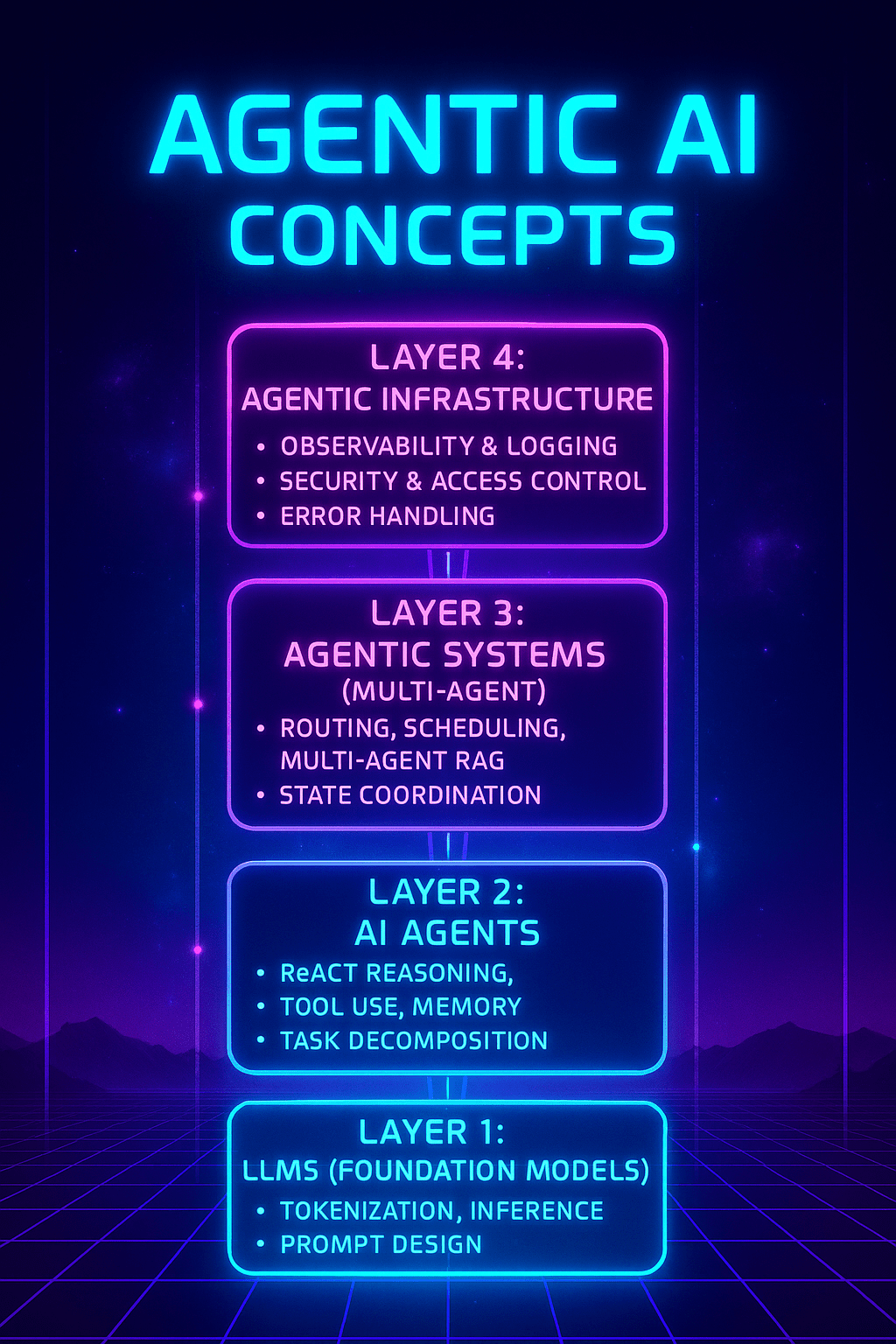
The diagram by Level Up Coding illustrates four concentric layers that capture the essence of this paradigm:
Layer 1: Large Language Models (LLMs)
Core foundation enabling:
Tokenisation & Inference Parameters – The computational primitives of reasoning. Prompt Engineering – Crafting structured inputs (e.g. CoT, ReAct) to elicit multi-step reasoning【Brown et al., 2020】. Task Decomposition – Breaking complex goals into executable sub-tasks.
🧠 Example: OpenAI’s GPT-4o performs structured tool calls via JSON, enabling integration with APIs and databases.
Layer 2: AI Agents
LLMs embedded with memory, reasoning, and action loops.
Key capabilities:
ReAct / CoT Reasoning (Yao et al., 2022) Memory & State Management – Persisting knowledge across sessions (e.g. LangGraph, MemGPT). Tool Usage / Function Calling – APIs, code execution, knowledge retrieval. Agent Roles & Specialisation – Distinct personas (Planner, Critic, Executor).
🧠 Case Study: AutoGPT and BabyAGI demonstrated early autonomous loops in 2023; modern successors (e.g. OpenDevin) orchestrate complex software tasks end-to-end.
Layer 3: Agentic Systems (Multi-Agent Orchestration)
When agents collaborate within ecosystems:
Inter-Agent Communication (e.g. message passing in CrewAI, Meta’s Habitat) Routing & Scheduling – Prioritising agent tasks for efficiency State Coordination – Shared world-models and context synchronisation Multi-Agent RAG – Distributed retrieval and consensus reasoning Workflow Automation – Linking reasoning chains into operational flows
🧠 Example: Microsoft’s AutoGen framework enables teams of agents (Planner–Executor–Evaluator) to collaboratively solve enterprise tasks such as data analysis, report generation, or risk scoring.
Layer 4: Agentic Infrastructure
The “cloud-scale” backbone ensuring trust, safety, and resilience:
Observability & Logging – Full telemetry for explainability (aligned with NIST AI RMF 2023) Security & Access Control – RBAC, secrets vaults, zero-trust policies Error Handling & Retries – Deterministic and stochastic recovery Human-in-the-Loop Controls – Ethical supervision and override mechanisms Cost Management & Rate Limiting – Sustainability of agentic workloads
🧠 Case Study: PwC’s AI Hub (Singapore, 2025) integrates AI Verify compliance modules for observability and assurance of agentic systems in financial services.
3. Why Agentic AI Matters

This paradigm enables:
Continuous workflows (no human stitching) Adaptive reasoning under uncertainty Compound productivity in banking, insurance, healthcare, public sector
🧠 Example: In financial compliance, multi-agent systems orchestrate risk monitoring, anomaly detection, and regulatory report generation autonomously.
4. Case Studies Across Industries
(a) Financial Services
UBS piloted multi-agent GenAI systems for wealth advisory—planner agents generate portfolios, executor agents validate compliance (PwC AI Hub 2025). MAS x AI Verify sandbox introduced agent observability protocols for Responsible AI compliance.
(b) Healthcare
Mayo Clinic’s agentic platform coordinates clinical triage and knowledge retrieval, reducing manual bottlenecks by 32%.
(c) Supply Chain & Manufacturing
Siemens Xcelerator uses agent orchestration to autonomously schedule maintenance, forecast demand, and trigger procurement actions.
5. Governance and Responsible Design
Agentic AI demands new governance paradigms:
Explainability Loops – Every decision must be traceable (OECD AI Principles 2024). Fail-Safe Mechanisms – Human override on unsafe or unethical trajectories. Agentic Safety Index (PwC 2025) – Quantifying risk across autonomy, criticality, and oversight. Simulation Sandboxes – Safe environments to test emergent behaviours (Anthropic 2024).
🧠 Framework Reference: Singapore’s Model AI Governance Framework (2024 update) now incorporates Agentic Autonomy Tiers.
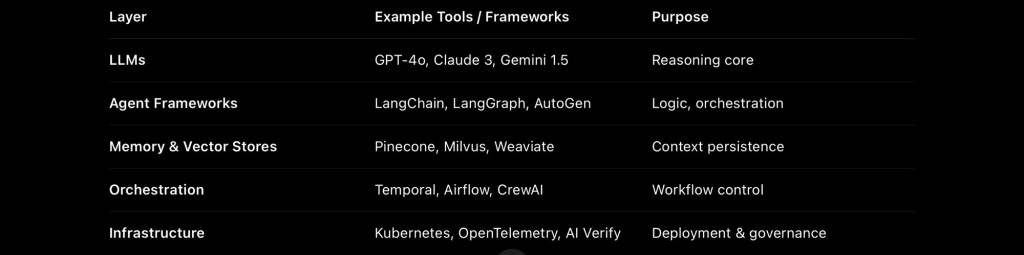
6. Building an Agentic Stack
7. Looking Ahead: Towards Embodied Intelligence
Agentic AI is the gateway to embodied cognition — when software agents interface with the physical world via robotics, IoT, and autonomous vehicles.
By 2030, hybrid systems will sense, decide, and act across cyber-physical domains — demanding new trust architectures and planetary ethics【Soon et al., Genesis 2022】.
8. Conclusion: From Generators to Governors
We are entering the Age of Agency. The organisations that thrive will not merely deploy LLMs but will orchestrate constellations of trustworthy agents — aligned with human purpose, ethical guardrails, and systemic resilience.
“The future is not about building smarter models, but cultivating wiser systems.” — Dr Luke Soon
References
Yao et al. (2022). ReAct: Synergising Reasoning and Acting in Language Models. MIT Sloan (2025). Organizations Aren’t Ready for the Risks of Agentic AI. Lasso Security (2025). Agentic AI Security Landscape. NIST (2023). AI Risk Management Framework 1.0. Singapore PDPC (2024). Model AI Governance Framework 3.0. OpenAI (2024). Function Calling & Agents API Documentation. PwC AI Hub (2025). AI Verify Compliance in Agentic Systems. OECD (2024). AI Governance & Ethics Principles. Soon, L. (2022). Genesis: Human Experience in the Age of AI.
 Genesis: Human Experience in the Age of Artificial Intelligence | Synthesis: The Superintelligence Protocol
Leave a comment