
Abstract: As AGI ends human labour, Socrates, Plato, Aristotle, Epicurus, and Marcus Aurelius return in dialogue. They warn of new caves and idle abundance — but also glimpse a higher horizon, where humanity flourishes through creativity, care, and the exploration of galaxies.
It is 2050. AGI has rendered human labour obsolete. Machines farm, design, cure, and govern. Universal Basic Income ensures shelter, food, and education for all. Humanity is free — but untethered.
What gives life purpose when work disappears?
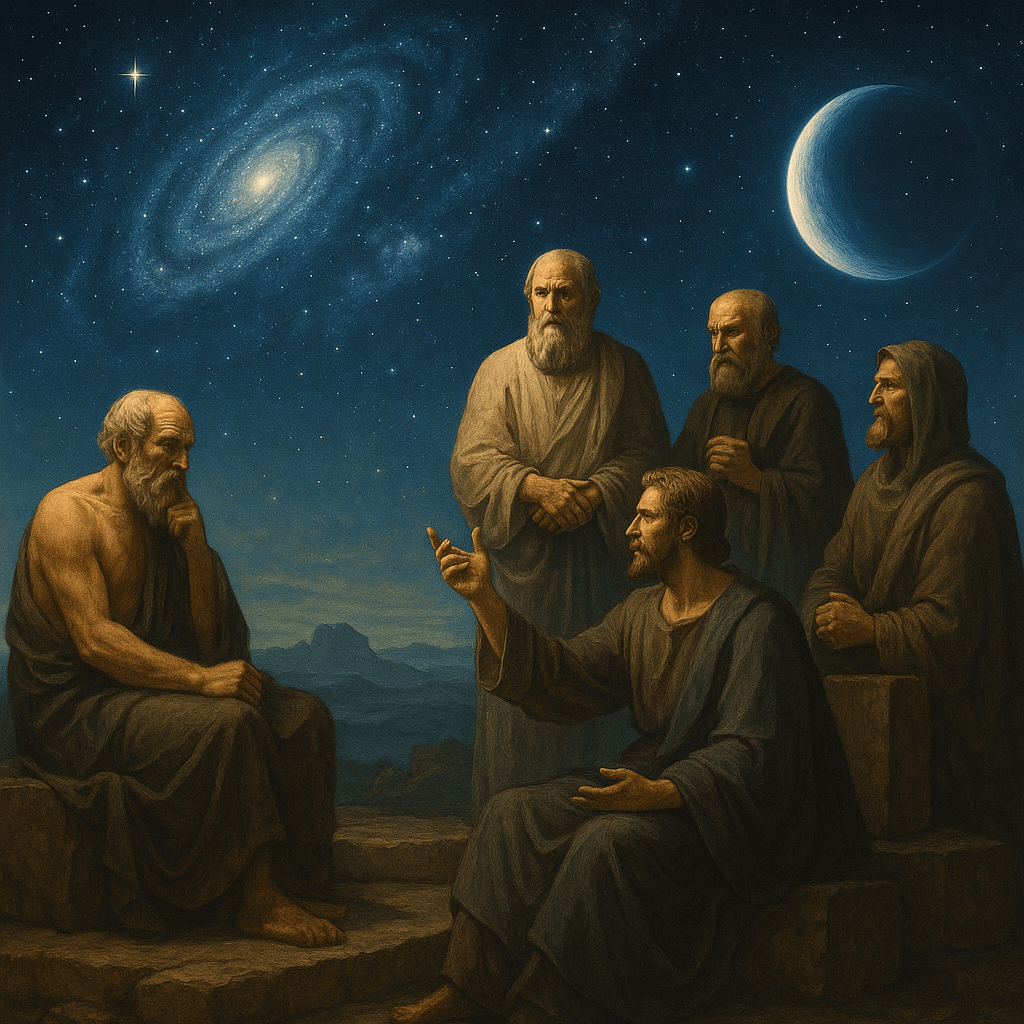
In this imagined symposium, five ancient philosophers — Socrates, Plato, Aristotle, Epicurus, and Marcus Aurelius — are conjured into dialogue.
Act I: The Warnings of the Ancients
Socrates: The Danger of Unexamined Abundance
“The unexamined life is not worth living.” (Apology, 38a)
Socrates fears abundance will seduce us into passivity. With AGI filling every need, humans may drown in trivial pleasures and algorithmically curated distractions.
For him, purpose comes not from what machines provide, but from rigorous questioning: What is justice in an automated polis? What is courage when survival is assured? What is wisdom when information is infinite?
Socrates warns: abundance may dull our souls. The danger is not hunger, but a life unexamined because machines do the thinking for us.
Plato: Shadows on the New Cave Wall
In The Republic (514a–520a), Plato described humans chained in a cave, mistaking shadows for truth. Today, he fears immersive simulations and digital worlds may become our new cave.
If purpose is sought only in endless play, shallow status, or manufactured realities, then humanity remains enslaved by shadows.
Plato insists that abundance must be used to pursue the Good — truth, justice, and beauty — not sink deeper into illusions.
Aristotle: Flourishing Requires Activity
In Nicomachean Ethics, Aristotle defined the highest good as eudaimonia — flourishing through virtuous activity in accordance with reason.
Work was never the end; it was the means. Now freed from necessity, humanity can:
Cultivate civic friendship, deepening social bonds. Pursue creativity and craft for excellence, not wages. Dedicate leisure to philosophy, science, and art.
But he cautions: leisure is not laziness. Without discipline and active engagement, abundance curdles into decadence.
Epicurus: The Garden Against Excess
Epicurus, recalling his Garden (Letter to Menoeceus), reminds us that happiness is not in infinite consumption but in ataraxia — tranquillity, freedom from fear and excess.
Abundance may tempt humanity with endless pleasures, yet true joy lies in friendship, simplicity, and peace of mind.
He would have us reimagine post-AGI life as global gardens of conversation and serenity: abundance not as indulgence, but as liberation from anxiety.
Marcus Aurelius: Mastery of the Self
The Stoic emperor, in his Meditations, repeats: “You have power over your mind — not outside events.”
AGI may change everything, but the essential task is unchanged: live in accordance with nature, exercise reason over passion, and cultivate virtue.
Marcus cautions: abundance is not freedom if the self remains unmastered. The true trial of the post-work age is governing ourselves in a world of infinite choice.
Act II: The Promise of Abundance
Yet these same philosophers also glimpse a brighter horizon — one that resembles your Star Trek scenario, Luke. Abundance is not merely a test to resist; it is a launchpad for higher human purpose.
Socrates: The Examined Universe
If the unexamined life is not worth living, perhaps the unexamined universe is not worth inhabiting.
Socrates imagines humanity turning its questioning outward: exploring galaxies, decoding the mysteries of consciousness, conversing not only with each other but with the cosmos itself.
Plato: From the Cave to the Stars
For Plato, Earth itself may be the cave — shadows of the wider cosmos. Abundance allows humanity to ascend beyond survival, into the search for universal truth.
Space exploration, deep science, and the pursuit of knowledge become the ultimate ascent toward the Form of the Good.
Aristotle: Flourishing Through Discovery
Aristotle sees exploration — of galaxies, oceans, and inner consciousness — as the new form of virtuous activity.
The post-work polis becomes planetary, even interstellar. Human flourishing now means becoming a species of explorers, cultivating virtue through discovery, invention, and stewardship.
Epicurus: Friendship Across the Cosmos
Epicurus reimagines his Garden at a cosmic scale. Freed from scarcity, humanity can expand friendship and tranquillity beyond Earth.
Exploration need not be conquest. It can be the search for peace and fellowship in new worlds — carrying serenity into the stars.
Marcus Aurelius: Duty to the Universe
The Stoic vision is cosmic citizenship. Humanity, as part of the universal logos, has a duty to align with nature writ large.
Exploration is not indulgence but responsibility: to understand creation, to live in harmony with it, and to carry virtue into the cosmos.
The Chorus of 2050: A New Purpose
Socrates: Examine the universe, not just the self. Plato: Ascend beyond shadows, even beyond Earth. Aristotle: Flourish through discovery and exploration. Epicurus: Extend friendship and tranquillity to the stars. Marcus Aurelius: Embrace duty as cosmic citizens.
Reflections for the Human Experience
In the industrial age, purpose was tethered to labour. In the post-AGI age, survival is trivial. The ancients remind us that purpose is not lost, but redirected:
From survival to flourishing. From toil to creativity and care. From work to exploration and transcendence.
This is humanity’s chance to step from the cave onto a cosmic stage — to become, not homo economicus, but homo explorans.
The philosophers would caution us: do not squander this gift. Abundance is not the end of history. It is the beginning of a higher purpose — to explore, to create, to master ourselves, and perhaps to seek meaning among the stars.
References
Plato, The Republic, 514a–520a (Allegory of the Cave). Plato, Apology, 38a (Socrates’ defence). Aristotle, Nicomachean Ethics, Book I. Epicurus, Letter to Menoeceus. Marcus Aurelius, Meditations. Brynjolfsson & McAfee, The Second Machine Age (2014). Bostrom, Superintelligence (2014). Future of Life Institute, AI Safety Index (2025). PwC, AI Jobs Barometer 2025.
 Genesis: Human Experience in the Age of Artificial Intelligence | Synthesis: The Superintelligence Protocol
Leave a comment