

By Dr Luke Soon
Introduction: AI’s Carbon Reckoning
Artificial Intelligence is no longer a discreet tool; it has become the scaffolding of our digital civilisation. But with scale comes consequence.
Across Virginia, Dublin, Singapore, and Johannesburg, we are erecting planet-scale compute systems: hyperscale data centres whose Scope 2 emissions already rival the national footprints of mid-sized economies. These gigawatt campuses, powered by coal-heavy grids or fragile renewables, are not abstract. They are physical, carbon-intensive infrastructures whose impact is measurable in tonnes of CO₂e.
This is the paradox of our century: AI is simultaneously the most energy-intensive technology ever deployed, and the most promising lever for climate solutions. If it consumes without restraint, it becomes another accelerant in the climate crisis. If guided wisely, it could be the very system that discovers new pathways to decarbonisation, negative-emissions materials, and a net-zero economy.
To track this knife-edge balance, I imagined what I call the AI–Climate Transition Framework: a structured year-by-year model from 2025 to 2050. It is not an atlas of possibilities nor a metaphorical compass. It is a dashboard and disclosure tracker — grounded in the same vocabulary that regulators, ESG auditors, and climate scientists use: Scope 1, 2, and 3 emissions; PUE, WUE, CUE; net-zero transition plans; and avoided emissions metrics.
This framework is both chronicle and accountability mechanism. It allows us to see whether AI will tip the balance towards planetary overshoot — or towards planetary abundance.
AI’s Dual Role: Emitter and Enabler
The challenge begins with the physics of compute:
Scope 1: Direct emissions from diesel backup generators, refrigerants in cooling, on-site fuels. Scope 2: Purchased electricity — the dominant driver, often 70–90% of AI’s carbon footprint. Scope 3: The hidden iceberg — emissions from chip fabrication, rare earth mining, supply chains, end-of-life disposal.
By 2030, industry forecasts suggest that AI-related demand could consume up to 10% of global electricity if unconstrained — pulling grids back toward fossil dependency.
Yet the same systems are being deployed to:
Optimise grid balancing and renewable integration. Accelerate fusion reactor design. Discover carbon-negative materials. Model climate pathways with higher fidelity than the IPCC ever could.
This is the contradiction regulators, boards, and society must navigate: AI as an emissions source vs AI as a climate solution.
Why a Transition Framework?
At COP conferences, regulators use terms like “Transition Pathways” and “Net Zero Roadmaps.” Investors look for disclosure matrices and science-based targets (SBTi). ESG professionals track emissions intensity per unit of output.
Poetic metaphors are insufficient here. What we need is a structured, auditable framework that shows:
Which policies are in force (EU AI Act, SEC Climate Rule, ESRS E1, GHG Protocol revisions). Which breakthroughs are expected (climate-neutral compute, 24/7 carbon-free energy, AI-discovered negative-emission tech). Which experts and regulators “own the levers” (from Priya Donti at Climate Change AI, to EFRAG on ESRS updates, to IMDA Singapore on green data centres). What threshold KPIs must be crossed for AI to become climate-aligned.
That is why the AI–Climate Transition Framework takes the form of a living workbook, extending from 2025 to 2050. It is designed in the language of regulators, so that when the sheet turns green, no translation is required.
Scenarios: Two Futures, One Choice
Scenario A: AI as Energy Predator
Compute demand grows faster than renewables. Nuclear plants are re-licensed at scale to meet AI’s base load. Scope 2 emissions spike, even as disclosures improve. Regulators tighten but lag; frameworks play catch-up. Net zero targets slip, and AI becomes a net driver of emissions.
Scenario B: AI as Climate Solution
AI optimises energy grids in real-time, cutting waste. New materials discovered by AI reduce embodied Scope 3 emissions in chips. Quantum computing and neuromorphic chips slash energy per FLOP. Negative-emissions breakthroughs (direct air capture, bio-engineered carbon sinks) are AI-assisted. Global disclosures align, 24/7 carbon-free energy becomes default, and AI transitions from emitter to enabler.
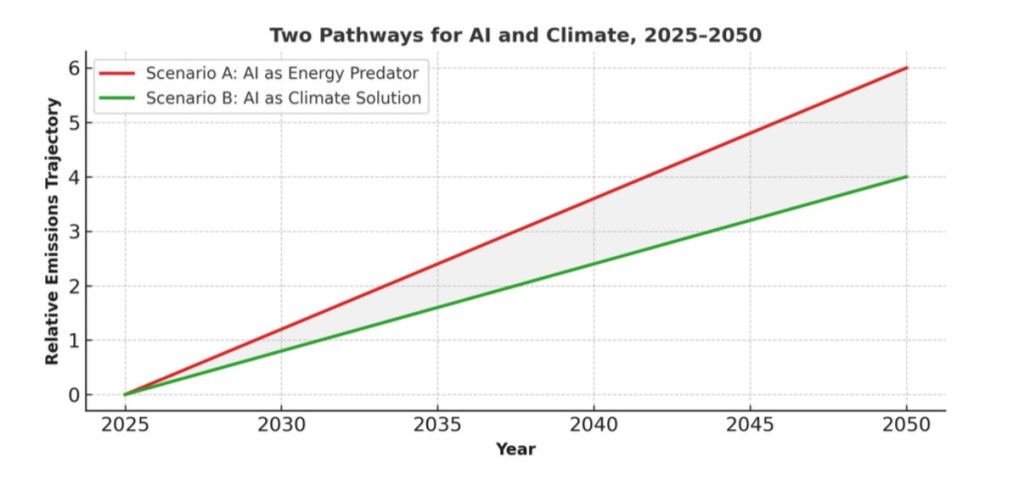
The Transition Framework maps both trajectories, year by year.
The Watchlist: Breakthroughs & KPIs
At the heart of the Framework are two mechanisms:
Breakthrough Watch — candidate innovations from 2025–2050: Climate-neutral compute by 2030. Sub-1.0 PUE hyperscale centres. Fusion-assisted grids by 2040. AI-designed carbon-negative materials by 2045. Quantum-assisted sustainability modelling. Threshold KPI Bands — traffic-light indicators that turn green when targets are met: kWh per model training < carbon-neutral benchmark. Scope 2 emissions fully matched with hourly, regional renewables. Scope 3 supply chains verifiably net-zero. Avoided emissions > operational emissions.
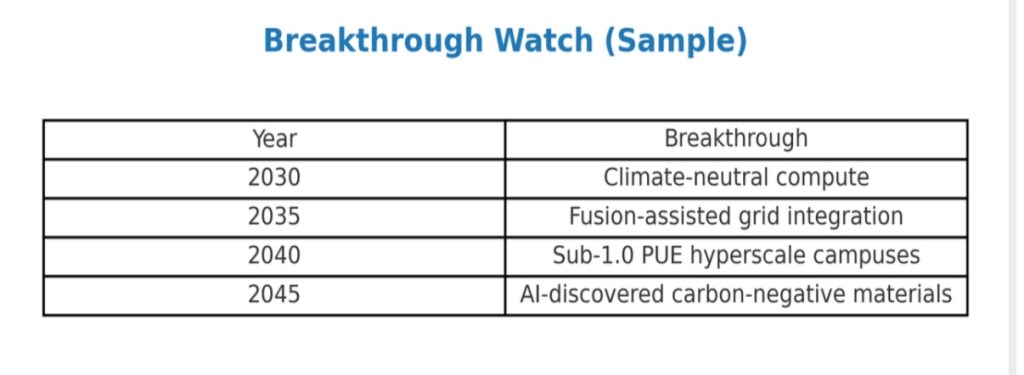
The logic is simple: when the sheet turns green, civilisation has crossed a climate threshold.
Who Holds the Levers?
Every KPI is cross-linked to an accountable entity:
At the core sits a traffic-light dashboard: a live snapshot of how each region is tracking
towards net-zero AI. Amber and red flags signal where compute growth is outpacing
renewable capacity; green signals early signs of climate alignment.

Policy / Disclosure: GHG Protocol Secretariat (Scope 2 revision). EFRAG (ESRS E1). SEC (US Climate Rule). ISSB (IFRS S2). Technology / Science: Priya Donti (Climate Change AI). Sasha Luccioni (AI for climate transparency). Fatih Birol (IEA). EnergyTag & WRI (24/7 CFE). Regions / Regulators: IMDA Singapore (Green Data Centre Roadmap). European Commission DG CLIMA. US DOE + NREL. African Union Climate & AI taskforces.
This makes the Framework not just a tracker of numbers, but a map of accountability.
From HX to PX: Human + Planetary Experience
In my work, I have long argued that HX = CX + EX: Human Experience as the synthesis of Customer and Employee Experience. But in the AI–climate era, we must extend HX into PX — Planetary Experience.
AI cannot simply optimise user journeys or employee workflows. It must optimise the planetary transition itself.
Reducing Scope 2 emissions through energy-aware training. Eliminating Scope 3 leakage through supply-chain AI. Amplifying avoided emissions through sectoral applications (mobility, energy, agriculture).
This is not only about disclosure. It is about stewardship.
The Call to Action: Stewardship at Scale
The AI–Climate Transition Framework is not a static document. It is a living, auditable roadmap — designed to be used by boards, regulators, scientists, and technologists alike.
It shows that AI can either be an energy predator, or a climate steward. The difference lies not in the technology alone, but in the governance, disclosure, and accountability frameworks we build around it.
By 2050, we will know whether these planet-scale compute systems drove us beyond planetary limits, or whether they unlocked pathways to abundance.
The Framework does not make the choice. It simply shows — in the language of regulators, in the metrics of ESG — whether civilisation has crossed the threshold.
Closing Reflection
This is both chronicle and transition plan.
It is how we hold ourselves accountable in the age of AI.
It is how we ensure that emissions give way to abundance.
And it is how we move from Scope 2 dependence to climate-neutral compute; from disclosure matrices to green cells; from ambition to verifiable progress.
The future is still unwritten. But it is no longer untracked.
🌍 Emissions: Scopes 1, 2, and 3 Applied to AI
The emissions lens matters. Regulators and ESG auditors now demand Scope 1, 2, and 3 accounting for AI infrastructure:
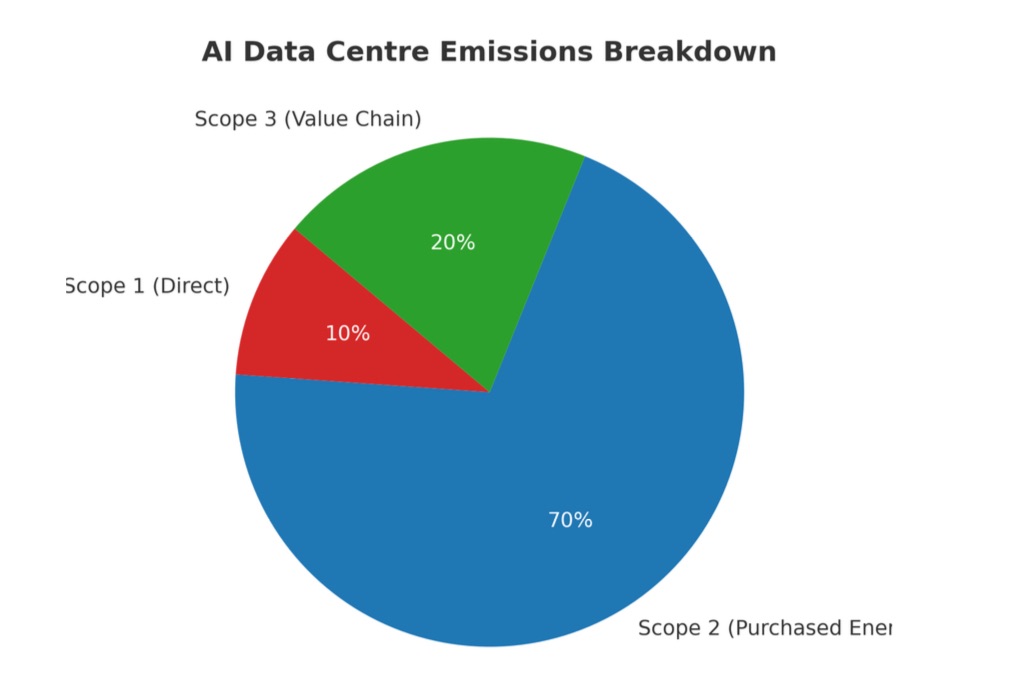
Scope 1: Direct emissions from backup diesel and on-site generation. Scope 2: Purchased electricity—by far the largest category. Scope 3: The global supply chain—semiconductors, cooling equipment, logistics, and end-of-life recycling.
⏳ Two Futures: AI as Predator vs AI as Solution
From 2025 to 2050, two divergent futures emerge.
Scenario A: AI as Energy Predator Compute demand rises unchecked. Nuclear is forced into the grid mix to stabilise supply. ESG metrics lag. Scenario B: AI as Climate Solution AI accelerates renewable innovation, quantum-assisted optimisation, and materials discovery. Net-negative emissions breakthroughs appear by 2045.
⚖️ Why This Matters
Boards, regulators, and climate scientists now share a common question: can AI help humanity bend the emissions curve, or will it lock us into overshoot?
Our Carbon Accountability Dashboard doesn’t claim to predict the future. Instead, it tracks the levers, owners, and breakthroughs that decide it—year by year, region by region.
If the dashboard turns green by 2035, AI will have earned its place as a partner in sustainability. If not, the same technology that promised abundance may instead accelerate scarcity.
🔗 This is the frontier where AI, ESG, and climate regulation collide. The choices we make in the next decade will determine whether AI becomes a carbon colossus—or the engine of planetary renewal.
 Genesis: Human Experience in the Age of Artificial Intelligence | Synthesis: The Superintelligence Protocol
Leave a comment