
By Luke Soon & Ryuka
Abstract
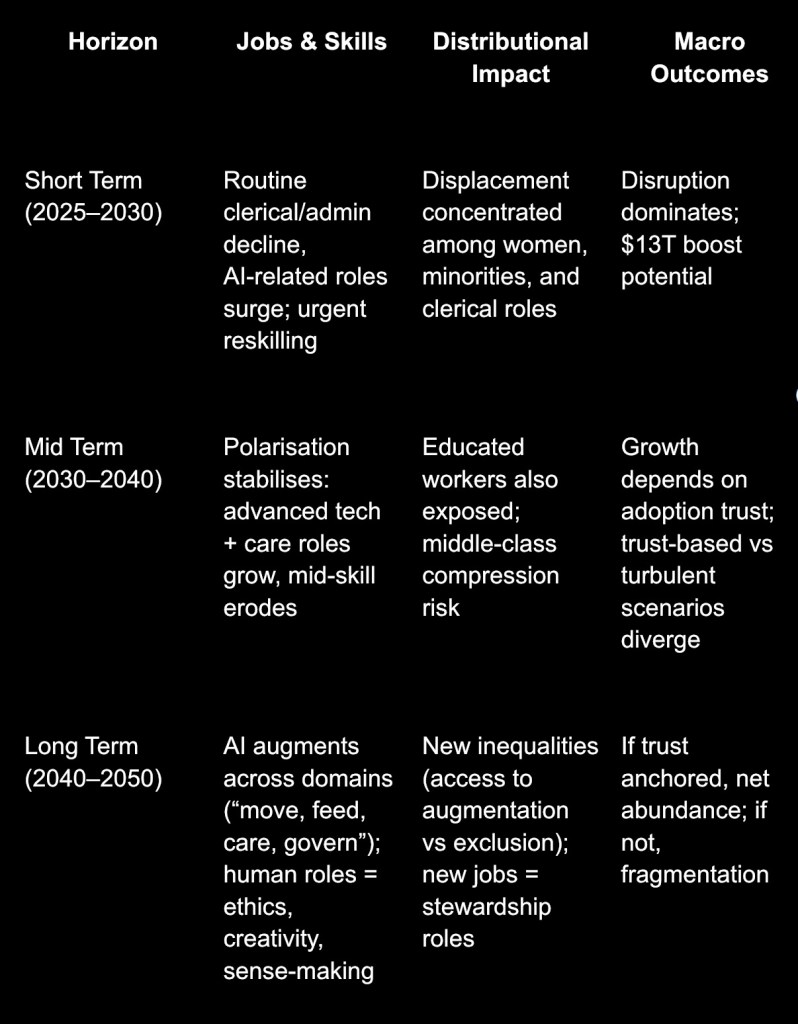
Artificial Intelligence (AI) is not merely the next wave of automation — it is a general-purpose capability spanning cognition, perception, and increasingly, physical dexterity. It is poised to reorder the foundations of work, reshape the social contract, and redefine the meaning of human contribution.
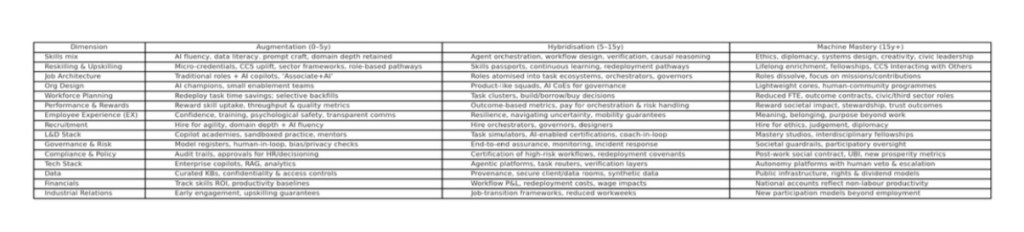
This article introduces the Luke–Ryuka Framework for AI Workforce Transition (LRF-AWT), a practical model that maps how jobs, skills, and organisations evolve across three eras: Augmentation (0–5 years), Hybridisation (5–15 years), and Machine Mastery (15+ years).
Drawing from global research (MIT, Oxford, ILO, OECD, IMF, WEF, Stanford HAI, McKinsey, PwC) and contextualising within Singapore’s policy ecosystem (SkillsFuture, Workforce Singapore, National AI Strategy 2.0, AI Verify, Singapore AI Safety Institute, MAS FEAT principles), the framework provides leaders with a structured compass for action.
A sectoral case study of Law & Tax illustrates how professions evolve from billable-hour drudgery to AI-augmented orchestration, and finally into stewardship and societal guardianship.
🌍 1. Global Trends: The New Labour Question
Productivity uplift, polarisation risks
MIT (David Autor, 2023): AI can rebuild middle-class work if deployed as complement, not substitute. Acemoglu & Johnson (2023, Power & Progress): productivity gains historically concentrated among elites; redistribution needed. Brynjolfsson, Li & Raymond (2023, Science): AI copilots improved productivity by 14–15% in real firms. BCG/MIT “Jagged Frontier” (2023): AI boosts quality in-domain, degrades outside — governance of task allocation essential.
Exposure estimates
Frey & Osborne (Oxford, 2013): 47% of US jobs at risk. OECD (2019–21): ~9% of jobs “highly automatable.” OpenAI/UPenn (Eloundou et al., 2023/24, Science): 80% of jobs have ≥10% of tasks exposed; higher-income jobs often more exposed. Goldman Sachs (2023): 300m FTEs disrupted globally; ~$7tn GDP upside. McKinsey (2023): $2.6–4.4T in annual productivity gains.
Policy & macroeconomic perspectives
ILO (2023, 2025): clerical/admin most exposed; augmentation > substitution. OECD (2024): 3 in 5 workers fear displacement; 2 in 5 expect wage stagnation. IMF (2024): 40% of jobs affected globally; advanced economies most exposed. WEF (2023): 23% of jobs to change by 2027.
🇸🇬 2. Singapore’s Response: Skills, Strategy, and Trusted AI
Singapore provides a systems-level response by integrating skills, jobs, and governance:
SkillsFuture & WSG: Skills Frameworks, Critical Core Skills (CCS), Jobs-Skills Integrators (JSITs), Job Redesign grants, Skills Demand for the Future Economy dashboards. NAIS 2.0 (2023): Singapore is “especially exposed” to AI disruption; aims to uplift workforce AI capabilities while minimising disruption. Governance: AI Verify (2024), Singapore AI Safety Institute (2024), MAS FEAT Principles (2018).
🔧 3. The Luke–Ryuka Framework (LRF-AWT)
We structure the AI–workforce transition into three eras:
Augmentation (0–5 years): Humans + AI copilots; micro-credentials; role redesign. Hybridisation (5–15 years): Agentic workflows; orchestrator & governance roles; redeployment at scale. Machine Mastery (15+ years): Autonomy dominates; humans focus on ethics, civic leadership, stewardship.
⚖️ 4. Case Study: Law & Tax Professions
Professional services epitomise the challenge: structured rules meet interpretive judgement.
📊 Law & Tax – Sample Trajectory
Augmentation: copilots for research, drafting, computations; roles = Associate+AI; skills = CCS Digital Fluency. Hybridisation: agentic matter prep; orchestrators and governance counsels; redeployment pathways. Machine Mastery: autonomous drafting; humans as Policy Architects & Stewards; KPIs = trust indices, societal fairness metrics.
When I first proposed HX = CX + EX — the integration of Customer Experience and Employee Experience — it was designed to capture how organisations could thrive in an AI-enabled economy by harmonising external value with internal culture.
The latest evidence from WEF (2025) and the IEDC Labour Market Review makes clear, however, that a third dimension must now be acknowledged: the psychological experience (PX) of workers and communities.
CX (Customer Experience): Trust, empathy, and human touch remain decisive in markets where AI delivers instant frictionless service. EX (Employee Experience): The skills agenda, inclusion, and adaptive learning ecosystems determine whether employees remain relevant and engaged. PX (Psychological Experience): Anxiety, fear of obsolescence, and loss of purpose are as real as productivity gains. Trust in AI adoption is not just institutional but personal.
By extending HX to HX = CX + EX + PX, we recognise that the future of work will not be defined solely by efficiency or economic uplift. It will be defined by whether humans can sustain dignity, resilience, and meaning in a world where AI executes the “what” of work, leaving us to redefine the “why”.
This refinement aligns directly with the distributional inequities and psychological risks highlighted in the WEF and IEDC studies. It also reframes the future of work not merely as a contest of skills, but as a test of societal design: can we engineer ecosystems where creativity, fairness, and purpose are not casualties of automation, but the defining characteristics of an abundant age?
📌 6. Conclusion
The LRF-AWT shows that disruption is phased, not binary. Singapore’s SkillsFuture + NAIS 2.0 + AI Verify ecosystem demonstrates how nations can align skills, governance, and policy to manage disruption responsibly.
The Law & Tax case study illustrates how a profession evolves: from augmentation to orchestration to stewardship.
Ultimately, in the Machine Mastery Era, the critical challenge is: if machines do the work, how will humans find purpose?
References
Autor, D. (MIT, 2023). “New Frontiers: The Complementarity of AI and Work.” Acemoglu, D., & Johnson, S. (2023). Power and Progress. PublicAffairs. Brynjolfsson, E., Li, D., & Raymond, L. (2023). “Generative AI at Work.” Science. BCG/MIT (2023). “The Jagged Frontier.” Frey, C., & Osborne, M. (2013). “The Future of Employment.” Oxford Martin School. Eloundou, T. et al. (2023/2024). “GPTs are GPTs.” Science. Goldman Sachs Research (2023). The Potential of Generative AI. McKinsey Global Institute (2023). The Economic Potential of Generative AI. International Labour Organisation (2023, 2025). Generative AI and Jobs. OECD (2024). Employment Outlook: Using AI in the Workplace. IMF (2024). AI and the Future of Work. World Economic Forum (2023). Future of Jobs Report. Singapore Smart Nation & Digital Government Office (2023). National AI Strategy 2.0. SkillsFuture Singapore (2025). Skills Demand for the Future Economy. Workforce Singapore (2024). Job Redesign Initiatives; Jobs-Skills Integrators. AI Verify Foundation (2024). Model Governance Framework for GenAI. Singapore AI Safety Institute (2024). Evaluation and Red-Teaming Reports. Monetary Authority of Singapore (2018). FEAT Principles.
Delta Insights (Applied to Professions)
We have now operationalised the Luke–Ryuka framework inside a master dataset that runs from 2025 to 2050:
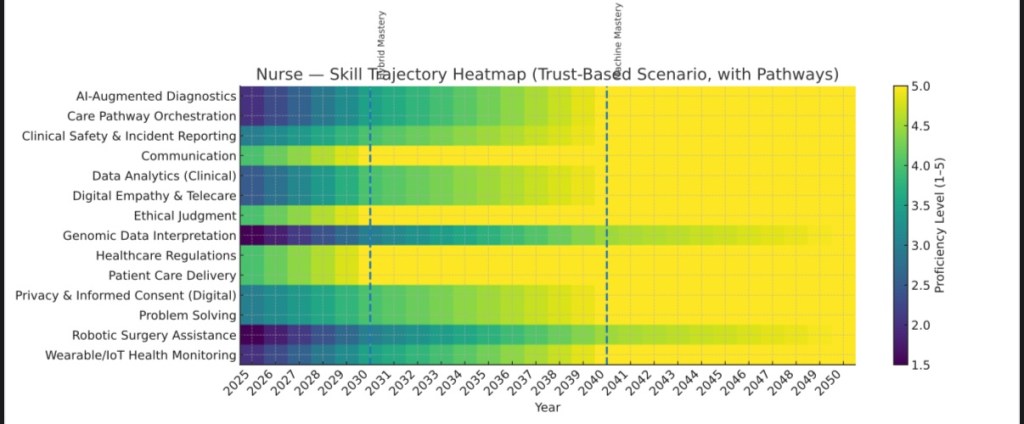
Legal Associate Augmentation (AI drafting) → Hybrid by 2034 (AI-led analytics + human judgment) → Mastery by 2043 (AI runs precedents, humans redefine justice outcomes). Nurse Augmentation (AI diagnostics, telehealth) → Hybrid by 2036 (robotic assistants + empathy at scale) → Mastery by 2045 (embodied AI procedures, humans focus on experience). Manufacturing Worker Augmentation (basic robotics) → Hybrid by 2035 (cobotics, predictive AI) → Mastery by 2044 (digital twins + autonomous factories). Customer Support Augmentation (chatbots + AI prompts) → Hybrid by 2033 (emotion AI, multimodal orchestration) → Mastery by 2042 (AI-first interactions, humans ensure trust). Software/Data Professional Augmentation (MLOps, data engineering) → Hybrid by 2032 (agentic AI supervision, bias audits) → Mastery by 2041 (AI builds AI, humans set governance rules).
The framework is no longer conceptual: it is a time-phased, skill-levelled roadmap, with policy-ready pivots for PSD, MOM, MOF/IRAS, MTI/EDB, and MOH.
The heatmaps make this shift visible at a glance, showing precisely when Augmentation ends and Hybrid/Mastery begin.
Heatmap to embed: Nurse – Skill Trajectory (2025–2050, Trust-Based Scenario). Why? Nursing illustrates the human-AI symbiosis beautifully: augmentation via AI diagnostics, hybrid through robotics + empathy, mastery when embodied AI executes procedures while humans hold ethical and emotional centre.
 Genesis: Human Experience in the Age of Artificial Intelligence | Synthesis: The Superintelligence Protocol
Leave a comment