

Picture yourself on a quiet night, gazing up at the stars. For most of human history, those distant lights were mysteries—guiding sailors, inspiring myths, and reminding us how small we are. But what if, one day, humanity could reach out and touch those stars—not just in dreams, but in reality?
This is the story the Kardashev Scale invites us to imagine. It’s not just a scientific framework; it’s a cosmic coming-of-age tale, mapping our journey from planetary infancy to the threshold of cosmic consciousness.
The Low Down (In Plain English)
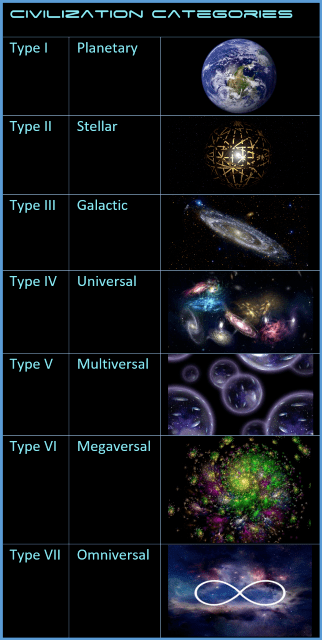
- The Kardashev Scale measures a civilisation’s progress by how much energy it can harness—from a single planet (Type I) to the entire universe (Type VII).
- Right now, we’re at about Type 0.73—still learning to walk, still burning fossil fuels, and facing existential risks.
- Each step up the scale is a leap in technology, imagination, and responsibility.
- Science fiction gives us glimpses of what these future civilisations might look like.
- The scale isn’t just about power—it’s about wisdom, sustainability, and what it means to be truly “advanced.”
- Our next big test: becoming a Type I civilisation within the next 100–200 years. Our survival may depend on it.
- Mastering energy is only half the story; mastering ourselves is the other.
1. The Cosmic Ladder: A Vision Born in the Cold War
In 1964, as the world watched the space race unfold, Soviet astrophysicist Nikolai Kardashev asked a simple but profound question: “How would we recognise an advanced civilisation if we saw one?” Instead of focusing on alien biology or culture, he zeroed in on something universal—energy. Every civilisation, no matter how strange, needs energy to survive, grow, and communicate.
Watch:
- The Entire Kardashev Scale Explained in 20 Minutes (YouTube)
- What Do Alien Civilizations Look Like? The Kardashev Scale (YouTube)
Read:
- Kardashev Scale – Wikipedia
- Kardashev Scale | Britannica
- Kardashev, N. S. (1964). “Transmission of Information by Extraterrestrial Civilizations.” Soviet Astronomy, 8, 217.
Imagine:
- Isaac Asimov’s Foundation series, where galaxy-spanning civilisations rise and fall.
- Arthur C. Clarke’s The City and the Stars, exploring advanced energy manipulation.
2. Type I: Planetary Masters—Turning Earth into a Symphony
Imagine a world where energy is as abundant and clean as air after a rainstorm. Hurricanes are tamed before they form, droughts ended with a nudge, and resource scarcity is a relic of the past. This is the promise of a Type I civilisation—one that has mastered all the energy available on its home planet.
We’re not there yet. Today, we’re still burning the remains of ancient forests and creatures—fossil fuels—while dreaming of fusion and renewables. But every solar panel, every wind turbine, is a step up the ladder.
Watch:
Read:
- Kaku, M. (2011). Physics of the Future. Penguin.
Imagine:
- The Matrix (film): Humanity’s energy is harvested (for dark purposes).
- Interstellar (film): A warning of what happens if we fail to make the leap.
3. Type II: Stellar Engineers—Building with Sunlight
Now, stretch your imagination. What if we could capture all the energy of our Sun? Enter the realm of Type II civilisations—builders of Dyson spheres, vast swarms of solar collectors encircling a star.
Watch:
- Ancient Civilizations and Tiny Dyson Spheres (YouTube)
- The Fermi Paradox: Searching For Dyson Spheres (YouTube)
- Dyson Spheres Found? The Search For Alien Civilizations (YouTube)
Read:
- Dyson, F. J. (1960). “Search for Artificial Stellar Sources of Infrared Radiation.” Science, 131(3414), 1667–1668.
- Worldbuilding Stack Exchange: Would a Type II civilization really build a Dyson sphere?
Imagine:
- Larry Niven’s Ringworld: A megastructure built around a star.
- Liu Cixin’s The Three-Body Problem series: Advanced civilisations and stellar engineering.
- Star Trek (TV/film): The Federation’s starships and encounters with Dyson spheres.
4. Type III: Galactic Architects—Dancing Among the Stars
Type III civilisations are the stuff of legend—masters of entire galaxies, wielding the energy of billions of stars. Imagine moving stars like chess pieces, building structures that span light-years, or tapping the power of black holes.
Energy: ≈10³⁶ – 10³⁷ W (entire Milky Way)
ETA: 10⁵ – 10⁶ years
- Stellar choreography
• Re-arranging orbits of rogue stars to spell glyphs 100 parsecs wide—cosmic graffiti visible for eons.
• Turning neutron-star binaries into gravitational-wave power plants. - Galactic Internet
• Faster-than-light messaging via stabilised wormhole throat lattice (Maldacena-Susskind ER = EPR style).
• Transmission bandwidth measured in Gödel numbers per second. - Core-black-hole engineering
• Growing a Sgr A* accretion-disk super-reactor; Hawking-radiation harvested in magnetic bottles.
• Spin-induced frame-dragging used as a reaction-wheel to torque the entire galaxy—nudging it clear of impending dwarf-galaxy collisions. - Biosphere diaspora
• Every terrestrial planet in the Milky Way seeded with “genome libraries in a can”—algorithmically tailoring new ecologies.
• Civilisation fragments into billions of cultural clades linked by shared quantum-ledgers. - Fictional echoes
• Asimov’s late-stage Foundation universe (Second Galactic Empire).
• Star Wars’ legends of Celestials manipulating star clusters.
• Alastair Reynolds’ Inhibitors (dark take on galaxy-wide engineering).
Watch:
Read:
- Sagan, C. (1973). “Communication with Extraterrestrial Intelligence.” MIT Press.
Imagine:
- Star Wars: The Galactic Empire (though arguably not a true Type III).
- Foundation (Asimov): Galactic-scale societies.
- Doctor Who: The Time Lords, beings with near-galactic influence.
- Star Trek: The Q Continuum, god-like entities.
5. Beyond: Types IV–VII—The Edge of Imagination
Some thinkers push the scale even further: Type IV (universal), Type V (multiversal), and beyond. Here, civilisations manipulate the very fabric of reality, create universes, and exist as pure consciousness. These are realms where science meets philosophy, and our language begins to fail.
Type 4:
Energy: ≈10⁴⁶ W (all stars in observable universe)
ETA: 10⁷ – 10⁸ years
- Cosmic Filament Harvest
• Super-cluster-scale Dyson webs siphon radiation from tens of trillions of stars.
• Matter-energy conversion factories shred dwarf galaxies, recycling baryons into computronium. - Entropy management
• Boltzmann-Braking: negative-entropy import via routing heat into baby universes (see Type V).
• Global reversal of proton decay by engineering beyond-Standard-Model interactions. - Rewrite the constants
• Using high-energy brane collisions to fine-tune α and G in local regions—tailoring physics to application.
• Creating safe zones with c ≈ 2 c allowing ultra-relativistic computation. - Fictional echoes
• Greg Egan’s Diaspora and Orthogonal trilogies.
• Marvel’s Beyonders manipulating entire universes.
Type 5:
Energy: ≈10⁵⁶ W (ensemble of branching universes)
ETA: unknown – civilisation now “post-temporal”
- Bubble-universe foundry
• False-vacuum nucleation chambers spawn new big-bangs to spec (cosmological constant set like a dial).
• Each daughter-universe becomes a computational shard or art-installation. - Cross-brane logistics
• Data ferried between universes via tower-of-Hanoi wormhole stack, bypassing thermodynamic costs of local heat death. - Meta-evolution
• Civilisation forks into variant physical-law environments, reconverging periodically to share discoveries. - Fictional echoes
• Stephen Baxter’s Manifold:Time (civilisations surfing multiverse outcomes).
• DC’s Monitor race or Marvel’s Living Tribunal.
Type 6: Omniversal Programmers
Energy: unbounded / infinite set of multiverses
Scope: All logically-possible realities
- Algebraic-reality synthesis
• Mathematical structures compiled directly into experiential realities (“Platonic rendering engine”).
• Temporal dimensions added or removed at will—creating 5-D holiday resorts where Monday never arrives. - Consciousness = substrate-independent field
• Individual minds instantiated as topological defects in information space—no memory loss across cosmic reboots. - Game-of-Rules
• Ability to rewrite the axioms of mathematics, spawning realities where 1 + 1 ≠ 2… purely to explore the consequences. - Fictional echoes
• Ted Chiang’s “The Story of Your Life” hints at beings perceiving non-linear time.
• Grant Morrison’s Multiversity guardians outside narrative space.
Type 7:
Energy: transfinite / beyond computation
Scope: The set of all conceivable and inconceivable existences
- Reality-as-art
• Creates ontologies ex nihilo, birthing entire Omniverses as aesthetic gestures. - Meta-causality
• Can retroactively edit its own origin, deleting paradox by fiat. - Narrative omniscience
• Every story that could ever be told, experienced simultaneously from every viewpoint. - Fictional echoes
• The Over-Void in cosmic-horror mythos; theological “Prime Mover”.
Watch:
Read:
- Badescu, V. (2020). Life Support Systems for Humans in Space. Springer.
Imagine:
- Star Trek: The Q Continuum.
- Marvel’s Multiverse (comics/films): Entities that manipulate reality itself.
6. Where Are We Now? The Perilous Climb
A Note on Time-Scales & Humility
Past Type III, timelines blur into geological or abstract epochs. Estimates above assume:
- Continuous survival (no extinction resets).
- Exponential—or faster—growth in energy capture and knowledge.
- Unknown physics remains discoverable and exploitable.
If any of those assumptions fail, progress may stall—or veer onto a wholly different ladder (e.g., one focused on efficiencyor wisdom rather than raw watts).Right now, humanity is a Type 0.73 civilisation—clever, ambitious, but still vulnerable. We have the power to destroy ourselves, but not yet the wisdom to guarantee our survival. The next step, to Type I, is our “Great Filter”—a test many civilisations may fail.
Watch:
Read:
- Sagan, C. (1973). “Communication with Extraterrestrial Intelligence.” MIT Press.
7. Lessons from Science Fiction: Our Mirror and Map
Because bold imagery galvanises innovation. When fusion scientists, climate activists or starship engineers share a cosmic narrative, their disparate efforts align. These projections are less prophecy than navigational beacons—glittering way-points urging us upward while warning of complacency.
So next time you flip a light-switch, remember: it is the faintest echo of storms we may one day tame, stars we may sculpt, and realities we might craft from pure thought.
The ladder stands. Our imagination is the first rung.Stories shape our future. The Matrix warns of technology without ethics. Interstellar shows the cost of inaction. Star Trekimagines a future where energy abundance enables exploration and diplomacy. These tales remind us: power without purpose is empty.
Watch:
Read:
- Asimov, I. Foundation series.
- Niven, L. Ringworld.
- Stross, C. Accelerando.
8. The Sustainability Paradox: Doing More with Less
The Kardashev Scale assumes ever-growing energy use. But what if true advancement means using energy more wisely, not just more abundantly? Advanced AI, nanotech, and biological engineering could let us achieve more with less—leaving a lighter footprint on our world.
Watch:
Read:
- Badescu, V. (2020). Life Support Systems for Humans in Space. Springer.
9. The Search for Others: Are We Alone?
The scale was born from the search for extraterrestrial intelligence (SETI). We scan the skies for “technosignatures”—the waste heat of Dyson spheres, the flicker of alien megastructures. So far, the universe is silent. But every search teaches us more about ourselves, and what it means to be a civilisation on the rise.
Watch:
Read:
- Kardashev, N. S. (1964). “Transmission of Information by Extraterrestrial Civilizations.” Soviet Astronomy, 8, 217.
10. The Great Filter: Our Moment of Truth
The biggest question: Why don’t we see others? Maybe most civilisations don’t survive the leap to Type I. Climate change, nuclear war, runaway AI—these are our tests. Passing them will require not just technology, but wisdom, cooperation, and a new sense of global identity.
Watch:
Read:
- Hanson, R. (1998). “The Great Filter – Are We Almost Past It?” Online Paper
11. Ethics and Cosmic Citizenship
With each step up the scale, our responsibilities grow. Controlling the weather, harnessing stars, shaping galaxies—these powers demand new forms of governance, empathy, and foresight. The true measure of advancement isn’t just energy, but how we use it to serve life, meaning, and beauty.
Watch:
Read:
- Kaku, M. (2011). Physics of the Future. Penguin.
12. The Path Forward: Climbing Together
Our journey up the Kardashev Scale is a story we write together. It’s about breakthroughs in fusion, AI, and space exploration—but also about education, culture, and the choices we make every day. The future isn’t just built in labs; it’s shaped in classrooms, boardrooms, and living rooms.
Conclusion: The Bridge to the Stars
The Kardashev Scale is more than a cosmic scoreboard. It’s a call to adventure—a reminder that our greatest challenge is not just to master energy, but to master ourselves. The bridge to the stars is built from our daily choices, our shared dreams, and our commitment to a future where technology serves humanity, not the other way around.
As we look up at the night sky, let’s remember: the story of the cosmos is still being written. And we are its authors.
Dr. Luke Soon is a Human Experience (HX) futurist, AI philosopher, and business transformation professional with 25+ years of experience helping organisations navigate the intersection of technology and human potential. His work focuses on creating human-led, tech-powered solutions that serve conscious beings while advancing our collective journey toward a more enlightened future.
#KardashevScale #HumanExperience #AIEthics #FutureOfCivilization #SpaceExploration #EnergyTransition #HumanLedTechPowered #CosmicConsciousness #SETI #SustainableFuture
References & Further Exploration:
- The Entire Kardashev Scale Explained in 20 Minutes (YouTube)
- What Do Alien Civilizations Look Like? The Kardashev Scale (YouTube)
- Ancient Civilizations and Tiny Dyson Spheres (YouTube)
- The Fermi Paradox: Searching For Dyson Spheres (YouTube)
- Dyson Spheres Found? The Search For Alien Civilizations (YouTube)
- Kardashev Scale – Wikipedia
- Kardashev Scale | Britannica
- Kardashev, N. S. (1964). “Transmission of Information by Extraterrestrial Civilizations.” Soviet Astronomy, 8, 217.
- Dyson, F. J. (1960). “Search for Artificial Stellar Sources of Infrared Radiation.” Science, 131(3414), 1667–1668.
- Kaku, M. (2011). Physics of the Future. Penguin.
- Badescu, V. (2020). Life Support Systems for Humans in Space. Springer.
- Sagan, C. (1973). “Communication with Extraterrestrial Intelligence.” MIT Press.
- Hanson, R. (1998). “The Great Filter – Are We Almost Past It?” Online Paper
- Asimov, I. Foundation series.
- Niven, L. Ringworld.
- Stross, C. Accelerando.
- Liu, Cixin. The Three-Body Problem series.
 Genesis: Human Experience in the Age of Artificial Intelligence | Synthesis: The Superintelligence Protocol
Leave a comment