

By Dr Luke Soon, Futuroptimistic AI Ethicist & Philosopher
Introduction: A New Fork in the Road for Artificial Intelligence
As a computer scientist who has witnessed the evolution of artificial intelligence from its earliest days, survived multiple AI winters, and contributed to the deployment of advanced models across industries, I have never seen a more pivotal moment than now. In 2025, the field is not only thriving but also rapidly diverging into two distinct paradigms: AI Agents and Agentic AI. This distinction is not just a matter of semantics; it is shaping the future of technology, business, and society.
Recent accolades, such as the Nobel Prize awarded to Geoffrey Hinton for AI x physics, underscore the mainstream recognition of AI’s transformative potential. Yet, as the hype intensifies, it is crucial to cut through the noise and provide clarity for practitioners, leaders, and policymakers alike.
Defining the Landscape: AI Agents and Agentic AI
AI Agents: The Workhorses of Automation
AI Agents are the digital workhorses of the last decade. They are designed to automate specific, well-defined tasks—think chatbots handling customer queries, virtual assistants scheduling meetings, or data analysts generating reports. Their value is clear: they are fast, reliable, and cost-effective for routine operations.

Key Features (Forrester, 2025; PwC, 2025):
- Task-based: Built for narrow, predefined roles (e.g., customer support, data retrieval).
- Rule-based or generative: Operate within fixed boundaries.
- Examples: Website bots, Siri, Alexa, Google Assistant, and sector-specific tools.
- Strengths: High efficiency, low error rates, and rapid deployment.
Industry Impact:
According to the PwC Global AI Jobs Barometer 2025, AI agents are now deployed in over 80% of Fortune 500 companies, delivering significant cost savings and operational efficiencies (PwC, 2025). However, their limitations are becoming increasingly apparent as organisations seek more adaptive, autonomous, and context-aware solutions.
Agentic AI: The Architects of Autonomous Intelligence
Agentic AI represents a paradigm shift. These systems are not just tools—they are intelligent collaborators capable of independent decision-making, dynamic goal pursuit, and continuous adaptation. Agentic AI is about building systems that can think, learn, and act on their own, often in complex, unpredictable environments.
Key Features (McKinsey, 2025; Nature AI, 2025):
- Autonomy: Operate independently, without step-by-step instructions.
- Goal-oriented: Pursue evolving objectives, not just execute tasks.
- Adaptability: Learn from outcomes, adjust strategies, and improve over time.
- Reasoning: Manage complex chains of thought and long-term planning.
Industry Impact:
A 2025 McKinsey study found that organisations deploying agentic, autonomous AI systems achieved up to 35% greater operational resilience during market shocks, compared to those relying solely on traditional AI agents (McKinsey, 2025). The PwC Global AI Jobs Barometer 2025 reports that sectors adopting agentic AI have seen a 2.8x increase in productivity growth, but also face new challenges in governance and ethical risk management.
Side-by-Side Comparison: Commonalities and Differences
Commonalities
Both AI Agents and Agentic AI:
- Leverage advanced machine learning, natural language processing, and data analytics to augment human capabilities (MIT Technology Review, 2025).
- Are increasingly subject to regulatory scrutiny, with the EU’s AI Act (2025) and Asia-Pacific’s Trust by Design frameworks setting new standards for transparency and accountability (European Commission, 2025).
- Require robust data governance and ethical oversight, as highlighted in the 2025 World Economic Forum AI Governance Report (WEF, 2025).
Key Differences (2025 Research Synthesis)
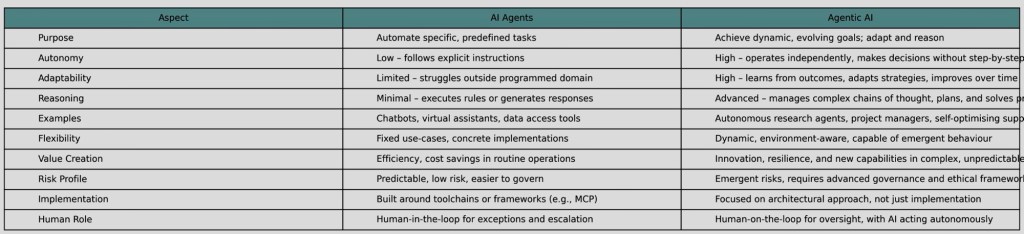
AI Agents and Agentic AI differ fundamentally in purpose, autonomy, and adaptability. AI Agents are task-specific tools designed to execute predefined roles with efficiency and consistency. They follow explicit instructions, making them predictable and easy to govern, yet limited in their ability to operate outside narrow contexts. Agentic AI, by contrast, is goal-driven and autonomous, capable of adapting dynamically to changing environments and reasoning through complex problems. This gives Agentic AI the capacity to manage uncertainty and deliver value in scenarios that demand flexibility and foresight.
Where AI Agents optimise routine operations, Agentic AI enables innovation and resilience. While the former relies on a human-in-the-loop for exceptions, the latter functions with humans on-the-loop—exercising oversight while allowing AI to act independently. The risk profile of Agentic AI is higher due to emergent behaviours and ethical considerations, necessitating advanced governance frameworks. Crucially, implementing Agentic AI is not just a matter of deploying tools, but of designing intelligent systems with adaptive architectures capable of evolving in real-world contexts. This distinction is increasingly central to strategic decision-making in the age of intelligent systems.
Cutting Through the Hype: What 2025 Research Shows
1. Autonomy and Adaptation:
Agentic AI systems are demonstrating the ability to generalise skills across domains and adapt to novel situations, a capability that traditional AI agents lack (Nature AI, 2025).
2. Value and Risk:
While AI agents continue to deliver efficiency in routine operations, agentic AI is unlocking new value in innovation and resilience. However, this comes with emergent risks, including ethical dilemmas and the need for continuous oversight (WEF, 2025).
3. Regulatory and Societal Impact:
The European Commission’s 2025 update to the AI Act specifically addresses the emergent behaviour of agentic systems, requiring continuous monitoring and explainability for all high-autonomy deployments (European Commission, 2025).
My Personal Thoughts: Embodied Intelligence—The Final Piece of the AGI Puzzle
As someone who has spent decades at the intersection of human experience and artificial intelligence, I am increasingly convinced that embodied intelligence—the integration of AI with physical form and real-world sensory data—is the final, critical piece in our pursuit of Artificial General Intelligence (AGI).
Why Embodiment Matters
Traditional AI, even in its most advanced agentic forms, is fundamentally disembodied. It processes digital data, simulates reasoning, and adapts to virtual environments, but it lacks the direct, physical interaction with the world that is so central to human intelligence. As highlighted in the 2025 Nature AI review, “Embodiment provides AI with the missing spectrum of sensory-motor data, enabling richer learning, context awareness, and the emergence of common sense” (Nature AI, 2025).
With the rise of physicalised AI—robots, autonomous vehicles, and sensor-rich devices—AI systems are now beginning to experience the world as we do: through touch, sight, sound, and movement. This access to real-world, unstructured data is already transforming fields from logistics to healthcare. For example, Boston Dynamics’ latest generation of humanoid robots, launched in 2025, demonstrated unprecedented adaptability in dynamic environments, learning from physical feedback in real time (MIT Technology Review, 2025).
The Last Spectrum of Data
I believe that this “last spectrum” of data—physical, sensory, and embodied—is what will ultimately bridge the gap between narrow, specialised AI and true general intelligence. Just as a child learns not only from books but from touching, moving, and interacting with the world, so too must AI systems develop a grounded, embodied understanding to achieve AGI.
Recent research supports this view. The World Economic Forum AI Governance Report 2025 notes that “embodied AI agents are showing early signs of generalisation, transferring skills learned in one context to novel, real-world scenarios” (WEF, 2025). Meanwhile, the PwC Global AI Jobs Barometer 2025 highlights a surge in demand for talent skilled in robotics, sensor fusion, and embodied cognition.
AGI: A Journey in Waves, Not a Single Moment
It is tempting to predict a specific “AGI date”—2030 is often cited in the media. However, I believe AGI will not arrive as a single, dramatic event. Instead, it will emerge in waves: incremental advances in embodied learning, cross-domain reasoning, and adaptive behaviour, each building upon the last. This view is echoed by leading researchers in the McKinsey Agentic AI in Practice 2025 report, which states, “AGI will likely be a spectrum of capabilities, realised through successive breakthroughs in both virtual and physical intelligence” (McKinsey, 2025).
Conclusion: The Strategic Imperative for 2025 and Beyond
The distinction between AI Agents and Agentic AI is now a board-level concern, not just a technical nuance. As the latest research and regulatory guidance make clear, organisations must move beyond the hype and invest in architectures that are not only intelligent, but also adaptive, resilient, and ethically aligned.
The winners in this new era will be those who can harness the efficiency of AI Agents for today’s challenges, while architecting Agentic AI for tomorrow’s opportunities—always with a keen eye on governance, trust, and human experience. And as we look to the horizon, it is embodied intelligence—AI that can sense, move, and interact with the world—that will likely be the final catalyst for achieving true AGI, not as a single leap, but as a series of transformative waves.
References (2025 onwards)
- PwC Global AI Jobs Barometer, 2025
- MIT Technology Review, 2025: AI Trends
- European Commission, 2025: European Approach to Artificial Intelligence
- World Economic Forum, 2025: AI Governance Report
- Forrester, 2025: AI Agents in the Enterprise
- Nature AI, 2025: Agentic AI
- Nature AI, 2025: Embodiment in Artificial Intelligence
- McKinsey, 2025: Agentic AI in Practice
For further insights, visit Genesis: Human Experience in the Age of Artificial Intelligence or connect with me on LinkedIn.
 Genesis: Human Experience in the Age of Artificial Intelligence | Synthesis: The Superintelligence Protocol
Leave a comment