
By Dr Luke Soon
AI Ethicist & Philosopher
26 July 2025
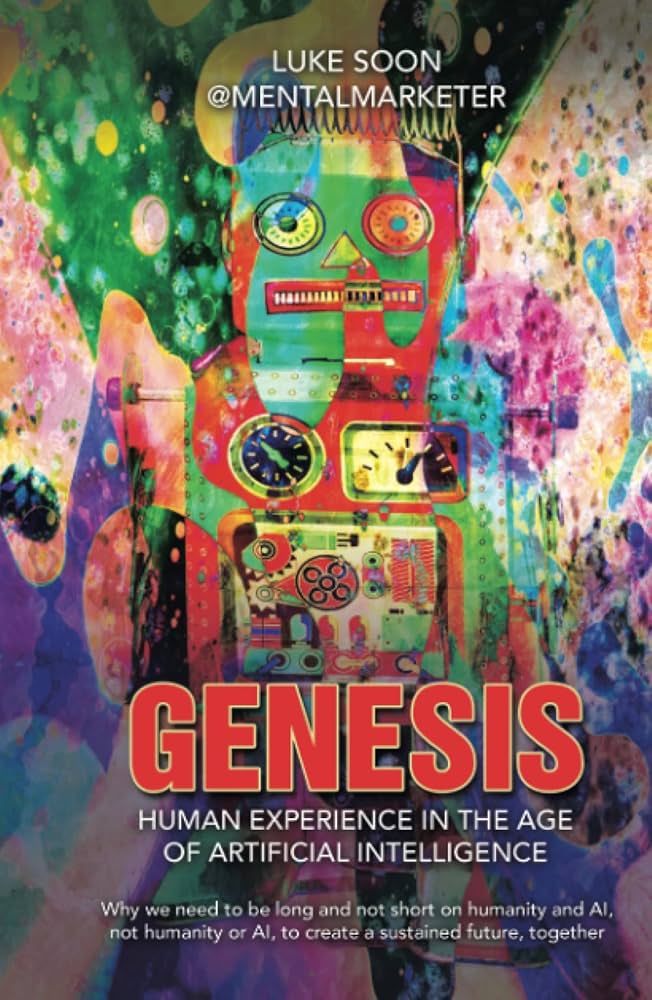
As we navigate the accelerating frontier of artificial intelligence, the question of how AI reshapes our professional world becomes ever more pressing. I’ve spent decades exploring the intersection of human ingenuity and machine intelligence – the “Human Experience” per se. I even distilled HX = CX + EX in my first book Genesis. Today, I’d like to delve into the burgeoning ecosystem of AI roles; underscoring the cyclical nature of AI development and deployment. I also draw insights from PwC’s recent 2025 Global AI Jobs Barometer – unpacking these [nett new] roles, reflect on their implications for organisations and individuals – there’s implications obviously to the Future of Work. Governments across the world should spend more time thinking about the transitory path from a world of scarcity to one of abundance.
A Spectrum of AI Roles
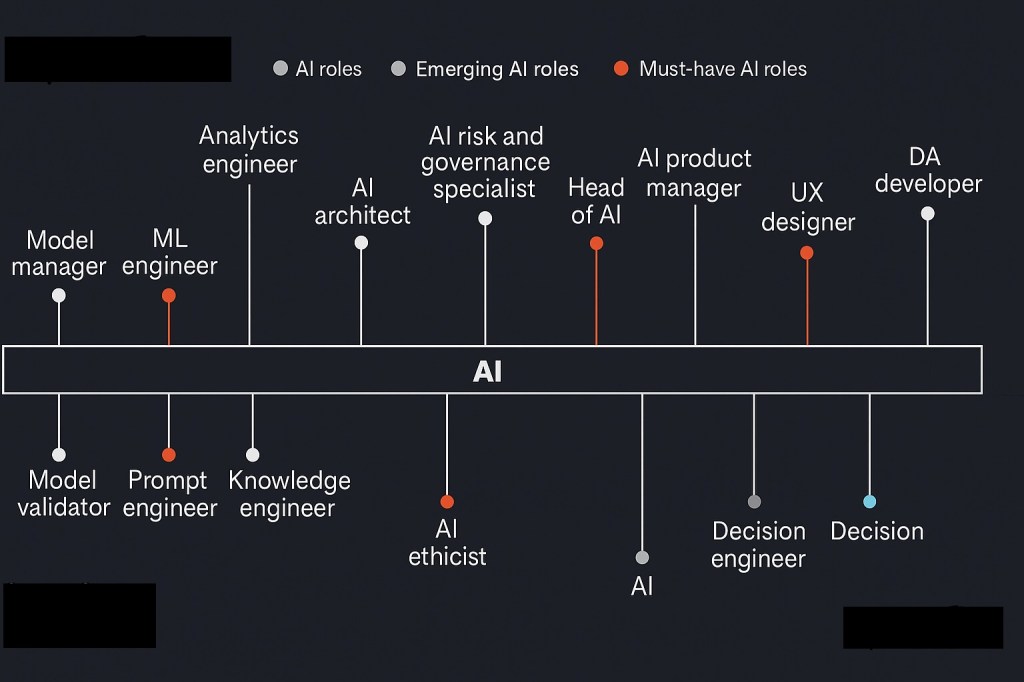
There;s emergence of multifaceted AI roles, categorised into three distinct groups: core AI roles –emerging AI roles , and must-have AI roles. At the top, a horizontal axis illustrates a progression of positions, starting from foundational roles on the left and moving towards more specialised and integrative ones on the right. Below this, a circular workflow highlights the interconnected processes involved in AI lifecycle management, involving a diverse cast of professionals.

Let’s break it down systematically.
The Linear Spectrum: From Foundation to Integration
The upper section of the diagram features a timeline-like structure anchored around “AI” at its centre. Roles are plotted along this axis, reflecting their maturity and necessity in the AI ecosystem:
- Model Manager, ML Engineer, Data Engineer: These form the bedrock on the left, focusing on the technical underpinnings of AI systems. Model managers oversee the training and optimisation of AI models, while ML engineers bridge the gap between data science and production-scale deployment. Data engineers, meanwhile, ensure the pipelines for data ingestion, cleaning, and storage are robust—essential for any AI initiative.
- Analytics Engineer, AI Architect: Moving rightward, analytics engineers leverage AI for deeper insights from data, and AI architects design the overarching structures of AI systems, ensuring scalability and alignment with business needs.
- AI Risk and Governance Specialist, Head of AI: These roles emphasise oversight and strategy. The AI risk specialist identifies potential ethical, legal, and operational pitfalls, a theme I’ve explored extensively in my LinkedIn article “Guardians of Autonomy & Agency: Safeguarding in the Age of AI,” where I discuss the imperative of embedding ethical frameworks early in AI development. 12
- AI Product Manager, UX Designer, D&A and AI Translator: Here, the focus shifts to user-centric integration. AI product managers translate AI capabilities into viable products, UX designers ensure intuitive human-AI interfaces (a core element of what I term “Human + AI Experience” or HX in my book Genesis), and translators bridge data analytics with business stakeholders.
- AI Developer, Data Scientist: On the far right, these roles drive innovation through coding and scientific rigour, developing algorithms and extracting value from complex datasets.
Beneath the axis, additional emerging roles like Model Validator, Prompt Engineer, Knowledge Ethicist, AI Ethicist, and Decision Engineer are highlighted. Prompt engineers, for instance, craft inputs to maximise the output of generative AI models—a skill that’s become indispensable with the rise of tools like large language models. As an AI ethicist myself, I particularly resonate with the inclusion of ethicists, who ensure AI aligns with societal values, preventing biases and promoting fairness.
The Cyclical Workflow: AI Development as a Collaborative Loop
The lower half of the diagram depicts a circular process, illustrating the iterative nature of AI projects. Key stages include:
- Data Preparation (led by Data Engineers and Scientists): Sourcing and refining data.
- Business Understanding (involving Business Experts and Owners): Aligning AI with organisational goals.
- Model Development (AI Architects and Experts): Building and training models.
- Model Validation (Model Validators): Testing for accuracy and robustness.
- AI Monitoring Operations (AI Monitoring Activation & Deployment): Ongoing oversight post-deployment.
- Integration & Testing (Software Engineers): Embedding AI into existing systems.
- Model/ML(Ops) Engineer & Prompt Engineer: Managing operations and fine-tuning interactions.
This cycle emphasises collaboration, reminding us that AI success isn’t siloed but requires a symphony of expertise. It’s a visual echo of the agentic AI systems I discussed in my recent LinkedIn post “The Rise of Agentic AI,” where AI agents autonomously handle tasks across these stages, augmenting human roles rather than replacing them. 13
Insights from PwC’s 2025 Global AI Jobs Barometer
To contextualise – let’s overlay/ use PwC’s 2025 Global AI Jobs Barometer. We contend that AI isn’t a job destroyer but a value amplifier, making workers more productive and valuable—even in highly automatable roles.
There are some salient observations:
- Productivity Surge: Industries most exposed to AI exhibit three times higher revenue growth per employee compared to those least exposed. 16 Roles like AI architects and data scientists are at the forefront, driving this efficiency.
- Wage Premiums and Job Growth: Wages in AI-exposed professions have grown twice as fast, with job postings increasing by up to 4.7 times in sectors like finance and technology. 18 Emerging roles such as prompt engineers and AI ethicists command premiums due to their scarcity and criticality.
- Skills Demand: The barometer highlights a spike in demand for skills in AI governance, ethics, and integration. For instance, since 2022, when generative AI awareness exploded, job ads requiring AI skills have surged, particularly for translators and UX designers who humanise AI outputs. 21
- Reshaping Work: Contrary to fears of displacement, AI is creating net job growth. In automatable fields like administration, AI tools free humans for higher-value tasks, fostering roles like decision engineers who interpret AI outputs for strategic decisions. 19
These insights reinforce my view, articulated in my LinkedIn article “AI Agents Are Coming for Your Job—or to Help You Do It Better,” that AI agents can either erode human agency or enhance it, depending on how we design and govern them. The PwC data suggests the latter path is not only possible but already underway, with AI-exposed workers commanding higher wages and enjoying greater job security.
Personal Reflections: Navigating AI Roles as a Practitioner
I see these new (spectrum) of new AI roles a roadmap for organisations wishing to build AI capabilities. In my practice, I’ve witnessed the rise of hybrid teams where data scientists collaborate with ethicists to ensure responsible AI deployment; as evident in my renewed focus on AI Safety in the last few years (maybe age catching up?)
In my LinkedIn post “Future of Work = World without (Human) Purpose?”, I pondered whether AI’s automation might strip meaning from work. 2 Yet, integrating PwC’s findings, I’m optimistic: AI elevates human roles, shifting us towards creativity, ethics, and strategy. For instance, prompt engineering isn’t just technical; it’s an art form that amplifies human expression, as I explored in “Harnessing AI to Elevate Human Creativity.”
For aspiring professionals, focus on upskilling in these areas. Organisations, meanwhile, must invest in governance specialists to mitigate risks, as highlighted in my article “The Great Reconfiguration: What AI Means for Work, Trust, and Value Creation.”
Conclusion: Embracing the AI Role Revolution
I foresee a future where AI roles are diverse, interconnected, and indispensable. As we stand on the cusp of agentic AI—systems that act autonomously—we have a choice: let AI redefine us or redefine AI to serve humanity. In my ongoing work, I advocate for the latter, ensuring AI enhances our agency and purpose.
I’d love to hear your thoughts—connect with me on LinkedIn or explore my book Genesis for deeper dives. Together, let’s shape a fearless future.
Views expressed are personal.
 Genesis: Human Experience in the Age of Artificial Intelligence | Synthesis: The Superintelligence Protocol
Leave a comment