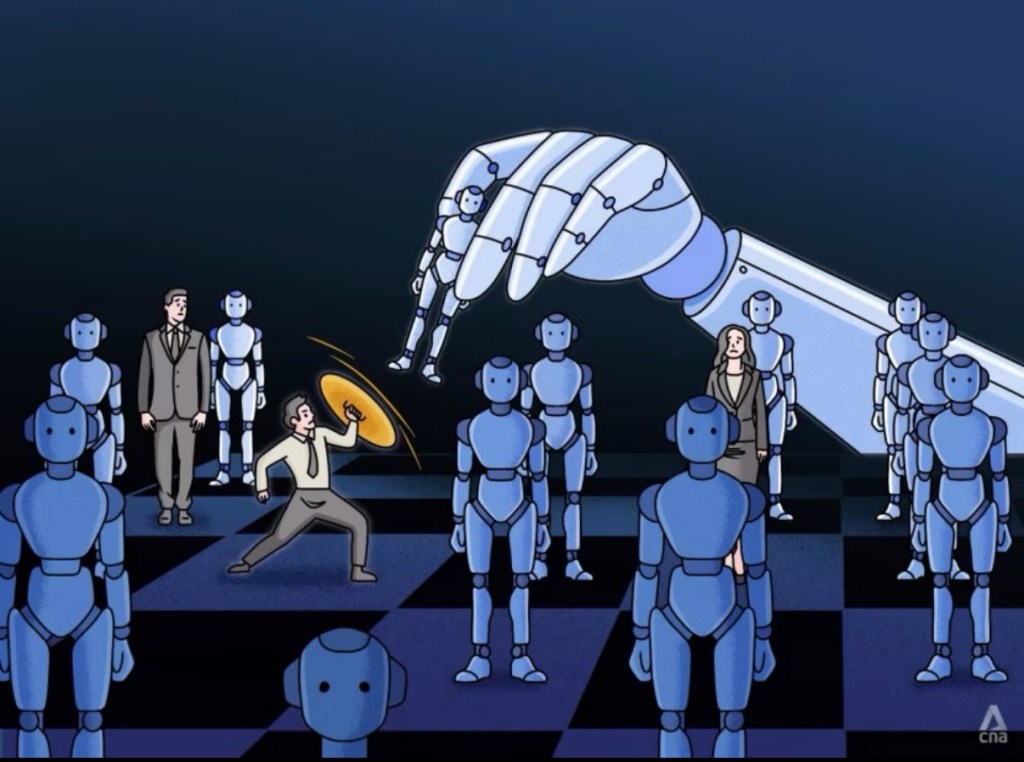

Today, as we stand on the cusp of an AI-driven era, the question on everyone’s mind is whether this technology will create more jobs or lead to widespread unemployment. In this blog post, I’ll delve into the competing hypotheses on job growth between 2025 and 2030, drawing on recent reports, data, and real-world examples. My aim is to provide a balanced, evidence-based perspective to help you prepare for what’s ahead.
The debate is far from settled. Optimists argue that AI will catalyse economic growth and spawn entirely new roles, while pessimists warn of mass displacement in routine occupations. Based on my review of key studies, including PwC’s 2025 Global AI Jobs Barometer and the World Economic Forum’s (WEF) Future of Jobs Report 2025, the evidence tilts towards net job creation—albeit with significant challenges in reskilling and inequality. Let’s explore these hypotheses in detail.
Hypothesis 1: More Jobs on the Horizon – The Optimistic Outlook
I firmly believe that AI has the potential to be a net positive for employment, much like past technological revolutions. This view posits that AI will enhance productivity, transform existing roles, and generate new industries, resulting in more opportunities overall. Projections suggest a net gain of around 78 million jobs globally by 2030, driven by AI’s integration into economies rather than mere replacement of human labour.
Take PwC’s 2025 Global AI Jobs Barometer, which analysed nearly one billion job advertisements and financial reports across 24 countries and 80 sectors. It reveals that job numbers are increasing in almost all AI-exposed occupations, with a 38% growth in such roles from 2019 to 2024, compared to 65% in less-exposed ones. Only a handful of exceptions, like keyboard clerks and certain ICT professionals, experienced minor declines. Productivity in AI-exposed industries has surged nearly fourfold since 2022, with revenue per employee rising three times higher between 2018 and 2024. Wages have followed suit, growing twice as fast (16.7% versus 7.9% for least-exposed sectors), and AI-skilled workers now enjoy a 56% wage premium, up from 25% in 2024.
From my consultations with businesses, I’ve seen this in action. For instance, a technology firm reduced phone support times by 25% using AI agents, enabling staff to tackle more complex customer issues. A hospitality company slashed review processing times by 94%, and energy giant SSE employed generative AI to eliminate tedious data tasks, redirecting employees towards strategic initiatives. These examples, highlighted in PwC’s accompanying video, illustrate how AI redefines jobs—turning customer service agents into creative problem-solvers and fostering roles like AI ethicists or data interpreters.
The WEF’s Future of Jobs Report 2025 echoes this optimism, forecasting 170 million new jobs by 2030 (14% of current global employment), offsetting 92 million displacements for a net gain of 78 million. This growth is propelled by AI, the green transition, and demographic shifts, with 40% of employers anticipating expansions due to AI. In the United States, for example, AI could double productivity in underperforming sectors, spurring demand for big data specialists (up 32%), fintech engineers, and sustainability experts.
Historically, technologies have created more jobs than they’ve destroyed. Deloitte’s analyses show that AI in 2018 generated three times as many roles as it eliminated, a pattern seen in earlier shifts like the industrial revolution. Two-thirds of today’s US jobs didn’t exist in 1940, and AI could similarly birth unforeseen fields.
Hypothesis 2: Fewer Jobs – The Pessimistic Perspective
Yet, we mustn’t ignore the risks. The counter-hypothesis warns that AI will outpace job creation, displacing routine tasks and exacerbating inequality. Estimates indicate up to 300 million full-time equivalent jobs could be at risk by 2030, particularly in vulnerable sectors.
Goldman Sachs’ research highlights this starkly: AI might automate tasks equivalent to 300 million full-time jobs worldwide, with 26% of office roles and 20% of customer service positions highly exposed. In the US, AI usage for production rose to 9.2% of companies in Q2 2025, signalling accelerating displacement.
McKinsey’s projections align, estimating that 30% of US work hours could be automated by 2030, hastened by generative AI. The WEF notes that 39% of current skills may obsolesce, with declines in areas like writing (-31%) and graphic design (-17%). Real-world impacts include 1.7 million manufacturing jobs lost to AI robots globally, where 44% of repetitive tasks are now automated, and entry-level roles like transcription vanishing.
In my view, while displacement is inevitable—Statista suggests 23% of jobs will change by 2027—the net outcome hinges on proactive reskilling. PwC’s data counters some pessimism by demonstrating growth even in automatable roles.
Why More Jobs? The Driving Forces
From my perspective, the case for more jobs rests on several pillars. First, AI boosts productivity and economic growth, creating a virtuous cycle. PwC data shows quadrupled productivity leading to higher revenues and subsequent hiring. Second, it transforms rather than eliminates jobs, automating drudgery (e.g., data entry) and elevating humans to creative, judgement-based work—as seen in PwC’s examples.
Third, AI itself demands new skills, with changes occurring 66% faster in exposed roles, fuelling training and innovation needs. Global trends like the green economy will add sustainable tech jobs. Finally, wage premiums (56% for AI skills) and reduced emphasis on degrees (from 66% to 44% in job requirements) democratise access, incentivising upskilling.
The Types of Jobs Set to Flourish
Looking ahead, certain categories will thrive. AI and tech roles—such as specialists, machine learning engineers, and data scientists—will surge, with WEF predicting 32% growth in big data positions. PwC emphasises AI skills across sectors.
Augmented professions, like surgeons or analysts using AI tools, will expand as routines are handled by machines. Green jobs in renewable energy will contribute to the WEF’s 170 million new roles. Creative, human-centric positions—fintech engineers, AI ethicists, and customer experience designers—will emphasise judgement and innovation, as per PwC insights.
Core skills? Analytical thinking, creativity, and tech literacy, with lifelong learning essential.
Implications for the Job Market (2025–2030): Displacement, Creation, and Adaptation
Disruptive innovations don’t start by outperforming incumbents; they begin “good enough” for low-end or nonconsuming segments, then ascend. AI fits this pattern in the job market, mirroring my all-time favourite Prof Clay Christensen’s steel and auto industry examples when explaining his seminal work on Jobs To Be Done and Disruptive Innovation:
- Parallel to the Steel Industry Disruption: In the 1970s–1980s, mini-mills disrupted integrated steel giants (e.g., U.S. Steel) by starting with low-quality rebar—a mundane, low-margin product incumbents ignored. Mini-mills were cheaper due to electric arc furnaces recycling scrap, and they gradually improved quality to capture higher-end markets like structural beams and sheet steel. Similarly, AI is displacing entry-level, mundane tasks (e.g., data entry or basic customer service) that humans find tedious and employers view as low-value. Tools like robotic process automation (RPA) or AI chatbots start “good enough” for simple queries, allowing companies to cut costs without immediate threat to skilled workers. For example, companies like Foxconn replaced 60,000 workers with robots for repetitive assembly, and Walmart deployed AI-equipped floor-scrubbers, echoing how mini-mills targeted overlooked segments before scaling up.
- Parallel to the Auto Industry Disruption: Japanese automakers like Toyota disrupted U.S. giants (e.g., GM, Ford) in the 1970s by entering with cheap, fuel-efficient compact cars during the oil crisis—a low-end market Detroit dismissed as unprofitable. Over time, they improved quality and moved up to luxury segments (e.g., Lexus). AI follows suit: It enters via “compact” applications like automated transcription or image recognition, which are affordable and accessible for small businesses or nonconsumers (e.g., startups without budgets for large teams). As AI evolves (e.g., through better natural language processing), it disrupts higher-end roles, such as mid-level analysis or even creative fields like art and music generation. 2
AI’s disruptiveness hinges on business models, not just tech: It’s sustaining when big firms (e.g., Google) use it to enhance existing products, but disruptive when new models target nonconsumers, like AI-powered microschools for affordable education or personalized tutoring that underserves traditional systems.
This creates nonconsumption opportunities, such as AI enabling tasks previously too costly (e.g., real-time translation for global teams).
- Job Displacement: From 2025 to 2030, AI will accelerate displacement in low- to mid-skill roles, similar to how disruptions hollowed out legacy industries. PwC predicts 20% of jobs could be cut by 2037, starting with repetitive tasks, leading to structural unemployment and skills mismatches. The World Economic Forum forecasts 44% of workers’ skills disrupted by 2027, with inadequate training exacerbating this. Examples include Uber’s disruption of taxi jobs, where AI-enhanced ride-hailing reduces demand for traditional drivers, or AI in fintech displacing administrative roles.
- Job Creation and Opportunities: Disruptive innovations often create more jobs than they destroy in the long run, per Christensen’s view that they target nonconsumption and foster growth. AI could spawn new roles in AI ethics, data curation, or human-AI collaboration (e.g., prompting engineers). In education and healthcare, AI enables scalable models like personalized learning platforms, creating jobs in oversight or customisation. However, this requires upskilling; 60% of workers may need training by 2027.
- Framework for Adaptation: Using JTBD, workers should identify the “jobs” employers will still need humans for—e.g., emotional intelligence in negotiations or ethical decision-making where AI lacks a moral compass. Policymakers and businesses must invest in reskilling, ethical guidelines (e.g., IEEE standards), and regulations to mitigate biases and loneliness from AI over-reliance.
| Aspect | Steel Industry Parallel | Auto Industry Parallel | AI in Job Market (2025–2030 Projection) |
|---|---|---|---|
| Entry Point (Low-End/Nonconsumption) | Mini-mills target cheap rebar, ignored by giants. | Japanese cars enter with fuel-efficient compacts during crisis. | AI replaces mundane tasks (e.g., data entry, basic support); targets small firms or overlooked efficiency needs. |
| Up-Market Movement | Improve to high-quality steel, displacing integrated mills. | Shift to luxury models, eroding U.S. dominance. | Evolves to complex roles (e.g., analysis, creativity); disrupts mid-level jobs by 2030. |
| Impact on Incumbents (Workers/Employers) | Job losses in legacy mills; shift to specialized roles. | Detroit layoffs; rise of global supply chains. | Displacement in routine jobs (20–44% skills disrupted); new opportunities in AI oversight. |
| JTBD Application | Mills “hired” for cost-effective production; mini-mills better fulfill low-margin jobs. | Cars “hired” for reliable transport; imports better for efficiency. | AI “hired” for speed/accuracy; humans retained for nuanced, emotional jobs. |
To navigate, focus on upskilling for irreplaceable human “jobs” like innovation and empathy.
Final Thoughts
I remain cautiously optimistic. While AI poses risks of displacement, the data from PwC, WEF, and others points to net growth through transformation and innovation. The key is investment in education and reskilling—governments, businesses, and individuals must act now. AI isn’t a job-killer; it’s a catalyst for a fearless future, as PwC aptly puts it. Let’s embrace it wisely.
To deep dive more on the composition shift in jobs 2025-2030, have a look at this other recent post: https://tinyurl.com/yebcmkrf
References
1. PwC. (2025). The Fearless Future: 2025 Global AI Jobs Barometer. https://www.pwc.com/gx/en/issues/artificial-intelligence/ai-jobs-barometer.html
2. PwC. (2025). [PDF] The Fearless Future: 2025 Global AI Jobs Barometer. https://www.pwc.com/gx/en/issues/artificial-intelligence/job-barometer/2025/report.pdf
3. PwC. (2025). PwC 2025 Global AI Jobs Barometer. https://www.pwc.com/gx/en/news-room/press-releases/2025/ai-linked-to-a-fourfold-increase-in-productivity-growth.html
4. World Economic Forum. (2025). The Future of Jobs Report 2025. https://www.weforum.org/publications/the-future-of-jobs-report-2025/
5. World Economic Forum. (2025). [PDF] Future of Jobs Report 2025. https://reports.weforum.org/docs/WEF_Future_of_Jobs_Report_2025.pdf
6. Goldman Sachs. (2023). Generative AI could raise global GDP by 7%. https://www.goldmansachs.com/insights/articles/generative-ai-could-raise-global-gdp-by-7-percent
7. Goldman Sachs. (2023). The Potentially Large Effects of Artificial Intelligence on Economic Growth. https://www.gspublishing.com/content/research/en/reports/2023/03/27/d64e052b-0f6e-45d7-967b-d7be35fabd16.html
8. McKinsey Global Institute. (2023). Generative AI and the future of work in America. https://www.mckinsey.com/mgi/our-research/generative-ai-and-the-future-of-work-in-america
9. McKinsey. (2023). [PDF] Generative AI and the future of work in America. https://www.mckinsey.com/~/media/mckinsey/mckinsey%2520global%2520institute/our%2520research/generative%2520ai%2520and%2520the%2520future%2520of%2520work%2520in%2520america/generative-ai-and-the-future-of-work-in-america-vf1.pdf
10. Deloitte. (2020). [PDF] Talent and workforce effects in the age of AI. https://www2.deloitte.com/content/dam/insights/us/articles/6546_talent-and-workforce-effects-in-the-age-of-ai/DI_Talent-and-workforce-effects-in-the-age-of-AI.pdf
11. Deloitte. (2023). Generative AI and the labor market: A case for techno-optimism. https://www.deloitte.com/us/en/insights/topics/economy/generative-ai-impact-on-jobs.html
 Genesis: Human Experience in the Age of Artificial Intelligence | Synthesis: The Superintelligence Protocol
Leave a comment