

By Dr Luke Soon | AI Ethicist
Introduction:
We are no longer speculating about the future of work. It’s unfolding—systematically, unevenly, and with generational consequences. The AI revolution is not a future event; it’s a present force, reconfiguring the anatomy of work, redefining the human role, and testing the resilience of trust at every level.
Two pivotal studies released in 2025—PwC’s AI Jobs Barometer and Value in Motion—shine a light on this transformation. One is deeply granular, drawing from over half a billion job postings globally. The other is strategic, mapping the pathways companies are taking to drive enterprise value in a volatile world.
Together, they form a twin lens on a profound truth: Organisations that embed trust, redefine human experience, and embrace the paradox of AI-led agency will lead the next chapter of value creation.
I. AI Jobs Barometer 2025: Rethinking the Supply and Demand of Talent
The AI Jobs Barometer is grounded in empirical labour market analysis. It tracked over 500 million job postings across 15 countries between 2012 and 2024, and the results challenge popular AI anxiety narratives.
🔍 Key Findings:
Demand for AI-skilled jobs is accelerating: In countries like Singapore, the UK, and the US, AI-related job postings have grown at 3.5x the rate of overall postings since 2016. Wage premiums are real and rising: Roles requiring AI expertise command up to 25% higher wages, particularly in finance, healthcare, and engineering. AI augments more than it automates: Rather than eliminating roles, AI is transforming job content. For instance, legal assistants are now trained in AI-powered research tools, reducing time spent on discovery by 60%, according to a pilot at Clifford Chance. Equity gaps persist: There’s a growing “digital fluency divide”. Those with access to reskilling ecosystems benefit; others risk obsolescence.
💡 Case Study: NHS England – Augmenting Diagnostic Work
NHS England deployed AI to assist radiologists with early-stage cancer detection. Rather than replacing radiologists, the system increased their diagnostic accuracy by 12% and reduced time per case by 28%. More significantly, it elevated the value of the radiologist’s judgment—repositioning them from screen readers to clinical strategists.
II. Value in Motion: Reimagining Value Creation in an Uncertain World
While the Barometer maps the labour shifts, Value in Motion addresses the strategic imperatives organisations face. In a world where value must flow faster and more meaningfully, five imperatives emerge:
1. Invest in Human-led Reinvention
Leaders must focus not only on digital fluency but on cognitive resilience and sensemaking skills—traits uniquely human.
“The most resilient organisations are those where people are encouraged to think critically, adapt rapidly, and trust intelligently.”
— PwC Value in Motion, 2025
2. Build Adaptable Operating Models
Agility now means designing workflows that flex across human and AI nodes. Agentic AI is accelerating this.
Example: At DBS Bank, AI agents now autonomously handle 80% of trade finance documentation. Human officers focus on exception handling, cross-border regulatory nuances, and trust-building.
3. Orchestrate Ecosystems for Shared Value
Instead of owning all capabilities, top performers orchestrate partnerships—especially around AI tools, data platforms, and customer interfaces.
Case: Siemens Healthineers partnered with startup Vara to deploy breast cancer detection AI across underserved European clinics. Impact: A 22% increase in early-stage detection rates and expansion to 20+ clinics without added headcount.
4. Execute with Discipline Amid Innovation
Strategic patience and execution rigour matter. High-value firms execute fewer but bolder moves, with clear KPIs.
5. Embed Trust at Every Interface
Agentic AI requires trust not only in systems but in intention, process, and outcome.
Example: In PwC’s AI auditing framework, “Explainability Thresholds” are set at different decision tiers—from front-end AI assistants to core financial decisioning engines. Transparency is tiered by risk level and accountability zones.
III. The HX Reframe: Trust as a Design Principle
In my work, I define HX as:
🧬 HX = CX (Customer Experience) + EX (Employee Experience)
But we are entering an era where agency, trust, and augmentation form new experience frontiers.
When AI begins to plan, reason, and act autonomously, the human experience shifts from doing to directing, from executing to evaluating.
The friction of work is giving way to the fluidity of agency.
Organisations must now design for trust, not just efficiency. That means:
Transparent AI decision pathways Value-aligned outcomes Safety nets for overreach Psychological safety in AI-human collaboration
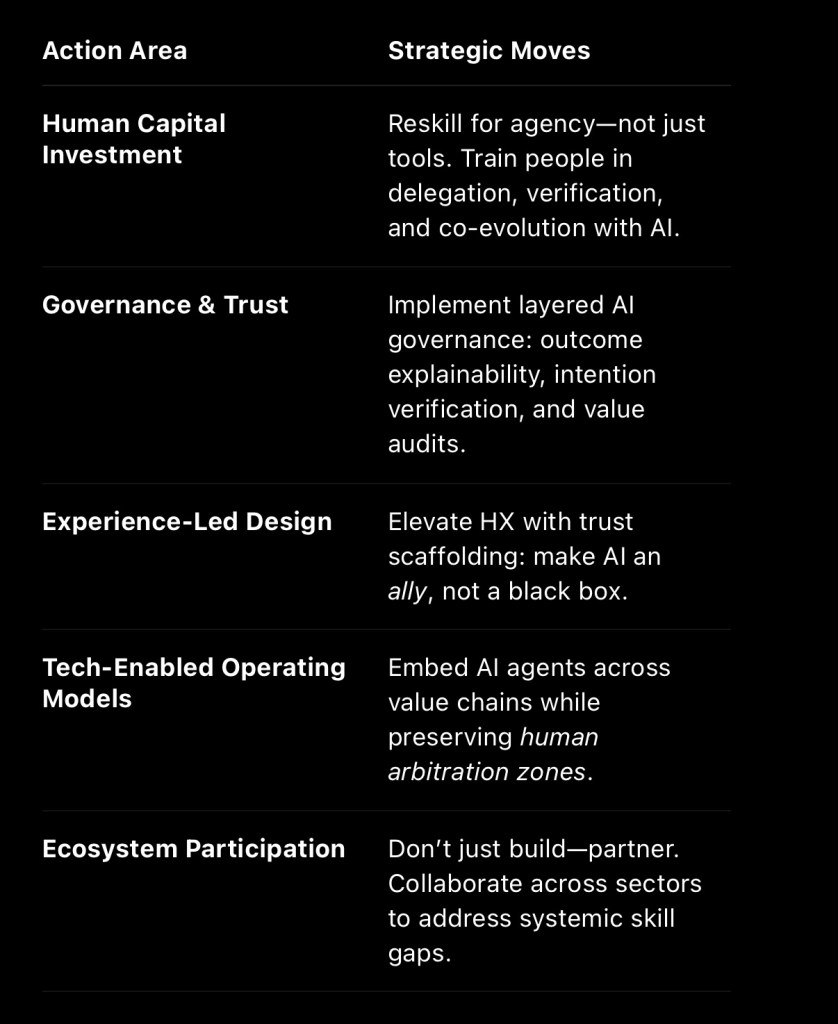
IV. The Strategic Horizon: What Leaders Must Do Now
Conclusion:
This is not merely a skills crisis. It’s a human purpose reconfiguration. The twin studies—AI Jobs Barometer and Value in Motion—remind us that the future of work is not about job loss, but meaning reallocation.
If we get this right, AI won’t just boost productivity. It will catalyse a renaissance of human contribution, creativity, and trust.
The winners will not be the fastest adopters. They will be the wisest architects—those who blend agency with accountability, innovation with empathy, and trust with transformation.
As we cross the turbulence ahead, let us move with both urgency and humanity.
 Genesis: Human Experience in the Age of Artificial Intelligence | Synthesis: The Superintelligence Protocol
Leave a comment