
In a Nutshell
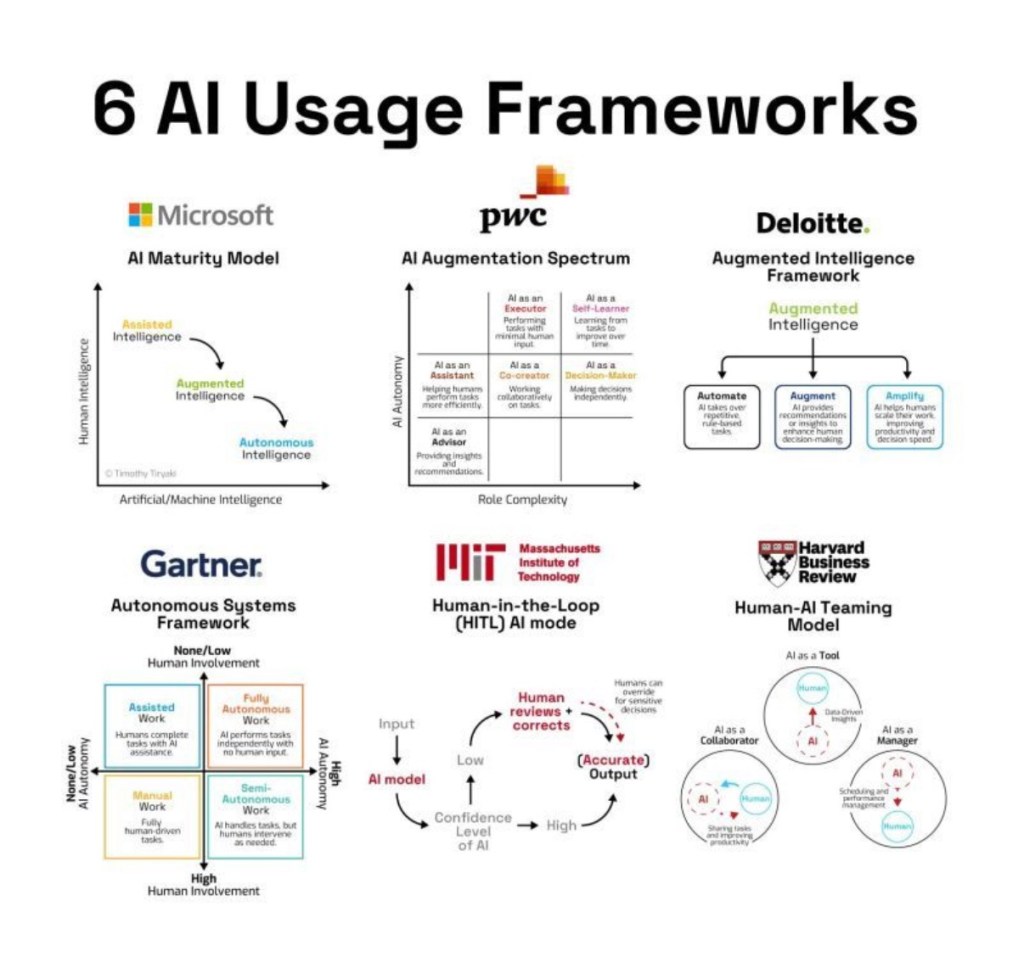
PwC’s AI Augmentation Spectrum provides a structured way to understand how AI interacts with humans in different roles, from simple assistance to full autonomy. It defines six key levels of AI involvement:
1. AI as an Advisor – AI provides insights and recommendations, but humans make all decisions.
2. AI as an Assistant – AI helps with tasks but still requires human oversight.
3. AI as a Co-Creator – AI collaborates with humans to complete complex tasks.
4. AI as an Executor – AI carries out tasks with minimal human intervention.
5. AI as a Decision-Maker – AI makes decisions independently.
6. AI as a Self-Learner – AI continuously improves itself through learning and adaptation.
This spectrum is useful for businesses to determine the right level of AI integration, ensuring the balance between automation and human oversight. It helps organisations strategically adopt AI, aligning its role with business needs and risk management.
AI isn’t just about robots taking over—it’s about how we work with AI to get things done smarter and faster. PwC’s AI Augmentation Spectrum is one of the most practical ways to think about this. It breaks AI’s role into six levels, ranging from simple assistance to full-on autonomous decision-making.
I’m sharing this because it’s a useful reference for anyone thinking about how AI fits into their business or industry. As I dive into my second year of research on AI augmentation, this framework continues to help me understand where we are today—and where we’re headed.
The Six Levels of AI Augmentation
PwC’s model describes how AI and humans interact, moving from AI as a simple advisor to a self-learning system that operates independently. Here’s a quick breakdown:
1. AI as an Advisor
At this stage, AI isn’t making decisions—it’s just helping us make better ones. Think of AI-powered analytics tools that provide insights, like recommendation engines or risk analysis software. You still have full control, but AI speeds up your decision-making.
Example: A financial analyst using AI to identify investment trends but making the final call themselves.
2. AI as an Assistant
Here, AI goes beyond just offering advice—it actively helps humans execute tasks. Virtual assistants, chatbots, and AI-driven customer service tools fit into this category. AI takes care of the repetitive parts, while you focus on the complex decisions.
Example: A legal AI tool drafting contracts, but lawyers still review and approve them.
3. AI as a Co-Creator
Now we’re talking true collaboration. AI and humans work together to produce something new, whether that’s creative work, strategic decisions, or problem-solving. This is where AI-powered design tools, coding assistants, and even generative AI models come in.
Example: A marketing team using AI to generate ad copy, then tweaking it to align with brand messaging.
4. AI as an Executor
At this level, AI doesn’t just help—it does the work. Humans define the objectives, and AI carries them out with minimal intervention. This is common in automation-heavy industries like manufacturing, logistics, or even finance.
Example: AI trading algorithms executing stock trades based on set parameters.
5. AI as a Decision-Maker
This is where AI starts making its own calls. It takes in data, analyses it, and makes decisions without waiting for human approval. We already see this in areas like fraud detection, where AI identifies and blocks suspicious transactions automatically.
Example: AI in cybersecurity, detecting and shutting down threats in real time without human involvement.
6. AI as a Self-Learner
At the highest level, AI doesn’t just follow rules—it improves itself over time. It learns from data, refines its processes, and adapts without needing human input. This is where we see advanced machine learning models in action.
Example: Self-driving cars learning from real-world driving conditions to improve navigation and safety.
Why This Matters
Understanding where your organisation sits on this spectrum is key to making AI work for you. Are you just using AI as an assistant, or are you ready to let it take the lead? As AI evolves, businesses need to be clear about how much autonomy they’re willing to give it—and where human oversight is still essential.
This framework helps make AI adoption more intentional, strategic, and—most importantly—aligned with business goals. As I continue my research into AI augmentation, I’ll be using this as a reference point to track how different industries are navigating AI’s role in decision-making and execution.
Where do you see AI in your work right now? And where do you think it should be?
 Genesis: Human Experience in the Age of Artificial Intelligence | Synthesis: The Superintelligence Protocol
Leave a comment